After the modest success of 1952’s The Story of Robin Hood and His Merrie Men, someone at Walt Disney Productions decided the legend clearly needed more talking animals and fewer human beings. Because if there’s one thing medieval English folklore was missing, it was a fox with impeccable comedic timing. Thus, 1973’s Robin Hood was born, proving once again that Disney will eventually animate anything that sits still long enough.
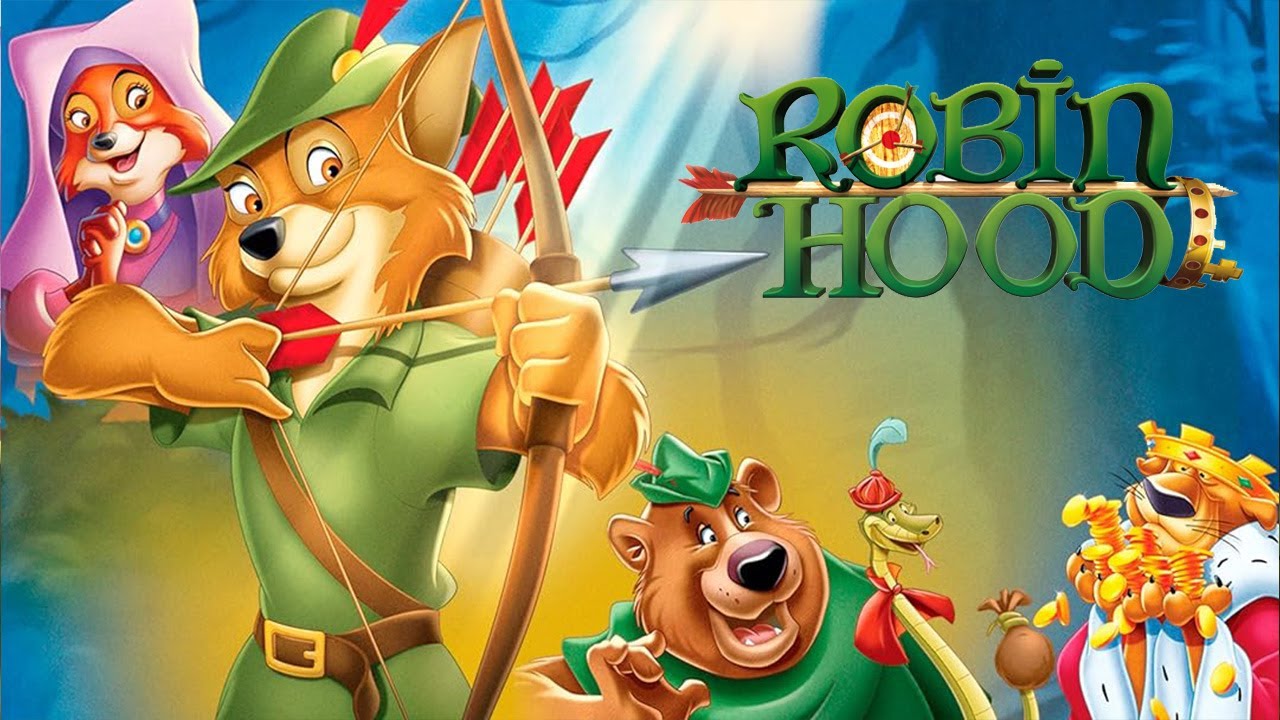
In medieval England, the story is narrated by the minstrel rooster Alan-a-Dale (Roger Miller), because nothing says historical authenticity like a mandolin-strumming bird. We meet the heroic outlaw Robin Hood (Brian Bedford) and his loyal, laid-back accomplice Little John (Phil Harris), who spend their days robbing the rich and, shockingly, not keeping it. When they learn that the deeply unqualified Prince John (Peter Ustinov) is passing through Sherwood Forest, along with his advisor Sir Hiss (Terry Thomas), they disguise themselves as fortune tellers and promptly relieve him of his wealth, humiliating him in the process. This goes about as well as you’d expect for a man whose emotional stability hinges on sucking his thumb.

Sadly, they didn’t have therapists back in the late 13th Century.
Robin and Little John redistribute the stolen wealth to the citizens of Nottingham, who are being taxed into oblivion by Prince John and his perpetually stressed-out enforcer, the Sheriff of Nottingham (Pat Buttram). Robin also gives a bow and hat to young Skippy Rabbit (Billy Whitaker), because apparently, even fugitives have time for birthday gifts. Skippy immediately fires an arrow into the castle grounds because children in cartoons have the survival instincts of a moth in a candle shop. Inside, he and his friends meet Maid Marian (Monica Evans) and Lady Kluck (Carole Shelley), and we learn that Marian and Robin have a romantic past, because of course they do.

“Marian, what is a furrie?”
Meanwhile, Robin is off in the forest brooding romantically when Friar Tuck (Andy Devine) arrives with news of an archery tournament hosted by Prince John, with a kiss from Maid Marian as the prize. It’s obviously a trap, which Robin acknowledges before walking straight into it anyway, because plot. Disguised as a stork, he wins the tournament, reveals himself, gets sentenced to death, is briefly saved, re-sentenced, and then rescued again in a chaotic brawl that includes Lady Kluck turning into a one-goose wrecking crew. Robin proposes mid-chaos, because nothing says romance like imminent execution.

“Who says romance is dead?”
Things take a darker turn, by Disney standards, when Prince John triples taxes and jails basically the entire population for being poor. After Friar Tuck finally snaps and assaults the Sheriff for stealing from the poor box, he’s sentenced to death as bait. Robin and Little John break into the castle, free the prisoners, and trigger a fiery climax where Robin rescues Skippy’s younger sister while the castle burns down around them. Eventually, King Richard (Peter Ustinov, briefly pulling double duty) returns, pardons everyone worth pardoning, and throws Prince John and his cronies in jail. Robin and Marian ride off into the sunset, because this is still a Disney film, and consequences are for other people.

Happily Ever After.
Stray Observations:
• The character designs were leftovers from an abandoned adaptation of Chanticleer and the Fox, meaning Robin Hood and Alan-a-Dale are basically recycled leads who lucked into a better gig.
• Friar Tuck was originally a pig, until someone realized maybe turning a man of the cloth into bacon wasn’t the safest public relations move. Enter: badger, the less controversial woodland theologian.
• Scat Cat from The Aristocats casually wanders in, because Disney never met a character reuse opportunity it didn’t like.
• The Sheriff’s entire strategy is “tax harder,” which historically has never led to unrest. Not once. He should have watched earlier adaptations of this story.
• The entire population of Nottingham waits until they’re bankrupt to object to taxation. Timing is not their strength.
• In real life, King John didn’t get the satisfying “thrown in jail by his brother” ending. He died of dysentery in 1216, which is historically accurate and dramatically… underwhelming.

This is a more family-friendly comeuppance.
The film’s long, winding journey to the screen is almost more interesting than the film itself. Walt Disney originally toyed with adapting the medieval tales of Reynard the Fox, but hesitated, worrying the character was too sly, too morally ambiguous, and generally too interesting for a children’s audience. So naturally, that project got shelved. Years later, the studio circled back to the safer, more familiar Robin Hood legend, briefly flirting with the baffling idea of setting it in the American South, because nothing screams “English folklore” like bayous, banjos and racism. Thankfully, someone intervened before that particular fever dream became reality, and the story returned to Sherwood Forest, where it belongs.

This could have been a Song of the South retread.
Budget constraints loom over the film like Prince John over a tax ledger. Coming off the financial strain of the Florida Project, Disney wasn’t exactly swimming in gold coins, so the animators did what any studio would do: they recycled. Generously. The most glaring example is “The Phony King of England,” where character movements feel suspiciously familiar, as if The Jungle Book, The Aristocats, and Snow White and the Seven Dwarfs all wandered in and left their animation cells lying around. Little John is essentially Baloo in a different outfit, which is either charming or distracting depending on how much you enjoy déjà vu.

This doesn’t even qualify as “thinly disguised.”
The voice cast, however, is doing heroic work to sell all this. Phil Harris brings his laid-back charisma to Little John, essentially reprising Baloo with a medieval twist. Terry-Thomas turns Sir Hiss into a wonderfully exasperated sidekick, constantly trying and failing to manage his boss’s incompetence. And then there’s Peter Ustinov as Prince John, who fully commits to the role of a whiny, insecure tyrant and somehow makes him both ridiculous and memorable. If the animation occasionally cuts corners, the performances never do.

They were a nice dynamic duo of villainy.
In the grand lineup of Robin Hood adaptations, this one stands out simply by virtue of being populated entirely by anthropomorphic animals. It’s a strange choice that somehow works, giving the story a layer of whimsy that softens its darker elements. Compared to grittier takes, this version is less concerned with historical accuracy and more interested in keeping things light, musical, and digestible for kids. It’s Robin Hood filtered through a Saturday morning cartoon lens, where injustice is real but never too overwhelming, and villains are as funny as they are cruel.

A furry legend brought to life!
In conclusion, Disney’s Robin Hood is a film caught between ingenuity and limitation, charm and corner-cutting. Its recycled animation and scaled-down ambition reflect a studio in transition, still figuring out how to move forward after the loss of its founder. And yet, despite those constraints, it remains oddly endearing. The characters are lively, the humour lands more often than it misses, and the voice performances carry the material with effortless charm. It may not be Disney at its most polished or groundbreaking, but it has a scrappy, underdog quality that feels strangely appropriate for a story about robbing the rich and giving to the poor.

No comments:
Post a Comment