Mario Bava’s Blood and Black Lace is a candy-coated nightmare, part fashion show, part slaughterhouse, and all style. This 1964 proto-giallo didn’t just invent the rules of the slasher film; it strutted down the catwalk and made murder fashionable. If Psycho turned the shower into a crime scene, Bava turned haute couture into a killing floor.

Our story kicks off when Isabella (Francesca Ungaro), one of many impossibly glamorous models working at Christian Haute Couture, takes a nighttime stroll through the fashion house gardens. Instead of a pleasant evening walk, she gets the business end of a masked, trench-coated psycho, wielding more menace than a Milan runway critic. Enter Inspector Silvestri (Thomas Reiner), who starts grilling everyone from Massimo Morlacchi (Cameron Mitchell), the co-manager of the salon, to the newly widowed Countess Cristiana Cuomo (Eva Bartok). Things look extra suspicious when Isabella’s ex, coke-snorting antique dealer Franco Scalo (Dante Dipaolo), is caught up in the mess, especially since Isabella was trying to get him to quit the nose candy.

This is not how you find a sponsor.
Naturally, Isabella wasn’t just a pretty face. She was keeping a diary stuffed with everyone’s dirty secrets; blackmail fuel so juicy it practically drips off the pages. Nicole (Ariana Gorini), Franco’s current flame, decides to play whistleblower and hand it over to the cops. But Peggy Peyton (Mary Arden) swipes it during a fashion show like it’s a backstage purse snatch. That night, Nicole brings Franco his powder fix, only to get introduced to the killer’s spiked glove, an accessory that would never pass Vogue standards. When the murderer finds no diary, he’s extra cranky. Meanwhile, Peggy gets a visit from the jittery dresser Marco (Massimo Righi), who’s in love with her but too hopped up on pills to be useful. After refusing his “protection,” Peggy winds up tied to a chair and discovers who the killer is, before her face is flambéed against an iron stove

Talk about haute couture going hot couture.
Inspector Silvestri decides the killer must be a sex maniac lurking among the suspects, so he does the logical thing: arrests everyone he can think of. Marco panics, tries to point the finger at Cesare Lazzarini (Luciano Pigozzi), the creepy eavesdropping designer, and promptly has an epileptic seizure. Not a great defence. While everyone’s stuck in custody, Greta (Lea Lander) finds Peggy’s corpse stuffed in her car trunk (note to self, always check the trunk before driving off) and winds up murdered herself in her fiancé’s mansion. The suspects are released, and wouldn’t you know it, Morlacchi just happens to have the very notebook the killer used to threaten Peggy. Red flags everywhere. Sadly, all the Red Flags in the world can’t help with these idiot cops on the case.

“Should we call Inspector Clouseau?”
The mask finally drops: Morlacchi and Cristiana have been pulling the strings all along. He’s been carving through models—Isabella, Nicole, Peggy—while Cristiana snuffed out Greta to keep him covered. Isabella had their dirty little secret: they murdered Cristiana’s husband, and she tried a spot of blackmail. The “sex maniac” angle? Just window dressing. What really drove them was greed, the deadliest aphrodisiac of all. So Morlacchi cooks up one last scheme…frame Tao-Li (Claude Dantes), one of the few surviving models, knock her off, and make it look like a neat little suicide. But when Cristiana realizes she’s next on his hit list, she flips the script and sticks a blade in him instead. After a shaky call to Inspector Silvestri, she crumples beside her late lover-in-crime, leaving a trail of corpses, couture, and treachery sprawled across the fashion house floor.

Not exactly a Romeo & Juliet ending.
Stray Observations:
•
Models in this film have two modes: strutting around the fashion house
in ridiculous outfits or walking alone at night in the creepiest
possible locations.
• Peggy is so blasé about Marco’s nervous,
pill-popping “protection offer” that you almost root for her
indifference, until she winds up tied to a chair and roasted alive.
Oops.
• Greta finds a corpse in the trunk of her car and doesn’t
immediately scream, run, or call the cops—she just lugs it into the
house until the killer shows up. Is this an Italian thing?
• The diary MacGuffin feels like something out of high school gossip: “OMG, Isabella wrote down everyone’s dirty secrets, better kill half the cast before it leaks!”
• The costumes are so over-the-top fabulous, you almost expect Tim Gunn to walk in and say, “Models, this week’s challenge is: Don’t get murdered.”
•
The ending twist—that the “sex maniac” theory was just a red
herring—feels like Bava wagging his finger at both the cops and the
audience for being so gullible.
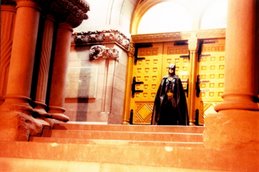
• The killer’s outfit—blank white
mask, trench coat, and fedora—looks like a cross between a mannequin and
a noir detective, which is both creepy and slightly fabulous.

Maybe he’s auditioning for the role of DC’s The Question.
Mario Bava wasn’t just directing here; he was painting in Technicolor, with a palette dipped in neon blood and baroque shadows. Every murder is treated like an art installation, staged with eerie precision and macabre elegance. The faceless killer doesn’t just lurk; he glides through the fashion house like some twisted mannequin come to life, turning the supposedly glamorous world of couture into a nightmare factory. Bava takes a lurid pulp story and elevates it into something hypnotic, where even the violence feels stylized to the point of surrealism.

It’s an “And Then There Were None” splashed in red.
Ubaldo Terzano’s cinematography deserves its own bow. Forget flat police procedurals or cheap horror lighting; this is chiaroscuro on acid. The deep reds, purples, and electric blues bathe every corridor and catwalk in menace, foreshadowing the neon giallo glow that directors like Argento would later run with. Shadows cut across faces like masks, mannequins leer in corners, and even the garden at night feels alive with dread. Terzano makes Blood and Black Lace less a whodunit and more a “Who cares, look at those colours!”

This movie explodes with colour.
The cast isn’t so much about emotional depth as it is about presence, and boy, do they have it. Cameron Mitchell oozes smarm as Morlacchi, every smile a snake’s hiss. Eva Bartok plays Cristiana with icy detachment, hiding cruelty behind a widow’s chic. The models, from Mary Arden’s doomed Peggy to Lea Lander’s unlucky Greta, aren’t given much to work with beyond “look fabulous, then die horribly,” but they do it with aplomb. Even Thomas Reiner’s Inspector Silvestri feels more like an accessory to the set design than an actual detective, but in a movie like this, the real stars are the costumes, the lighting, and that blank, terrifying mask.

Wait, is this Madonna from Dick Tracy?
In conclusion, Blood and Black Lace isn’t just a murder mystery; it’s the birth of the giallo as full-blown cinema. Bava turned lurid pulp into lurid art, making death look seductive and shadows feel alive. It’s a film where plot plays second fiddle to atmosphere, where mannequins and models share equal billing, and where every frame feels dipped in gothic glamour. Fifty years later, the slasher genre is still catching up to what Bava accomplished with a faceless killer, a couture salon, and a whole lot of style.