Few films capture the haunting ambiguity of Gothic horror quite like 1961’s The Innocents. Directed by Jack Clayton and shot with eerie precision by cinematographer Freddie Francis, this adaptation of Henry James’s The Turn of the Screw turns repression, loneliness, and madness into an elegant fever dream. It’s not just a ghost story; it’s a study of what happens when the lights go down and propriety gives way to obsession.

We are first introduced to Miss Giddens (Deborah Kerr), a minister’s daughter with a fragile confidence and an eagerness to please, who applies for her first job as a governess. Her prospective employer—a wealthy bachelor (Michael Redgrave) with the emotional availability of a marble bust—makes it clear that he wants nothing to do with the children under his care. They’re his orphaned niece and nephew, living in a sprawling country estate called Bly Manor; his only stipulation is that Miss Giddens must handle everything herself. No letters. No questions. No interference with his champagne-fueled social calendar. Naturally, this seems perfectly normal to her, and she accepts immediately.
 “And never feed them after midnight.”

Upon arriving at Bly, Miss Giddens meets Flora (Pamela Franklin), a bright-eyed little girl whose angelic manner feels just a bit too rehearsed, and the kindly housekeeper Mrs. Grose (Megs Jenkins), who speaks in the hushed, ominous tones reserved exclusively for people living in haunted mansions. Miles (Martin Stephens), Flora’s brother, is away at boarding school but soon returns home after being expelled for “corrupting” his classmates. When he greets Miss Giddens with flowers and compliments her beauty, the alarm bells ring faintly, but, being British, everyone just politely ignores it. Even sweet little Flora will pop in to watch Miss Giddens sleep, because that’s normal.
 Big house with creepy children? Check!

Before long, Miss Giddens begins to hear strange whispers, footsteps, and voices echoing across Bly’s halls. She spots a man staring at her from a tower and a woman weeping by the lake, who Mrs. Grose identifies as the deceased Peter Quint (Peter Wyngarde), the former valet, and Miss Jessel (Clytie Jessop), the previous governess who conveniently drowned herself after her scandalous affair with Quint. Miss Giddens, clearly not one for subtlety, decides that the ghosts must be possessing the children so they can keep their torrid love affair going in spirit form, an idea she accepts with the serene confidence of someone who’s never heard of Occam’s Razor.
 “Miles, either you’re possessed, or I’m insane.”

The tension crescendos as Miss Giddens tries to “save” the children. She sends Mrs. Grose and Flora away, leaving herself alone with Miles. In the film’s unforgettable climax, Miles breaks down under her obsessive questioning. He screams obscenities, laughs maniacally, and sees nothing as Quint’s ghost looms outside the window. When Miles finally shouts Quint’s name, the boy collapses dead in her arms. Miss Giddens kisses his lifeless lips, convinced she’s freed him, though one might argue she’s freed herself from sanity instead.

The lesson at Bly: Even love can kill.
Stray Observations:
• Truman Capote hit pause on In Cold Blood to punch up this screenplay, because apparently, writing about real-life murderers wasn’t spooky enough.
• Bly Manor: The perfect place to send your orphaned relatives if you want them raised by ghosts and guilt.
• Miles’ expulsion for being a “bad influence” is the most British understatement since “the Titanic experienced a bit of difficulty.”
• The ghosts are oddly polite, appearing only at the most dramatic, compositionally perfect moments.
• There is enough creepy statuary on the estates of Bly Manor to give Jean Cocteau’s La Belle et la Bête a run for its money.
• Nobody ever questions how a single woman in a dark manor keeps seeing the same two dead lovers everywhere.
 Therapy clearly hadn’t reached Bly yet.

Jack Clayton’s The Innocents is one of those rare Gothic films that manages to be both a ghost story and a psychological case study. Clayton doesn’t rely on jump scares or ghastly effects; instead, he wields silence, stillness, and suggestion like weapons. The camera lingers too long, the children stare a moment too intently, and the viewer begins to feel that what’s haunting Bly might not be the dead at all…but the living. It’s an exercise in restraint, executed by a director who understood that the most terrifying spectre is ambiguity itself.
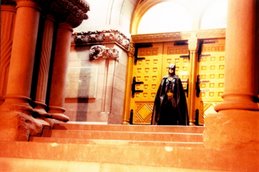
 You can’t go far wrong with a classic Woman in Black.

Freddie Francis’s cinematography deserves its own séance. Shot in luminous black-and-white CinemaScope, the visuals make every corridor seem endless and every shadow alive with implication. The oblique angles and misty vistas do more than set the mood; they externalize the characters’ fractured states of mind. Beneath the supernatural trappings lies an unbearable sadness: the isolation of two children cut off from innocence, and of a woman undone by her own moral panic. Even Miss Jessel, glimpsed weeping in the classroom, feels more like a victim than a villain, a ghost caught between passion and despair. And through it all, Francis’s deep focus and candlelight turn Bly into a psychological maze; gorgeous, haunted, and suffocating.
 Deborah Kerr, looking for answers and adequate lighting since 1961.

As an adaptation of The Turn of the Screw, The Innocents walks the razor edge between the supernatural and the psychological. Henry James’s novella famously leaves readers unsure whether the ghosts are real or figments of hysteria, and Clayton wisely preserves that ambiguity while giving it a shimmering cinematic life. But where James’s story is about repression in polite society, Clayton’s version turns that repression into something almost erotic. Sexual anxiety pulses beneath every line and glance particularly in the charged interactions between Miles and Miss Giddens. It’s no coincidence that The Innocents pairs beautifully with Robert Wise’s The Haunting. Both films adapt literary ghost stories into explorations of desire, loneliness, and the unspoken. Where Wise’s film shudders with repressed lesbian yearning, Clayton’s trembles with moral panic and forbidden sexuality—two sides of the same haunted coin.
 What lurks in the dark halls of Bly Manor?

Then there’s Deborah Kerr, who was forty when she played a governess meant to be twenty. On paper, it shouldn’t work. In practice, it’s perfect. Kerr brings not naïveté but emotional depth, a mature woman’s understanding of love and fear, coupled with the brittle idealism of someone desperate to prove her virtue. Her performance walks an exquisite tightrope: sympathetic yet unsettling, authoritative yet fragile. Megs Jenkins’s Mrs. Grose, meanwhile, is the embodiment of English stoicism, equal parts compassion and denial. And as for the children, Martin Stephens and Pamela Franklin are the gold standard of horror’s unnerving innocents, balancing sweetness and eerie knowingness in ways that make the skin crawl.
 There’s nothing more frightening than a polite little boy.

In conclusion, The Innocents remains one of cinema’s great Gothic achievements; a film that proves horror can thrive on suggestion, ambiguity, and beauty. Every frame breathes unease, every whisper carries implication, and every flicker of candlelight suggests the possibility of madness. It’s as much a tragedy as a haunting: a tale of a woman who mistakes obsession for salvation, and purity for possession. Over sixty years later, it still casts a long, shivering shadow over the genre, reminding us that sometimes the scariest thing of all is what’s inside our own minds.

No comments:
Post a Comment