Hammer Films’ The Devil Rides Out is a strange beast: a heady cocktail of stately drawing-room drama, occult chills, and pure pulp lunacy, all handled with a straight face by people who should have known better but somehow pulled it off magnificently. Directed by Hammer’s maestro Terrence Fisher, the film remains one of the studio’s boldest attempts at mixing gothic tradition with contemporary supernatural dread. It’s serious, scary, sometimes silly, and endlessly entertaining.
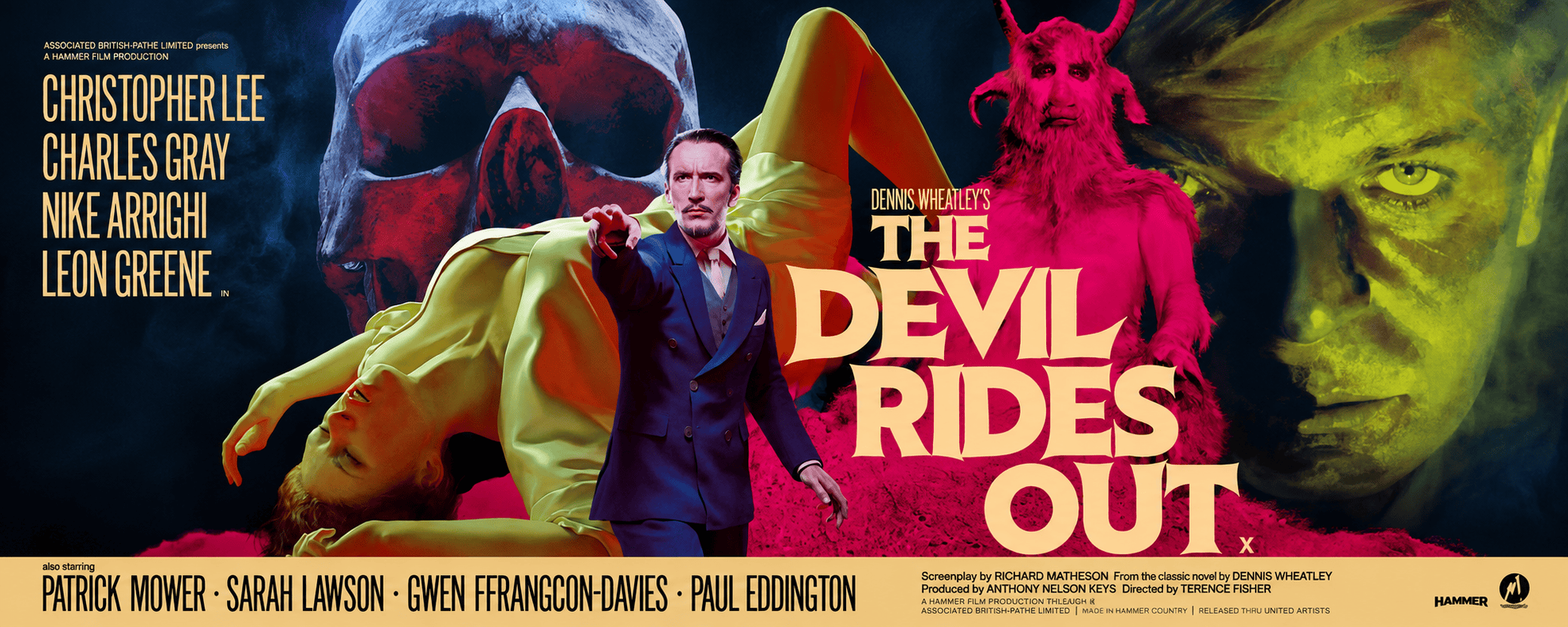
Based on the 1934 novel by Dennis Wheatley, our story is set in London, 1929, where the refined Duc de Richleau (Christopher Lee) notices his young protegé Simon Aron (Patrick Mower) has been keeping suspicious company and decorating his house like a Black Mass IKEA showroom—pentagrams, symbols, the whole “Don’t open this book” starter pack. With his old chum Rex Van Ryn (Leon Greene), de Richleau snoops around and discovers Simon is being groomed for devil-worship by a shady cult led by the smooth-talking Mocata (Charles Gray). They also stumble across Tanith Carlisle (Nike Arrighi), another recruit who looks like she wandered in from a Vogue séance spread. The Duc whisks them both away and even gatecrashes a May Day ritual on Salisbury Plain where the Devil himself shows up in full “Goat of Mendes” cosplay.

“You were expecting, maybe, Smokey the Bear?”
The escape plan? Hide everyone at the country estate of de Richleau’s niece, Marie (Sarah Lawson) and her husband Richard (Paul Eddington). Safety first! Except de Richleau then leaves, Mocata shows up to be all smug and evil, only to be thwarted by the interruption of their small daughter Peggy (Rosalyn Landor). Sadly, she’s later left upstairs with only the butler as protection while de Richleau draws a protective circle for the grown-ups downstairs. Yes, the same butler who couldn’t stop two initiates from wandering into a cult earlier. Guess who Mocata decides to target?

Spoiler: Not the heavily armed adults in the magic circle.
While Mocata’s polite but menacing visit to the Eatons failed – he briefly mind-controlled poor Marie before her daughter’s well-timed entrance saved the day – and he ups the ante by unleashing a barrage of psychic assaults on the household. Cue nightmare visions, sinister apparitions, and finally the summoning of the Angel of Death, who arrives on horseback like the world’s grimmest Uber Eats delivery. De Richleau wards him off, but Tanith pays the price since death apparently runs on a strict “must claim someone” policy.

Well, there goes the film’s love interest.
Mocata, annoyed but not deterred, escalates by kidnapping Peggy outright. And I must say, leaving a little girl upstairs in her bedroom, with nothing but the butler for protection, seems like a bit of an oversight when facing the forces of evil. All seems lost until De Richleau calls forth the spirit of Tanith, who possesses Marie and drops some cryptic breadcrumbs. Rex remembers a suspicious house from earlier (convenient!), and the gang rushes in for a final showdown. Mocata looks poised to win, but divine intervention kicks in: Marie channels Tanith to help Peggy recite a spell that basically rewrites history. Time reverses, Tanith and Simon live, and Mocata’s attempt to summon death boomerangs right back at him, condemning him to eternal damnation.

Cue the fiery wrath of God.
Stray Observations:
• Charles Gray’s Mocata is the suavest cult leader imaginable. You’d almost join just to hear him narrate your downfall.
• The “protective circle” sequence is great—until you realize the adults are safe while poor Peggy is left upstairs, basically babysat by a tea tray. Parenting level: Victorian horror film logic.
• Tanith’s possession of Marie is handled with utmost seriousness, but it plays like the world’s slowest improv séance
• The Goat of Mendes looks less like the Prince of Darkness and more like the mascot for a rural cheese festival. He’d have been more at home in the Wicker Man remake with Nicolas Cage.
• The Angel of Death arriving on horseback indoors is both terrifying and hilarious, like a Monty Python gag played straight.

“None shall pass!”
Terrence Fisher, Hammer’s house genius, directs with his trademark blend of gothic grandeur and stiff-upper-lip seriousness, while none other than Richard Matheson — yes, the legendary mind behind I Am Legend and The Twilight Zone — provides the screenplay. What could have been a campy Dennis Wheatley adaptation full of hokey costumes and silly incantations is instead played utterly straight, and that’s exactly why it works. Fisher stages occult ceremonies with ritualistic weight, treating every chant like it might truly summon something dreadful. Even the quieter dialogue scenes crackle with unease, as if danger lurks just outside the frame. With Matheson’s sharp scripting and Fisher’s refusal to wink at the audience, the supernatural is treated as serious business, giving the film an unsettling edge. That restraint in the face of absurdity is what lifts The Devil Rides Out from pulp curiosity to legitimate horror classic.

A supernatural Holmes and Watson, if you will.
Arthur Grant’s cinematography is another triumph, bathing the countryside in golden light that suggests calm, only to plunge interiors into shadow that drips menace. The film has a painterly richness, like an old master’s canvas on which someone scribbled a pentagram. The protective circle sequence is especially striking: tight close-ups, distorted angles, and oppressive lighting make it feel as though evil is pressing in from every side. Even when the effects wobble (and they do), Grant’s careful compositions elevate the material, making the supernatural seem far more powerful than the budget could show. His visual grandeur gives the film a scale Hammer’s modest resources could rarely match, proving that atmosphere can be just as convincing as spectacle.

Note: This film does contain the standard trope of the hero on guard falling asleep at the most inopportune time. Poor Rex; he can’t catch a break.
In the context of 1960s horror, The Devil Rides Out is Hammer pushing boundaries in both bold and daring ways. Gone are the endless Dracula retreads; this time the studio tapped into the rising public fascination with Satanism, black magic, and whispered tales of real covens. The result is eerie and strangely ahead of its time, swapping cobwebbed castles for something that felt alarmingly contemporary. In doing so, it bridges the gothic traditions Hammer had built its empire on with the darker, more experimental horror sensibilities the 1970s would embrace in films like The Exorcist and Rosemary’s Baby. It’s as if Hammer, usually lost in Victorian fog, briefly looked around at swinging London and declared: “The devil is in fashion now—let’s give people what they’re afraid to admit they want.”

Hammer knows how to deliver nasty occult action.
As for the performances, Christopher Lee shines as the heroic Duc de Richleau, relishing the chance to be the learned saviour instead of the monster. He brings such authority to his performance that you half believe he really does keep grimoires on his nightstand. Charles Gray, meanwhile, is pure charisma as Mocata: Urbane, hypnotic, and deliciously sinister. He plays evil with such charm that it’s no wonder he later got to stroke a white cat as Blofeld. The supporting cast, from Rex’s square-jawed loyalty to Tanith’s ethereal wavering, all play their parts well, but this is ultimately a duel between Lee and Gray, and what a duel it is.

Charles Gray, the epitome of smug evil.
In conclusion, The Devil Rides Out is one of Hammer’s crown jewels: bold, atmospheric, and unapologetically pulpy. It mixes ritual magic, genuine chills, and the occasional head-scratching character decision into a heady brew that has aged surprisingly well. Fisher, Grant, Lee, and Gray elevate the material beyond its hokey roots, creating a film that still rides high in the Hammer canon.

No comments:
Post a Comment