From Basil Rathbone and Nigel Bruce to Robert Downey Jr. and Jude Law, cinema has produced no shortage of takes on the world’s most famous detective and his steadfast companion, Dr. Watson. Some versions stick closely to Conan Doyle’s text, while others sprint off in their own, more enthusiastic directions. Then, in 1985, Barry Levinson and Chris Columbus asked a far more interesting question by reimagining Sherlock Holmes and Dr. John Watson altogether: “What if they’d met as children?”

The mystery kicks off with a series of murders committed by a
mysterious hooded figure using a blowgun to shoot its victims with
thorns, which would then induce nightmarish hallucinations resulting in
their apparent suicides. Our young Sherlock Holmes (Nicolas Rowe) gets involved when his mentor Rupert Waxflatter (Nigel Stock) becomes the latest casualty, uttering the final word “Eh-Tar”
to Holmes, and our hero becomes obsessed with solving what he believes
to be a series of murders. Helping Holmes solve this mystery is
Waxflatter’s niece, Elizabeth Hardy (Sophie Ward), who is also Holmes’ love interest, and John Watson (Alan Cox), new to the school but eager to become Holmes’ friend and assistant.

Note:
The film endangers itself by dropping in “origins” for all of the
classic Holmes tropes, as if we needed to know where he got his
deerstalker cap or pipe.
Holmes, Watson, and Elizabeth follow the
trail to a shadowy Egyptian cult called Rame-Tep, who are out for
revenge. Which, as cults go, is at least a step up from waiting for a
comet. We learn that years ago, a British expedition defiled a sacred
tomb in Egypt, and now the descendants of those explorers are dying one
by one via blow-darts laced with hallucinogenic nightmares. The cult
operates from a hidden underground temple in the middle of London
because, you know, zoning laws weren’t a big thing back then. Our
teenage trio crashes a cult ritual (never a good idea), rescues a
would-be sacrifice, and nearly gets roasted alive by torch-wielding
robed maniacs. Not to mention, some weird tonal shifts.

Cute killer desserts?
The investigation leads to a shocking twist: the kindly Professor Rathe (Anthony Higgins), who was Holmes’ fencing teacher and father figure, is actually the sinister cult leader, going by the name Eh-Tar, and the school nurse, Mrs. Dribb (Susan Fleetwood) is Rathe/Eh-Tar’s younger sister and his cult’s second-in-command as well as chief assassin. The film concludes with a chilling duel between Holmes and Rathe on the icy Thames in an epic final showdown. Rathe falls through the ice, seemingly to his death, while Holmes, badly bruised and emotionally wrecked, faces an even greater tragedy: the death of Elizabeth.

A pretty dark ending for a kids’ movie.
Stray Observations:
•
A story about three school kids, two boys and a girl, who have to team
up to fight evil was a nice training ground for screenwriter Chris
Columbus, who would later helm the first two Harry Potter movies.
• Nigel Stock, who plays Waxflatter, played the role of Dr. Watson in Sherlock Holmes (1964).
•
Uncle Waxflatter’s whirlybird was modelled after Leonardo da Vinci’s
sketches — adding to the film’s steampunk-adjacent aesthetic before
“steampunk” was a term.
• The deduction sequences are visual and flashy — a style that would be copied in Sherlock and the Downey Jr. films.
• The villain using an elaborate contraption to pour boiling wax over his victim is very reminiscent of the Vincent Price movie House of Wax.
•
A post-credit scene (rare for its time!) teases Holmes’ future
arch-nemesis in a cheeky nod that predates Marvel’s stingers by decades.
It’s a bold little wink that rewards diehard Holmes fans.

Sadly, no sequel was forthcoming.
Director Barry Levinson brought an unusual seriousness to what could have been a lightweight adventure, as the tone is often dark and brooding, particularly in its hallucinatory sequences, which blend gothic horror and fantasy in ways that push the boundaries of a PG-13 film. Aided by cinematographer Stephen Goldblatt, the movie bathes in mist, candlelight, and gothic textures, giving us a pervasive sense of dread, but also awe and an appropriate blend for a film exploring the early trauma and brilliance of a future great detective. And while not directed by Steven Spielberg, his fingerprints are all over this. There are thrilling chases, creepy hallucinations (some of which remain surprisingly eerie), and a sense of youthful discovery.

Youthful rebellion against authority.
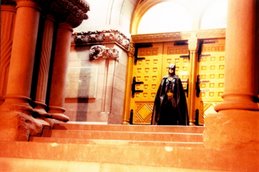
The hallucination scenes are standout sequences, including cooked killer Cornish hens, a nightmare of pastries coming to life (both comical and disturbing) and a chilling stained-glass knight that comes to life in a landmark achievement in early CGI animation by Industrial Light & Magic. That stained-glass knight was the first fully CGI-animated character in a feature film, pre-dating even the more famous T-1000 of Terminator 2. It’s a brief but jaw-dropping sequence that hints at the future of cinema.

When science and religion meet.
At its core, Young Sherlock Holmes is a story about identity formation and emotional awakening. The film portrays Holmes not as the fully-formed, emotionally detached genius seen in later interpretations, but as a brilliant, passionate, and occasionally impulsive teenager. Nicholas Rowe’s portrayal gives the character depth and vulnerability, particularly in his romantic relationship with Elizabeth Hardy. This emotional layer—largely absent in Doyle’s Holmes—adds poignancy to the film’s tragic climax and helps explain Holmes’s later emotional reserve. In this way, the movie bridges the gap between Holmes the boy and Holmes the man, suggesting that his experiences as a teenager shaped the stoic figure readers would come to know.

Having good villains is also a big plus.
One of the film’s most distinctive features is its willingness to incorporate fantasy elements. The central mystery involves a secret Egyptian cult conducting ritualistic murders using hallucinogenic darts that cause victims to experience vivid, often terrifying visions. While some purists might object to the “supernatural” overtones, the film’s gothic atmosphere and visual inventiveness elevate it beyond standard genre fare, aligning it with other Spielberg-produced projects of the era, such as Goonies and Indiana Jones and the Temple of Doom.

Sherlock Holmes and the Temple of Doom.
Thematically, the film addresses the pain of loss and the difficulty of growing up. Holmes is repeatedly confronted with failure, vulnerability, and grief—experiences that humanize him and offer viewers a glimpse into the emotional cost of genius. His romantic loss at the end of the film serves as a turning point, one that transforms him from an idealistic youth into the emotionally guarded detective the world would later know. This trajectory adds weight to the character’s psychological development and lends the film an unexpected gravitas. The film even dares to explore Holmes’s vulnerabilities, particularly through his romantic relationship with Elizabeth, which lends real emotional weight to the climax.

A dash of tragic teen romance to spice things up.
In conclusion, Young Sherlock Holmes is a fun and poignant coming-of-age story that feels like a blueprint for the modern YA mystery genre. A brisk, spooky, and imaginative adventure that turns the origin story of the world’s most famous detective into a YA thrill ride. It’s not canon, and it’s not particularly faithful, but it’s got heart, flair, and a dash of Spielbergian awe. It may be “elementary,” but it’s certainly entertaining.

No comments:
Post a Comment