Blog Archive

Thursday, April 4, 2019

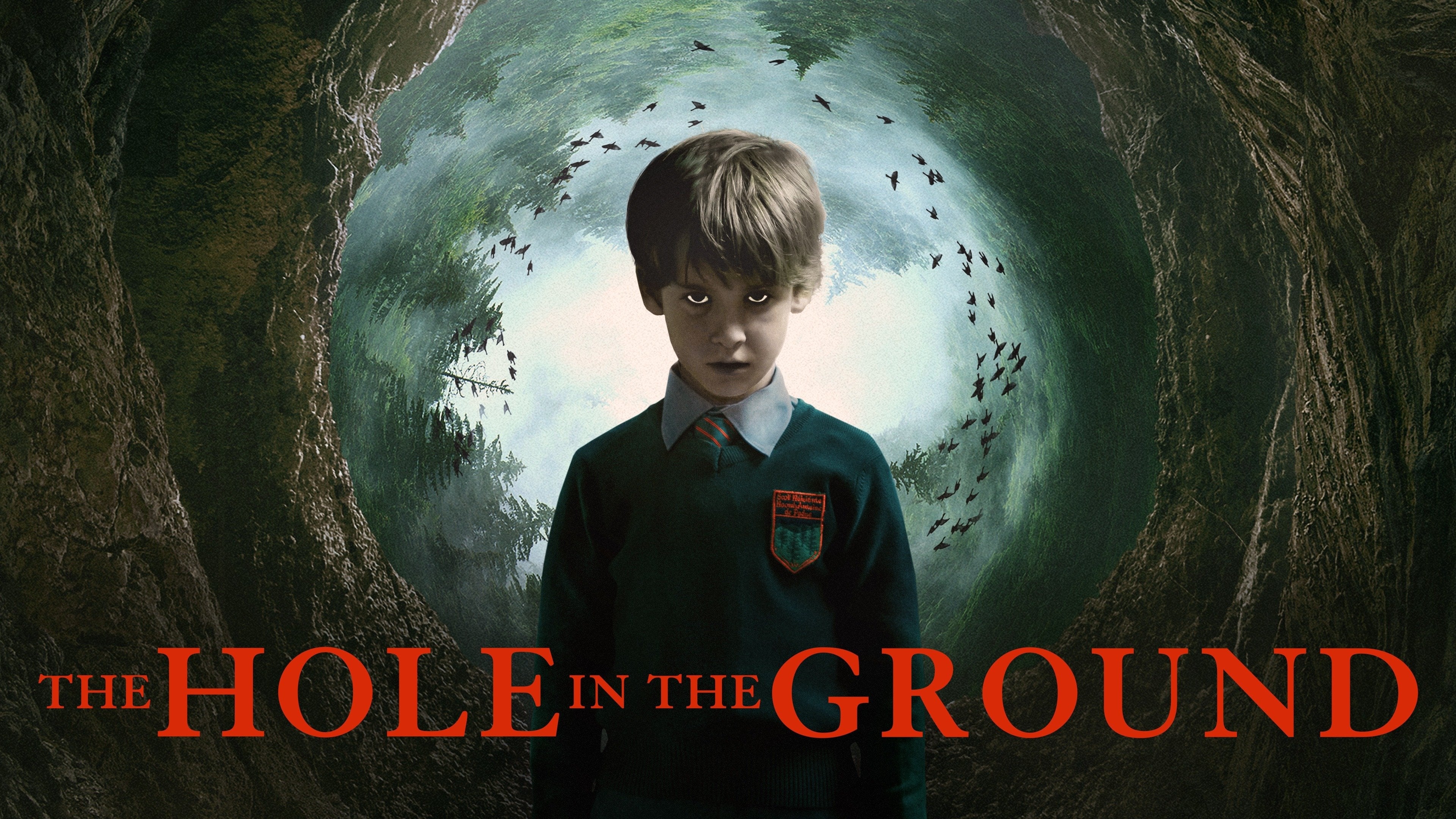
The Hole in the Ground (2019) – Review

One of the more prevalent staples of the horror genre is the creepy kid, whether he be the son of Satan, as in The Omen, or a whole brood of them, such as from Children of the Corn. No matter what, there is something inherently horrifying about kids — even ones not in horror movies — and once again, this trope is explored with writer/director Lee Cronin’s The Hole in the Ground, sadly without bothering to add anything original to the genre.


We are introduced to Sarah O'Neill (Seána Kerslake) and her son Chris (James Quinn Markey) while visiting a carnival, where we see them making faces in a funhouse mirror, giving us a little foreshadowing of the twisted duality yet to come, and as the story unfolds, we discover that Sarah had moved to this particular hamlet to escape her abusive husband, with whom she had a son. Will this film touch on the drama of spousal abuse and the effects it has on the children? Nope, that carrot is dangled for about a half a second before being cast aside so that we can have horror trope after horror trope rolled out as if on some kind of evil train schedule.

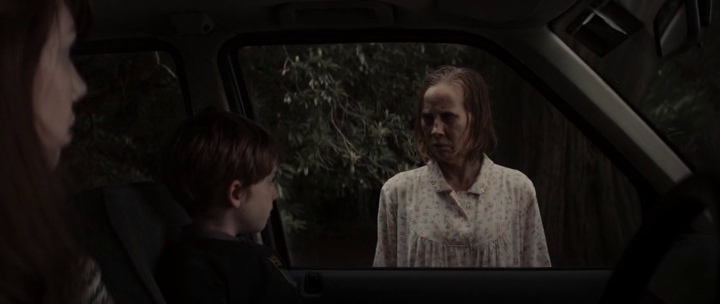
• Sarah and Chris meet a crazy lady (Kati Outinen) who may or may not have murdered her son for “Not being her son.”
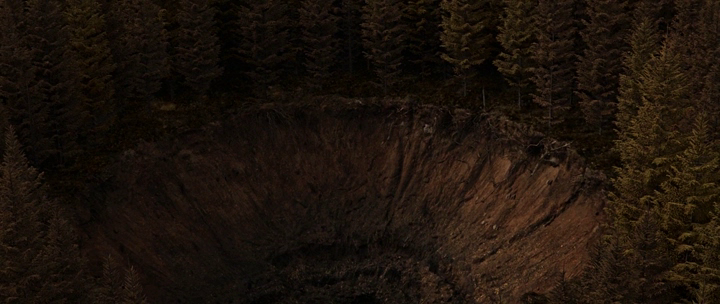
• They’ve move into an isolated farmhouse next to a dark forest that contains a massive sinkhole.
• The farmhouse has your standard spooky basement with flickering lights.
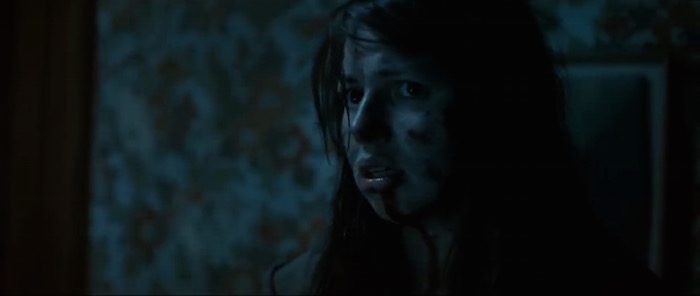
• Sarah will be plagued by nasty visions and nightmares.
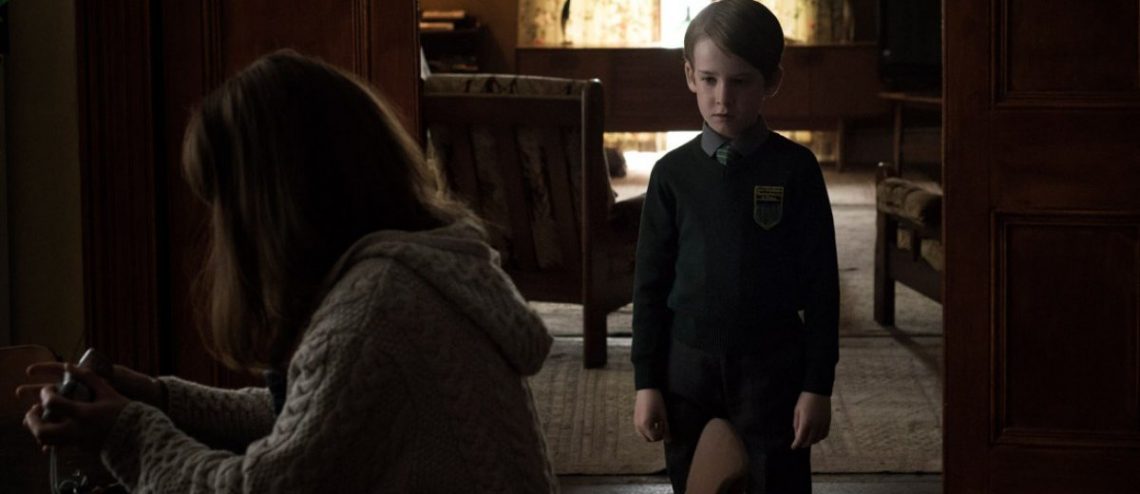
• Chris will start acting oddly while giving Sarah creepy blank stares.
• Friends and doctors will “pooh-pooh” her belief that Chis is not her son.


"Ireland, come for the sinkholes, stay for the unrelenting evil."

The basic premise of The Hole in the Ground is that Sarah’s young son has been switched out for a doppelganger — or a changeling, if you are up on your folklore — and at times, it looked to me like director Lee Cronin was trying to make a dark psychological horror film, exploring the nature of motherly bonding while also dabbling in dark fantasy. She, this was not the case, and instead, the end result was a tedious mess that never seemed sure of what it wanted to be or say. When Sarah started to suspect things may not be all right with her son — him going from being afraid of spiders to eating them being a big red flag — she doesn’t do much in the way of constructive investigating, other than hiding a camera in the kid's room and confronting the husband (James Cosmo) of the crazy lady who murdered her own son, but none of these scenes go anywhere.


Ireland actually has road signs warning you about creepy heralds of doom.

A key part in the balancing act of the horror genre is keeping your protagonist's behavior somewhat believable; there can be only so many instances causing such questions as, “Why are they still in that house?” or “Who checks out a dark basement in the middle of the night?” or “Why is she diving into that fucking massive sinkhole?” Yet in Cronin’s The Hole in the Ground, we find the protagonist doing maybe one intelligent thing but then completely undermining it by doing the most insane thing possible the very next minute.

Stray Observations and Spoilers:

• It’s stated that a changeling’s reflection reveals their true nature, and we do see an evil creature in the mirror when Sarah tries to verify if her son is truly a monster, but if that's the case, shouldn't it be easy to prove to others by just hauling her kid before witnesses — friends, doctors, even the bloody police — and placing a mirror in front of the little monster?
• Sarah confronts the creature that is impersonating her son, after catching him out on the fact that it doesn’t know her son’s favourite game, which results in the monster proceeding to toss her around like a rag doll. Now, Sarah did plan a little ahead for this outcome — a rare moment for her — as she had drugged the kid’s dinner. Unfortunately, it was one of those slow-acting drugs that gets her buried head-first in the front yard before finally taking effect, but once she is able to drag his evil ass down into the basement, she doesn’t bother to tie him up, which then results in her being attacked again.
• She then heads out into the forest to find her real son, which involves diving into the sinkhole with nothing but a flashlight. Now I know a mother’s love for her child is a powerful force, able to draw on almost supernatural strengths, but maybe one should have taken a breath and thought this through — maybe write a pros and cons list — before jumping into an unknown environment, with no weapon of any kind, in the slim hope you will find your son. We can almost buy this impulsive act — and the actress does manage to sell the moment — but when she easily escapes from a horde of these monsters, with her unconscious kid in tow, I called bullshit.


Doesn’t Ireland have a Scully and Mulder she could have called?

The Hole in the Ground is wonderfully shot by cinematographer Tom Comerford, and the music provided by Stephen McKeon sets the mood brilliantly, but these are just two elements in service of a rather pedestrian story that brings nothing new to the genre. I’m not expecting every film dealing with this particular subject matter to be Guillermo del Toro Pan’s Labyrinth, but a little extra effort in your world-building can really make a difference. Cronin’s film isn’t altogether terrible, and the two lead actors did their best considering the script given to them, but it’s the wasted potential that bothered me the most.


“I see faerie people.”

Wednesday, April 3, 2019

The Fantastic Journey (1977) – Review

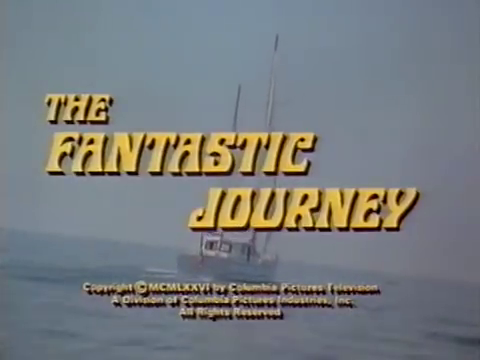
In 1977, producer Bruce Lansbury brought to the small screen a show called The Fantastic Journey, a startling tale about a small group of people trapped on a mysterious island — decades before J.J. Abrams would conjure up his series Lost — and though this particular series didn’t even manage a full season, thanks to the evil machinations of NBC network's executives, it was quite a remarkable little adventure show, and deserved more than to become "One of the Forgotten."


 In the pilot episode “Vortex,” a small but diverse group of “eggheads” take a boat cruise into the Bermuda Triangle — to what end is never exactly addressed — with a party consisting of Professor Paul Jordan (Scott Thomas), his thirteen year-old son Scott (Ike Eisenmann), young African American Dr. Fred Walters (Carl Franklin), university students Jill Sands (Karen Somerville) and Eve Costigan (Susan Howard), marine biologists Andy (Jack Stauffer) and George (Byron Chung), with the boat itself being operated by Captain Ben Wallace (Leif Erickson) and his First Mate Carl Johanson (Scott Brady). Don’t worry about remembering all those names and characters because most of them won't make it past the pilot episode.


Entering the Bermuda Triangle.

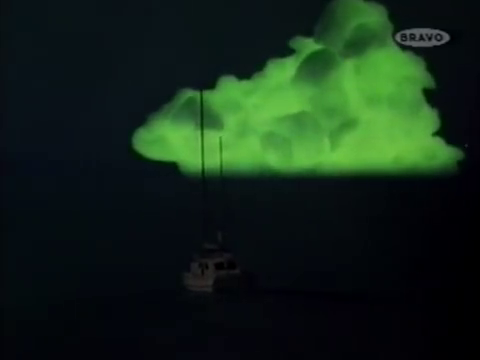
When night falls, the boat loses power as well as the use of its radio, as it's drawn towards a mysterious glowing green cloud. The first casualty is poor Carl, who during the stormy passage into the cloud falls overboard, and when the rest of them find themselves washed ashore the following morning, Carl is nowhere to be found. Professor Jordan and his son do a quick reconnoiter, where they soon discover that they are on a massive island, one with mountains in the distance and no sign of indigenous people. So it’s clear that they are on some strange and uncharted island, which has Andy and George eager to try and take the ship’s surviving dingy back out to sea in an attempt to make it into the shipping lanes. This does not go well for the two marine biologists, as they are both found washed ashore, dead, the very next day.


Enter Varian, man from another time.

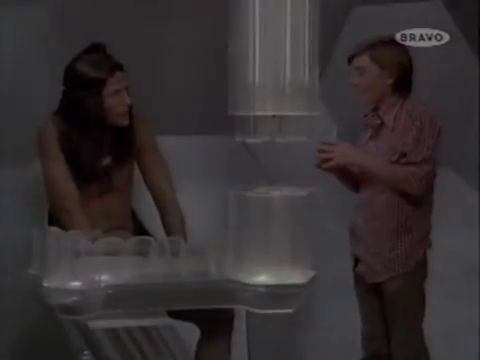
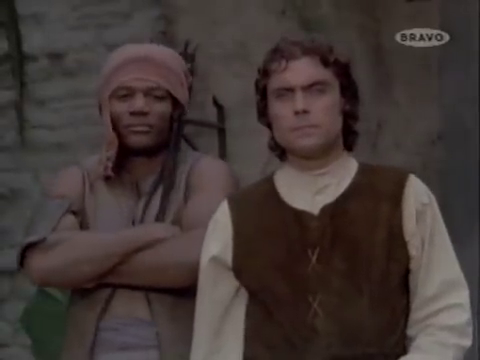
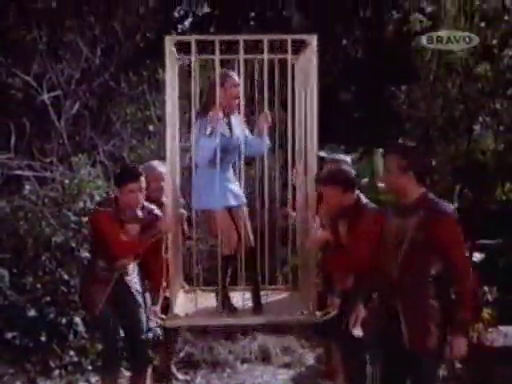
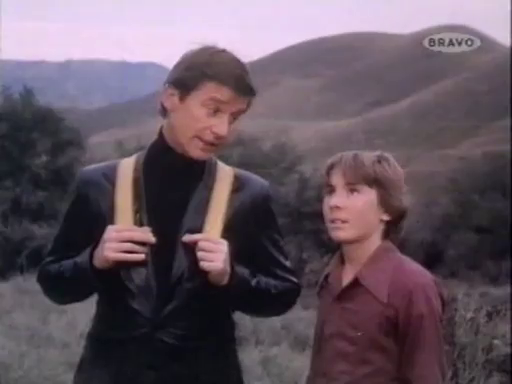
The group soon encounters a man dressed like a member of an extinct indigenous tribe — standard loin cloth and long hair style — but the man is clearly not too primitive as he carries a device that instantly heals Captain Wallace’s broken arm, and when Scott follows this strange individual into the jungle (Scott does this wandering off thing quite a bit on this show), he discovers that the man is not a primitive tribesman at all, but a man from the 23rd Century named Varian (Jared Martin) who, like our intrepid group of castaways, was also marooned on this strange island. He later tells the group that, “In Earth year 2230, I was a musician, and my work was very important to me because in my century, musicians do nearly all the healing.” From this, Professor Jordan deduces that, “We’re in some sort of time lock, a space time continuum. Past, present and future exist together, each on its own terms.” Unfortunately, running into musicians from the future is far from their only concern, as also located nearby is a group of 16th Century privateers, led by Sir James Camden (Ian McShane), and Jill, Fred and Captain Wallace are soon captured by these English ruffians.


Pirates of the Bermuda Triangle.

The trio are rescued, with the reluctant help of Varian, who is opposed to violence and destruction of any kind, but Captain Wallace succumbs to greed and runs back to grab some Spanish treasure, which leads to his demise at the end of the poisoned fangs of Camden’s pet cobra. Thus, another member of the original party exits the series, and the show isn’t finished yet, as only three of the original nine will make it to the second episode. This is easily the highest attrition right I’ve ever seen in a television series. This would be like if the second episode of Lost only included Jack, Hurley, and Walt, and it's this kind of shake-up in casting that would have been a key reason for the show's failing, as a certain amount continuity of cast members is something audience members of the time were more used to, but for me, the bigger issue came along with how the show ditched the next three cast mates.


Enter the evil Atlanteans.

Varian explains to the travelers that, “Here on this island, even as the first man walked upright out of his Neanderthal cave, man was also taking his first step on the moon, and that there is only a thin tissue of consciousness separating one event from the other.” He further explains that the island is honeycombed with many different “time zones,” all separated by invisible fields, and that one step through these “invisible gateways” can take you from the 23rd Century to the 16th Century in an instant. They also learn that the only way home is to head towards the Eastern Shore, to a mythical terrain called Evoland, where a device purportedly exists that could send any person back to his appropriate home in time. At the end of the pilot, Professor Jordan, Jill and Eve step through one of these invisible gateways, but when Varian, Fred and Scott step through, they find no sign of Scott’s dad or the two girls, but they are met by an Atlantean named Rhea (Mary Ann Mobley) who tells them that Professor Jordan and the two girls had gone on ahead to the city of Atlantium.


She certainly doesn’t look like the lying type, I’d trust her.

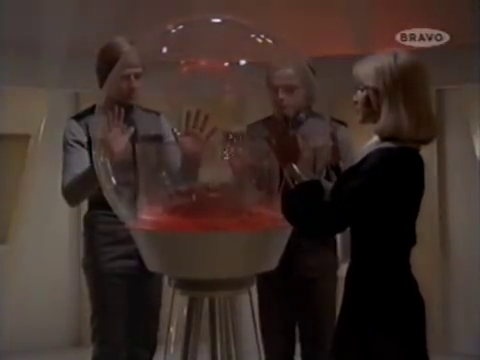
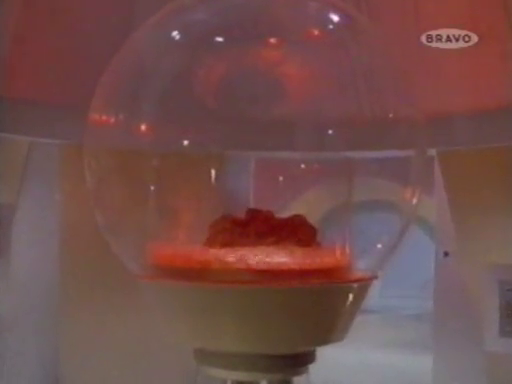
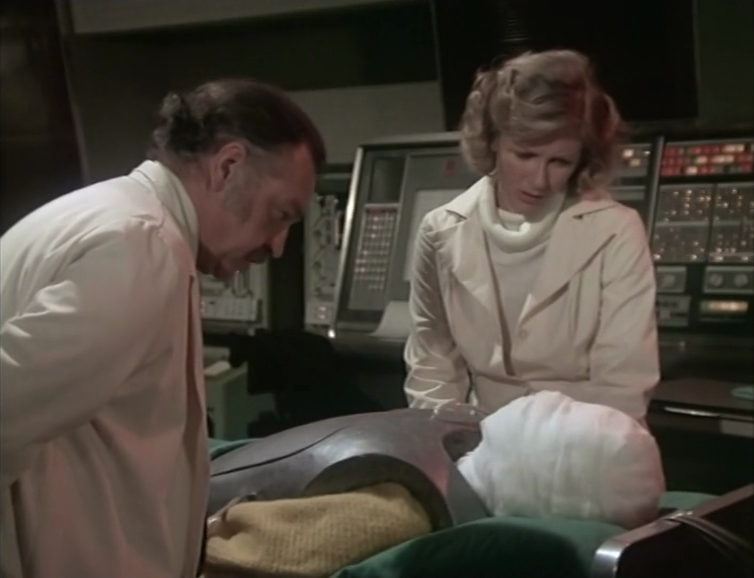
Yet when they enter the city, they are quickly informed that Scott’s dad and the two girls have gone back to their own time. Needless to say, that rather upsets Scott. Dar-L (Gary Collins), one of Atlantium triumvirate, gives Scott a letter written by his dad, explaining that he knew that Scott would be fine while in the capable hands of Varian and Fred, and that he needed to get home as soon as possible so as to relieve the pain that Scott’s mother must be going through. Now the level of bullshit here is just staggering, and at first I’d assumed this was some duplicitous scheme of the Atlanteans, but turns out the letter was genuine, and that Scott’s dad is just such an asshole that he couldn’t wait five damn minutes for his son to show up. If the showrunners were so eager to get rid of these three characters — which seems a like strange thing to do after just one episode — why not have it be revealed that the Atlanteans murdered them, and that the letter was a fake? We quickly learn that the city is run by a giant brain in a jar, simply called The Source, and that it needs a new body for rejuvenation, and that it had chosen Scott to serve that purpose, so having them kill off Professor Jordan, and those with him, would certainly be in keeping with their evil plan.


Never trust a brain in a jar.

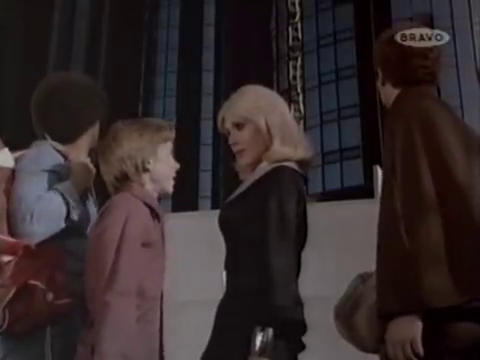
Lucky for our trio, the Atlanteans were about to have a rebellion, led by an Atlantean named Liana (Katie Saylor), who is the daughter of an Atlantean father but with an extraterrestrial mother, and with her help Scott is saved and The Source is defeated.  When all is said and done, she decides to leave Atlantium with our heroes. Now, Liana is quite an interesting character; she has some psychic abilities, such as telepathically communicating with animals — which comes in handy when she uses her cat as a spy — and she also has greater than normal human strength due to her mother being from a planet with a higher gravity than that of Earth's. Sadly, her “super strength" is rarely used, so instead of having a show featuring a woman kicking serious ass, which would have been awesome, we often see Liana captured and in need of rescue by the boys. This is such a criminal waste of potential, especially when you consider that over on ABC they had Lynda Carter tossing around Nazis as Wonder Woman, so why not make Liana the action hero of this show? With pacifist Varian in charge of our trio, it would have been natural to have her as a physical back-up, but instead, fisticuffs and flying dropkicks were left to George.


This is just embarrassing.

In episode three, “Beyond the Mountain,” the group were separated after being engulfed by a mysterious red cloud, so while Varian, Fred and Scott end up in a dreary swamp, Liana finds herself in a small little utopia run by a man named Willoway (Roddy McDowall), who we later learn is the only human inhabitant, as all the other “citizens” are robots. Willoway is very happy to see Liana, but she is less than thrilled when he announces the fact that they are to be married — even his robot “son” seems a tad jealous — and it’s only with the arrival of Varian, Fred and Scott, along with the little green men who original lived in this utopia before Willoway betrayed them and had them ousted, that she is saved from an awkward matrimonial situation. What is quite surprising is that after the little green men reclaim their homeland, and exile their usurper, Varian offers Willoway the opportunity to travel with them, stating that the Dr. Jonathan Willoway he knew was a man who treasured life over death, and whose achievements became the building blocks of the future that Varian comes from.

It’s not every show where an episode's villain ends up becoming a regular cast member, and he’s not even given the cowardly aspect we got with such charactera like Dr. Smith from Lost in Space — he becomes a valued member of the team, whose somewhat “flexible moral compass” serves them well, from time to time.

Note: The character of Willoway was written specifically to attract Roddy McDowall to the part, and he was so liked in the role by the producers that he was asked to become a regular.

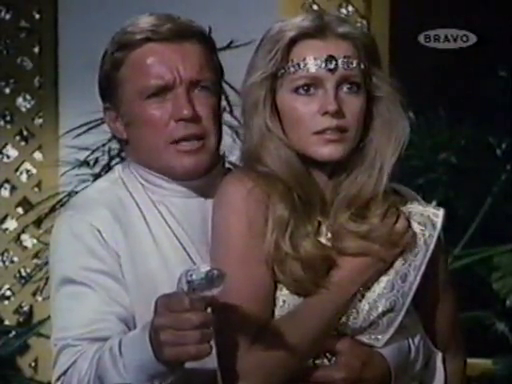
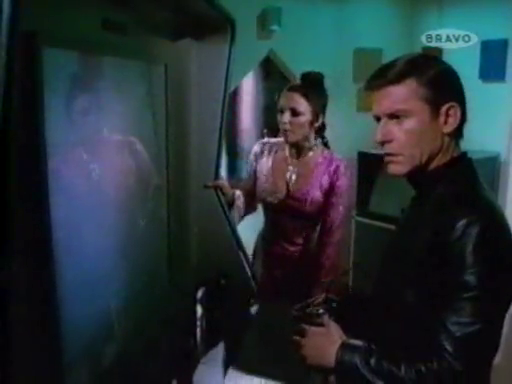
The rest of the season finds our group running into various science fiction clichés, with only the excellent work by science fiction legend (and this show’s story editor), Dorothy Fontana, preventing The Fantastic Journey from becoming a running joke. The network wasn’t too keen on having our heroes running across figures from the past, maybe it cost too much to find period sets and clothing for those kinds of episodes, and thus the 16th Century privateers were the only historical encounter our heroes would have. Instead, they ran into a post-apocalyptic city run by children — think “Miri” from the original Star Trek series — then there was a military dictator (John Saxon) who wanted to march across and conquer the various time zones, a society that practiced human sacrifices, who wanted to chuck Varian into a volcano, Willoway is briefly possessed by an ancient Greek magician (Mel Ferrer) in a "Funhouse" of horror, then in the episode “Turnabout” we find a society where sexist men have enslaved women, but the slave queen (Joan Collins) leads a rebellion, and our heroes are captured so as to be used as breeding stock. We even have an episode where space convicts (Richard Jaeckel and Nicholas Hammond) make things tough for an alien colony of pacifists (Cheryl Ladd and Lew Ayres).


Take note, there are lot of aliens in this show, but mostly of the humanoid variety.

In the ten episodes that make up this brief run, our heroes come across a helluva lot of aliens, for every dystopian future society they come across they encounter two made up of aliens who got sucked in by the Bermuda Triangle, making this show more Lost in Space than Time Tunnel. Sure, we are told these aliens races are from the future, but they’re aliens, does it really matter what time zone they came from? The repetitive nature of these encounters was probably key in the show's cancellation, as one could easily imagine how “old hat” our heroes stumbling from one alien society to another would get, until eventually reaching the fabled Evoland. The show’s formula became quickly apparent.

• Our heroes would step through a gateway.
• They would encounter a strange society.
• Varian would not want to interfere.
• Willoway would want to get the hell out.
• Scott would befriend one of the residents.
• Varian would change his mind about interfering.
• Ben would then get to punch or dropkick somebody.
• Our heroes would then step through another gateway.

You can see how that could get tiresome after a while, but with the addition of Roddy McDowall to the cast they really had an ace up their sleeves, as any scene where Willoway had to debate the bizarre aspects of whatever topsy-turvy society they’d wandered into was a true joy to behold. McDowall was simply brilliant, and I would have happily listened to him read the phone book for fifty minutes, but even his valiant efforts could not save the show from being flushed by the network executives.


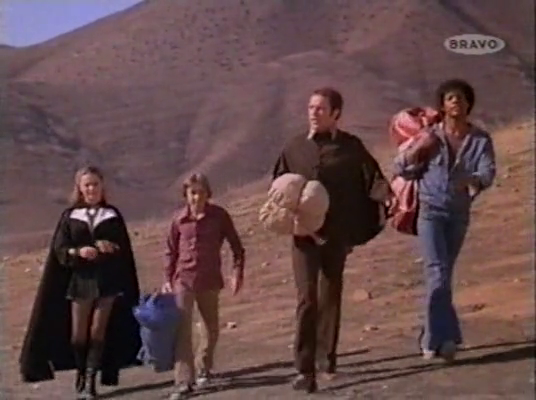
The Fantastic Journey certainly had an interesting concept, and the cast were uniformly excellent — that is, once they settled down to our four main heroes — and the show allowed time to develop some great comradely moments between them, but the network’s decision to no longer have our characters encounter people from the past was a huge mistake, as a show about time travel kind of needs that aspect or it’s just becomes another generic space opera, only without the cool spaceships. Since its cancellation, we’ve had several shows with similar themes, but I for one would love to see a complete reboot of the series, for with a proper budget, and writers given free reign, you could really give modern audiences a real Fantastic Journey.


I’d love HBO to take a crack at a show like this.
Thursday, March 28, 2019

The Image (1975) - Review

When it comes to bondage and erotica in film French director Just Jaeckin's adaptation of author Anne Cécile Desclosthe The Story of O pretty much set the bar for which all movies with this subject matter would be measured by, while over in America director Radley Metzger took note of this, seeing what Jaeckin had done with The Story of O, and said “Is that what you call sadomasochism?” and with that mindset this American director brought us the film known simply as The Image, a film that is not at all shy with its subject matter.


The Image may have been an American production but it was shot in Paris, France and is based on the novel L’Image by Jean de Berg, which leaves one to believe that France must have been one incredibly kinky place in the 70s. The story follows bored playboy Jean (Carl Parker) who, while mingling amongst a group of wealthy socialites at a literary party, spots Anne (Mary Mendum), a ravishing blonde that immediately wants to know her better. Also at the party, and looking equally as bored, is Claire (Marilyn Roberts), an old friend of his who he approaches so that he learn more about this beautiful and mysterious blonde. Jean is quite surprised to find out that Clair and Anne are an item, as he had no idea that Clair swung that way.


I would not be surprised if Mary Mendum turned women bisexual on a daily basis.
Turns out that Claire is the mistress of young Anne, cause why not, and she begins to draw Jean into her world of sadistic pleasures. Claire is a strong and powerful force, cold and cruel, while Anne’s submissive nature hides a volcanic desire that hints at who is actually in charge of this relationship. Then there is Jean, who is so drab and boring that it almost hurts to watch him on screen. He’s also the one who provides the godawful narration that is so intrusive at times that it’s almost as if we are watching an Audio Book version of the novel.
 

Who needs narration over stuff like this?

The nature of Claire and Anne’s relationship becomes quite apparent to Jean when they visit a public garden and Claire orders Anne to steal a rose, and hide its thorny stem under her garter, then made to squat and pee right in front of him. I must say this caught me quite off guard, and not just the kinky act of public watersports, but the fact that we get quite the graphic close-up of Mary Mendum peeing. This is not softcore porn, this is the real deal, and later Claire forces Anne to perform many sexual acts with Jean as well, adding more moments of humiliation for Anne, but when we see the twinkle in her eyes we know that she is getting more out of this than her tormentors are.


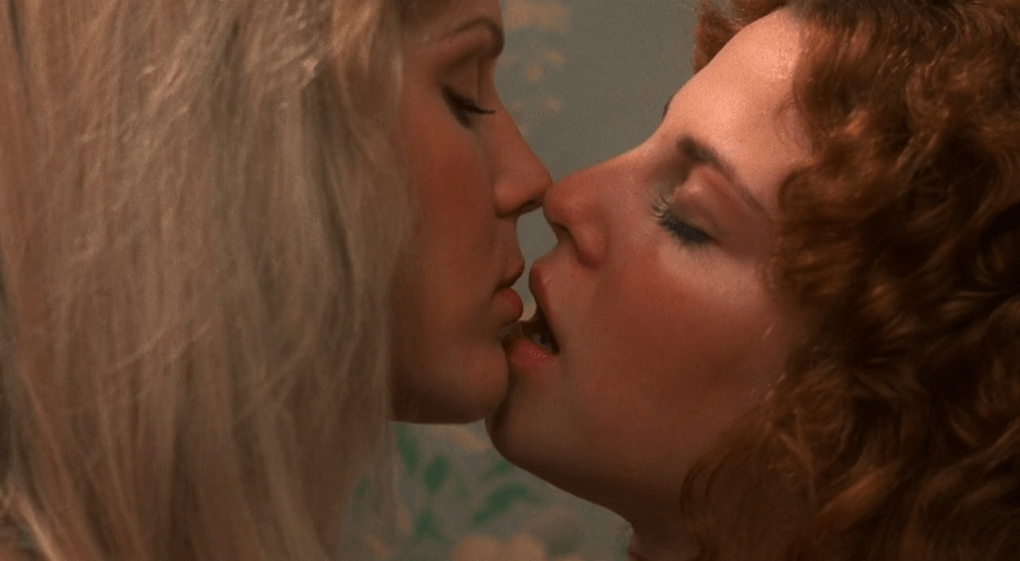
The movie is broken into eleven chapters, as we follow the bizarre and somewhat twisted threesome as they bounce from one sexual escapade to the another; - playing hide the fruit in a restaurant, oral sex in an alley - and at one point Claire offers Anne to Jean so that he to take her on an outing to her shopping for lingerie, which ends up turning into a threesome with a cute shop girl (Valerie Marron).


All films could be improved by a little girl on girl action.

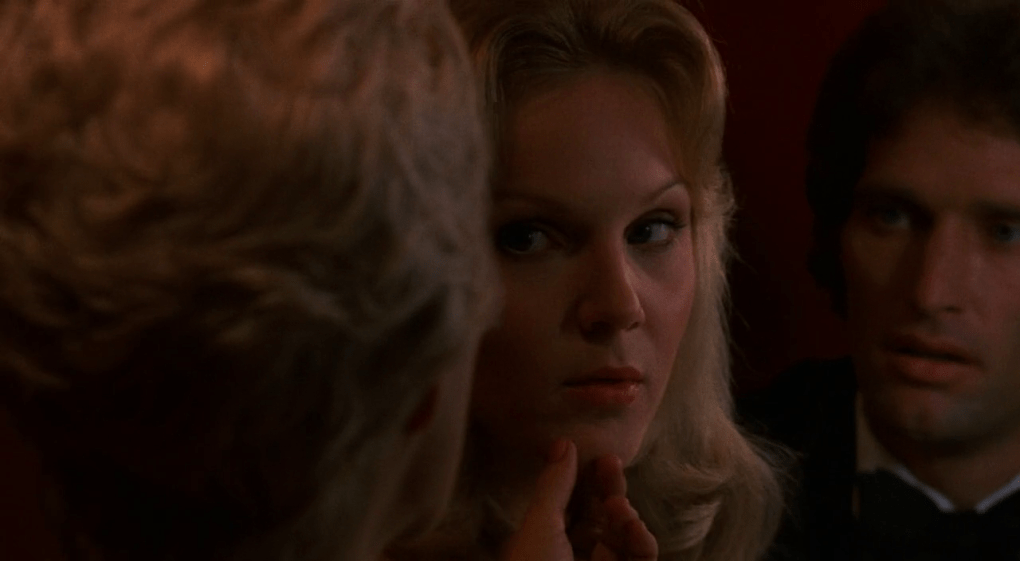
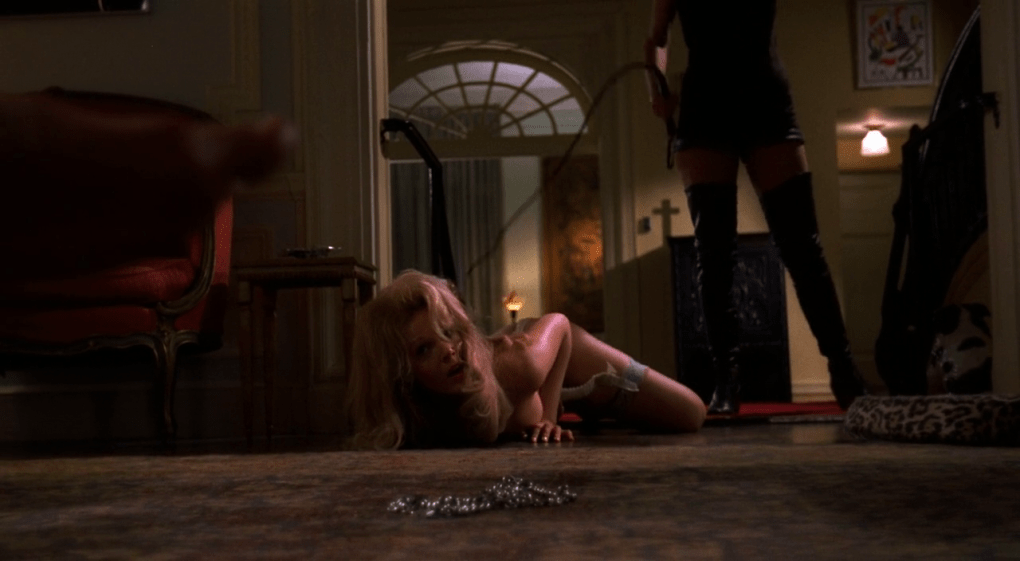
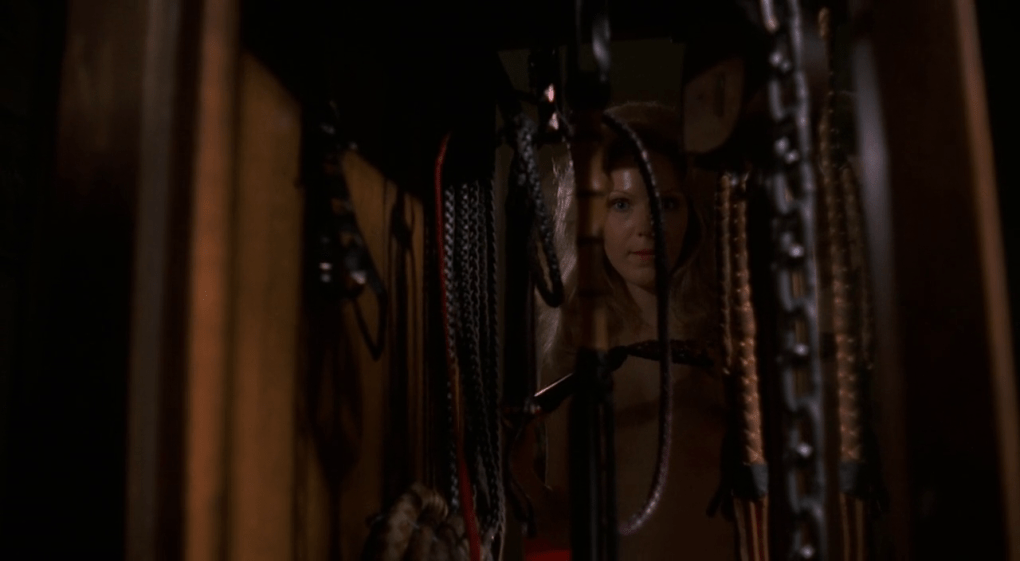
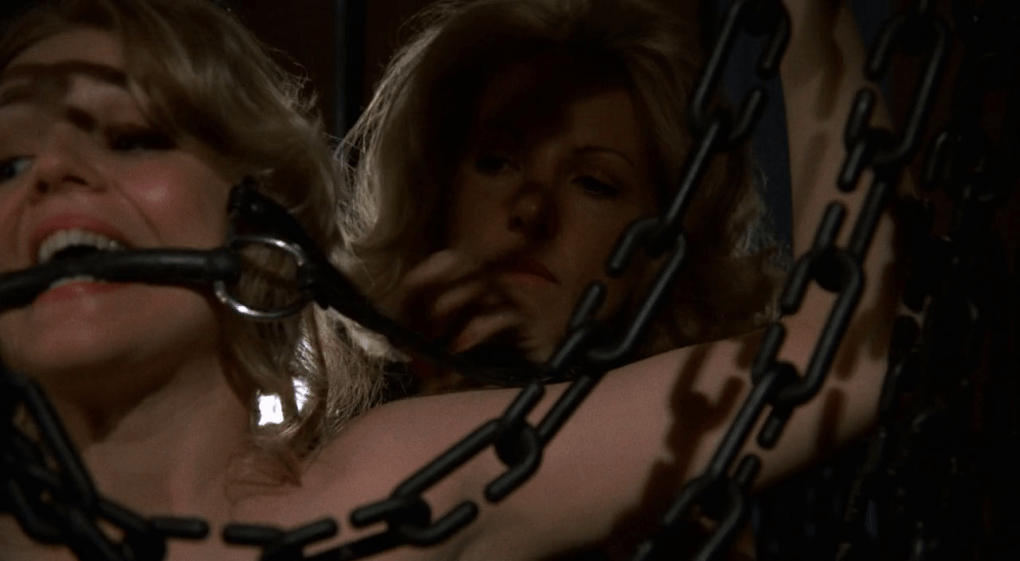
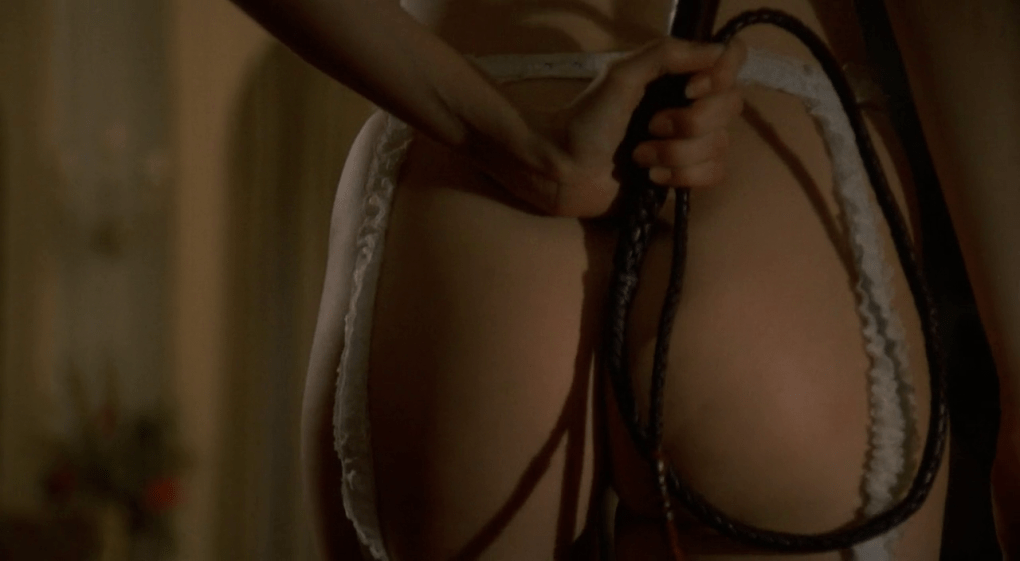
The tenth chapter “The Gothic Chamber” is the most intense, and the one that may put off some viewers (though if you made through all the graphic sexual acts and humiliations so far I’m betting you’ll make it the rest of the way) as the torture level is amped to eleven as Claire chains up Anne, fits her with a rubber bit gag and proceeds to stick her with heated pins. Jean joins in with some brutal flogging - not wanting to feel left out - but it’s when he has a passionate and sensual sexual bout with her that Claire loses it and attacks him with the whip. Jean tries to restrain Claire, as she goes totally bananas, but what’s really nice is that Anne steps in and clobbers Jean with a bottle of champagne and he is driven out of the house. "I'm going to leave now," Anne says quietly to Claire. "But what will I do?” asks Claire, and right there we get a good inkling as to who was really in charge the whole time.


A bit much, you say?

This film is hot, and I mean super-hot, also not for everyone as the graphic nature of the sex scenes could certainly make some people a little squeamish, and the sexual torture and humiliation makes modern erotica like Fifty Shades of Grey look like family entertainment. For me what makes this film a stand-out among films of this genre is Mary Mendum and Marilyn Roberts’ performances, as they felt pure and with a level of authenticity one doesn’t expect to see in this type of film. Radley Metzger gave the world one of the best S&M films to date, but it would have been even better if they had lost that awful narration.


The End.

The Wandering Earth (2019) – Review

I’ll make no bones about disaster films being a genre I’m particularly fond of — something about national landmarks exploding or massive tidal waves engulfing whole cities being a great backdrop for both action and drama — and Hollywood has done much to fulfill audiences' desire to see such massive catastrophes in all their glory. From way back in 1933 with Deluge, where massive quakes and tidal waves almost wipe out civilization, to 2015’s San Andreas, which gave us Dwayne “The Rock” Johnson pitting his biceps against shifting tectonic plates, we now have The Wandering Earth, China's entry with a premise so insane that one can’t help but be impressed.


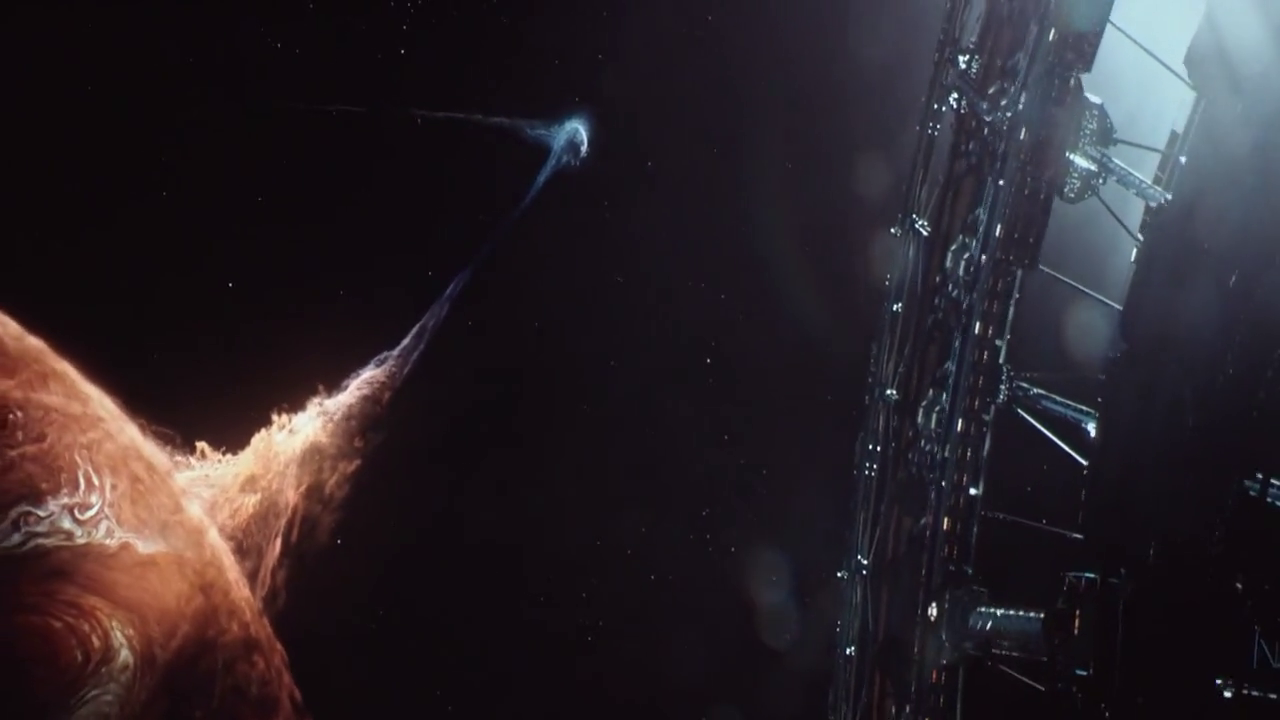
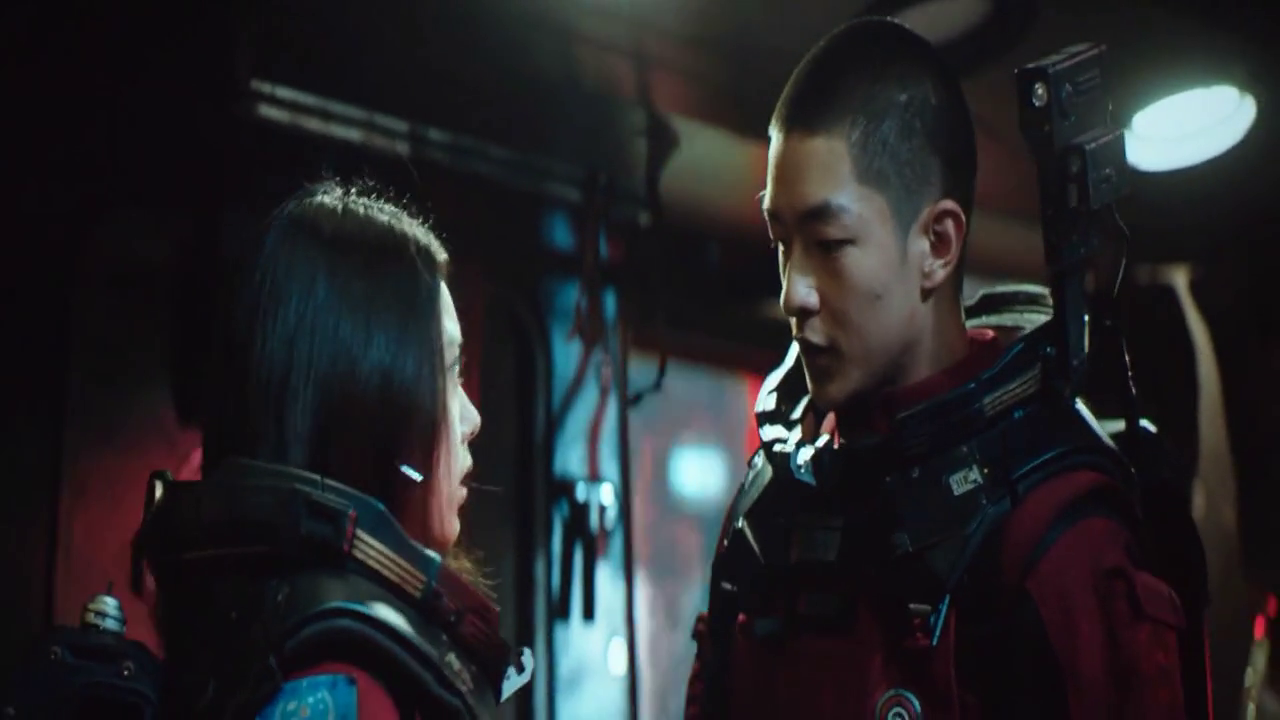
Directed by Frant Gwo, The Wandering Earth is an epic disaster film in every sense of the word, based on the novella of the same name, by award-winning author Liu Cixin, it tells the thrilling tale of mankind’s greatest achievement in the face of ultimate disaster as it tries to save itself from extinction. The basic premise to The Wandering Earth is that the sun has reached the point in its lifecycle where it is about to become a red giant, which means that sometime within the next hundred years, the Earth will become a charred cinder, so mankind must put aside their differences if the human race is going to survive. Now, that’s not even the crazy part — Danny Boyle’s science fiction film Sunshine dealt with a similar threat (with the sun dying and mankind’s last ditch effort being to jump-start the thing with some well-placed nuclear bombs), which was pretty crazy, yet maybe somewhat plausible — but with The Wandering Earth, the plan is to construct 10,000 enormous thruster engines across the planet, running on fusion power, to propel the Earth to another solar system.


The Wandering Earth is China’s first real science fiction blockbuster, one with a good deal of money spent on an array of stunning visual effects that will surely make many a viewers' jaws drop, but with all that money spent on making this the most impressive-looking science fiction action-packed disaster epic, it would have been nice if a little more time and money had been spent on the screenplay. The first few minutes of the movie throws a ton of information at the viewer — the doomed destiny of the Earth, the Sun already wreaking havoc on the global climate, the plan to build massive engines to halt the planet’s orbit and then propel it out of the solar system on its 2,500 year journey to a new home in Alpha Centauri, the massive tsunamis caused by the stopping of the Earth’s rotation, wiping out 75% of the Earth’s population, and giant underground cities constructed below each of these colossal engines to keep what's left of humanity safe — all of this is before we get to learn anything about the film’s group of protagonists.


"Just sit right back and you'll hear a tale, a tale of a fateful trip."

We are first introduced to Liu Peiqiang (Jing Wu), an astronaut who will be part of the flight crew aboard “The Navigational Platform International Space Station,” which will be guiding the Earth on its long journey to Alpha Centauri. Unfortunately, Liu’s first shift is seventeen years long, so this means abandoning his young son Liu Qi to the care of his father-in-law Han Zi'ang (Man-Tat Ng). When the film jumps ahead seventeen years later, we find his now grown son (Chuxiao Qu) has become a rebellious, resentful young man, furious with his father for not only leaving him, but also blaming him for the death of his mother — her dying of some undefined illness and thus not being eligible for the lottery that picked people to occupy the underground cities. So one day Liu Qi decides to take his adoptive sister Han Duoduo (Jin Mai Jaho) to the planet’s surface, which requires getting a black market environment suit from nefarious criminals, and it’s after getting arrested for joy-riding in his grandfather’s massive truck, that disaster strikes.


"Tonight on Ice Road Truckers."

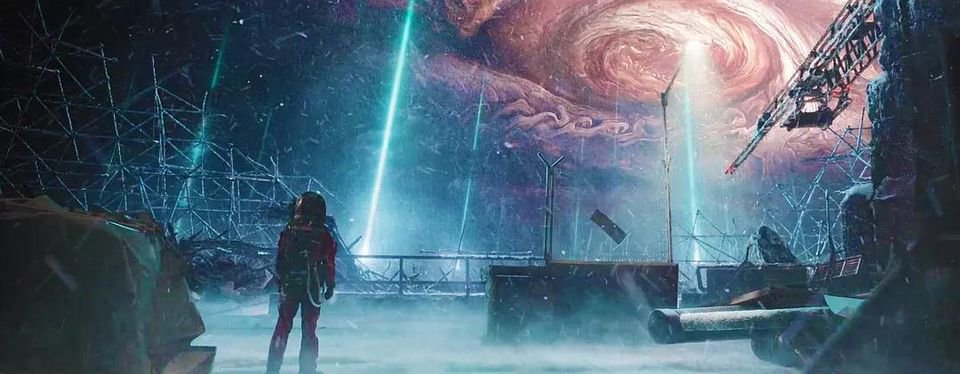
The Earth was supposed to use Jupiter’s gravity to assist her exit from our solar system, but when a gravitational spike from the gas giant causes devastating earthquakes, which disables many of the thrusters located across the globe, it starts to pull the Earth towards it. With mere hours to get those thrusters back online, or see the Earth collide with Jupiter, all truckers are recruited to transport a lighter core (an engine component to restart the nearest planetary thruster engine). Joy-riders Liu Qi and Han Duoduo are basically press-ganged into the mission — with Liu Qi being a selfish dick about it long enough for us to really come to hate him — until eventually it comes down to just this one plucky group standing between the Earth’s survival or its utter destruction.

What follows is an action-packed thrill ride that is as fun to watch as it is impossible to believe, and if the whole premise of a “Wandering Earth” seems ludicrous to you — which, to be fair, will mostly likely be everyone watching this thing — the complete lack of actual science in this science fiction movie will break you. If you start questioning things like “How does the Earth retain its gravity while traveling through space?” or “Can a frozen planet, one that is hurtling through space, retain an atmosphere?” you may find yourself being yanked out of the narrative, but director Frant Gwo does his best to keep the action flying fast and furious so as not to give the viewer too much time to think of how ridiculous it all is.


"We're in the Suck Zone!"

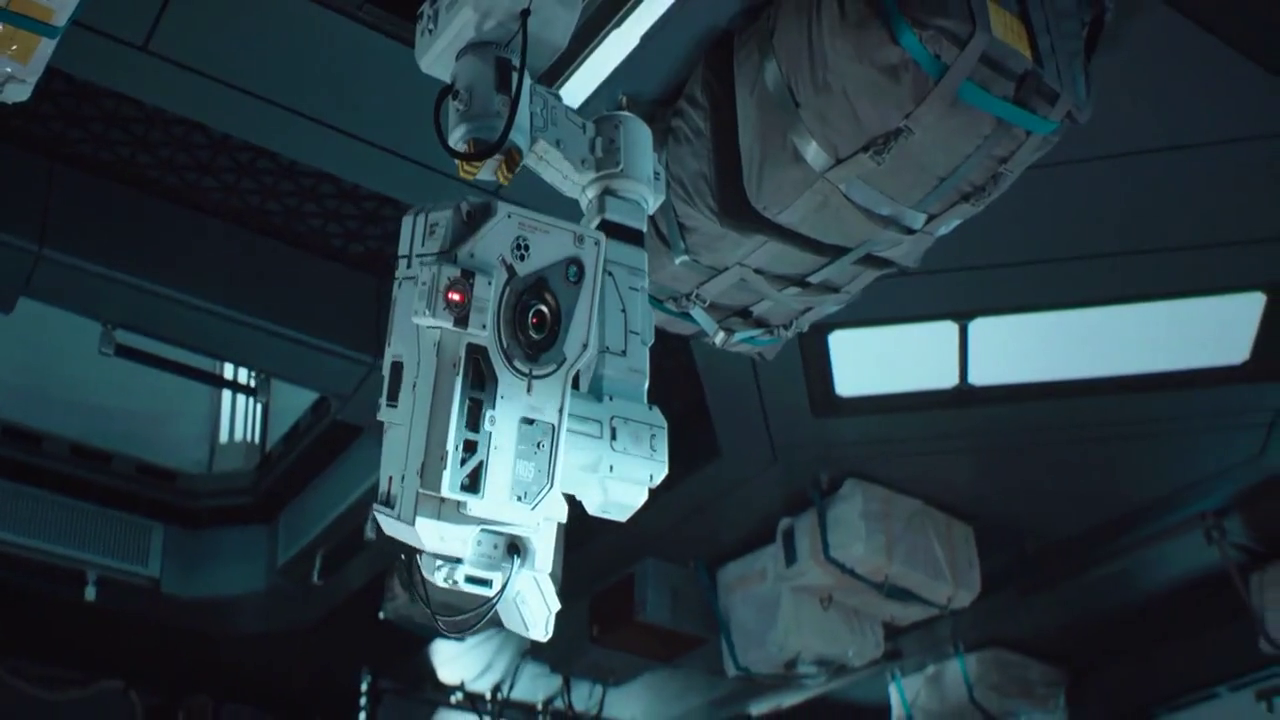
The Wandering Earth does get major points for being balls-to-the-wall crazy with its premise, which I have to admit, I find wonderfully insane, but it also owes a lot to many science fiction and disaster films that have come before it; the look of the underground cities is very reminiscent of Ridley Scott’s Blade Runner, the Sun being a threat is, as mentioned, very similar to Danny Boyles Sunshine, the team of heroes racing across a frozen and exploding landscape is  reminiscent of the comet sequence in Deep Impact, and a lot of the snowy aspects will remind one of The Day After Tomorrow and Snowpiercer. But one of the more surprising elements is the inclusion of a HAL 9000 evil robot from Stanley Kubrick’s 2001: A Space Odyssey. Now, this last point comes along while our heroes scramble across arctic landscapes, which are constantly being torn apart by quakes. Above all this, on the space station, Liu Qi’s father finds himself in a battle with a computer hell-bent on writing off the Earth so as to preserve its back-up cargo of frozen embryos, and who will kill anyone who stands between it and its objective.


"Let the Earth die, Dave."

While viewing Frant Gwo’s The Wandering Earth, you may lose track of how many times our heroes should have died — I gave up at around twelve — but strangely enough, that didn’t affect my enjoyment of this movie, and maybe that has something to do with just how crazy the central premise was, for if you have signed on to the whole “move the planet through the galaxy” premise, then every other crazy moment will just pale in comparison. This isn’t to say there weren’t genuine problems with some of the film's elements; an obnoxious Australian-Chinese comic relief, whose every moment on screen made my soul die a little more, and Liu Qi’s adoptive sister could easily have been written out as her sole character trait is "Hi, I’m female, and that’s about it," but the real killer for me was Liu Qi himself, as his change from selfish idiot to self-sacrificing hero comes with no real organic progression of character. It’s as if the writers reached a certain point in the script and realized they needed a hero, so they just flicked a switch.


"Sis, it's time for me to stop being a dick."

Simply put, The Wandering Earth is a beautiful dystopian science fiction disaster film, one that puts its visual splendor ahead of such petty concerns like having three dimensional characters — the closest we get is the moments with Liu Qi’s father aboard the space station — but I couldn’t help but put aside most of my qualms while being carried away with this particular adventure tale, which highlighted mankind’s indomitable spirit and can-do attitude. The Wandering Earth is the type of film that must be looked at as a tapestry — while not looking too closely at the individual parts — as it tackles clichés and tropes at levels never dreamed of before, making many of its Hollywood contemporaries pale in comparison. The Wandering Earth is well worth checking out, even if you are normally opposed to foreign films and reading subtitles, you won't be disappointed.


You'll be hard pressed to find a more visually stunning film out there.

Wednesday, March 27, 2019

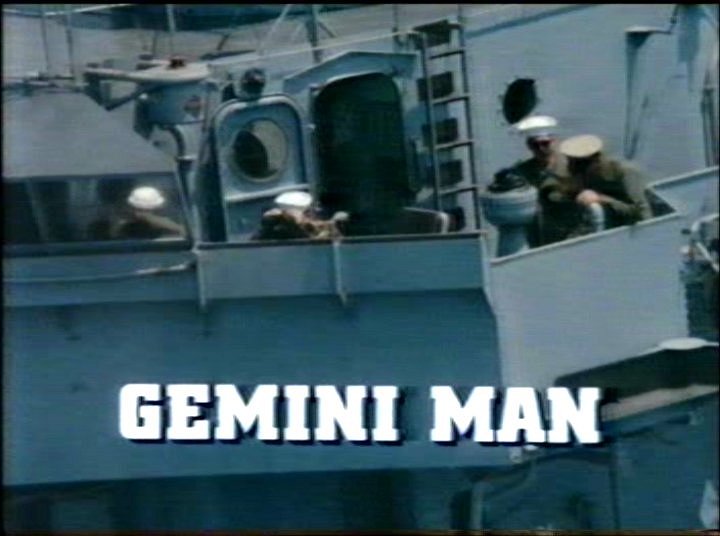
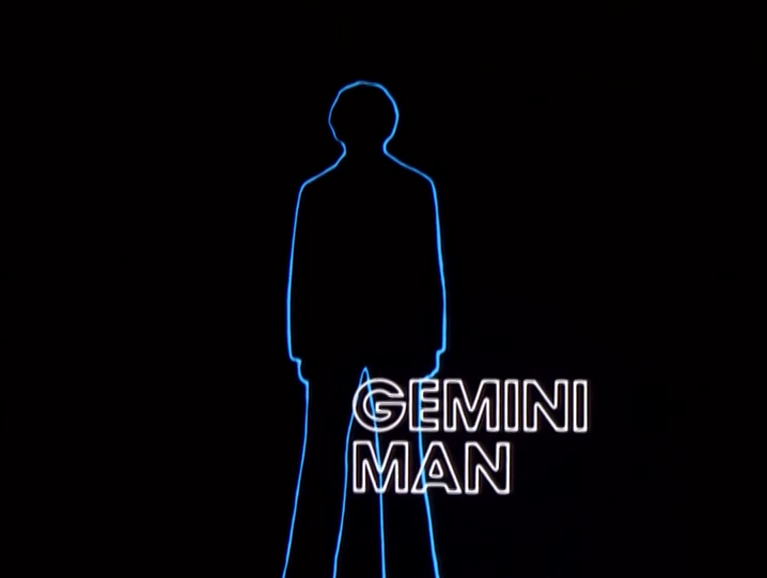
Gemini Man (1976) – Review

In 1975, NBC released an Invisible Man series created by television legends Harve Bennett and Steven Bochco. Sadly, poor ratings saw the end of that show after only one season, but apparently the network had faith that a show about an invisible agent was a viable idea, and that they just needed the right mix of action and adventure to make it work, so Bennett and Bochco were given another shot. Thus the Gemini Man was born.


A year after NBC pulled the plug on the adventures of scientist Daniel Westin in The Invisible Man, creators of that show decided to do away with that whole namby-pamby scientist hero bit — who needs a hero that uses his brains along with his invisibility to thwart various villains? — so enters Sam Casey (Ben Murphy), an ex-intelligence field agent more comfortable in his faded denim jacket and jeans than he’d ever be in a lab coat, a man of action who solves most of his problems with a roundhouse kick or a right cross. The pilot episode introduced Casey as your standard "fly-by-the-seat-of-your- pants" type hero, now working for a high-tech government think-tank called Intersect (International Security Techniques. When a salvage job to recover a downed Russian “weather” satellite leads to sabotage, Casey finds himself caught in a radioactive explosion that turns him invisible.

Note: At no point in this series is he ever called the Gemini Man, he’s not even given it as some kind of codename like Daniel Westin being called The Klae Resource in The Invisible Man, and what exactly does the zodiac symbol for twins have to do with invisibility anyway?

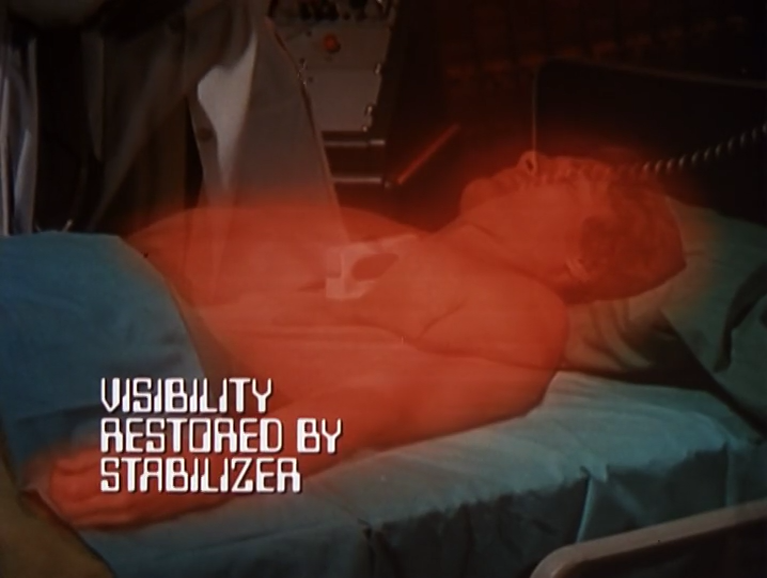
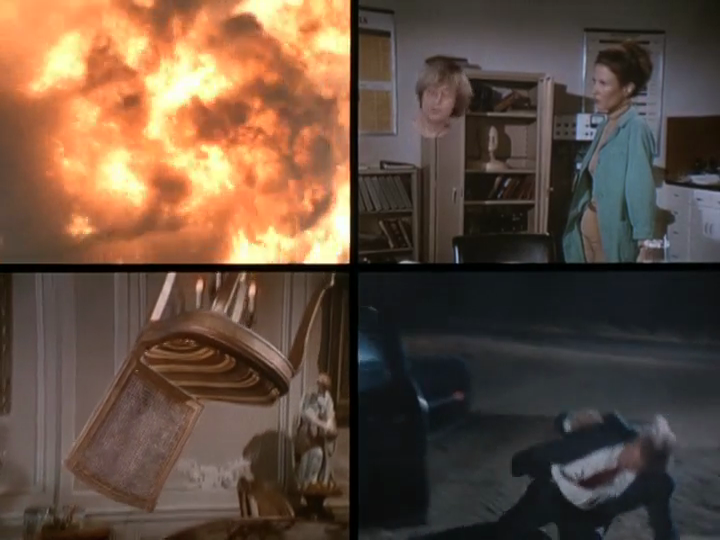
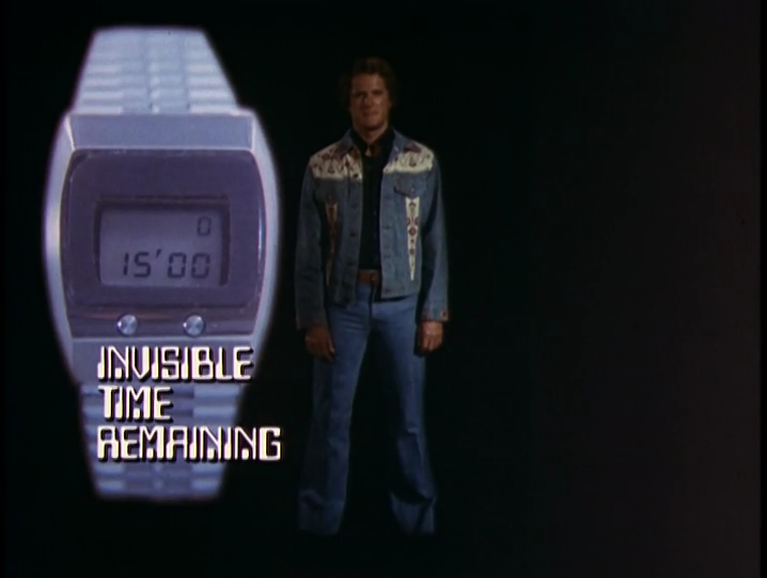
The producers of the Gemini Man were also given instructions to use a much more cost-effective form of invisibility for their protagonist; this time around, there would be no costly chroma key technique to be found here — that being the special effect technique which gave us those cool visuals of headless shirts floating around a room — because in this show, Sam Casey isn’t simply invisible, he actually generates a small field of invisibility that encompasses whatever clothes he is wearing as well. In the pilot episode, we learn from Intersect chief Leonard Driscoll (Richard Dysart), and scientist Abby Lawrence (Katherine Crawford), that the radiation distorted his molecular field structure, but with an atomic powered wristwatch — designed by Abby and which works as a molecular stabilizer — he is able to turn on and off his invisibility with the mere press of a button.

Note: Like in The Invisible Man series, the role of the heroes’ boss gets an immediate cast change; Richard Dysart only appeared as Leonard Driscoll in the pilot, the part was then taken over by veteran television actor William Sylvester for the remaining episodes.

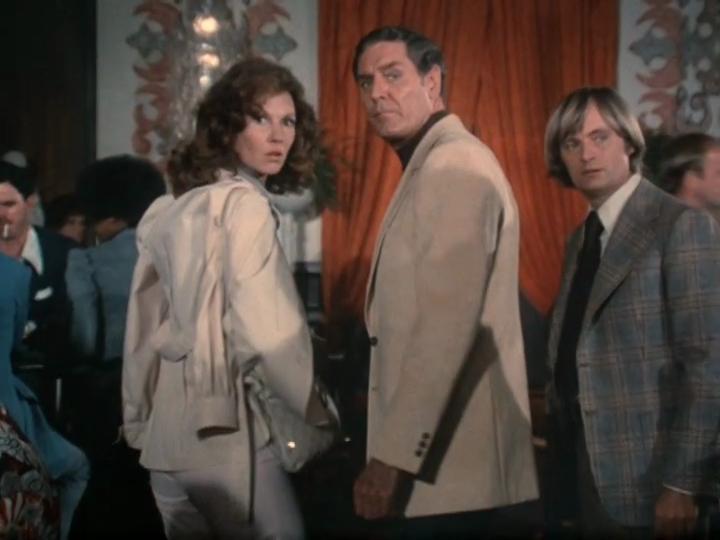
As with The Invisible Man series, the Gemini Man borrowed much of its plot structure from The Six Million Dollar Man, with Leonard Driscoll (William Sylvester) giving Sam Casey whatever super-secret mission he must undertake in that week’s particular episode. But where The Invisible Man utilized the husband and wife dynamic, in a very Nick and Nora Charles way, Gemini Man mostly had Casey working alone in the field, with Abby and Driscoll giving him technical support from the bowels of Intersect.

The show threw in a bit of extra tension by adding an interesting wrinkle to Sam Casey’s invisibility, that he could only be invisible for fifteen minutes per day, and if he remained invisible beyond that allotted time, he would die, as Abby explained to him, “You pass out, you fade away, and you never come back.” He can remain invisible five seconds, a minute, ten minutes, as long as it adds up to no more than fifteen per day.

Note: The show never explains when this magical reset of the day occurs; does his fifteen minute limit reset at midnight, when the sun goes down, or maybe after he has dinner?

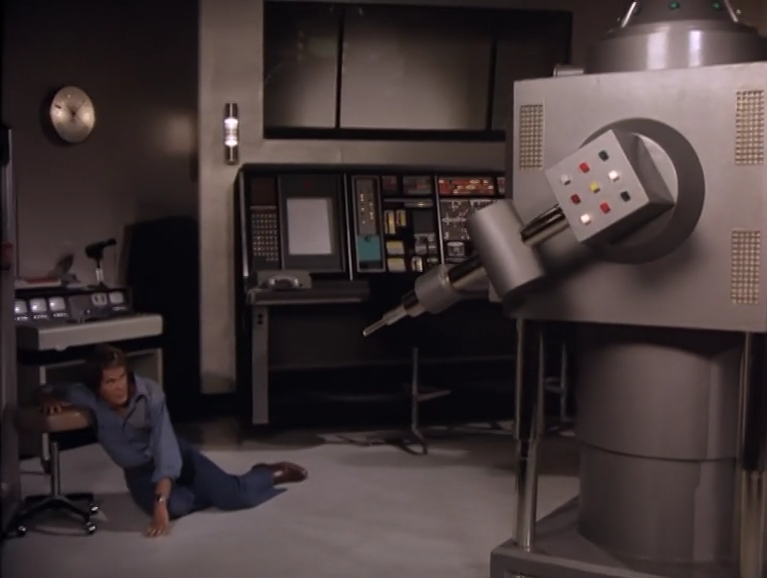
Gemini Man only lasted eleven episodes, plus the pilot, with only five of those episodes even airing in the United States, which is a shame as the show was a lot of fun to watch. We got to see Sam Casey pitted against a variety of dastardly villains; a corrupt scientist (Alan Oppenheimer) conning Intersect with his supposed miracle fuel — 70s' television shows always had a few episodes dealing with the energy crisis — Casey had to do battle with a look-a-like who had infiltrated Intersect to steal vital information, he worked undercover as a rookie to learn what a certain police officer (Richard Jaeckel ) had to do with a planned political assassination, and poor Sam even had to go on the run from his friends after being framed for killing a fellow Intersect agent. Best of all, however, was when he went up against a disgruntled mad scientist (Ross Martin ), who had built a robot with the power to level a skyscraper.


You weren't a true 70s action hero if you didn’t fight a robot.

The charismatically engaging performance by Ben Murphy was easily the best part of the show, death-dealing robots aside, as Murphy gave the character of Sam Casey a nice surfer guy charm, mixed with just a dash of chauvinism, which somehow worked for this particular secret agent. This invisible man series was supposed to be more action centric than the previous incarnation, and Sam Casey does kick a lot of butt while visible and invisible, but the key factor of its low budget roots tended to rear its ugly head from time to time. This lack of funds led to such moments as Casey, having been tasked to put an African dictator back into power, wandering around an Africa that looked a lot like Bronson Canyon, and the tendency to recycle plots from The Invisible Man, which if you remember, had only aired a year earlier.

• In The Invisible Man episode “The Klae Resource” Daniel Westin had to uncover a plot that dealt with villains impersonating an oil tycoon, while the real man was kept locked away in his own hotel, so that they could sell his new efficiency fuel process to Middle Eastern concerns.
• In the Gemini Man episode “Escape Hatch,” a shipping tycoon is held hostage aboard her own ocean liner, while the villains have an impersonator offering to sell her fleet of super oil tankers to hostile foreign parties.
• In The Invisible Man episode “Barnard Wants Out,” Daniel Westin had to help a man re-defect back to West, but things were complicated by the fact that the man’s daughter had fallen in love with a villainous Russian officer.
• In the Gemini Man episode “Targets,” Sam Casey must help a woman re-defect to the West, but things are complicated by the fact that her daughter has a crush on her archery coach, who just so happens to be the head of the Secret Police.

That is pretty damn lazy, and from the likes of Harve Bennett and Steven Bochco, it’s even more surprising, but I guess back in the 70s they weren’t too worried about viewers remembering what they saw on television a whole year ago. Aside from dodgy writing, and a budget that seriously limited what action they could depict, the show was pretty darn solid, and it handled the concept of the “invisible agent” a little better than its predecessor, with Sam Casey more than willing to use his invisibility to kick some serious butt. Fans of the genre will find Gemini Man to be a harder show to track down, never having gotten a North American DVD release, but if you do manage to stumble across this particular sci-fi adventure show, it’s well worth the watch.

Note: Both Gemini Man and The Invisible Man credit their show as being “Based on a Novel by H.G. Wells” while almost nothing in these shows, aside from the obvious invisibility aspect, had anything to do with the plot or characters from H.G. Wells’ book.

Sunday, March 24, 2019

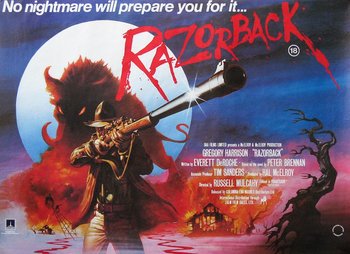
Razorback (1984) – Review

When Spielberg’s monster hit Jaws arrived in theaters the summer of ’75, the onslaught of rip-offs to follow was staggering, with such notable entries as 1977's Orca,1978's Piranha, and 1984's The Last Shark , but such rip-offs were not relegated to creatures of the sea, and thus we got such “classics” as 1976's Grizzly and the film we are looking at today, Razorback.


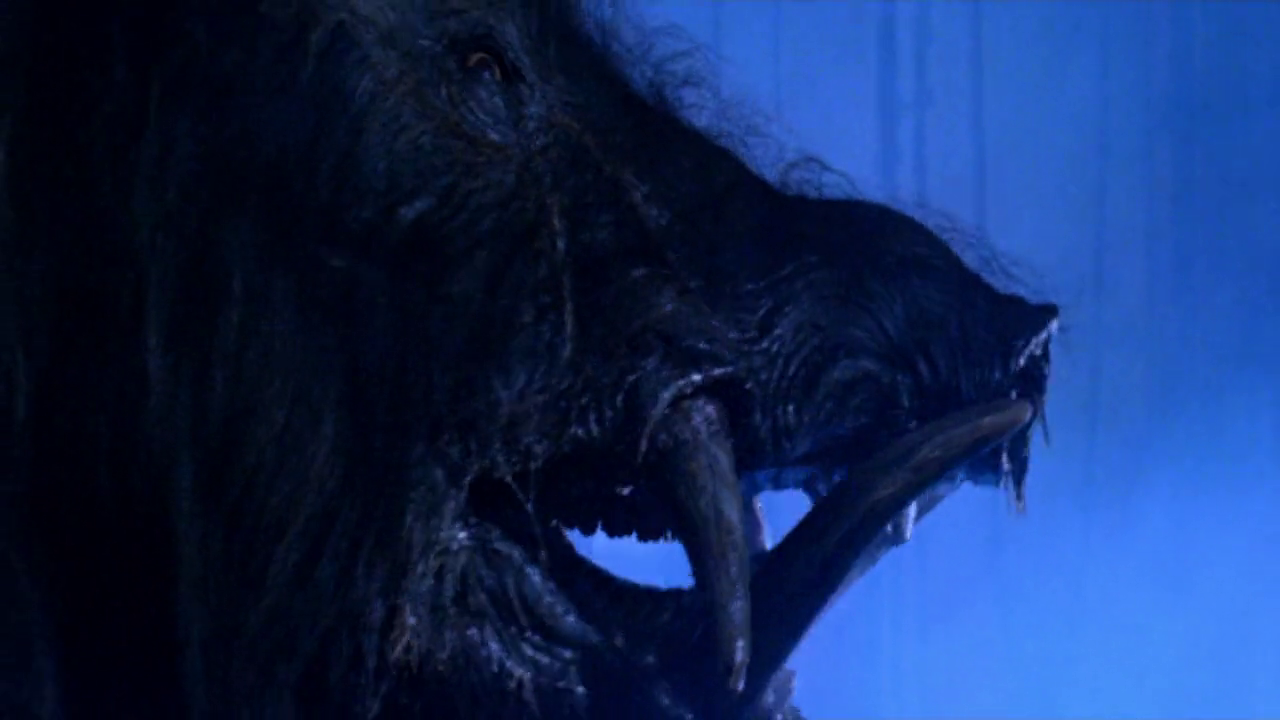
“There's something about blasting the shit out of a razorback that brightens up my whole day,” and it’s these immortal words, spoken by a man Hell-bent on vengeance against the wild boars of Australia, that really sets the tone of the film Razorback, and this statement is provided by Jake Cullen (Bill Kerr), who in the film’s opening minutes has his life destroyed when a giant razorback boar attacks him in his home, making off with his little grandson — who he'd been babysitting — to devour the poor tyke alive. That is certainly a dark opening, but it's only the beginning of director Russell Mulcahy's descent into the abyss of despair, blood and pain.


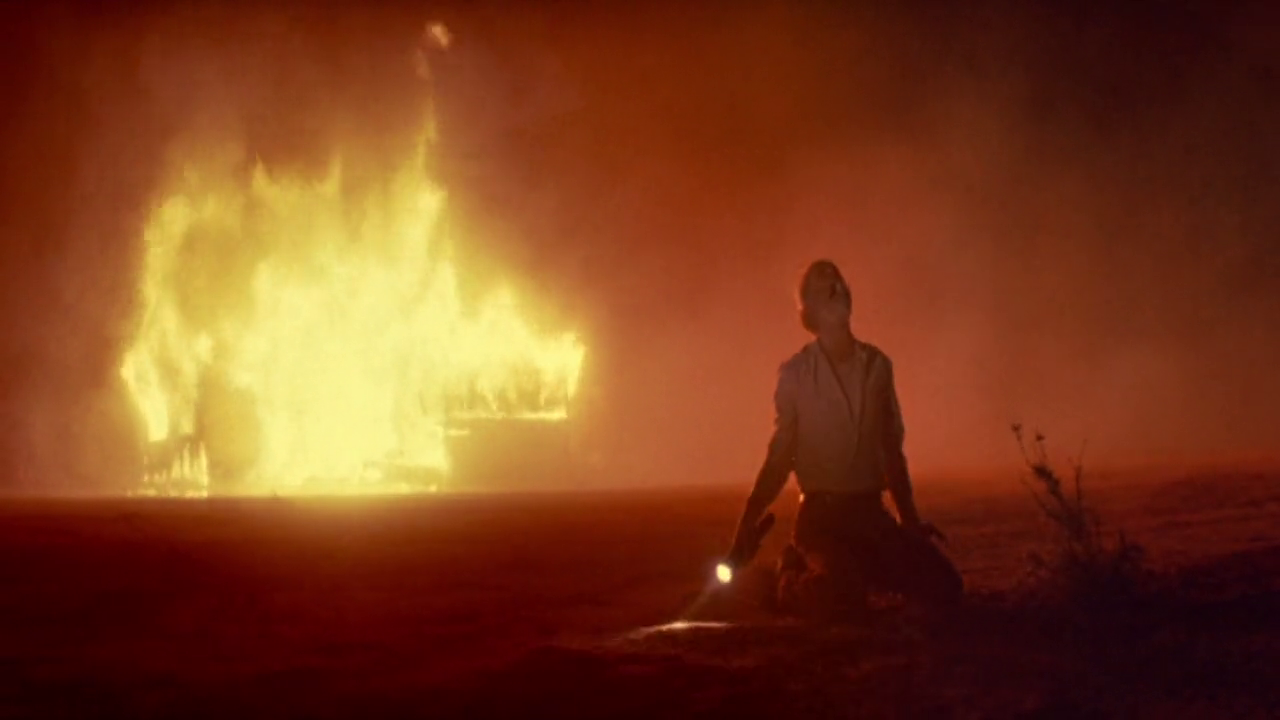
Not only did it run off with a little kid, it also burned his bloody house down.

You’d think having your grandson carried off into the night by a murderous beast would be pretty terrible, and as traumatic experiences go, that would be a hard one to top, but things go from bad to worse for poor Jake as he is then accused of murdering the child. He is put on trial, with a lawyer doing his best to float the idea of this particular razorback being a hybrid species — “a freak, an aberration” — and though most of the locals take his account of the events with a considerable amount of skepticism (I mean, who wouldn't doubt such a story?), he is acquitted due to insufficient evidence to support the charge. It's with this moment that we have our “Quint Analogue,” the one who will provide grizzled assistance to the hero before meeting an untimely death during the film’s third act.


“From Hell’s heart I stab at thee!”

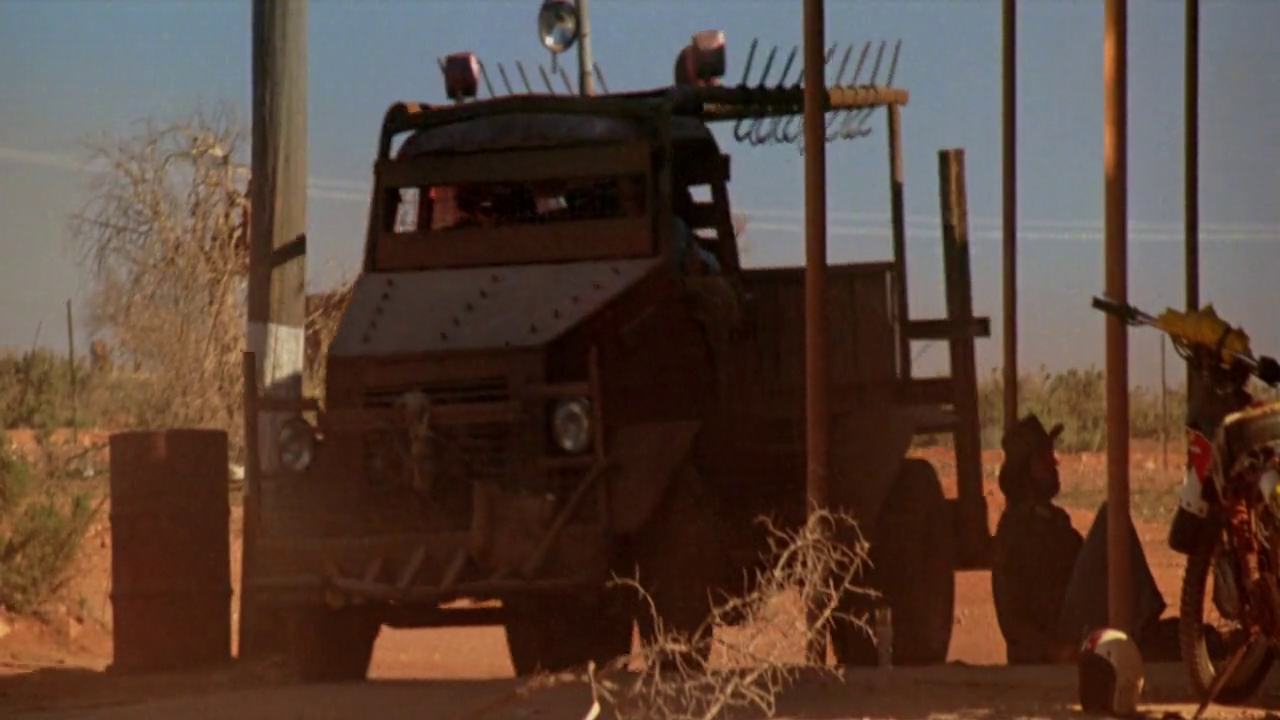
The movie jumps ahead two years and introduces us to American wildlife reporter Beth Winters (Judy Morris), who exposes industries that abuse and kill animals, and her latest assignment takes her to a small outpost in the Australian outback, where a particularly nasty company is guilty of slaughtering kangaroos to make dog food. To say that she isn’t too popular with the locals would be a massive understatement, but things get downright ugly when she runs across Benny Baker (Chris Haywood) and his brother Dicko (David Argue), a couple of psychos who are the Australian equivalent of the rednecks from Deliverance, and whose dog food factory looks to have been designed by the family from The Texas Chainsaw Massacre.


They also drive a castoff truck from The Road Warrior.

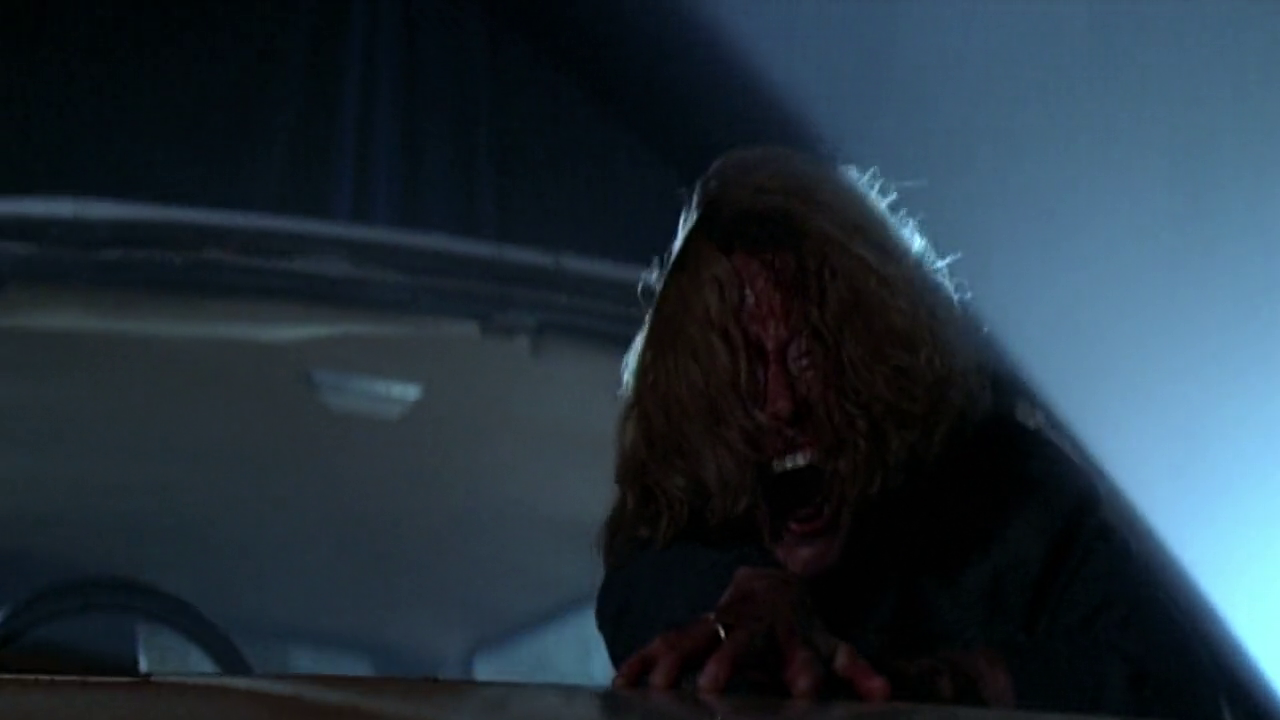
How about some attempted rape to spice things up? The Baker brothers use their four-wheel death machine to run Beth off the road so that they can have a go with a little “ultra-violence” as Benny attempts to rape the poor woman, and it was at this point that I was sure that either Jake or the giant razorback was going to show up in the nick of time to spare Beth from this particular indignity, but I was only half right. The rampaging giant hog does show up, sending the Baker brothers running for the hills, but this was no rescue from a fate worse than death, unless you consider being eaten by a giant razorback some kind of rescue.


Animal rights activist killed by irony.

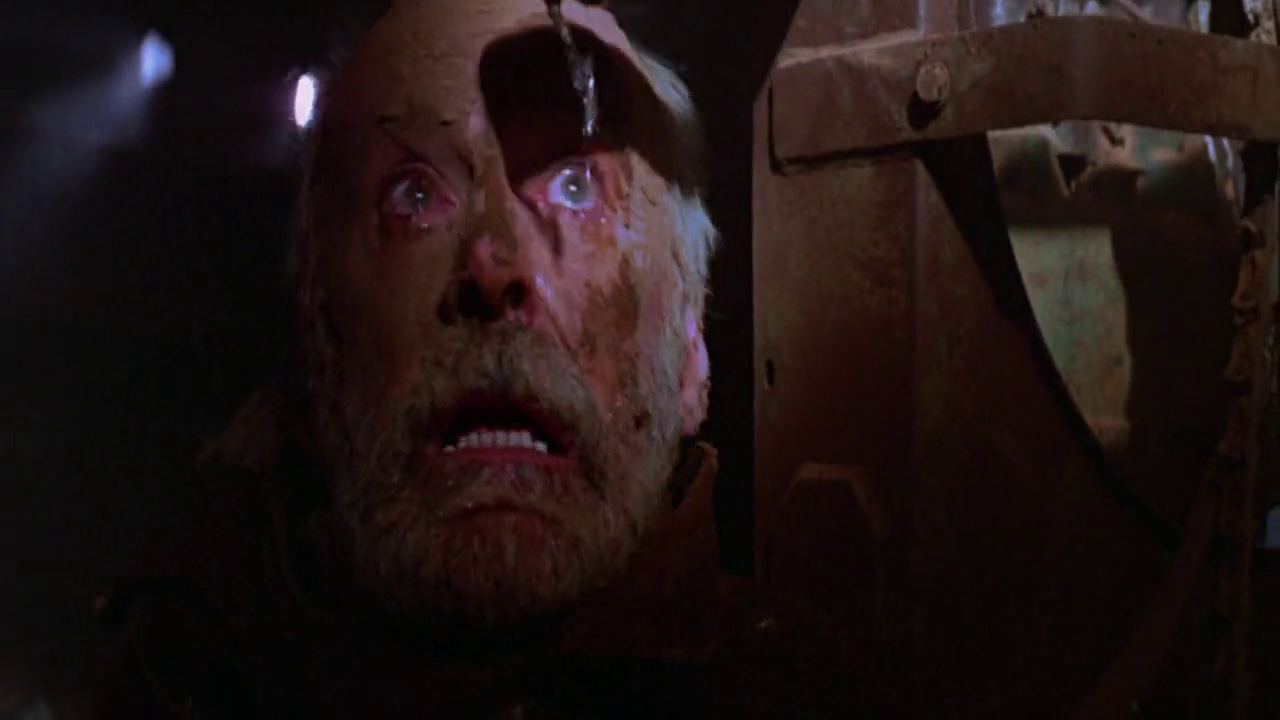
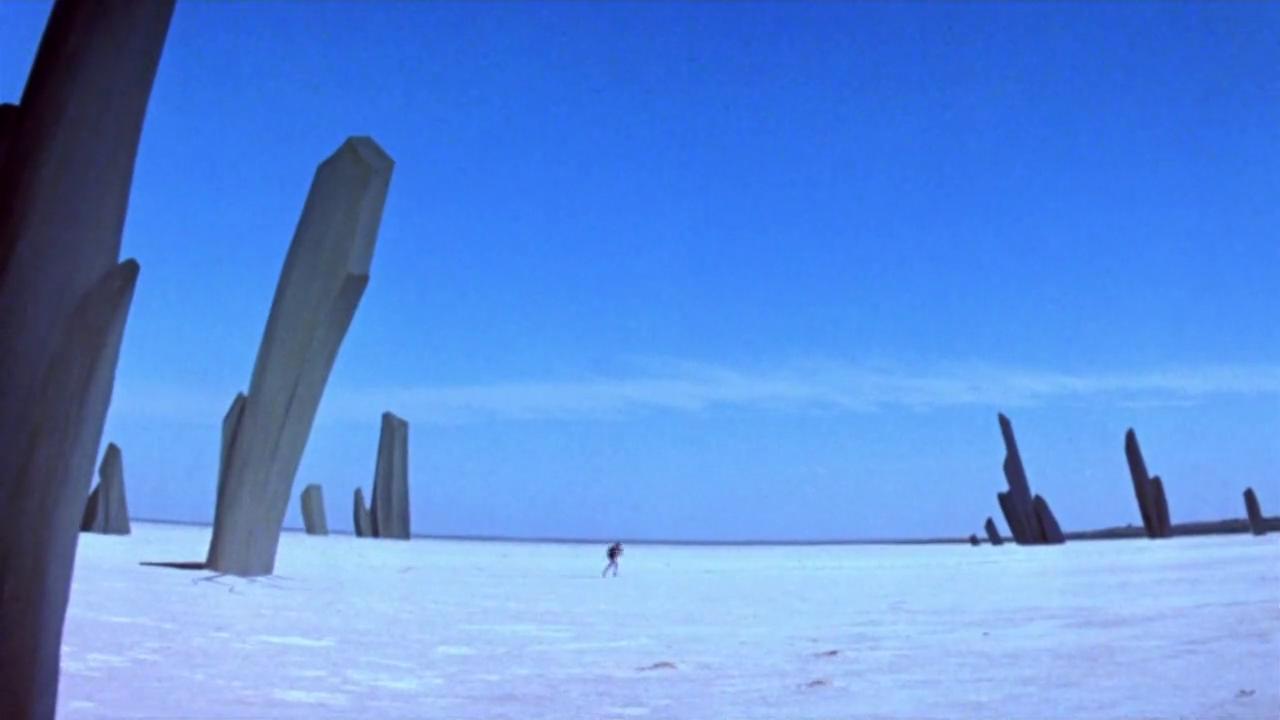
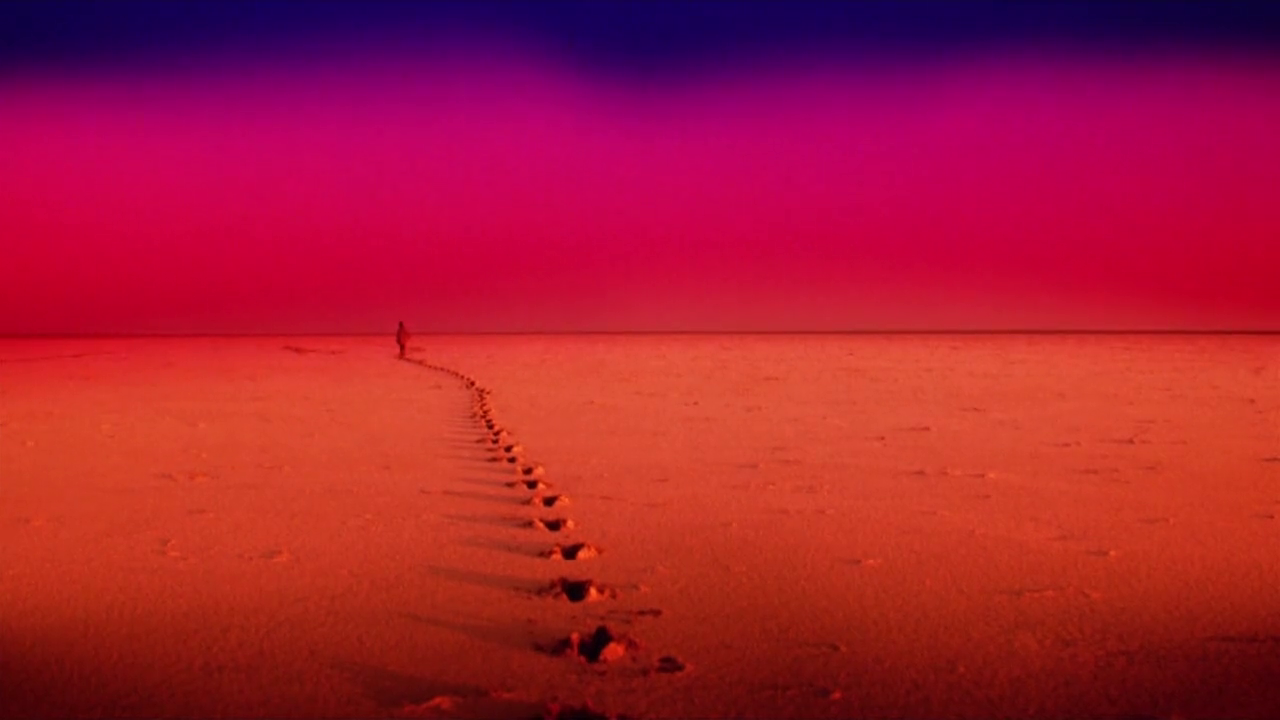
Beth is declared missing, assumed to have fallen down an abandoned mine shaft, which means that the Australian authorities somehow failed to notice the blood all over her car during her struggle with the boar — I guess they don’t have a CSI: Outback edition down under — and so the missing American is pretty much forgotten. Enter Beth’s husband Carl (Gregory Harrison), who travels to Australia to find out the truth behind what happened to his wife, and for some reason this involves him going undercover as a Canadian tourist, which then leads to him convincing the Baker brothers to take him along on their next kangaroo hunt. Needless to say things don’t go well for good ole Carl, for his inability to keep his stomach contents down during the slaughtering of kangaroo results in him being abandoned in the middle of nowhere, and the hits keep on coming as Carl is then attacked by a herd of wild pigs, spurred on by the giant boar, which then chases him through the night and forces him to take shelter atop a windmill. It’s at this point that the movie takes a hard right turn into surrealism, as Carl’s trek across the Australian outback causes him to suffer from dehydration-induced hallucinations.


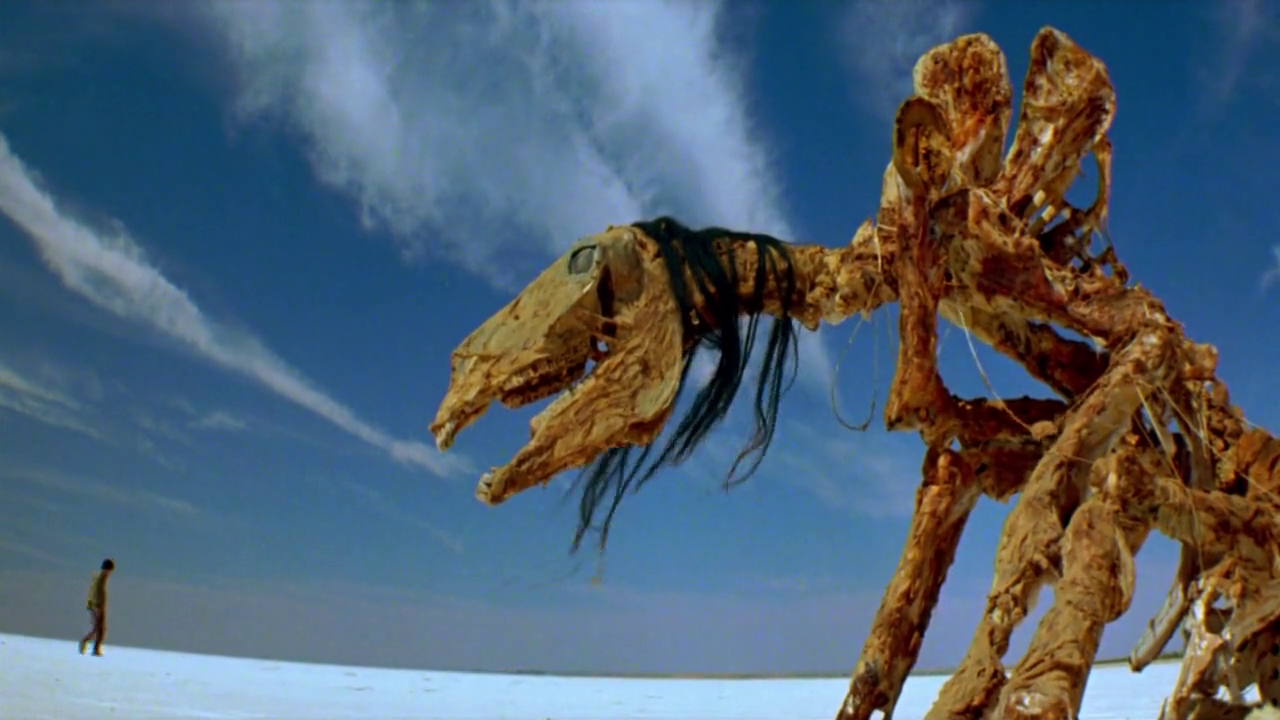
From alien landscapes to bizarre manifestations these are some seriously trippy moments, and we owe much of this to cinematographer Dean Semler who was hired on the strength of his work on Mad Max 2: The Road Warrior, and it is some of the most breathtakingly haunting imagery you'll ever see. It’s touches like these, provided by Mulcahy and Semler, that makes Razorback stand apart from the countless other Jaws rip-offs. Sadly, the brilliance of Carl’s delusional journey is never repeated, and once Carl staggers into the homestead of Sarah Cameron (Arkie Whiteley), a young woman studying the wild boars as part of some government grant, the film dovetails into the standard “hero must avenge his woman” trope … well not too standard, as there is still a giant razorback boar to contend with.


“Squeal like a pig!”

Stray Observations:

• Jake had managed to tag the razorback with a tracking dart, which leads to all the locals whooping and hollering as they scramble into their vehicles to hunt down the killer boar, a scene that clearly mirrors the fishing armada sequence from Jaws.
• Jake finds Beth’s wedding ring in a pile of boar feces. Yikes.
• Carl doesn’t have the stomach to actually kill either Benny or Dicko, though they still both die horribly, but that Carl isn’t able to “properly” avenge his wife is a nice character moment.
• A romance between Carl and Beth seems to be in the offing, which is weird considering he just lost his wife, a pregnant wife, I must add.
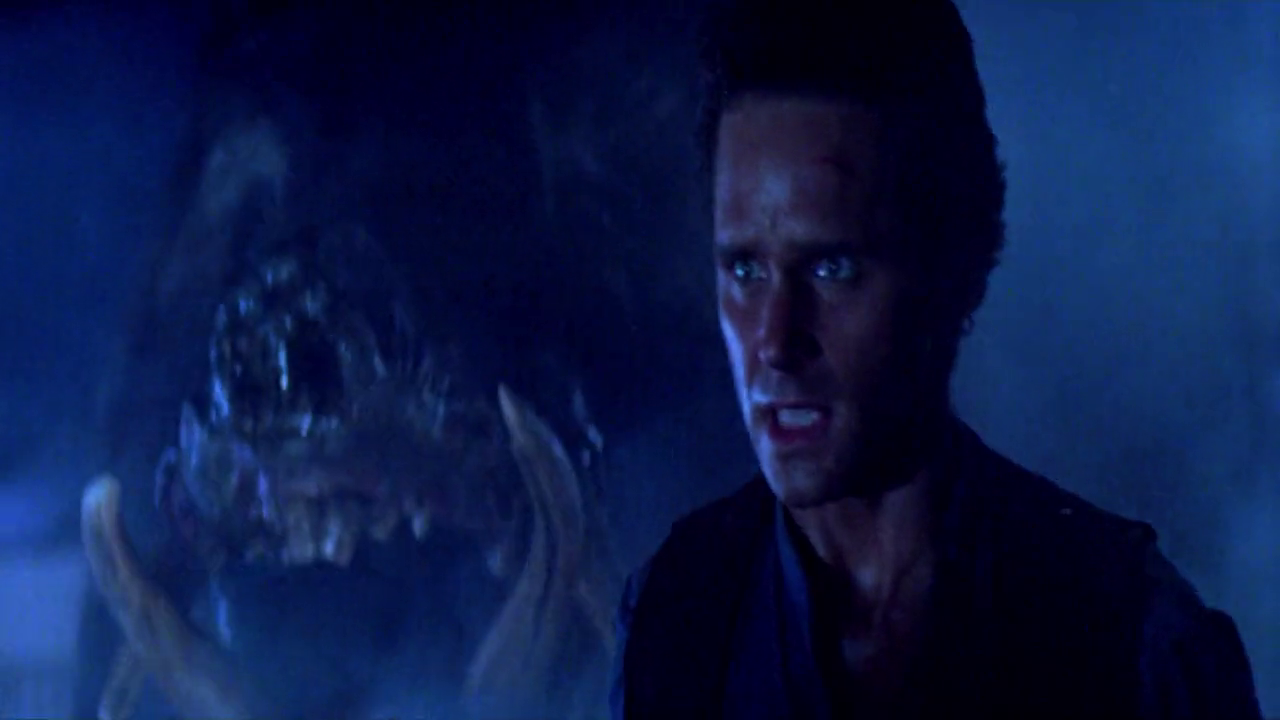
• The razorback is hardly visible in this film, we only get quick glimpses of it during the attacks, much in the way that Spielberg did with his unworkable mechanical shark.
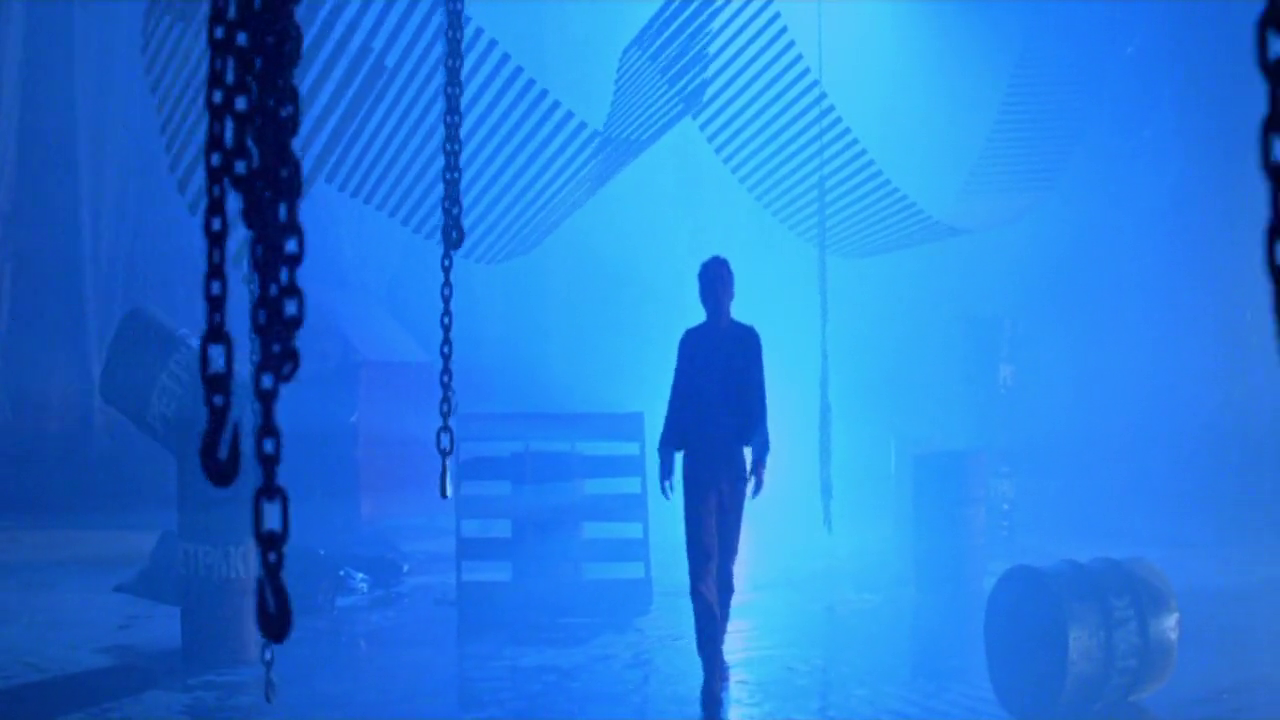
• The final showdown takes place in the dark confines of the dog food factory, with smoke and mood lighting that wouldn’t be out of place in a Dario Argento film.


All this film needed was a Goblin soundtrack.

Russell Mulcahy is mostly known for directing The Highlander, a film that has achieved some serious cult status, but his film Razorback is easily one of the more interesting entries in “Nature Attacks” and is quite superior to most of the Jaws rip-offs. If one had to point out a failing in this film, it would be that not all the actors bring their best to the roles — especially the two American actors — and some of the Australian dialogue and slang could leave some viewers in the dust, but overall this is a horror film that I highly recommend simply for how beautifully the thing was shot.


This is one pig you need to hunt down.

Tuesday, March 19, 2019

The Invisible Man (1975) – Review

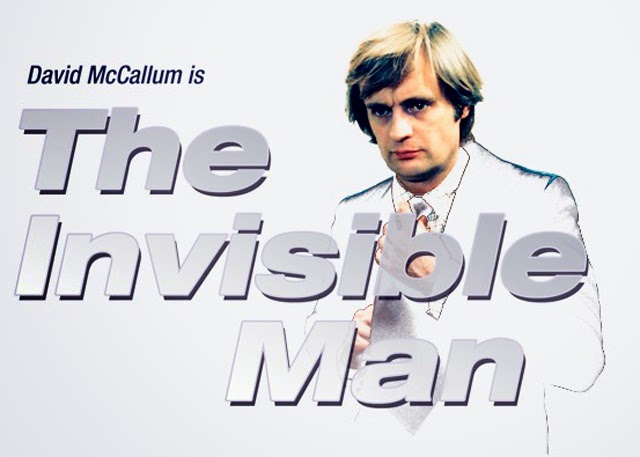
The idea of an invisible secret agent is certainly an enticing one — what could be better than a spy that no one can see — and it's such an obvious premise that it had already been explored during the Universal Pictures run of Invisible Man movies, where in the 1946 movie Invisible Agent, the grandson of the original Invisible Man, was utilized by the American government to track down Nazi and Japanese spies during WWII. Then, later on in a 1958, there was a British television series where a scientist developed the invisibility formula and was then quickly recruited by the British Intelligence Service. Today we will look at the second attempt at bringing the H.G. Wells inspired story to the small screen,  this one starring Man from U.N.C.L.E.'s David McCallum as the titular Invisible Man.


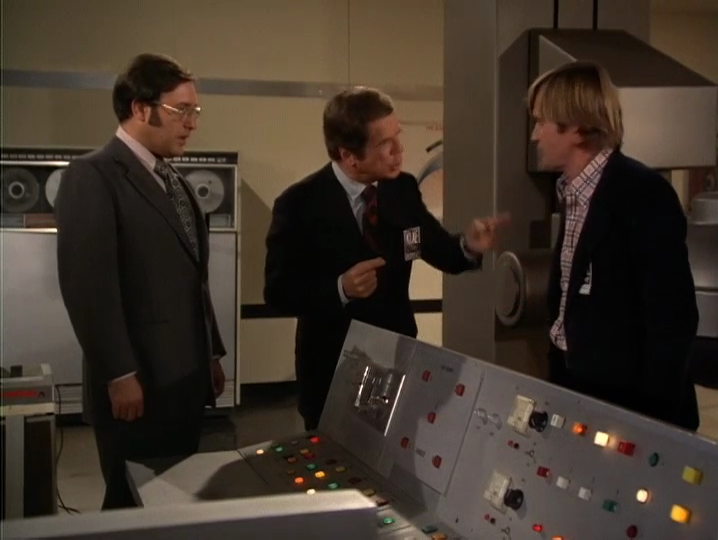
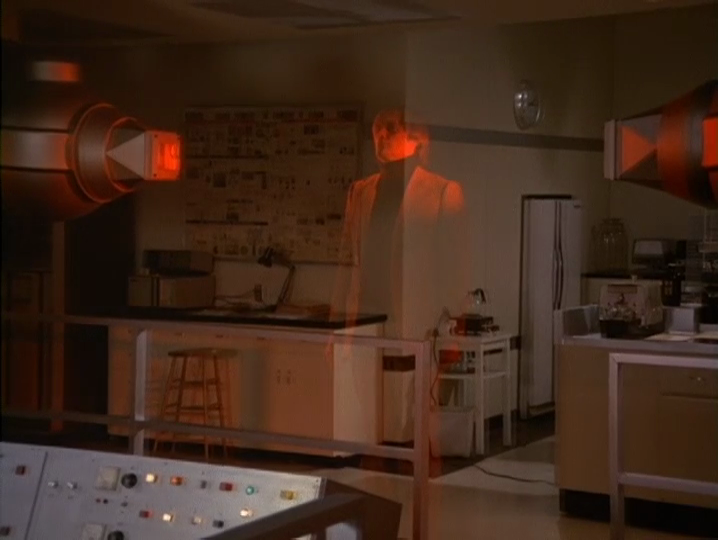
Created by Harve Bennett and Steven Bochco, this series dealt with brilliant physicist Daniel Westin (David McCallum), who had been trying to develop a teleportation system for a company called the Klae Corporation, and though aided by his equally brilliant wife Dr. Kate Westin (Melinda O. Fee), they hadn't quite managed to crack the secret of matter transportation via demolecularization, but one of the side effects of their experimentations was the discovery of an invisibility process. This is probably one of my favourite aspects of the show, because we know for a fact that some of the greatest scientific discoveries have happened by accident, and so having our hero discover the secret of invisibility while working on something completely different, is all quite believable. Also quite believable is the reaction of their boss Walter Carlson (Jackie Cooper), who immediately sees the military aspect of such a discovery, and the money from Pentagon contracts that it would inevitably bring in.

Note: The character of Walter Carlson is only played by Jackie Cooper in the pilot episode, a much more avuncular and friendly Walter, played by Craig Stevens, joins our heroes for the rest of the season.

Of course, Daniel has no desire to see his work being used as a weapon, informing his boss, “You gave me your guarantee, I came here because you said I wouldn’t have to work on weapon systems anymore, I want to use invisibility in positive ways,” and after a bit of shouting, Carlson eventually concedes to Daniel, allowing him to proceed in whatever manner he sees fit. Because our hero is of the naïve, altruistic sort, he actually believes his boss, thus he is blindsided by a meeting with Pentagon Brass a few days later. Realizing that destroying his invention is the only way to prevent it from being used for military purposes, Daniel sneaks into his lab late one night, turns himself invisible, triggers an overload of the system, and destroys all of the apparatus in the process. With him being invisible, escaping Walter and his security goons was no problem, but plans have a way of not always working out as well as one would hope.

Science Note: An invisible person would be completely blind as light would pass right through the retina without resistance, so unless your invisibility was based on a magic ring like in the Hobbit, don't count on being able to see.

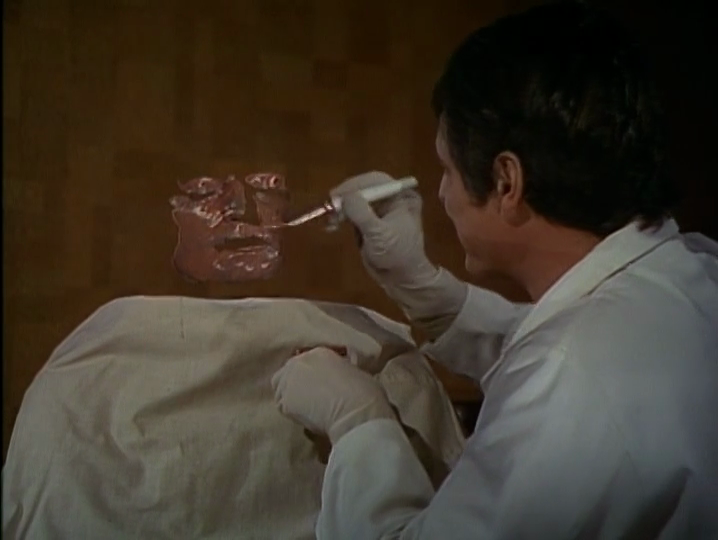
Now earlier, we learned that the invisibility process was only temporary — test rabbits would revert to being visible after a few hours — and Daniel had even developed a serum that could reverse the invisibility instantly, and because Daniel is your typical science fiction doctor, he of course tries the invisibility process on himself, much to the chagrin of his wife. His reversal serum seemed to work fine at first, yet on the night of his industrial sabotage, the serum worked, but only briefly, and soon Daniel found himself once again to be an invisible man. The process turns out to be unstable, and the serum pretty much ineffective, so he tracks down the plastic surgeon Nick Maggio (Henry Darrow), who had developed special material called Dermaplex, which has the same properties as skin and can be used to make a mask for Daniel to wear.

Note: Nick also provides special contact lenses and dental caps, so that Daniel will have visible eyes and teeth, but in later episodes we see that the mask actually incorporates eyes and teeth, which makes no functional sense.

Daniel returns to the Klae Corporation to inform Walter that he is willing to bend on his principles, but only if he can rebuild his lab — apparently being permanently invisible can soften ones moral center — and Walter agrees, after warning Daniel that what he has discovered has most likely already leaked, and that many interested parties will be looking for him, stating that, “Everybody wants you now, and if they can’t have you alive, they will settle for you dead.” Walter is immediately proven right when Klae executive Rick Steiner (Alex Henteloff), who Daniel had considered to be a friend, shows up with some goons to kidnap Daniel and Kate. Things don’t go well for the traitorous friend and his pals — they die in an inferno when Daniel causes their van to crash — and when the dust is settled, Daniel declares his independence by punching Walter in the jaw and going home with his wife. As they walk off together, Kate remarks, “I’ve never spent the night with an invisible man before,” to which Daniel responds, “With the lights out you will never know the difference.”

Note: The pilot episode is much darker in tone than the rest of the season, with Daniel’s invisibility treated more as a curse than an awesome super power, while the following episodes take on more of the aspect of a comedy/adventure show.

That last bit of dialogue exchange marked this shift in tone, and as for the rest of the season, Daniel and Kate become sort of a “Nick and Nora” type couple from The Thin Man movie series, with their flirty banter being the highlight of the show, giving us a married couple who are clearly madly and deeply in love with each other. They now eagerly work alongside Walter Carlson (Craig Stevens), who inexplicably no longer has designs on making money through military applications. We get a quick hand wave to explain Daniel and Kate’s return to the Klae Corporation, that they will work as “secret agents” when not trying to cure Daniel’s invisibility, but in the following eleven episodes, we barely see them in the lab as the happy couple seem quite content to jet around the world solving a variety of problems.

A show's new opening would explain the show’s basic premise, with narration explaining, “Machine Malfunction…Westin Permanently Invisible…Klae Corporation Will Finance Recovery Effort...Westin Will Render Aid as a Secret Agent. His Codename: The Klae Resource.”

The series takes on many of the aspects of one of its chief contemporaries, The Six Million Dollar Man, with Walter becoming this show’s version of Oscar Goldman and Daniel's invisibility subbing in for bionic powers. Daniel would become something called “The Klae Resource,” which governments could call on for aid in sticky situations, but only Daniel, Kate and Walter would know that this mysterious resource was just Daniel running around invisible.

Note: Some religious groups protested the series, claiming it was obscene because it featured a "naked" man.

Our heroes would frequently deal with “international threats” of which we often saw Steve Austin encounter as an agent of the OSI — sadly Daniel and Kate never meet a robot bigfoot — and thus, during this single season, before being cancelled due to poor ratings, they’d come across a variety of foes; a nefarious art thief (Ross Martin), a fake spiritualist (John Vernon), a corrupt prison warden (Pat Harrington Jr.), a crooked small town judge (Roger C. Carmel), and an escaped mental patient (Monte Markham) who would demand the secret of The Klae Resource. This last example was easily the shows best entry, as the self-proclaimed psychopath wanted to use Daniel’s invisibility to take over the world — Markham’s performance in this episode was masterfully chilling, you actually felt our heroes were in danger — and this was the only time the show veered close to the source material of H.G. Wells's book, with a madman trying to use invisibility for nefarious purposes.


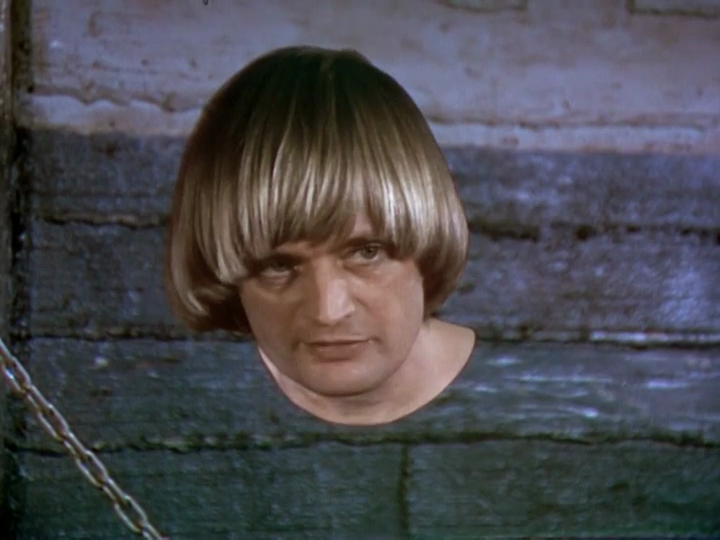
The show utilized the same chroma key technique that weather forecasters of the time used when standing in front of a blue screened weather map, and this at times resulted in some less than convincing invisibility moments, but most often the show relied on point-of-view shots of Daniel wandering around while invisible, with the occasional wire used to hold up telephone receivers or bolt cutters. As a whole, the show was certainly not breaking ground in the area of visual effects, and these less than effective techniques may have attributed somewhat to the show’s drop in ratings, but star David McCallum has since stated that the majority of the episodes were too tongue in cheek, in his opinion, and lacked the tension of the pilot episode, which he believed to be the real downfall of the show.

This 1975 version of The Invisible Man may have only lasted one season, where its visual effects could at best be described as adequate, but overall, it was a vastly entertaining outing, mostly due to the charismatic chemistry between the two leads, and it makes this adventure/comedy something worth seeking out.