Hammer’s The Brides of Dracula is a curious beast. It’s a direct sequel to 1958’s Dracula, yet it lacks the very thing the title promises: Dracula himself. What it does have is Peter Cushing returning as Van Helsing, and that alone keeps the film afloat, even as Hammer serves us a Dracula substitute with a suspiciously youthful glow.

The movie opens with French schoolteacher Marianne Danielle (Yvonne Monlaur) setting out for a new job in Transylvania—always a promising career move—but promptly gets ditched by her coach driver at a creepy inn. Enter the regal but shifty Baroness Meinster (Martita Hunt), who offers Marianne a bed at her castle. The catch? The Baroness keeps her son, Baron Meinster (David Peel), locked up like the family embarrassment. Naturally, Marianne can’t resist sneaking in, only to find a handsome young man chained to the wall. He pleads for help, claiming his mother has stolen his lands, and Marianne obliges by swiping the key and freeing him.

Mistake number one.
Baron Meinster wastes no time showing his gratitude by killing his mother and drinking her blood—because nothing says “thanks, Mom” like matricide with fangs. Marianne bolts in terror, while Greta (Freda Jackson), the world’s most unhinged servant, blames the Baroness for letting her boy fall in with Dracula in the first place. Loyal to a fault, Greta clings to her murderous master like a deranged nanny, cheering him on as he starts thinning out the local talent pool of village girls, turning this corner of Transylvania into one very messy family soap opera.

Dysfunction doesn’t get more gothic than this.
After fleeing the castle, Marianne stumbled across Doctor Van Helsing (Peter Cushing), who politely escorted her to her teaching post. Van Helsing, however, is here on business, namely, the dead villagers popping up with suspicious neck wounds. Partnering with Father Stepnik (Fred Johnson), he tries to stop the spread of vampirism, but soon learns Meinster has set his sights on Marianne and turned her jealous roommate, Gina (Andrée Melly), into one of his undead brides.

School life just got complicated.
Things come to a head at an abandoned mill, where Meinster and his growing harem are hiding out. Van Helsing fights off the brides, loses his cross to Greta (who then meets gravity in the worst way possible), and even gets bitten by the Baron himself. But Van Helsing is made of sterner stuff: he literally cauterizes his own neck wound and baptizes it with holy water. In the fiery finale, he rescues Marianne, douses Meinster with holy water, and ingeniously turns the mill’s sails into a giant cross, reducing the would-be Dracula replacement to dust. Moral of the story: don’t underestimate Peter Cushing with access to farm equipment.

Peter Cushing never chokes in the end.
Stray Observation:
•
Marianne is not so much naive as she is rock stupid. After escaping the
house, where her last image was of a cackling mad housekeeper and the
dead Countess, she agrees to marry the Baron as if nothing had ever
happened.
• Van Helsing is pretty inept in this outing. He only ever
brings one cross with him, which he constantly loses, and this is not
helped by the fact that he’s always bloody late to stop a rising
vampire.
• Van Helsing stakes the vampire turned Countess about two
inches below where his heart would be. Did he skip that day of biology
lessons where the location of the heart was taught?
• Greta deserves a
medal for Most Loyal Minion. She protects Meinster, cheers on baby
vampires, and finally swan-dives off a railing for her troubles.
• Van Helsing burning and dousing his own bite wound is peak Hammer horror—equal parts gruesome and badass.
•
During the final confrontation, the Baron has two vampiric brides, but
they do absolutely nothing to aid their master in fighting Van Helsing.

He should have left them at the altar.
As sequels go, The Brides of Dracula is both ambitious and faintly ridiculous. Terence Fisher doubles down on gothic mood—fog, crypts, and Technicolor gore—Asher’s lush visuals, and one unforgettable windmill showdown, the film proves that Hammer could still deliver the thrills, even if Dracula himself was conspicuously absent. This is the film’s key problem. No Christopher Lee. Instead, Hammer hands us Baron Meinster, a Dracula understudy who looks like he should be modelling knitwear rather than commanding legions of the undead. He’s fine as a villain, but the menace just isn’t there. You don’t tremble when he shows up; you half expect him to ask where the nearest spa is.

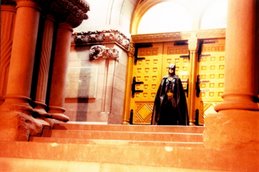
“Do you like my cape?”
What Hammer did get right was bringing back Peter Cushing. As Van Helsing, he’s still the gold standard of vampire hunters; calm, clinical, and willing to sear his own jugular with a hot poker if the job requires it. Around him, the cast does what’s needed: Yvonne Monlaur is sweet but mostly a damsel on the run, Martita Hunt adds tragic weight as the doomed Baroness, and Freda Jackson gleefully chews through every scene as Greta, who might actually be scarier than the Baron himself. And through it all, Jack Asher’s cinematography makes the film glow with the rich, painterly style that was Hammer’s secret weapon. The film may be missing Dracula, but it still looks like a Hammer classic; it’s lavish, lurid, and just theatrical enough to work. And, of course, the great Peter Cushing helps carry things.

Have Cross – Will Travel.
In the end, The Brides of Dracula is Hammer trying to sell you Pepsi when you ordered Coke. No Christopher Lee, no Dracula, just a pretty-boy knockoff with fangs. But thanks to Terence Fisher’s gothic flair, Jack Asher’s velvet-and-fog visuals, and Peter Cushing proving once again that Van Helsing is the coolest teacher you’ll never have, the film still delivers. It may not have the bite of its predecessor, but as vampire sequels go, it’s classy, creepy, and just unhinged enough to remind you why Hammer ruled the coffin for so long.

No comments:
Post a Comment