Blog Archive

Monday, December 11, 2023

The Spirit (1987) – Review

The Spirit is a fictional masked crimefighter created by cartoonist Will Eisner and first appeared in comics way back in 1940 despite remaining a somewhat popular character for decades he never reached the heights of say Batman or Superman and thus his road into other mediums never quite took.

The first live-action incarnation of The Spirit was a made-for-television movie released in 1987 and directed by Michael Schultz that was intended as a backdoor pilot for a new television series, this was not to be. This television movie follows the story of a police detective who is believed to be dead, in reality, he has taken on the guise of The Spirit, a masked crimefighter who patrols the streets of Central City. Along the way, he becomes embroiled in a plot involving a corrupt businessman, a beautiful thief, and a dangerous scientist, and while these all seem to be great ingredients for what could have been a fun action-filled ride it ended up being lamer than they were heroic.


The opening title card certainly didn’t inspire confidence.

The movie kicks off with Denny Colt (Sam Jones), a detective in East Amphett, Oregon, investigating the death of his good friend William Sevrin (Philip Baker Hall), who had been working on a book about crimes being conducted at the Roxton Museum in Central City.  This leads to Denny crossing swords with Simon Teasdale (Daniel Davis), the museum curator, and his own murder when one of Teasdale’s goons lures him into a trap. Of course, our hero wasn’t going to stay dead, so shortly after being presumed deceased by the world’s laziest police force, Denny claws his way up out of the “grave” and sets up a base of operations in a crypt at the Wildwood Cemetery. While sporting the classic Will Eisner designed suit and mask, he will seek justice with the aid of the young street kid Eubie (Bumper Robinson) and Police Commissioner Dolan (Gary Walberg) as well as his lovely daughter Ellen (Nana Visitor), and though Denny Colt is “dead” The Spirit lives on.


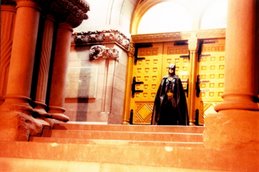
Pause for dramatic posturing.

Stray Observations:

• The film opens with William Sevrin crawling near dead towards the phone but when the house blows up he is suddenly able to sprint out the front door just so he can impart his last wishes to Denny Colt.
• Despite being updated to a modern setting Denny Colt still wears a trench coat and fedora as if his wardrobe had been stuck in a 1940s time warp.
• Simon Teasdale has his museum’s security guards throw Denny Colt out of the museum and bounce down the stairs, but as Denny is a police officer this should have landed them all in jail under an assault charge.
• Denny tells Commissioner Dolan “The criminals I captured are behind bars, where they all belong, but if those same criminals had been caught by Officer Denny Colt, instead of the mysterious Spirit, you’d still be in court stumbling over red tape.” In reality, it’s quite the opposite, as any halfway decent lawyer would point out that a vigilante leaving a bound suspect at the scene of the crime is not going to hold up in court.


“I did read them their Miranda Rights.”

One can understand the network thinking this take on a classic comic book character would be a success, the Adam West Batman series being a prime example of campy superheroes on television raking in the big bucks, but by the release of this film comic book fans had already moved past these campy offerings and had embraced more adult material like Frank Miller’s The Dark Knight Returns, thus this offering from Warner Bros. Television fell on deaf ears and has become a mere footnote in the live-action world of superheroes. The costume designs by Brienne Glyttov were a solid attempt at a translation of what appeared in the pages of the Will Eisner but unlike how it was handled in the Warren Beatty Dick Tracy, which the comic book aesthetic to the nth degree, The Spirit costume in this film simply looked cheap and uninspired.

Note: The movie’s $2.5 million budget prevented them from making this a period picture, the original comic taking place in the 1940s, and that added to the visual disconnect between the hero and the world he was inhabiting.

While the movie has its flaws, it is a fun and entertaining romp that captures the spirit of the source material. Sam Jones gives a decent performance as The Spirit, playing him as a charming and slightly cheeky hero, unfortunately, the film suffers from a lack of depth in its storytelling and characters. The supporting cast is also somewhat hit or miss, with some actors delivering performances that are delightfully cheesy, while others come across as wooden and uninspired. The action scenes are well-staged and exciting, and the film’s overall look captures the pulpy, noirish tone of the source material. Modern viewers may look at these production values as being a bit dated, with some of the special effects and action sequences feeling a bit cheesy by today’s standards, however, the movie’s stylish visuals and catchy soundtrack help to make up for some of its shortcomings.


“We’ll see you in the funny papers.”

While The Spirit may not be a cinematic masterpiece it is a fun and entertaining adaptation of the classic comic book character and was a nice follow-up to Flash Gordon for Sam Jones as they both have a fun and cheesy appeal, not to mention that the screenplay by Steven E. de Souza has some nice comedic moments that give both Sam Jones and Nana Visitor some time to shine. Overall, fans of pulp adventure stories and superhero tales should definitely check this one out.

Thursday, December 7, 2023

Black Friday (1940) – Review

Modern viewers should be warned that Universal’s Black Friday has nothing to do with certain holiday centric sales promotion – which is its own type of horror – in this film we have another great pairing of Boris Karloff and Bela Lugosi but instead of the usual Gothic horror, this particular outing has a mad science within a gangster movie setting.

This film is a rather odd entry from the folks over at Universal Pictures, a film that while originally to be called Friday the Thirteenth it has nothing really to do with that unlucky day, other than the events of the movie simply kicking off on that particular day of the week – it will decade a few more decades to get a proper Friday the 13th movie – which could be why the title change.  Set in the aftermath of a prison break, the plot of this film follows Dr. Ernest Sovac (Boris Karloff), a brilliant and compassionate neurologist who finds himself faced with a moral dilemma when his close friend, Professor George Kingsley (Stanley Ridges), is critically injured in a car accident. Sovac decides to perform a risky brain transplant that will replace Kingsley’s damaged brain with that of a previously injured gangster, Red Cannon (also played by Stanley Ridges), who was in the midst of a “falling out” with his crime syndicate.  His gang is now being led by Eric Marnay (Bela Lugosi) and will lead to further complications when Kingsley awakens with some of Cannon’s memories and criminal tendencies, an “unforeseen” consequences of Sovac’s experiment become increasingly dire. It’s at this point in the history Universal horror films that we must ask the question “Where are all these supposed doctors getting their medical degrees?”


“I got my license from the Acme School of Medicine and Screen Door Installers.”

Stray Observations:

• Boris Karloff and Bela Lugosi both get above the title billing despite the fact that Stanley Ridges, in the dual role of Doctor Sovac and Red Cannon, is the actual star of this movie.
• Professor George Kingsley is part of the long line of absent-minded professors but instead of inventing something like Flubber the one thing he does is lose is his friend’s mind.
• Dr. Ernest Sovac goes to the electric chair for shooting Kingsley but as Kingsley was trying to murder Sovac’s daughter at the time I don’t see how he ended up with a murder charge.  At most he should have been charged with manslaughter.


“I really should have called Perry Mason.”

This science-fiction oddity doesn’t make a lot of sense, with Karloff plopping the brain of a gangster in the skull of his best friend with the hope of both proving his surgical technique as viable, while also hopefully learning where the gangster had hidden the $500 hundred thousand dollars that his gangster pals were after. But what’s so crazy about all that? Well, as the movie goes along we have what can best be described as a “body sharing” movie, with a kindly English professor struggling for control over his body with the mind of a notorious gangster. Now, I’m no doctor but I’m betting that a person who undergoes a brain transplant is not going to have the memories of both participants. Needless to say, things get sillier from here on out, for whenever the Professor takes a nap he then wakes up with the gangster persona in control and would then go off on a revenge killing spree. As I said, it doesn’t make much sense.


“My Dear, I’m sure your husband’s new killer instincts are quite natural.”

As goofy as the film’s premise is Boris Karloff’s performance as Dr. Sovac is nothing short of mesmerizing as he brilliantly portrays the internal struggle between his ambition and moral conscience – fame and money both being corrupting influences – creating a complex character with shades of both sympathy and menace, but the real standout is Stanley Ridges who delivers a stellar dual performance as both Professor Kingsley and his alter ego, Red Cannon. Ridges masterfully capture the subtle nuances of the two characters, convincingly differentiating their personalities and physicality. His transformation from the mild-mannered professor to the ruthless gangster is truly impressive and it elevates what could have been just another silly mad science movie. What doesn’t make sense is the fact that this film was billed as a starring vehicle for Karloff and Bela Lugosi when it’s actually a film starring Stanley Ridges in the dual role of the professor and the gangster, with Karloff playing the second banana and Lugosi being relegated to third banana role as one of Red Cannon’s criminal partners. Karloff was originally intended to play the pivotal dual role but he felt he was too old to pull off the tough gangster routine, and that the dual role would be too much for him, so he took the part of the mad doctor.  Sadly, this resulted in Lugosi, who was to have played the doctor, now being pushed down the cast list to that of supporting thug.


“I know you are the “Uncanny Karloff” but give me a break!”

With Black Friday, director Arthur Lubin created an atmosphere of suspense and unease, utilizing the dark and shadowy cinematography of Elwood Bredell to enhanced the eerie mood of the narrative, effectively reflecting the moral dilemmas faced by the characters, and the black-and-white visuals only add to the film’s classic charm, capturing the essence of the era’s horror movies and crime thrillers. While this entry may lack the elaborate special effects and fast-paced editing of contemporary films of this genre it more than compensates for this with its engrossing storytelling and thought-provoking themes. The exploration of identity, morality and the consequence of scientific intervention remains relevant even today, making the film’s underlying message enduring.


That message is that mad science never pays off.

In conclusion, Black Friday is a unique film noir/science fiction horror blend, one that explores the boundaries of science and morality.  With impressive performances, a captivating storyline and a touch of classic horror charm, it stands as a testament to the enduring appeal of the genre. Fans of classic horror movies, and those interested in the ethical dilemmas of scientific advancement, will find Black Friday to be an engaging and thought-provoking watch.

Monday, December 4, 2023

Tower of London (1939) – Review

In the early 1500s, William Shakespeare wrote the most notable drama depicting the rise of King Richard III, a vile character who usurped the thrown and murdered children, but quite a while after Shakespeare penned his version Universal Pictures offered their own take when they paired Basil Rathbone and Boris Karloff to depict this classic tale in a gripping film that would combine history, suspense, and a touch of horror.

The film revolves around the power-hungry Richard, Duke of Gloucester (Basil Rathbone), who schemes and murders his way to the English throne. It is Richard’s insatiable thirst for power that drives him to eliminate all those who stand in his way, including his own family members, and as the bodies pile up the notorious Tower of London serves as the setting for his sinister deeds, with its labyrinthine corridors and secret chambers adding to the atmosphere of dread and intrigue. Aiding him in his journey of blood and regicide is the club-footed executioner Mord (Boris Karloff), a man who has no qualms about torture and is equally adept at swinging the headsman’s axe.


“You know, it’s the long hours that kill you.”

The filmmakers did a excellent job blending historical accuracy with elements of horror and suspense and while the script takes some rather big liberties with the historical events surrounding Richard III, Universal’s Tower of London does successfully captures the essence of the era, its political intrigues and the ruthless nature of the characters involved. It presents a grim and morally ambiguous world, one where treachery and violence often overshadow loyalty and honour. Of course it can’t be all murder and torture so the film also has a nice little love tryst between Lady Alice Barton (Nan Grey) and John Wyatt (John Sutton), as a couple who simply want permission from King Edward IV (Ian Hunter) to marry, sadly, this is not to be and their situation kicks off even more betrayals and on every level. Then we have the Duke of Clarence (Vincent Price), who is caught between two brothers, one the King and the other a duplicitous monster.


Think “Keeping Up with the Kardashians” only bloodier.

Stray Observations:

• “Mord” means “murder” in Scandinavian languages, so did Karloff’s character change his name to “Mord” to help his career or were his parents amazingly prescient?
• Richard keeps a hidden diorama that contains dolls which represent the line of succession so that he can keep track of his murder plot to seize the throne. Some people scrapbook while others have murder dioramas.
• Rathbone was twice the British Army Fencing Champion and we get a nice sword fight between him and the Prince of Wales, unfortunately, like many films of this period they depict people using modern fencing techniques with swords that were meant for hacking and slashing, not thrusting and parrying.
• This film would later inspire a remake in 1962, with United Artists signing Roger Corman to direct his version of Tower of London.


“Who is the Corman person, and should we have him killed?”

Basil Rathbone delivers a captivating performance as Richard, showcasing his talent for portraying complex and morally ambiguous characters and it’s his commanding presence and his chilling portrayal of Richard’s descent into madness that makes this a truly memorable role. Boris Karloff, known for his iconic role as Frankenstein’s monster, adds another layer of darkness to the film with his portrayal of the brutal Mord, Richard’s loyal executioner, and Karloff’s physicality and intensity bring an eerie and unsettling quality to the character. The supporting cast also delivers exceptional performances, notably Vincent Price as the Duke of Clarence. Price portrays the tormented man with great emotional depth, which is a nice counterpoint to Karloff’s more brutal portrayal of the hunchbacked Mord, and the chemistry between these actors helps to bring these characters to life while also adding layers of complexity to the story.


How about a little ultra-violence?

The film’s production design deserves special mention for its impressive recreation of the Tower of London, the sets are atmospheric and detailed, effectively capturing the gloomy and claustrophobic nature of the infamous fortress. And making these set pieces all the better is George Robinson’s excellent cinematography which enhances the overall mood of the film, utilizing low lighting and shadows to create an ominous atmosphere, reminiscent of Gothic horror, and it should be noted that even though Tower of London is a black-and-white film it doesn’t diminish the impact of its storytelling as the lack of colour accentuates the starkness and brutality of the narrative, lending it a timeless quality that still resonates with viewers today. The absence of distracting visuals also allows the performances and the plot to take centre stage, resulting in a more engaging and immersive experience.


Feel the wrath of Basil Rathbone.

Despite being released in 1939, the film’s storytelling and pacing hold up remarkably well with the narrative maintaining a steady pace, gradually building tension and suspense as Richard’s machinations unfold. The script offers sharp dialogue and well-crafted scenes that keep the audience engaged and invested in the story, however, Tower of London does have some shortcomings as low budget impacts some of the action sequences – such as cardboard armour that melted in the rain and caused costly re-shoots – but they still managed to convey the necessary impact and are still quite impressive for that era of filmmaking, and with both Rathbone and Karloff chewing the scenery one can forgive a few production shortcomings.


Poor Vincent Price gets no respect in this earlier outing.

In conclusion, Tower of London is a captivating historical drama that skilfully blends elements of horror and suspense in a most artful way, and while not quite Shakespearean in nature it’s still quite entertaining. Basil Rathbone’s commanding performance as Richard, Duke of Gloucester and Boris Karloff’s eerie portrayal of Mord add depth to the film, while its atmospheric sets, effective cinematography and compelling narrative make this an engaging watch, showcasing the dark side of ambition and power. The script may not be Shakespeare’s level of excellence but if you appreciate historical dramas with a touch of suspense and horror then Tower of London is definitely worth a watch.

Thursday, November 30, 2023

The Walking Dead (1936)

Not to be confused with the AMC horror series of the same name, this horror film does not have Rick Grimes and Daryl Dixon shooting zombies in the head, instead, we get a unique blend of horror, mystery and courtroom drama, not to mention the legendary horror icon Boris Karloff, all going towards making this an unforgettable cinematic experience, even after all these years. I give you, The Walking Dead.

Directed by Michael Curtiz, The Walking Dead isn’t your traditional horror movie as much its plot deals with organized crime and the plot follows the actions of a particular syndicate who needs an honest judge (Joe King) out of the way. The leader of this criminal enterprise is criminal defence lawyer Nolan (Ricardo Cortez), who has come up with a plan to have the judge murdered and ex-con John Ellman (Boris Karloff) framed for the crime, turns out that the judge had sent Ellman up the river years ago for second-degree murder, which makes him the perfect patsy for the crime as they can sell it as a revenge killing.  The fact that Nolan will be Ellman’s lawyer ensures that he will not be a fair trial.


“Don’t worry, if you get the chair I’ll make sure your grave gets fresh flowers.”

The only wrinkle in this diabolic plan is that there were two witnesses to the crime, a young couple who saw Nolan’s goons stuff the dead body of the judge into the backseat of Ellman’s car, but as they are too terrified of gangland repercussions they keep silent throughout the trial. Eventually these two “good Samaritans” grow a spine but when they finally decide to come forward they make the mistake of contacting Ellman’s crooked lawyer instead of the police and he is able to delay things long enough so that the poor man is electrocuted before the governor could give a stay of execution. However, Ellman’s story doesn’t end there – as if death was ever going to stop Boris Karloff – those two witnesses just so happened to work for  Dr. Beaumont (Edmund Gwenn), a renowned scientist who has discovered a way to revive the dead, and he uses this process to bring Ellman back from the dead.


I can’t possibly imagine anything going wrong with this.

As a surprise to no one who has ever seen a Universal horror movie before, Ellman awakens from his grave and embarks on a mission to seek justice and reveal the truth behind his wrongful conviction, but what is unexpected is that Ellman doesn’t go on some murderous rampage of revenge, not at all, instead he simply confronts them with one simply question “Why did you have me killed?” But how is the possible, Ellman didn’t know anything about the murder conspiracy prior to his death, so what has changed? Turns out coming back from the grave has some advantages, it seems Ellman has gained an innate sense of knowing those who are responsible for his death. Is this some kind of divine gift? We are left to wonder. While he doesn’t directly murder the conspirators the horrifying sight of his accusing eyes and his piercing question results in one of the conspirators shooting himself by accident, another into backing into the path of an oncoming train and a third having a heart attack and falling out of a window.


If I saw that face on a dark night, I’d probably jump out a window too.

Stray Observations:

• In the 1941 film The Monster and the Girl, a man is wrongfully convicted and after execution his body is given over to a scientist for experiments, leading to his brain being put inside a gorilla and it escaping and seeking revenge. It’s nice to know if the justice system fails we have mad science as a backstop.
• Reanimating a body is one thing but Ellman met his end in the electric chair and there isn’t much in the way of scientific mumbo jumbo to explain how his brain still functions after being fried.
• Boris Karloff played Frankenstein’s Monster, who was reanimated via electricity, so it’s kind of interesting that here he’s killed by electricity and revived in an even weirder fashion.
• After bringing Ellman back to life Dr. Beaumont asks if he has any memories of the afterlife, which is not a very scientific line of question, but even stranger is Beaumont is soon willing to risk Ellman’s life with a second operation in the hopes of learning “Secrets from the beyond.” I’m not sure Dr. Beaumont understands the Hippocratic Oath.
• The two witnesses who could have proven Ellman’s innocence just so happen to work for Dr. Beaumont as lab assistants, coincidence or lazy plot contrivance, you be the judge.


“We are cowards and also really bad lab assistants.”

With Michael Curtiz at the helm, each scene is crafted with precision and is allowed to slowly build tension as the plot carefully unfolds and the revenge plays out. The film’s blend of crime drama and science fiction, with a nice helping of the supernatural, creates a neat little tapestry for our characters to wander through, in a story that raises thought-provoking questions about justice, redemption and the boundaries of scientific experimentation. Another excellent aspect of The Walking Dead is its atmospheric and moody cinematography by Hal Mohr, and while this horror entry doesn’t have foggy moors or a Gothic castle it is still able to create a sense of foreboding and unease through its use of shadows, dimly lit sets and a haunting musical score by Bernhard Kaun.


This is the kind of world where you’d expect to see Karloff lurking in the shadows.

Boris Karloff’s portrayal of John Ellman is exceptional and despite being a resurrected corpse he brings sense of depth and empathy to the character, making him both sympathetic and terrifying at the same time. Karloff’s physicality and expressive eyes enhance the unnerving nature of his performance, creating an unforgettable on-screen presence. But Karloff is not acting alone here as the supporting cast also deliver commendable performances, particularly Edmund Gwenn as Dr. Beaumont and his portrayal of a conflicted if well-meaning scientist – one with questionable ethics – adds an intriguing layer to the narrative. The interactions between Karloff and Gwenn’s characters are captivating, as the two men navigate the moral implications of their actions.


And by morality, I mean Gwenn’s character has none.

In conclusion, The Walking Dead is another horror entry that showcases Boris Karloff’s immense talent and exemplifies the golden age of horror cinema, with its atmospheric visuals, compelling performances and intriguing storyline, it has rightfully earned its place as a must-watch for fans of the genre. While the pacing may be a tad slow by today’s standards, its ability to evoke chills and engage the audience’s imagination is a testament to its enduring appeal.

Monday, November 27, 2023

The Invisible Ray (1936) – Review

In this 1936 offering from Universal Pictures we find Karloff giving a rather understated and subdued performance as the film’s villain.  In this outing he’s almost a tragic figure and only becomes the stereotypical “mad scientist” when something goes drastically wrong, but The Invisible Ray doesn’t just provide us a fun take on the genre it’s also the third pairing of screen legends Boris Karloff and Bela Lugosi.

Directed by Lambert Hillyer, The Invisible Ray is a classic science fiction thriller from 1936 that contains an imaginative plot, stellar performances, and stunning visual effects, even by today’s standards there is solid work here. Set in a world of scientific exploration and discovery, the film follows the brilliant but enigmatic astronomer Dr. Janos Rukh (Boris Karloff) who has invented a telescope that can look far out into deep space, into the Andromeda Galaxy, and photograph light rays that will show the Earth’s past. Despite the fact that his theories having been discredited among his fellow scientist-colleague over the years he invites a group of them up to his observatory to witness the proof of his discovery, this group consists of Dr. Felix Benet (Bela Lugosi), Sir Francis Stevens (Walter Kingsford), Lady Arabella Stevens (Beulah Bondi) and her nephew Ronald Drake (Frank Lawton), all who become so impressed with Rukh’s device that they quickly invite him to join their expedition to Africa.


With this group, I expected a murder mystery to break out.
This expedition to Africa is to uncover a mysterious element known as Radium X which is believed to have been deposited by a meteor that Rukh witnessed crashing to Earth millions of years ago via his unique telescope.  Needless to say, things don’t go all that smoothly on the expedition, with an obsessed Rukh taking off on his own, with only a few native porters to do the heavy liftin, and leaving his wife Diana (Frances Drake) back at camp so that she can fall in love with Ronald Drake.  As to  Benet’s own bizarre work in the field of astrochemistry, it makes even less sense than a telescope that can photograph ancient history by capturing light rays from distant galaxies. Unfortunately, Rukh does discover the meteor but its prolonged exposure to Radium X not only causes him to glow in the dark but has also grants him the ability to kill with a mere touch.


On the plus side, he’ll never need a Night Light again.

Dr. Benet is able to develop a counter agent to the Radium X poisoning and while this does hold the lethal element’s toxicity at bay, as long as Rukh keeps taking a daily dose of the serum, it does have a rather distressing side-effect on Rukh’s mental health and he soon becomes consumed by a twisted desire for revenge, believing his colleagues robbed him of his discovery. This mad belief sets in motion a diabolical plan to hunt down each and every one of his colleagues, including his wife who he believes has betrayed him in the most hurtful way possible, and soon he is stalking the streets of Paris with his glowing hands of death. In this film’s 79-minute running time we will learn the answers to such questions as “Will true love prevail?” and “Can Benet and the police find a way to stop this madman and his death touch?”


A glow-in-the-dark Jack the Ripper.

Stray Observations:

• In a case of strange casting, Englishman Boris Karloff plays a Hungarian scientist while Bela Lugosi, who was actually a Hungarian, plays a Frenchman. You’ve got to love Hollywood casting decisions.
• In an early sequence we see the meteor landing on Earth somewhere around the southwest coast of Africa but later a magazine article announces that our heroes are off to Nigeria to find the meteor, which is over 1,000 miles away from where we saw it land. They’d be more likely to find Dr. Livingston than that meteor.
• The set for Dr. Rukh’s laboratory appeared as that of Ming the Merciless in Flash Gordon (1936) and Countess Zelaska’s castle in Dracula’s Daughter (1936).


It’s important to have the proper setting for mad science.

One of the film’s strongest attributes is its atmospheric and visually striking presentation, its black and white cinematography effectively capturing the eerie and dark undertones of the story and wonderfully enhanced by the evocative use of shadows and contrast. Additionally, the special effects, particularly the depiction of Radium X’s lethal effects and Dr. Rukh’s transformation are commendable for the era, showcasing the technical prowess of the filmmakers. Another notable aspect of the film is its exploration of the moral choices faced by the characters as Dr. Rukh’s transformation from a well-intentioned scientist to a tormented and vengeful figure nicely highlights the dark side of scientific ambition and the slippery slope into madness. It was also nice to see Bela Lugosi playing the good guy for a change and his portrayal of Dr. Benet was a turn from his previous mad doctor in 1935’s The Raven.


“Is that a death ray or are you just happy to see me?”

The Invisible Ray successfully blends elements of horror and science fiction, exploring the dangers of unchecked scientific progress while also raising ethical questions about the pursuit of knowledge and the potential consequences of meddling with forces beyond our control, thought to be fair, scientists in these movies are always dealing with forces beyond their control, and the film’s thematic depth adds an extra intellectual layer to the thrilling narrative.  The plot is well supported by Boris Karloff’s standout performance as Dr. Janos Rukh, brilliantly portraying the character’s descent into madness and obsession and his physicality and expressive face make him a perfect fit for the role, allowing him to convey both the tormented soul and the cold-blooded menace that Rukh later becomes. 


The Uncanny Karloff!

Universal’s The Invisible Ray is a timeless gem that showcases the talents of two iconic actors of the horror genre at the top of their game, with the film’s thought-provoking and visually captivating tale demonstrating the allure of early science fiction cinema. Fans of classic movies and Mad Science, or those simply interested in the origins of the genre, will find this Karloff/Lugosi pairing to be an engaging and entertaining experience, one that provides a glimpse into the creative visions of the past.

Thursday, November 23, 2023

The Raven (1935) – Review

There have been many movies based on the works of Edgar Allan Poe but with this early offering from Universal Pictures we get a nice spin on things, a mad doctor with an obsession for the works of Edgar Allen Poe is twisted and turned when his fixation on a woman he saved on the operating table becomes murderous, add Bela Lugosi and Boris Karloff into the mix and you are talking horror gold.

Directed by Lew Landers and released in 1935, Universal’s The Raven is a captivating and atmospheric Gothic thriller that immerses viewers in a world of mystery and suspense. Set in early 19th-century England, the film follows a brilliant but tortured surgeon named Dr. Richard Vollin (Bela Lugosi) who is obsessed with Edgar Allan Poe’s poem, “The Raven.” The horror begins when Vollin becomes infatuated with a young dancer, Jean Thatcher (Irene Ware), who is gravely injured in a car accident, and Vollin comes out of retirement and performs the surgery when the girl’s father Judge Thatcher (Samuel S. Hinds) pleads for his help. Unfortunately, while the surgery was a rousing success Vollin becomes obsessed with Jean and his desire for her soon spirals into madness and he will let no one stand in the way of his claiming her.  Not her boyfriend Dr. Jerry Halden (Lester Matthews) and especially not her father, but love is not his ultimate go as his Poe-fuelled obsession results in a desire to torture all parties, with poor Jean and Jerry are locked in a room with crushing walls and Judge Hardin placed under a device inspired by Poe’s “The Pit and the Pendulum.”


It’s nice when a hobby turns out useful as this.

Of course, no self-respecting mad scientist can function properly without a disfigured assistant at his side and in the case of The Raven that role is filled by Edmond Bateman (Boris Karloff), a bank robber on the run after killing two guards and then escaping from San Quentin, who is advised by one of his criminal associates to seek out Dr. Vollin and see if the good doctor could perform plastic surgery to alter his looks. Vollin informs Bateman that he will perform such surgery if Bateman helps him murder and torture a few annoying individuals, which sounds like a fair deal to me, but when Bateman posits the theory of why he became criminal, stating “I’m saying, Doc, maybe because I look ugly… maybe if a man looks ugly, he does ugly things,”  which gives Vollin the brilliant idea of giving Bateman a very memorable face, instead of a nice unassuming visage he disfigures half of the man’s face by damaging his seventh cranial nerve.  This results in Bateman reluctantly submitting to Vollin’s demands so that the doctor will hopefully undo the procedure. Which sounds like a plan, it’s not like Vollin seems at all untrustworthy or totally off his rocker.


How could anyone doubt this man?

Stray Observations:

• For someone who has been in a terrible automobile accident Jean Thatcher looks in surprisingly good shape, sure she has nerve damage but I don’t think her make-up even got smudged.
• If the only chance to save your daughter’s life relies on an Edgar Allan Poe-obsessed Bela Lugosi you’d best start making funeral arrangements, also, book bulk graveyard plots as well.
• Dr. Vollin illustrates the fact that if you have a pipe organ in your home you must play Bach’s Toccata in Fugue in D-Minor.
• Jean Thatcher does an interpretive dance to Edgar Allan Poe’s poem “The Raven” and I have to wonder “Did she want to drive the Poe-obsessed Vollin over the edge?”
• It’s never explained why or how a world-renowned neurosurgeon became known to the underworld as someone who could provide plastic surgery for criminals looking for a new face.


“This is how I funded my medical schooling.”

Bela Lugosi’s portrayal of Dr. Vollin is masterful, showcasing his ability to portray complex characters with depth and intensity and his transformation from a respected surgeon into a deranged and vengeful madman is both chilling and mesmerizing. Then as an added bonus, we have Boris Karloff delivering a strong performance as Bateman, a criminal who becomes entangled in Vollin’s wicked schemes and his empathetic and tragic figure is a nice counterpoint to Lugosi’s mad scientist. On the technical side of things, the film’s cinematography by Charles Stumar deserves praise for its moody and atmospheric visuals with its shadowy and Gothic settings, coupled with the use of stark contrasts, create a sense of foreboding that keeps viewers on the edge of their seats. The atmospheric lighting and eerie sound design further enhance the film’s overall sense of dread and suspense. Then there is the nice work by legendary make-up artist Jack Pierce who was on hand to provide Karloff’s gruesome appearance.

Note: In the stage play Arsenic and Old Lace, Boris Karloff plays a killer who has plastic surgery to change his features, unfortunately, this results in him killing a man because “He said I looked like Boris Karloff” which is a pretty nice meta-joke for a 1930s play.

The Raven excels in building tension and maintaining a constant air of mystery and while the script at times seems a little melodramatic, it is well-crafted and keeps the audience engaged throughout. The film also effectively explores themes of obsession, madness and the corrupting power of revenge, drawing inspiration from Edgar Allan Poe’s works in the most horrifying ways possible. One of the film’s standout moments is the climax, which delivers a thrilling and suspenseful showdown between the characters, with its final act providing a satisfying culmination of the story, with unexpected twists and turns that leave a lasting impact.

Question: How do you go about finding a contractor to build you a house with hidden passageways, rooms that can be lowered like an elevated car, install various torture devices like a bladed pendulum, and a room where the walls close in to crush its occupants?

What is a little disappointing is that not only did Karloff get top billing over Lugosi in this outing he also received twice the salary, which is terrible when considering the fact that Karloff was clearly a secondary character and the whole movie centres around Lugosi’s Poe-obsessed madman and not the disfigured henchman. Karloff does give an excellent performance as an escaped convict, who Lugosi mutilates into becoming his reluctant murder accomplice, but he doesn’t even enter the movie until almost the halfway point.


“Exactly how are you the star of my movie?”

It should be noted that this movie also nicely escapes the “In name only adaptation” problem that plagues many adaptions of Poe’s work by utilizing a nice twist on the source material, this is not a literal depiction of any of Edgar Allan Poe’s stories, instead, it’s about a man obsessed with the author and his works. Overall, Universal’s 1965 release of The Raven is a must-watch for fans of classic horror and mystery films. Its atmospheric visuals, exceptional performances, and chilling storyline make it a timeless gem and remain an important film in the horror genre, showcasing the talents of two iconic actors, Boris Karloff and Bela Lugosi.