Blog Archive

Thursday, April 9, 2026

Hell Comes to Frogtown (1988) – Review

In 1988, we were treated to a gloriously absurd slice of B-movie brilliance called Hell Comes to Frogtown. This is a film that takes the post-apocalyptic action genre, sprinkles in some dystopian satire, and then throws in Rowdy Roddy Piper and an army of frog people, because why the heck not?

Off the hop, we learn that the world has been nuked into oblivion, and humanity’s future is in peril – so we’re talking your standard post-apocalyptic Mad Max world – and in this distant future (which looks suspiciously like the California desert), nuclear war has left most of humanity sterile. The government, now a militarized matriarchal authority known as Med-Tech, is desperately searching for men with viable sperm to help repopulate the planet. And how do we know it’s a matriarch? Well, would military equipment be painted pink if men were in charge?


This will definitely blend into the desert terrain.

Enter Sam Hell (Roddy Piper), a drifter, scavenger, and all-around rugged survivor with a notorious reputation but also one of the last virile men on Earth. After being captured by Med-Tech operatives, led by the no-nonsense Spangle (Sandahl Bergman) and the tough, gun-wielding Corporal Centinella (Cec Verrell), Sam is informed that he has been conscripted into Med-Tech’s breeding program, his freedom revoked, and an explosive chastity belt is locked onto him, preventing any escape and ensuring he follows orders. If he gets too far away from Spangle, his groin will feel an excruciating stinging sensation, and if the device is tampered with, it will explode.


That’s definitely a strong piece of motivation.

Sam’s first mission: infiltrate Frogtown, a dangerous mutant settlement inhabited by anthropomorphic, intelligent humanoid frogs and led by an oppressive warlord named Commander Toty (Brian Frank). This is where a group of fertile women have been captured and enslaved, and Med-Tech needs Sam to rescue them so they can be impregnated and aid in humanity’s survival. Though reluctant, he has little choice given the explosive device strapped to his groin. As Sam, Spangle, and Centinella embark on their journey, they venture into Frogtown’s dangerous territory, encountering a variety of sadistic, power-hungry mutants who have taken control of the settlement. Frogtown is a mix of lawlessness, mutant crime lords, and eerie remnants of civilization, making it a perilous place for humans.


He’s a despot, to be sure, but he’s no Lord Humongous.

Their infiltration is anything but smooth. Spangle, playing the part of a captured slave, is taken to Toty’s harem, where the rescued women are being held. Meanwhile, Sam encounters Looney Tunes (Rory Calhoun), an old prospector with insider knowledge of Frogtown’s underbelly, who offers some much-needed guidance. But with time running out, Spangle must use her government training to manipulate Toty’s mind-control techniques while Sam stages a chaotic rescue. A climactic battle erupts between the humans and the mutant forces, featuring high-octane brawls, laser gun shootouts, and absurd yet thrilling action. Can our heroes possibly pull off such a dangerous mission? Will Sam Hell learn to respect women? And can Spangle’s frosty demeanour be melted?


“A slave girl outfit worked for Princess Leia, why not you?”

Stray Observations:

• If most humans are sterile and you find an incredibly virile dude, why would you send him into the dangerous wastelands? Wouldn’t it make more sense to keep him in a lab and milk him like a cow and send less important men out to bring back fertile women?
• Our gallant trio runs down a poor, traumatized woman, then they tie her up, and when Spangle discovers she’s fertile, she drugs the poor girl and orders Sam to have sex with her. These are the good guys?
• Frogtown isn’t some rundown wasteland; these amphibians have style. They wear robes, vests, and even jewellery. One of them even has a fez, because nothing says “menacing saloon keeper” like a frog Shriner.
• Sam Hell battles Commander ‘Toty on Vasquez Rocks, where Captain Kirk once battled the Gorn in the original Star Trek series, because where else could it take place?
• There’s a scene where Sam Hell gets seduced by a frog woman wearing a beaded headdress and a feather boa. If you say you didn’t laugh at this, you’re lying. She’s giving 100% effort in a movie that’s running at about 35% effort.
• Just when you think this movie can’t get weirder, a mutant frog wields a chainsaw in an attempt to remove Sam’s exploding codpiece. 


Who needs logic when you have chainsaw-wielding frogs?

Despite its seemingly ridiculous plot, Hell Comes to Frogtown offers a satirical take on traditional action hero tropes, and it all kind of works. The film flips the script on the hyper-masculine protagonist by placing Sam Hell in a submissive role; his virility is treated as a commodity, and he spends much of the film under the control of Spangle and MedTech. His exaggerated machismo is constantly undercut by the absurdity of his situation, making him more of a reluctant anti-hero than a true action star.


“Who do I have to wrestle to get out of this chickenshit outfit?”

This movie lives and dies by its main character, and Roddy Piper’s face throughout the movie is a perfect mix of mild annoyance and complete bewilderment. He’s a pro-wrestler who got dropped into a low-budget fever dream, and it shows. He spends the film alternating between confused, irritated, and hilariously smug. His one-liners aren’t quite They Live level, but then again, lines like “Hey, you try making love to a complete stranger in a hostile, mutant environment, see how you like it” would be tough for anyone to pull off, still, watching him navigate a world of frog people while wearing a government-issued “exploding jockstrap” is comedy gold. As for the frog people, they look like someone raided Jim Henson’s Creature Shop after a week-long bender.


No fetish will remain unexplored.

Needless to say, this is the kind of film that doesn’t worry about such pesky things as character motivation. Commander Toty is a warlord running Frogtown, but what does he actually want? World domination? A mutant army? More frog dancers? The movie never really explains, and honestly, it doesn’t have to. He’s just a big, angry frog man with a deep voice, and that’s enough. This movie knows exactly what it is: a bizarre, goofy, post-apocalyptic sex comedy featuring mutant frogs. And it embraces every second of it, blending elements of Mad Max-style dystopian landscapes, absurd humour, and B-movie schlock, giving us an eccentric gem that revels in its outlandish premise. And say what you will about this movie’s plot, you have to admit, Sandahl Bergman looks great in uniform.


If this is the military, sign me up.

In conclusion, Hell Comes to Frogtown is a film that embraces its ridiculousness with full enthusiasm, making it a must-watch for fans of cult cinema. With its mix of dystopian adventure, mutant amphibians, and tongue-in-cheek humour, the film is a testament to the creativity and charm that defines the best of low-budget 1980s sci-fi. Though it may not be a masterpiece in a conventional sense, its campy energy and unapologetic weirdness ensure its place in the annals of cult movie history.

Monday, April 6, 2026

Belladonna of Sadness (1973) – Review

To call Belladonna of Sadness a “movie” feels like calling a cathedral a “building.” It’s a hallucination stretched across 93 minutes. It’s what happens when you paint a nightmare in watercolours and then set it on fire. And yet, despite its hypnotic beauty, this is not an easy watch, nor should it be. At its core, Belladonna is a story of sexual violence, exploitation, and the dark, seductive power of rebellion. It is not just provocative, it is pain rendered in motion.

Directed by Eiichi Yamamoto and produced by Osamu Tezuka’s Mushi Production (yes, that Osamu Tezuka — the father of Astro Boy — proving again that the ‘70s were weird for everyone), Belladonna of Sadness was the final instalment in the “Animerama” trilogy, and by far the most radical. Where the previous two films, A Thousand and One Nights and Cleopatra, wove eroticism with slapstick and psychedelia, Belladonna of Sadness discards almost all levity. This film is not fun. It’s art, in the most dangerous, devastating sense.


Love will not conquer all. 

At first glance, it’s a simple story, based on Jules Michelet’s 1862 novel, “La Sorcière.” Its plot is rooted in medieval injustice, but rendered mythic, brutal, and strange. Jeanne (Aiko Nagayama), a luminous peasant girl, marries Jean (Katsutaka Ito), a gentle but passive farmer. Their love is real, their happiness brief. On their wedding night, the local baron (Masaya Takahashi), drunk on his own divine right, invokes droit du seigneur and has Jeanne raped by his court. The violence unfolds not with realism, but as a swirling, stylized nightmare, her pain abstracted into jagged lines, bleeding colours, and haunting symbolism.


It’s beautiful, and it’s awful.

Jean retreats into silence, clinging to a past already lost, helpless and ashamed, eventually abandoning Jeanne. This is when something inside her breaks — or hardens — and a flicker of resistance takes hold. She begins seeing (or summoning) a small devil (Tatsuya Nakadai), a seductive trickster who offers power, not comfort. Whether he’s real or imagined, he becomes the catalyst. Jeanne begins to resist…quietly, then with resolve. She sheds the roles forced upon her, defies the church and lord, and becomes something more: a healer, a merchant, a force. Jean, once her partner, now watches her from the margins, with awe and fear.


“Who says anger and hate are ugly?”

As suffering spreads, war, famine, plague, the people turn to Jeanne. She heals, comforts, seduces, and refuses to apologize. Her power comes not from sorcery, but from knowledge, autonomy, and will. That is enough to make her dangerous. She becomes a witch not by spellwork, but by definition: a woman beyond control. She becomes a legend, not by claiming authority, but by embodying defiance. Her strength, her sexuality, and her refusal to disappear make her myth.


Herein lies the power of beauty and sexuality.

The world does what it always does to women who won’t kneel: Jeanne is branded a witch — not for curses, but for living freely. Her healing is heresy, her independence a threat, and she is burned to be erased. But the flames fail. Her body turns to ash, yet a presence endures, a name, a whisper, a spark that won’t die. Belladonna of Sadness is no triumph, no revenge fantasy. It’s a tragedy where even power corrupts or consumes. By the end, Jeanne is less woman than myth, rage, desire, disease, all the fears men projected onto her. And in death, she becomes more powerful than ever, her spirit carried forward in every act of defiance, a fire waiting to ignite.


“Vive la Résistance”

What makes Belladonna so arresting—besides its raw thematic ambition—is the animation itself. Or, more accurately, its refusal to animate in the traditional sense. Entire scenes unfold like illustrated storybooks: slow pans across still images, whispered narration, a score that shifts from baroque to psychedelic. It’s less a film than an incantation. At times, it feels like time itself has stopped, and you’re trapped inside a cursed manuscript, gilded, grotesque, and whispering secrets you shouldn’t know.


Be wary if that whispering is from a little penis-sized devil. 

Visually, this thing should not exist. It’s mostly still images, languid, delicate, unnervingly still — punctuated by eruptions of animated chaos. It moves like a storybook caught in a fever dream. The watercolour aesthetic recalls European illuminated manuscripts and Art Nouveau posters, but infected with erotic decay. Think Egon Schiele meets tarot deck meets prog rock album cover. Some of the transitions are jaw-dropping; a single line of narration will trigger a visual montage of such audacity it feels like cinema itself is convulsing. Jeanne’s rape scene, for example, is rendered not through lurid realism but as a kaleidoscopic barrage of limbs, flowers, and tears. It doesn’t soften the violence; if anything, it amplifies the horror by refusing to let you look away.


There is no safe emotional distance.

Let’s be clear: Belladonna of Sadness is drenched in sex. Nudity, moaning, orgies, phallic symbols by the dozen. But it’s not sexy. It’s disorienting, confrontational, and often disturbing. The eroticism here is not celebratory…it’s weaponized. Jeanne’s body becomes a battlefield. Her sexuality is used against her, then reclaimed, then used again. The line between empowerment and damnation blurs until it evaporates completely. There’s thematic weight here, buried beneath the psychedelia: that female autonomy, in a patriarchal structure, is often branded as witchcraft. That society fears women who refuse to be destroyed. Jeanne is punished for surviving, not for vengeance, not for witchery, but for daring to endure.


A truly dark and evil society.

This is where Belladonna tips from tragedy into something mythic. Jeanne becomes a symbol not just of individual defiance but of collective memory, the spirit that would someday echo in revolution. The final moments leap through time, hinting at Joan of Arc, the French Revolution, and the women’s liberation movement. Jeanne doesn’t just die. She spreads. But again, this isn’t triumph. It’s the cold comfort of legacy. Jeanne’s “win” is posthumous, symbolic, and bittersweet. She was not allowed to live. And the film does not pretend otherwise.


A powerful and poignant film.

In conclusion, Belladonna of Sadness is not a film for everyone. It’s slow, it’s abstract, and it doesn’t provide easy catharsis. But it’s a masterpiece of expressionistic animation—a feminist horror-opera wrapped in medieval parchment and lit with matchstick fire. It feels like it was exhumed from a forgotten crypt, and maybe it was better off there. But now that it’s here, we should listen. Carefully. Because Belladonna doesn’t ask to be liked. It demands to be witnessed.

Thursday, April 2, 2026

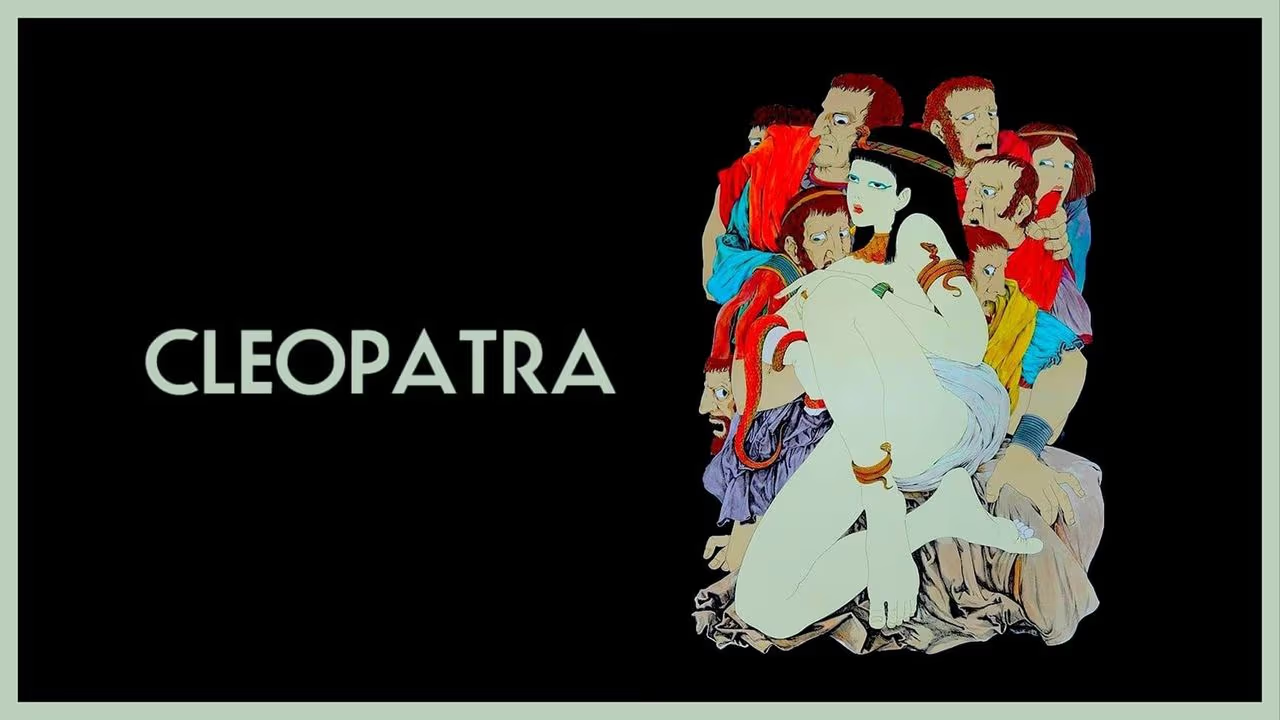
Cleopatra (1970) – Review


Let’s get one thing out of the way: Osamu Tezuka’s Cleopatra is not your average historical epic. It’s also not your average anime. It’s… well, it’s what happens when the “God of Manga” watches Barbarella, chugs a vat of sake, and says, “Let’s do Ben-Hur, but horny and in space-time.”

Released in 1970 as the second film in Tezuka and Yamamoto’s Animerama trilogy — sandwiched between A Thousand and One Nights and Belladonna of Sadness Osamu Tezuka’s Cleopatra is part psychedelic head trip, part horny history lesson, and all chaos. What starts as a sci-fi time travel plot quickly dives headfirst into ancient orgies, intergalactic seduction schemes, and Romans wielding handguns, because why not? The animation swings wildly between gorgeous, experimental, and downright crude, while the story tries to juggle satire, sex comedy, and Shakespearean tragedy, usually all in the same scene.

Subtlety is not on the menu.

As for the plot, our story opens in the distant future, where three scientists—Jirō (Nobuo Tsukamoto), Hal (Tsubame Yanagiya), and Maria (Jitsuko Yoshimura)—have discovered a cosmic threat known as the “Cleopatra Plan,” devised by a sinister alien race called the Pasateli. Their solution? Shove their minds back in time and into the bodies of people in Cleopatra’s court to find out what the plan is. Jirō ends up in a Greek slave named Ionius, Maria in the form of a handmaiden named Libya, and poor Hal—who only signed up to seduce Cleopatra—gets stuck inside a literal leopard.

So much for being the galaxy’s greatest lover.

Meanwhile, ancient Egypt is having a rough time of it. Cleopatra (Chinatsu Nakayama), caught in a Roman power struggle, is chosen to seduce Julius Caesar (Hajime Hana) and stab him in the back. After a priestess magically gives her a bombshell makeover, she flees an ambush with her handmaidens and catches Caesar’s eye. Jirō/Ionius busts out of slavery by whipping up hand grenades (naturally) and ends up winning Caesar’s favour, gladiator-style, with a modern handgun. Cleopatra becomes queen, Caesar gets more popular than ever, and that makes Rome’s senatorial elite very twitchy.

“Did you hear anyone mention the Ides of March?”

Plans unravel when Cleopatra starts enjoying her role a little too much—more silk sheets, less assassination. Caesar is stabbed on cue, and in walks Mark Antony (Osami Nabe), who falls hard for Cleopatra, setting the stage for their doomed love affair and the inevitable Roman smackdown at sea that results in him killing himself. Along comes Octavian (Nachi Nozawa), Caesar’s heir, who is less interested in Cleopatra and more into Ionius. Cleopatra tries the same old seduction strategy, but Octavian is both gay and unimpressed.

Note: There is a scene where Cleopatra uses two bananas to illustrate to Mark Antony the unimportance of dick size. If that’s not true love, I don’t know what is.

Filled with grief and betrayal, Cleopatra retreats into the Great Pyramid with her friends and commits suicide via asp, deliriously calling for Anthony until death. We then jump back to the future, where Jirō, Hal and Maria have returned to their future time, but not without consequences. What they’ve learned is ambiguous at best. The final scenes are bleak: the war against the Nekonell continues, and humanity’s self-destructive instincts remain intact. The implication is clear: history is a cycle of lust, power, and ruin. Cleopatra was not just a queen or a woman, but an avatar for desire — exploited by men, by gods, and by history itself.

Missiles Away!

 Like A Thousand and One Nights, Osamu Tezuka’s Cleopatra is a stylistic free-for-all — and not always in a good way. It swings from lush, candlelit tableaux and swirling erotic abstractions to slapstick mayhem, where characters squawk like birds and sprint in full Looney Tunes mode. One moment it’s art-house erotica; the next, it’s Speed Racer on psychedelics. The animation has a raw, jazz-like spontaneity; ancient battles explode in jagged montages, love scenes melt into surreal abstraction, until, suddenly, someone farts or gets clobbered with a mallet. It’s Fantasia by way of a drunk Fellini and Monty Python on fast-forward.

Why is there a Frankenstein/Mummy hybrid? Cause, why not?

There’s real thematic potential in Cleopatra’s use of sexuality — as power, rebellion, even cosmic danger — but most of it gets sidelined by the film’s relentless urge to titillate. Cleopatra could be a fascinating figure: a woman weaponizing her desire in a world ruled by men and gods. Instead, she’s mostly treated like a walking myth — beautiful, doomed, and frustratingly passive. Compare that to A Thousand and One Nights, where the eroticism is wild, weird, and occasionally liberating. Characters like Aldin get to joke, seduce, and screw their way through a mad desert fever dream. In Cleopatra, sex is slower, sadder, and draped in heavy symbolism. It’s not liberating — it’s ornamental. She isn’t a person so much as an animated painting the film keeps panning over.

“Caesar, you live in De-Nile.” 

As for the animation, Cleopatra makes some bold and undeniably strange stylistic choices—chief among them, the jarring inclusion of live-action elements and what looks like animation crudely pasted over real footage. At times, it feels like you’re watching an experimental student film that wandered into a big-budget acid trip. You’ll see fully animated characters awkwardly composited into real sets, live actors interacting with toons, and even sequences where live faces are traced or overlaid with animation like some unholy fusion of rotoscope and ransom note.

Who needs rotoscoping when you’ve got this option?

This isn’t just a gimmick; it’s part of Osamu Tezuka and Eiichi Yamamoto’s larger collage-like aesthetic. But whether it works is another story. Instead of blending worlds, it often rips you out of the narrative entirely. The effect is more alienating than immersive, and it can make the already surreal tone of the film feel even more disconnected. That said, there’s something perversely charming about how fearless it is. Cleopatra doesn’t just bend the rules of animation—it gleefully sets them on fire, eats the ashes, and films the whole thing on a soundstage with a dude in a toga and a cartoon cat.

Also, don’t ask things like “Why is Caesar green?”

In conclusion, Cleopatra is a mess, but a fascinating, singular, and occasionally brilliant mess. It’s a film that bites off more than it can chew, then starts chewing anyway with its mouth wide open. Historically inaccurate, narratively incoherent, and tonally bipolar, it’s somehow both high-concept and lowbrow at once, like a horny philosophy professor on mushrooms.

Monday, March 30, 2026

A Thousand and One Nights (1969) – Review


When most people hear the name Osamu Tezuka, they think of wide-eyed robots (Astro Boy), jungle adventures (Kimba the White Lion), or whimsical medical dramas (Black Jack). But in 1969, Tezuka — the so-called “God of Manga” — shocked audiences with something very different: a psychedelic, erotic, and adult-oriented animated film called A Thousand and One Nights.

As the inaugural film in his experimental Animerama trilogy (followed by 1970’s Cleopatra and 1973’s Belladonna of Sadness), this feature stands at a strange crossroads, somewhere between art film, erotic fantasy, social satire, and cultural collage. Boldly adult in theme and experimental in form, it was a declaration that animation could be more than children’s entertainment, and a chaotic fever dream that still defies easy categorization.

A Thousand Nights of Liberation… and Male Fantasy.

The film is very loosely based on the classic Arabian Nights tales, but you’d be forgiven for forgetting that. It follows Aldin (Yukio Aoshima), a humble water seller with big dreams and even bigger libido. He falls head over heels for Miriam (Kyouko Kishida), a gorgeous slave girl up for auction in Baghdad, because this is that kind of story. Before the corrupt cops can take her away, a sandstorm hits, Aldin plays hero, and they shack up in a creepy mansion. Just as things are heating up, they’re caught mid-coitus by the voyeuristic mansion owner Shalieman (Minoru Uchida), who locks them in and demands an encore. It all ends with murder, a wrongful imprisonment, torture, Aldin’s faked death and escape, and Miriam tragically dying in childbirth, because Tezuka loves his Shakespearean tragedy with a side of cartoon nudity.

See, it’s not just Disney that kills off a parent.

But what led to their imprisonment? In another, equally unhinged subplot, Inspector Badli (Hiroshi Akutagawa), a greasy henchman with zero chill, was hired by Baghdad’s Chief of Police (Hitoshi Takagi) to kill Shalieman, steal his treasure, and bring back Aldin and Miriam in chains. But before that, he rapes Madia (Sachiko Itou), the sword-swinging daughter of the leader of the Forty Thieves, whom he had hired to help pull off the robbery and abductions. Madia vows revenge while the film tries (and fails) to keep its tone consistent. Aldin, having escaped from prison, finds Badli in the desert, has a stabby moral dilemma, and decides to let him go, for reasons. Then he stumbles upon the thieves’ treasure cave, meets Madia, and somehow convinces her to ditch the revenge arc and go sightseeing with him on a flying wooden horse. As one does.

“I thought we’d be using a flying carpet.”

Their romantic vacation doesn’t last long; they’re dragged underwater by magical hair (yes, really) and deposited on Lotus Island, home to snake-women sirens and their queen Lamia (Takako Andō), who seduces Aldin like a jazz-age vampire. Madia takes off on the magic horse, leaving Aldin to enjoy a full buffet of forbidden fruits before realizing—surprise!—Lamia and her ladies are all monstrous snake demons. He barely escapes, only to be picked up by sailors, eaten by a giant, and rescued by a talking magic ship that grants wishes and probably has better character development than half the cast.

“You’ve got a friend in me.”

Fast-forward 15 years: Aldin, now rich and spiritually bankrupt and going by the name Sinbad, wins a king-making contest in Baghdad by marooning his opponent on his magic yacht. He sets his sights on a beautiful girl named Jalis (Kyouko Kishida), who turns out to be Miriam’s daughter—awkward—but she is in love with a shepherd named Aslan (Isao Hashizume), who may or may not be dating a genie-horse. Aldin builds a giant tower to heaven out of sheer ego until the people, fuelled by the ever-manipulating Badli, revolt. Realizing he’s bad at kingship and possibly life in general, Aldin abdicates and rides off into the sunset as a poor man once more, older, wiser, and hopefully done with magic horses.

So, a happy ending?

As one can tell, this isn’t a tightly plotted fairy tale — it’s more like Barbarella meets The Arabian Nights, animated on acid. The film treats the original source material as a launchpad for an entirely new genre: the sex-fantasy epic. But for all its eroticism, this isn’t softcore smut, well, not exactly. The sex is symbolic, expressionist, sometimes exploitative, but often daringly artistic. Women are frequently idealized (and objectified), yes, but they also represent freedom, transformation, and rebellion. The film is caught between progressive impulses and the very male gaze it indulges.

Why Madia runs around with one breast exposed is beyond me.

The animation is a visual fever dream; bold, erratic, and constantly shifting styles like a restless painter experimenting on every frame. Rather than follow a consistent aesthetic, the film embraces chaos as a design principle: one scene bursts with bawdy, cartoonish slapstick, the next slips into painterly melancholy, and another spirals into abstract psychedelia. It’s less a traditional narrative than a kaleidoscopic jazz solo in motion—fluid, unpredictable, and deeply expressive. These shifting styles are anchored by Isao Tomita’s groundbreaking score, which fuses Arabic motifs with space-age Moog and rock textures—perfectly mirroring the film’s fusion of ancient story and modern sensibility.

Who knew that the Tower of Babel was in Baghdad? 

Though it broke ground as the first Japanese “X-rated” animated film, A Thousand and One Nights is more than a skin flick. It is, in many ways, a commentary on colonialism, class, and liberation, all filtered through the prism of male libido. Aldin’s rise and fall is a tale of consumerism and desire; he buys slaves, climbs political ladders, and tries to turn love into possession. But his attempts to control women — particularly Miriam — are always punished. In the end, the film seems to argue, freedom cannot be bought, and love cannot be owned. There’s an undercurrent of sorrow beneath the surrealism, a kind of erotic existentialism that recalls Fellini, Pasolini, or even Kubrick’s later Eyes Wide Shut.

Things tend to get weird and rapey.

This leads to the film’s biggest critique. Its portrayal of women swings between reverence and objectification; they’re often presented as divine, sensual, and mysterious, yet ultimately exist to serve male desire. Miriam, the central love interest, is more symbol than character, defined by what she represents to Aldin rather than any inner agency. Other women are either temptresses or tragic beauties, their sexuality filtered entirely through a male gaze.

One male fantasy after another.

While the film champions sexual liberation, it does so largely through a male lens. Erotic freedom is empowering when it benefits the male protagonist, but for the women, it more often results in loss, objectification, or being treated like a prize. In this, the film reflects the paradoxes of the 1960s sexual revolution, bold and forward-thinking on the surface, yet still tethered to old patriarchal ideas. And then there are the two genies: mischievous little shape-shifters whose idea of experimenting with sex is turning into various animals, more cartoonish than liberating, but certainly on-brand for the film’s surreal tone.

It’s as if the Great Gazoo were a horny lech.

In conclusion, A Thousand and One Nights is a messy, brilliant, deeply flawed masterpiece, overflowing with imagination, excess, and ideas that even today feel ahead of their time. It dares to ask: What happens when you let an animator’s id run wild? What does animation look like when it’s not bound by censors, demographics, or expectations? Apparently, it looks like A Thousand and One Nights — a dream that’s part erotic poem, part acid trip, part morality tale, and all Tezuka.

Monday, March 23, 2026

Invasion U.S.A. (1985) – Review

Chuck Norris doesn’t call 911. 911 calls him. Chuck Norris doesn’t believe in homeland security. Homeland Security believes in Chuck Norris. In 1985, America was invaded. Chuck Norris filed the eviction notice.

The film opens with a boatload of Cuban refugees cruising toward the American Dream, only to be greeted by what looks like the U.S. Coast Guard. The captain smiles, welcomes them to freedom, and then immediately orders his men to gun them down because subtlety is for Europeans. The killers turn out to be guerrillas in stolen Coast Guard uniforms who grab hidden cocaine from the boat, because nothing says “international ideological terror” like a side hustle in narcotics. It’s less geopolitics and more Scooby-Doo villainy with automatic weapons.


“My only weakness is a meddling Chuck Norris.”

Soon, the real Coast Guard finds the bodies, the FBI and Miami PD show up looking confused, and we meet Soviet mastermind Mikhail Rostov (Richard Lynch), a man whose cheekbones alone could cut glass. He trades drugs for weapons in Florida like he’s at a particularly violent flea market, but what is his evil plan?  Meanwhile, former CIA agent Matt Hunter (Chuck Norris) is busy being retired and shirtless in the Everglades, but when he is asked to come back into the fold, he declines, because of course he does. Only after Rostov blows up his house and kills his friend John Eagle (Dehl Berti) does Hunter decide that maybe terrorism is rude and should be addressed. Will villains ever learn that this is the best way to get the hero involved?


“Hold it, I’m sure he’s dead, and there’s no reason to check for a body.”

Then the movie goes from “contained thriller” to “Red Scare fever dream.” Hundreds of guerrillas storm Southern Florida in pre-positioned trucks like they’re late for a tailgate party of doom. They attack suburban homes, mow down civilians, and even impersonate Miami cops to shoot up a community centre full of Cuban expatriates, cleverly sparking chaos and riots. The FBI scratches its head while Hunter squints meaningfully into the distance, because in this universe, bureaucracy is allergic to competence. Of course, the government must abide by Hunter’s one simple rule, “I work alone.”


“I refuse to share my body count.”

Things escalate into full-blown Christmas mall mayhem, bomb threats, church explosions, and a school bus with a bomb planted by Rostov’s sidekick Nikko Kador (Alexander Zale). Hunter literally grabs a bomb off a moving bus and throws it at Nikko’s vehicle, because why defuse when you can re-gift? Hunter isn’t just dealing with an army of terrorists; he also gets called a “Cowboy” by the film’s lone female character, reporter Dahlia McGuire (Melissa Prophet). I guess that’s called character development? Needless, the violence escalates, Martial Law is declared, governors convene at Atlanta’s Georgia-Pacific Tower, and Hunter gets himself arrested on purpose just to bait Rostov into a massive assault. The final showdown ends with Hunter firing an M72 LAW at Rostov, because apparently, subtle character arcs were also declared enemies of the state.


Chuck will shoot subtlety right in the face.

Stray Observations:

Cannon Films reportedly hacked out most of the story and background characters in the editing room, bravely deciding that plot was an unnecessary distraction from watching Chuck Norris walk toward explosions.
• The terrorists’ master plan relies heavily on Americans instantly turning into riotous maniacs the second something explodes. Um, yeah, that checks out.
• The FBI is perpetually three steps behind a man who lives in a swamp with a pet armadillo vibe.
• The movie Hunter is casually watching when he gets arrested is Earth vs. the Flying Saucers, because nothing says subtle thematic layering like aliens invading during a movie about terrorists invading.
• Hunter’s Everglades shack explodes with the enthusiasm of a Fourth of July finale. Was Hunter arming up for his own invasion?
• At one point, armed civilians organize neighbourhood defence patrols faster than most HOAs approve lawn décor.
• The climax hinges on terrorists obediently charging into a building that looks suspiciously empty.
• Despite being one of the most celebrated martial artists on the planet, Chuck Norris kicks exactly two people in the entire film, apparently deciding that fists and rocket launchers were more efficient.
• Matt Hunter racks up an on-screen body count of 30, which is less a statistic and more a public service announcement about ammunition sales.


“Get your NRA membership certificate now.”

This fever dream of patriotism was the first entry in a six-film contract Chuck Norris signed with Cannon Films after the success of the Missing in Action movies. It was directed by Joseph Zito, who also helmed those earlier POW revenge fantasies, proving that if something explodes profitably once, Cannon will absolutely do it again, but louder. Norris himself co-wrote the script, inspired by a Reader’s Digest article claiming hundreds of terrorists were running loose in America. He reportedly read it and thought, “Boy, that’s scary,” then imagined a Khomeini or Gaddafi type mobilizing them because of America’s “freedom of movement.” The film, he insisted, was not meant to scare but to raise awareness and “make a statement” about the people of the United States. It certainly does. The statement is roughly…


“Have you considered more rocket launchers?”

If this is a message movie, it’s the kind of message you’d find engraved on a commemorative rifle. The film’s politics are less nuanced commentary and more of a blunt instrument, the cinematic equivalent of solving a crossword puzzle with a sledgehammer. Terrorism is presented as both omnipresent and hilariously easy, as though America’s greatest weakness is having parking lots and civil liberties. The solution offered is not policy, diplomacy, or even basic coordination between agencies, but one exceptionally stern man with access to surplus weaponry. It’s paranoia wrapped in pyrotechnics, a Cold War bedtime story where the moral is that one stoic man with a bandolier can fix systemic threats through aggressive landscaping. Subtlety is treated like an unpatriotic luxury, and complexity is something that gets edited out right along with the supporting cast.


Chuck will mow down the supporting cast.

At the centre of this is Chuck Norris as Matt Hunter, who embodies stoicism so severe it could be classified as a mineral. He barely blinks, barely speaks, and yet somehow radiates the certainty that he could bench-press the Constitution. Melissa Prophet plays “the woman” because the screenplay apparently misplaced her character traits, and she does what she can with a role that exists mainly to look concerned. Richard Lynch, meanwhile, is your go-to villain when you need a face that screams “international menace” on a budget. His Rostov is icy, theatrical, and permanently five seconds away from petting a white cat he couldn’t afford.


There’s over-the-top, and then there’s Richard Lynch.

Placed alongside something like Red Dawn, directed by John Milius, this makes that film look almost restrained and borderline academic. Red Dawn at least flirted with the idea that war might be traumatic for teenagers; Invasion U.S.A. just hands the keys of the republic to a man with a rocket launcher and says, “Sort it out.” Even next to the musclebound geopolitics of Rambo III, the Soviet punch-fest theatrics of Rocky IV, the testosterone safari of Commando, or the guerrilla cosplay of Missing in Action, this thing feels like it was mixed with an extra shot of Cold War espresso. It belongs to that glorious 80s subgenre where geopolitical anxiety was processed through slow-motion explosions and synth scores, but it cranks the hysteria to maximum and then snaps the dial clean off.


This film revels in hysteria and imagined peril.

In conclusion, Invasion U.S.A. is not subtle, not plausible, and not even remotely interested in complexity. It is, however, a pure distillation of 1980s action cinema, where ideological dread met pyrotechnic wish fulfillment and decided to arm wrestle. The film takes America’s Cold War fears, sprinkles in cocaine-fuelled guerrillas, and solves everything with a one-man arsenal who treats rocket launchers like punctuation marks. It’s absurd, politically cartoonish, and occasionally jaw-dropping in its audacity, but there’s something almost admirable about its commitment to the bit. If you want realism, read a policy paper. If you want Chuck Norris single-handedly repelling an invasion while barely raising his voice, welcome home.