Blog Archive

Wednesday, April 17, 2019

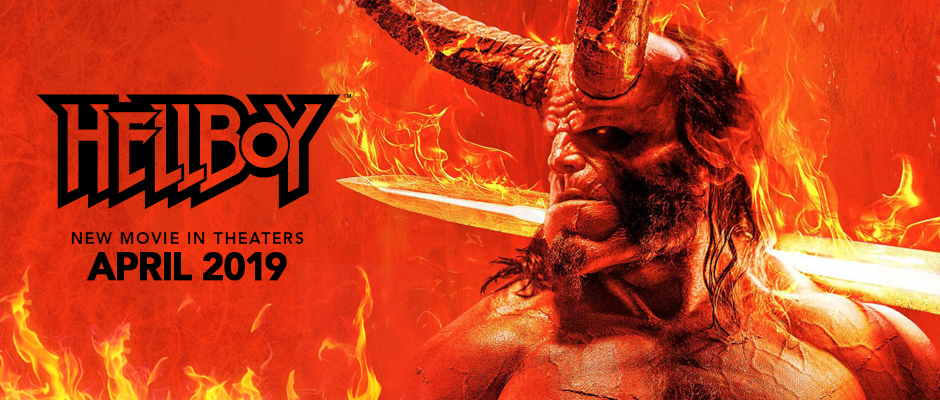
Hellboy (2019) – Review

In 2004, visionary director Guillermo del Toro adapted the Mike Mignola comic Hellboy to the big screen — it didn’t make much money — then in 2008, Del toro followed up that film with Hellboy II: The Golden Army, a film even better than the original — and it also didn’t make much money — which of course in Hollywood parlance means it’s time for a REBOOT. This led to the big question, “How does one go about rebooting a series based on comic property that has failed to produce box office gold with its first two swings at bat?” Well apparently, director Neil Marshall, and the people at Lionsgate, thought going for a hard “R” would do the trick, maybe get some of that Deadpool money. Sadly, it takes more than a little gore and a few “F” bombs to make a successful movie.


Do you like films with seemingly endless and tedious exposition? Boy do we have the movie for you. With this reboot of Hellboy, we basically get two hours of people sitting around talking about the plot, then Hellboy will leave to punch a monster before arriving at a new location so that he and his pals can sit around and talk about the plot some more. Whenever someone isn’t reiterating the events we’ve already had explained to us, ad nauseam, director Neil Marshall will then punish us with one of forty or sixty flashback sequences that populate this film — I may be exaggerating a tad, but God does he overkill it with these things — and when we aren’t being subjected to massive expository dumps, our main characters will take side quests that have pretty much no bearing on the plot. If this film had been properly edited, it would be about as long as an episode of Supernatural.


This movie is so jam-packed it should have come with CliffsNotes.

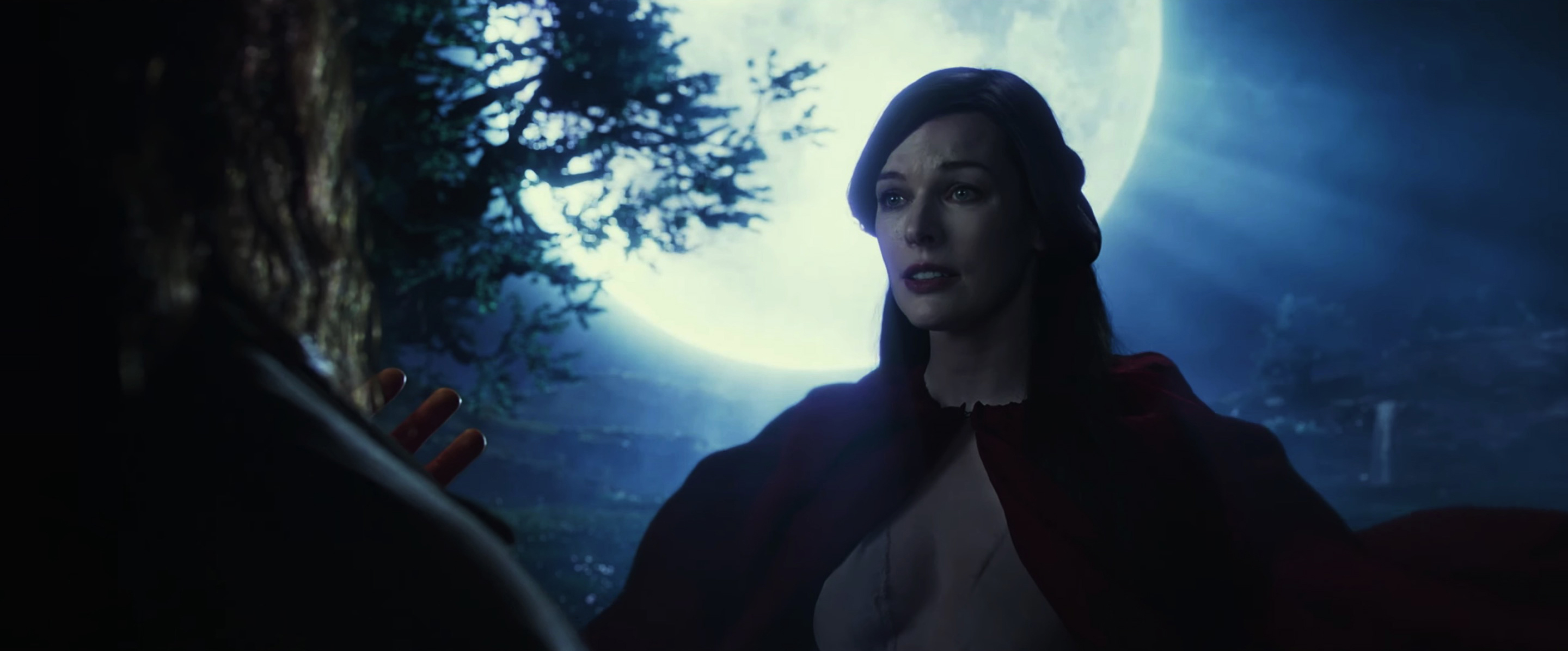
So what exactly is the plot of Neil Marshall’s Hellboy, you ask? Well, in an opening prologue, we learn that back during the Middle Ages a witch named Nimue “The Blood Queen” (Milla Jovovich) was betrayed by her coven and dismembered by Merlin and King Arthur. Her body parts were then placed in separate magically sealed chests and spirited away to the four corners of England. We’re told that she had planned to unleash some deadly plague to wipe out that pesky scourge we call humanity — looking at the world today you can't really fault her — and something about finding a demonic mate to rule a new world. As far as villains go, Nimue is about as boring and generic as it gets. The movie teases us with some complexity to her character, with Nimue meeting with Arthur to work out some kind of truce and then being betrayed, which could have led to her being a sympathetic character, but the screenplay pretty much ditches all that to give us another snarling harpy bent on world domination.


“Hellboy, have you heard of something called the Me Too movement?”

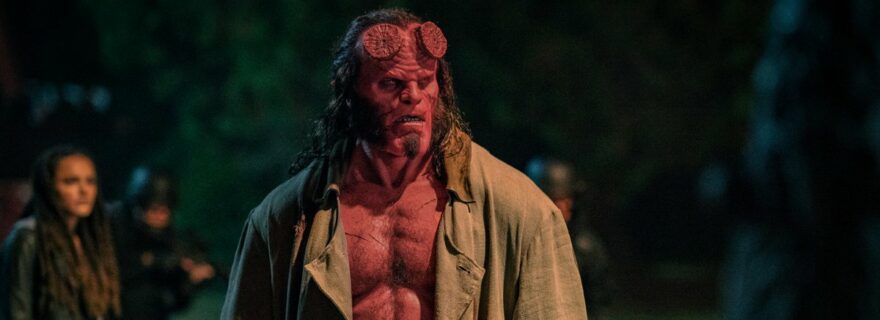
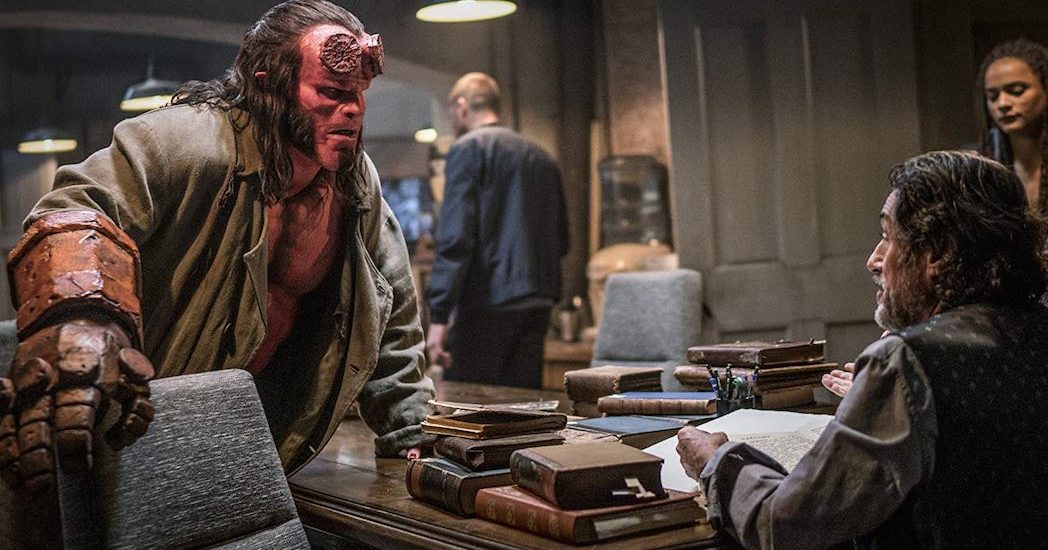
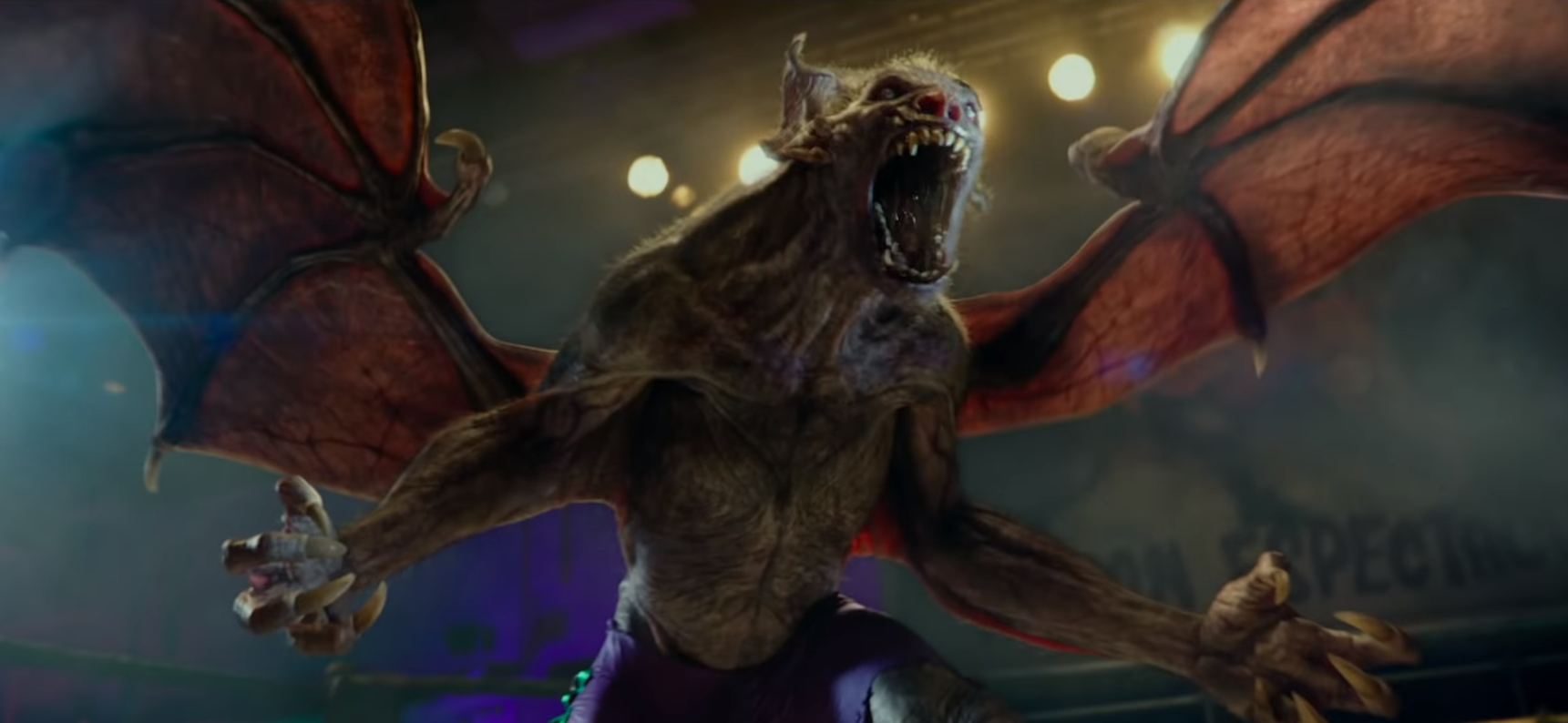
Then we have Hellboy (David Harbour) as a disgruntled employee of the B.P.R.D. (The Bureau for Paranormal Research and Defense) who is sad that he was forced to kill a friend and fellow agent, that said agent having been turned into a vampiric luchadore — damn but does that sound like a better idea for a movie than what we get here with cliché witches and lame prophesies — and things are made worse by the strained relationship between Hellboy and his adoptive father Professor Broom (Ian McShane), a man who shows not one ounce of fatherly compassion or concern about the fact that he has been sending his son out to do battle against a cadre of monsters on what looks to be a never-ending mission. I love Ian McShane to death, but this version of Broom is more in keeping with McShane’s Al Swearengen character from Deadwood than the kindly father figure from either the comic books or the Guillermo del Toro movies.


“God rest the souls of that poor family... and pussy's half price for the next 15 minutes.”

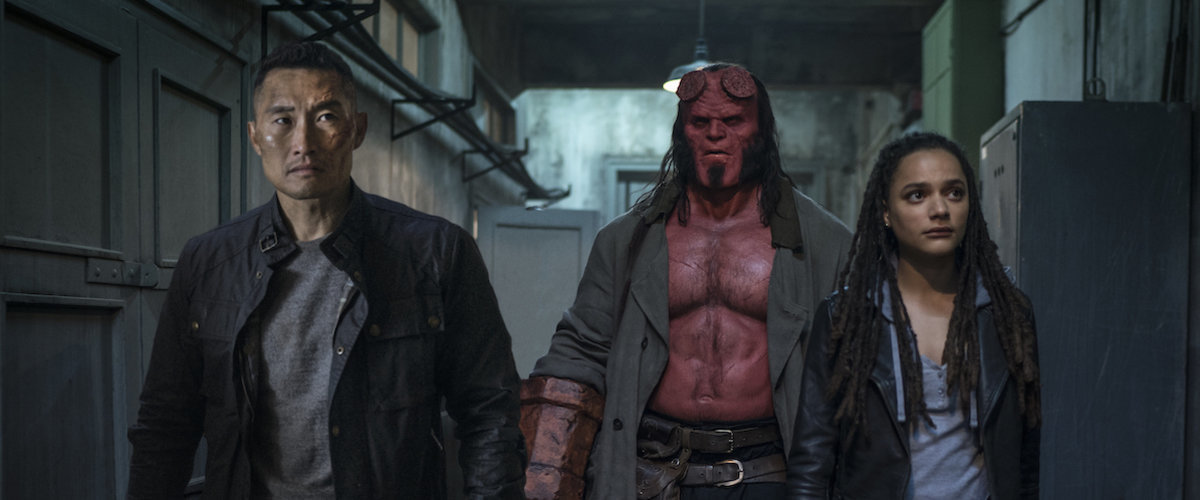
In this two-hour reboot, we find Hellboy encountering the aforementioned Lucha libre vampire. After that, he’s sent off to England to aid the British version of the B.P.R.D. in hunting three giants, he then hooks up with an old friend (Sasha Lane) who just so happens to be able to talk to the dead, and then visits with the British M11 agents in their secret headquarters, where he is partnered up with an agent (Daniel Dae Kim), a man with a personal grudge against monsters and considers Hellboy a threat to the world’s safety. Hellboy has a tussle with an ex-changeling pig monster, one that looks a lot like Bebop from the Teenage Mutant Ninja Turtles, gets briefly shanghaied by Baba Yaga, who is pissed at him for taking one of her eyes, and then Hellboy has a nice meeting with a briefly resurrected Merlin (Brian Gleeson). Now with all this going on, Hellboy does manage to cross paths with Nimue once or twice, you know the actual villain of this movie, but with the amount of clutter in this film, she's lost amongst all the noise.


Here’s Team Hellboy, don’t ask me their names as I’ve already forgotten them.

Any one of those encounters listed above could have been made into a solid Hellboy movie, but instead they are all crammed into this one film, and because of this, they are all drastically shortchanged, especially Nimue, who once again I must point out is the film’s primary antagonist. I feel obliged to keep pointing this out because clearly Neil Marshall was unaware of her importance. I have to believe that the filmmakers were more concerned with getting that precious “R” rating than whether or not they had a solid story to tell. The result was a disappointing mishmash without any heart or soul, which are two key components in telling a good Hellboy story.

As for that “R” rating, well all they managed to do was stuff obtrusively bad gore into lame sequences, and create moments that were chocked full of terrible CGI monsters rampaging through the streets of London, which is truly a shame because we do get practical effects and make-up used to create many of the creatures in this film, and they are all quite good, but the film undercuts this wonderful work by shoving cheap computer-generated images in our faces.


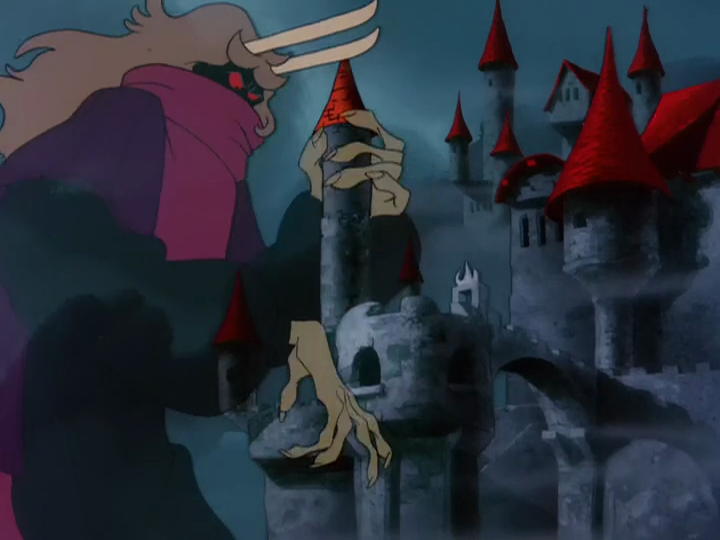
Shouldn’t this thing be off fighting Scooby-Doo and the gang?

Neil Marshall has a solid resume with this genre, having given us such films as Dog Soldiers, Doomsday, and the Descent, but with his take on Hellboy we get none of the fun or terror found in his earlier works. All the jokes fall flat, which is pretty bad considering the Hellboy comics are basically horror-comedy, and none of the characters develop into anything remotely memorable, and when words like “prophecy” and “destiny” are bandied about, we can only roll our eyes in despair. There is some solid action sequences to be found in this movie, choregraphed fights that you can actually follow, and Harbour does try his best with the material given — some of it being pretty bad — but he's mostly guilty of not being Ron Perlman.

I was sad when I first heard that Guillermo del Toro and Ron Perlman were not going to be allowed to finish the story they had worked so hard on, yet I was not going to hold that against Neil Marshall and David Harbour; I truly wanted this film to succeed because I love that character, but sadly, the end result was certainly not a case of third time's the charm.

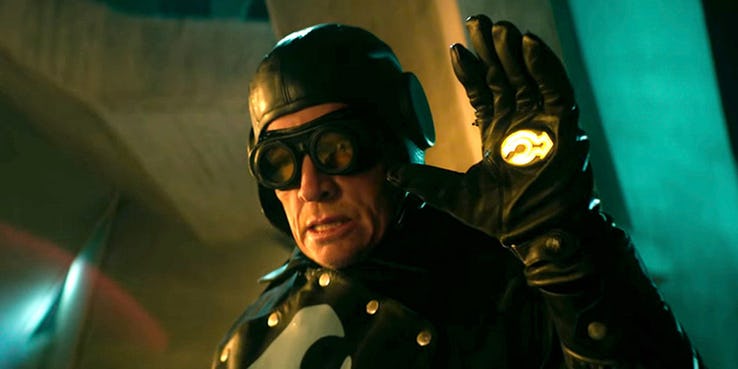
Note: The film teases us with further stories, even promising us the return of Abe Sapien — who was greatly missed in this outing — and more of the wonderful 1930s vigilante Lobster Johnson (Thomas Haden Church), but I honestly doubt we will be getting a fourth Hellboy movie any time soon.

Thursday, April 11, 2019

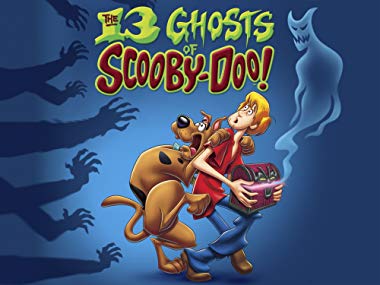
The 13 Ghosts of Scooby-Doo (1985) – Review

n five decades of Scooby-Doo mysteries, there is one show that stands apart from the rest, and that would be the 1985 series The 13 Ghosts of Scooby-Doo. It stands apart not because it had the gang encountering real ghosts and monsters (for in the second season of Scooby-Doo and Scrappy-Doo they already started dealing with actual ghosts), but because it was in the seventh incarnation of Scooby-Doo that the showrunners first introduced the idea of an ongoing story arc. The show would deal with Scooby and friends trying to round up thirteen “ghosts” that had escaped The Chest of Demons — which did kind of make the amount of episodes rather finite — but even as limited as this show’s concept was due to early cancellation, it still failed to get the story completed, that is until 2019 with Scooby-Doo and the Curse of the 13th Ghost.


 A modern viewer looking back at The 13 Ghosts of Scooby-Doo may posit the question, “Where in the hell are Fred and Velma?” Sadly, it was due to poor ratings that network brass decided to revamp the series by introducing Scooby-Doo’s rambunctious nephew Scrappy-Doo — to be fair, this did save the show from cancellation — but come the fifth incarnation of the show, Scooby-Doo and Scrappy Doo, the network also decided to drop poor Fred, Daphne and Velma from the cast — though Daphne would return for The New Scooby and Scrappy Doo Show and carry on without Fred and Velma right through to the show we are talking about today, The 13 Ghosts of Scooby-Doo.
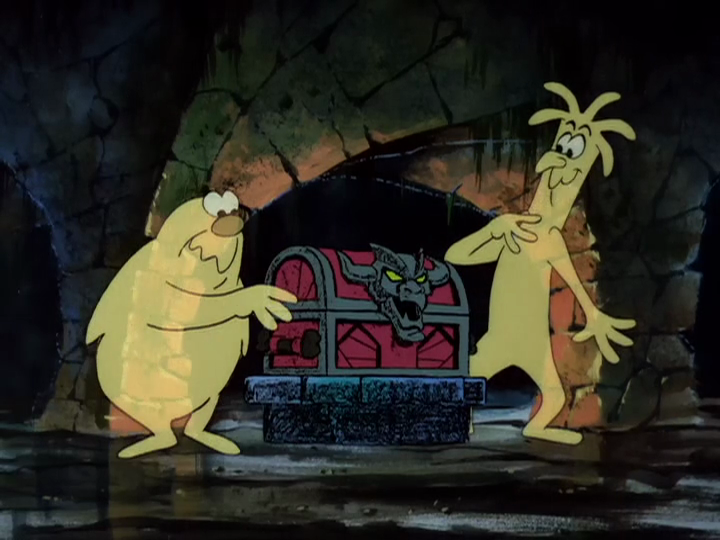
This series finds our gang, consisting of Shaggy (Casey Kasem), Daphne Blake (Heather North) Scooby-Doo and Scrappy-Doo (Don Messick), being thrown off course while on a trip to Honolulu via the Himalayan mountains, where a couple of bumbling ghosts — Weerd (Arte Johnson) and Bogel (Howard Morris) — have plotted to trick our heroes into opening the Chest of Demons, a magical artifact which houses the thirteen most terrifying and powerful ghosts and demons to ever walk the face of the Earth.


It’s at this point we realize that maybe a guy in a mask is a better threat.

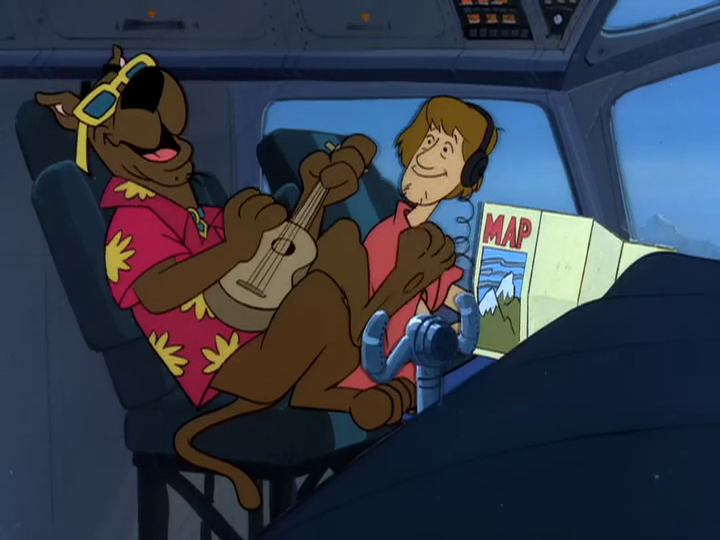
Even as a short-lived series, The 13 Ghosts of Scooby-Doo raised a few questions — the whole real ghosts and demons being a given — with the biggest question being, “When exactly did they trade in The Mystery Machine for a Mystery Plane and how did they pay for it?” Throughout the many incarnations of the Scooby-Doo show, I’ve always been left wondering, “Where does the money for all this mystery solving come from?” In all their globetrotting adventures we never see the gang getting paid for exposing amusement park owners as mask-wearing criminals, so were we to assume that they were independently wealthy and that ghost hunting was their choice of philanthropy? Even weirder than seeing them flying around in a private plane is the fact that Daphne seemed okay with Shaggy and Scooby as pilots.


What state issued these idiots a pilot’s license?

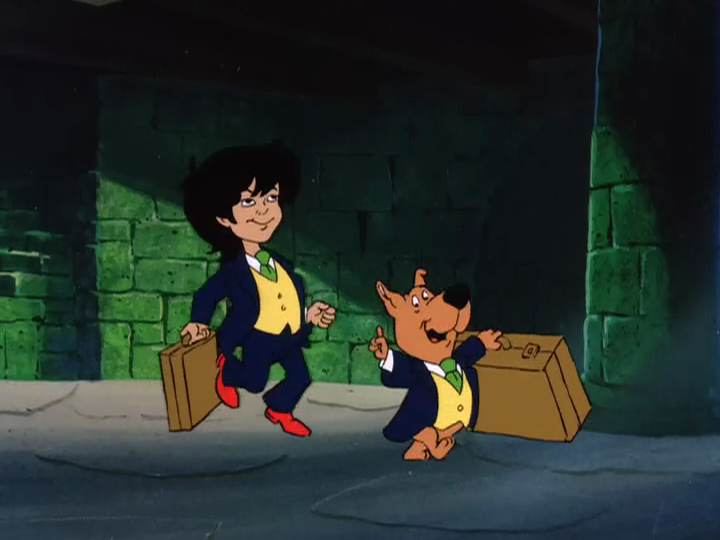
Another most notable addition to the Scooby-Doo canon is the appearance of Flim Flam (Susan Blu), a pint-sized con artist who we first meet as he’s being chased by a mob of townsfolk — him being guilty of selling a supposed miracle drink called “Lotsa Luck Joy Juice” which he claimed could remove unwanted curses, jinxes and evil spells, while also working as a rocket fuel and being a darn good dandruff remover — and Flim Flam's sole purpose in this show seemed to be in trumping Scrappy-Doo in the obnoxiously annoying category. For much of this show's thirteen episode run, we find Scrappy and Flim Flam working together — pulling off the disguise gags that were the staple of Scooby and Shaggy’s antics — which of course left little for our regular cast of characters to do.  Shaggy and Scooby were basically relegated to running and hiding while poor Daphne was given even less to do — which considering her old job revolved around her mostly getting tied up by the villain, that’s saying something. This was all made worse by the fact that Scrappy and Flim Flam were basically just carbon copies of each other’s characters. They had almost identical, very annoying character traits, with the only difference between them being that one of them was apparently human.


That Flim Flam and Scrappy never returned as regulars is no surprise.

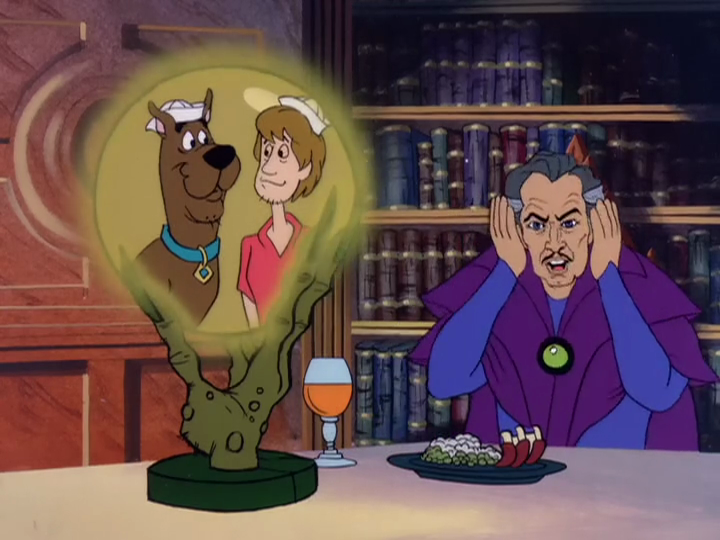
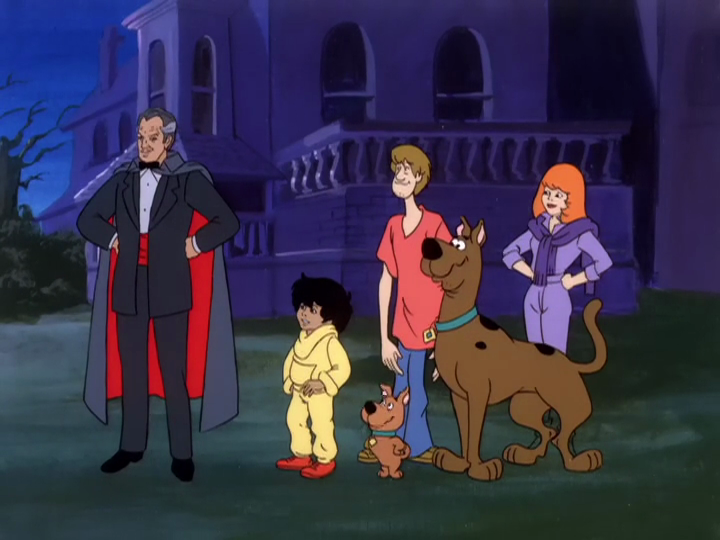
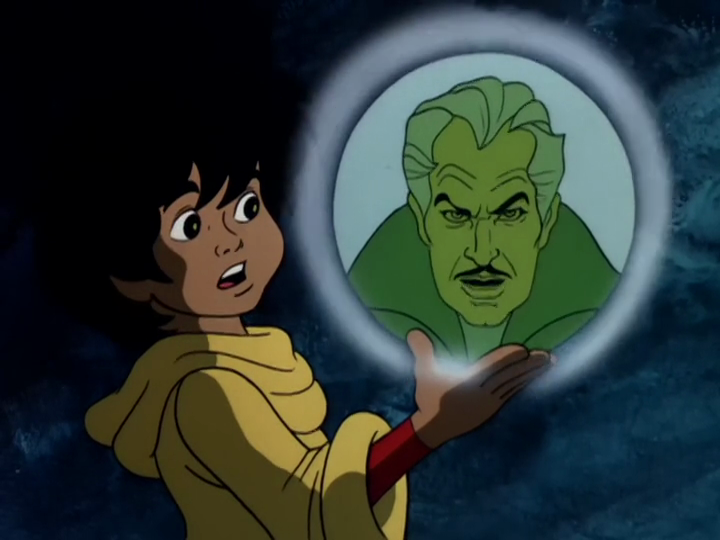
Rounding out the cast of The 13 Ghosts of Scooby-Doo was Vincent Van Ghoul (Vincent Price), a renowned magician and warlock who was enlisted to help the gang when the Chest of Demons was opened by Shaggy and Scooby, and his role in the show was much in keeping with the 1970s television show Charlie's Angels, as each week he’d inform our heroes of the activities of one of the escaped “ghosts” and he'd point them in the right direction. Though Vincent would give them much needed aid, often via crystal ball communications or magical rescues, he mostly worked as their disgruntled boss — though once again it's not as if he was paying them for any of this — and he would only rarely become directly involved in a particularly ghostly encounter.


"See no evil, speak no evil, get me off this show!"

As for the ghosts themselves, well this was probably the weirdest aspect of the show, because they don’t really come across as being all that ghostly — that they came out of something called the Chest of Demons being a big clue to this — as they run the gamut from zombies to witches to demons, with only Weerd and Bogel providing the show with regular ghostly appearances. Was this supposed to be a case of these creatures having been killed sometime in the past, and now our gang was to do battle with their ghostly versions? If so, none of them acted in any particularly ghostly manner, and can you even have a ghost of a zombie or a demon? The first “ghost” the gang tracked down was the warlock Maldor the Malevolent, who didn't let being dead slow him down any as he easily bent reality and conjured up dragons to fight our heroes.


Maldor even turns himself into a giant to terrorize Scooby.

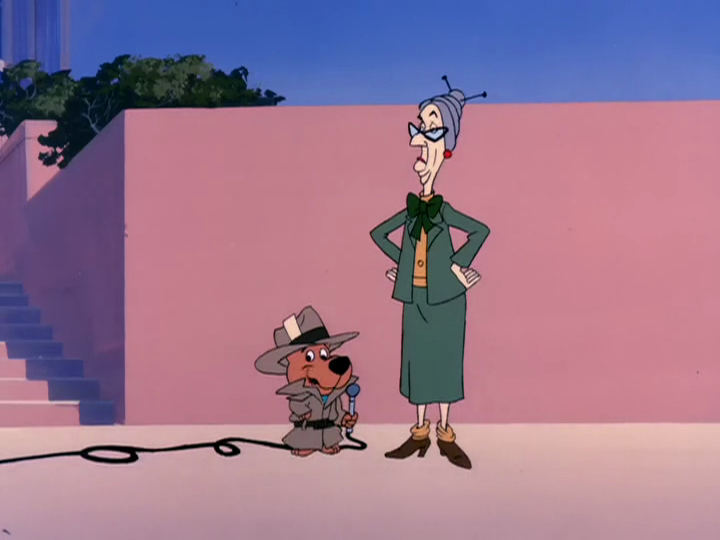
Another unique characteristic of The 13 Ghosts of Scooby-Doo was the constant breaking of the fourth wall — mostly handled by Scrappy and Flim Flam, of course — which provided some decidedly weird moments. For example, in the episode with Maldor the Malevolent their battle with the evil warlock was interrupted by a “Special Editorial” where Scrappy Doo accosted a woman named Loretta Cut-it-Out from the Bureau of Television No Nos, and who had raised concerns about the use of fire during the dragon sequence (fire being a dangerous element for children). Scrappy then accused her of being “Anti-Dragon.” It’s clear that the show’s writers were having fun taking pot shots at the television Standards and Practices of the time, which had violence in morning cartoons being constantly under fire from parent groups, and this was a really fun and meta point in the show. Maybe if they'd done a little more of this type of humor we'd have developed a little less hate for Scrappy-Doo.

Note: It was Standard and Practices that prevented such shows as the Super Friends from allowing Batman and Robin to punch bad guys.

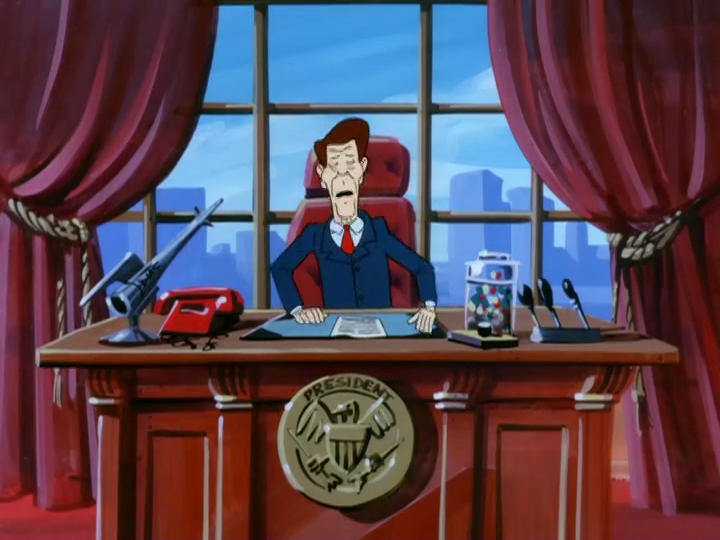
This show went into even stranger areas with such episodes as "That's Monstertainment," where our heroes were trapped inside an old black and white monster movie; or in the episode "Scooby in Kwackyland," we find that the villainous Demondo has trapped them in the newspaper comics section. Then there was the episode “It’s a Wonderful Scoob,” where Vincent Van Ghoul takes a depressed Scooby to the future to show him what the world would be like if he didn't return to ghost hunting, and during that episode we also discover that kids are actually watching The 13 Ghosts of Scooby-Doo, as if it was a live broadcast of real events.


Even Ronald Reagan steps in to plea for Scooby’s return to the show.

It’s these meta-moments that older viewers will find most entertaining, while younger viewers — like my six year-old niece — will most likely still be asking, “Where’s Velma?” and though this is far from the trainwreck that the following show A Pup Named Scooby-Doo was, it still suffers from the painful comic stylings of Scrappy and Flim Flam, and even the dulcet tones of Vincent Price can’t save The 13 Ghosts of Scooby-Doo from falling flat more times than not. This all led to the show being cancelled before the last ghosts were caught — though I doubt even audiences of the time were keeping score — and we had to wait three decades for a proper conclusion.

Stray Observations:

• Daphne trades in her standard purple dress for a more modern jumpsuit.
The Mystery Machine isn’t just replaced by a plane; the gang also drives around in a cool red van that works as a strategic all-terrain mobile command unit, one that has an inflatable ducky raft.
• In the episode “It’s a Wonderful Scoob,” Scooby meets future Daphne and Shaggy, but for some reason Flim Flam is still a kid and Scrappy is still a pup.
• In the episode "Reflections in a Ghoulish Eye," the Scooby Gang encounter a character that is an homage/rip-off of Martin Short’s Second City character Ed Grimley, “I must say.”
• In the episode "A Ship of Ghouls," we get a flip on a standard Scooby trope, with the ship’s captain having his mask pulled off to reveal he is a ghost.
• Episode titles for Scooby-Doo have always been pun-centric, but The 13 Ghosts of Scooby-Doo adds a little wrinkle by going with song title puns, such as "To All the Ghouls I've Loved Before, "Me and My Shadow Demon," and "When You Witch Upon a Star."
• Scooby-Doo and his friends never did catch all 13 ghosts. Only 11 of them were shown being caught, which means that even after the release of Scooby-Doo and the Curse of the 13th Ghost  we still have one more ghost unaccounted for.


Math was never a strong suit with this group.

When a show runs on for about five decades there is going to be some high points and some low points, and I'd say this particular run was at most a mid-point in the history of Scooby Doo, and though The 13 Ghosts of Scooby-Doo does contain two of the more reviled characters in the show’s history, the idea of a story arc was a noble effort, one that sadly wouldn’t again be attempted until 2010 in the series Scooby Doo! Mystery Incorporated. There is still enough on hand to make this show worth a watch, even if it’s just to listen to the awesome voice work of the always entertaining Vincent Price.


Vincent Price, Master of Comedy and Terror.

Dollman (1991) – Review

Science fiction stories about tiny protagonists have been around for quite some time; Universal Pictures adapted Richard Matheson’s story of a man shrunken due to exposure to a radioactive cloud into the classic film The Incredible Shrinking Man, and of course Disney’s popular Honey I Shrunk the Kids dealt with the classic idea of a scientist and his shrinking ray, but it was the late 60s television show Land of the Giants, created by legendary producer Irwin Allen, that dealt with a small group of space travelers who found themselves dragged through a space warp and onto a world of giants, that is the closest inspiration I can find to Charles Band’s cinematic “masterpiece” Dollman.


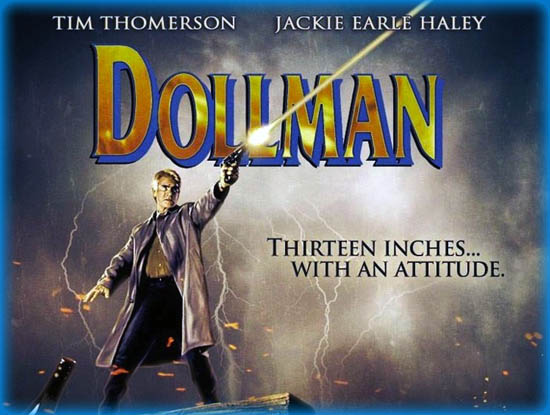
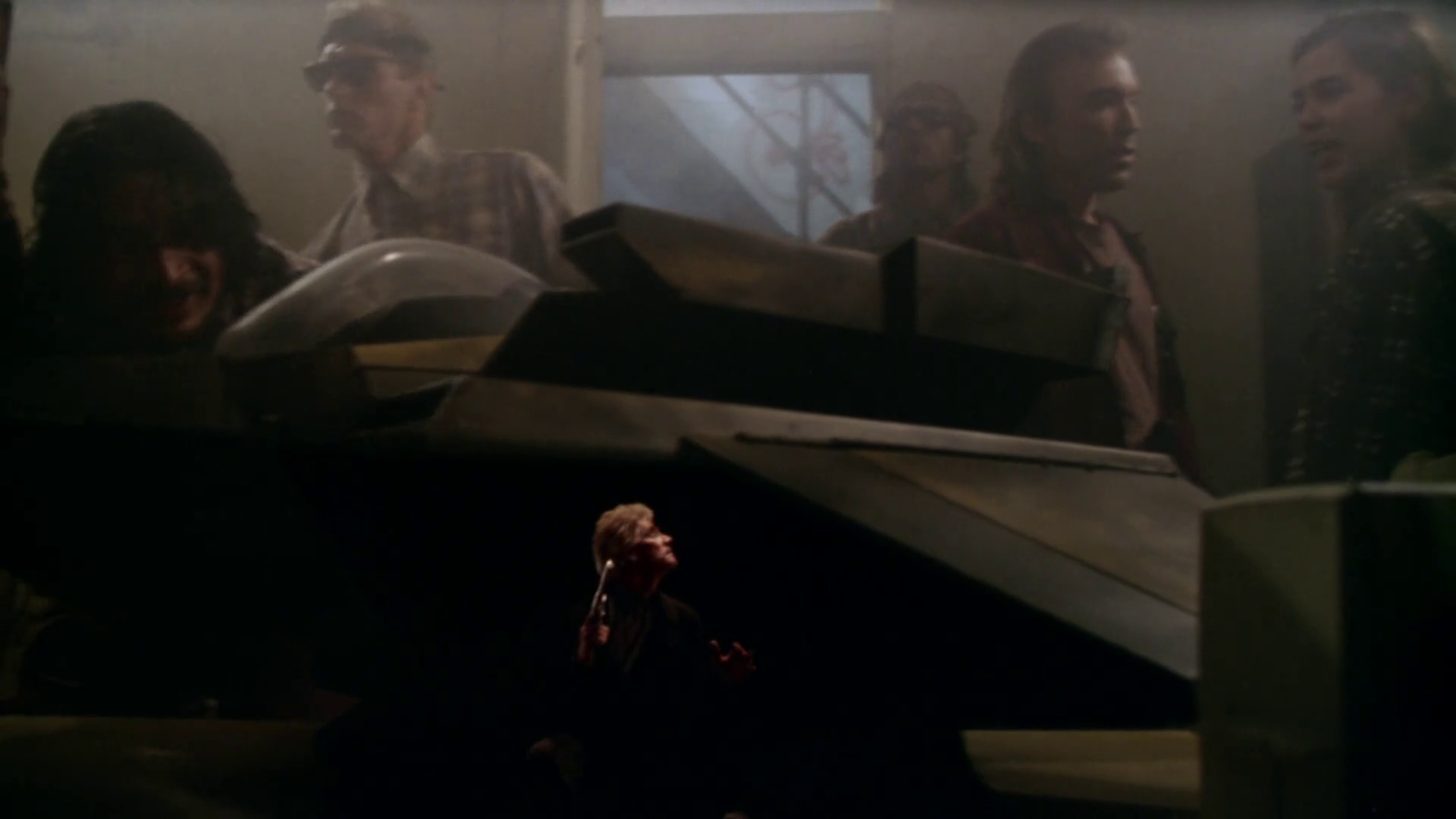
 If you are unaware of the name Charles Band and his production company Full Moon Entertainment — which introduced such classics to the world as the Puppet Master and Trancer franchises — you have probably led a more sedate and sheltered cinematic life than my own, for Band and company were mostly known for producing low budget exploitation flicks, with lots of gore and nudity, while not worrying so much about the creation of nuanced characters or substantive stories. It is with the film Dollman, whose title character was played by the great Tim Thomerson — who also played the lead hero in the Trancer films — that Charles Band clearly wanted to start another franchise with his 13 inch Dirty Harry. She, this was not to be, aside from a cameo in the 1992 film Bad Channels, and crossover sequel Dollman vs. Demonic Toys, this idea was pretty much doomed from the beginning, for as cool as a concept of a pint sized super cop was, these classy filmmakers had neither the skills nor the budget to effectively pull it off. Someone should have pointed out to them that if your effects-work is worse than what we’ve seen on a television show made back in the 60s, then maybe you need to rethink your premise.


Dollman vs. Bad Opticals.

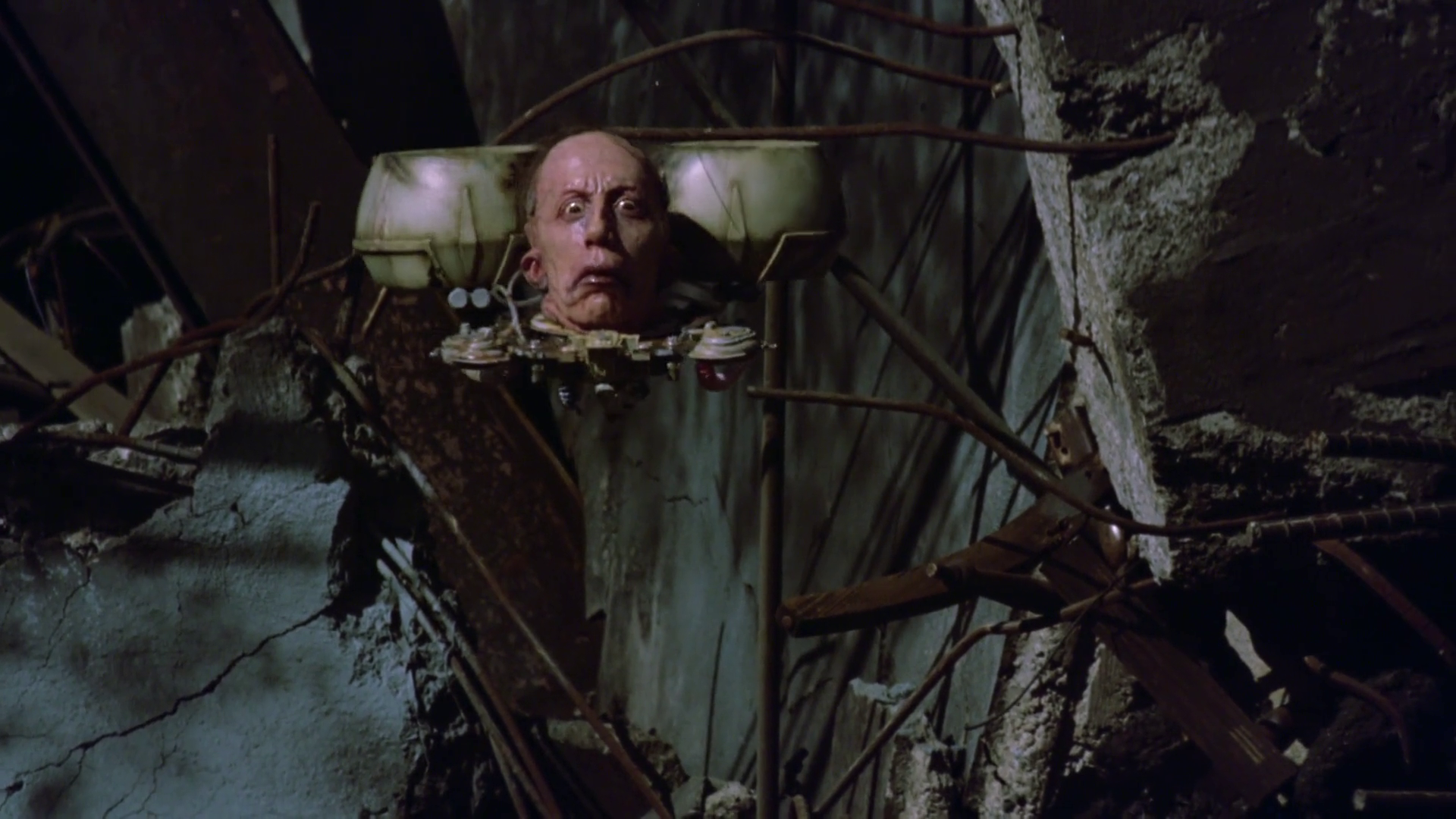
The premise of Dollman is fairly simple; we’ve got badass hero Brick Bardo (Tim Thomerson), who tries to keep the streets clean on planet Arturos from all the scum and villainy, and Bardo is basically your standard cliché cop — suspended from the force and prone to blowing away villains rather than arresting them — and when he attempts to chase down his greatest enemy Sprug (Frank Collison) (who due to numerous violent encounters with Bardo is now just a floating head), they end up in a brief space chase where he and Sprug fly their respective spaceships through a strange energy band, which sends them to Earth. Unfortunately, for these two on our Earth everything is larger by a six to one ratio. Bardo crash-lands in the South Bronx, in a territory run by gang leader Braxton Red (Jackie Earle Haley), and his first encounter is with gang members who aren’t too fond of Neighbourhood Watch leader Debi Alejandro (Kamala Lopez), and so Bardo must step in and save the day.


Groger Blaster, the most powerful handgun in the universe!

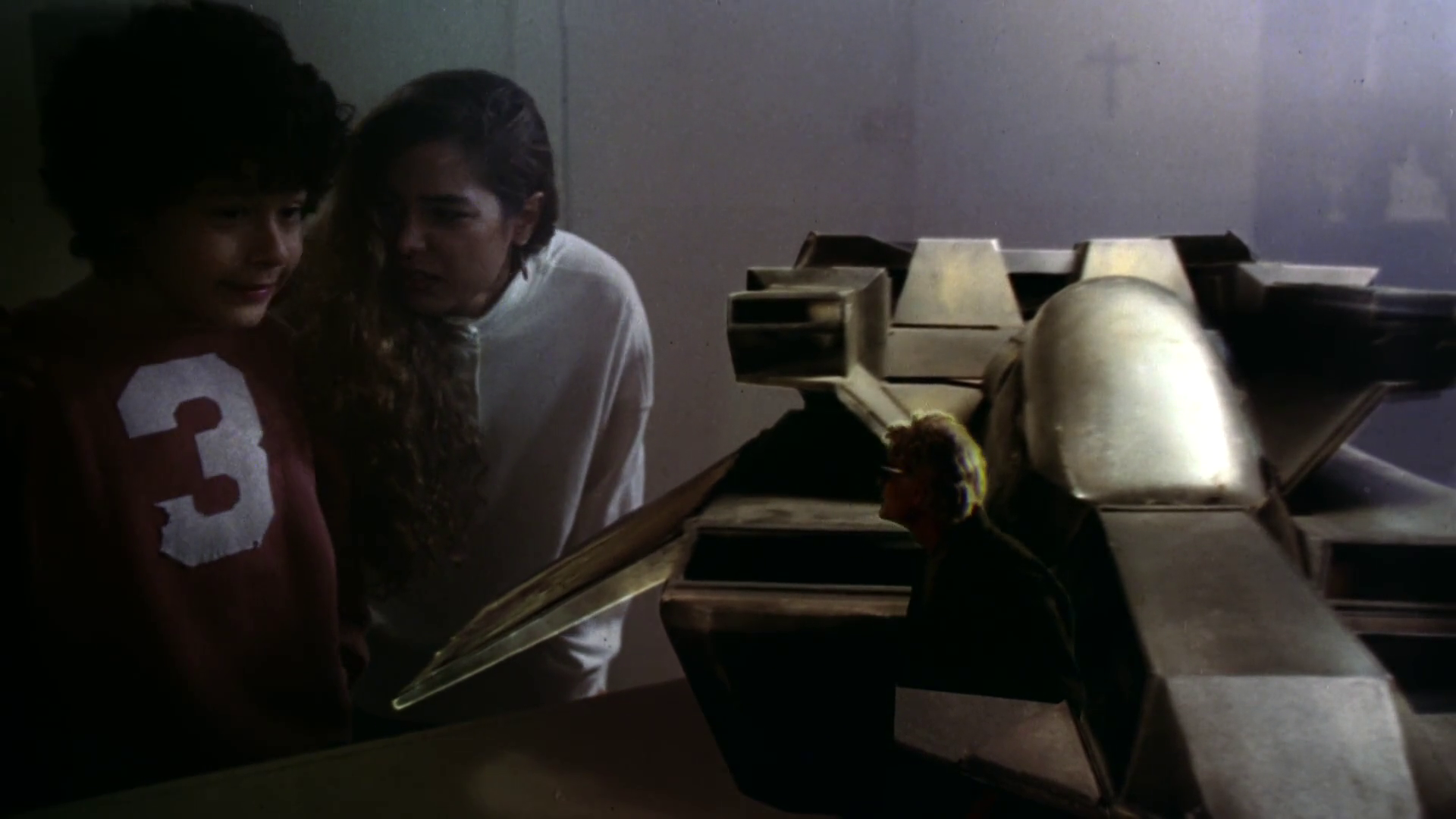
Aside from the “shrunken hero” aspect of Dollman, there isn’t an ounce of originality to be found in its short eighty minute run-time; we have Deb as the noble Hispanic mother, who wants to keep her young son (Humberto Ortiz) from joining one of the local gangs, and she gets no help from police Captain Shuller (Eugene Robert Glazer), who is more interested in getting sound bites than actually cleaning up poor neighbourhoods. This could easily be one of the crappy Deathwish sequels, with Tim Thomerson stepping in for Charles Bronson by way of Dirty Harry, because the whole aspect of him being a thirteen inch cop with a gun doesn’t really add much to the story. For most of the film’s run-time he and his ship just sit on Deb’s kitchen table, where neighbours pop in to occasionally gawk at him, and none of the film’s shootouts would have been any different if he’d been a full sized cop — well other than him being a slightly smaller target to shoot at — but these gangbangers are so bad at their jobs, they probably would have missed him even if he was eight feet tall and stationary.


To be fair, it does make hiding easier.

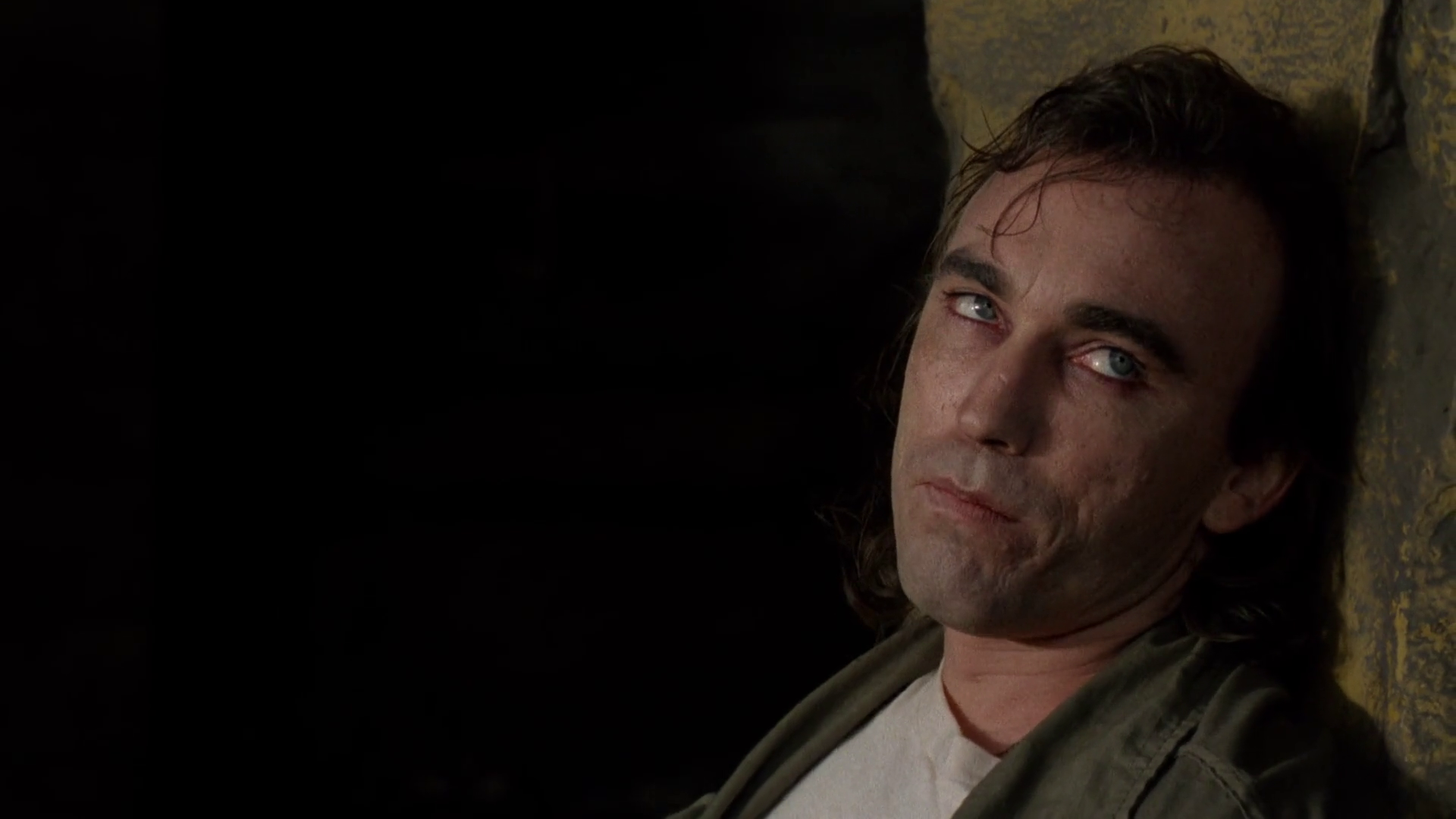
About the only interesting element of this film was the hinted-at relationship between Braxton and Deb, that he had in the past ordered his men to leave her alone — even though she is a thorn in the side of his organization — but we never find out exactly why this was the case. Did they grow up together as friends but then drifted apart when he joined a gang? The film doesn’t have time to explore this kind of thing, too much random violence to fit in, which is a shame because the only standout performance in this film was the one given by Jackie Earl Haley. He is given a brief villain monologue at the end of the film, one that hints at him being an actual flesh and blood character, but then he blows himself up, so let’s not worry about that.


Jackie Earl Haley, this film’s MVP.

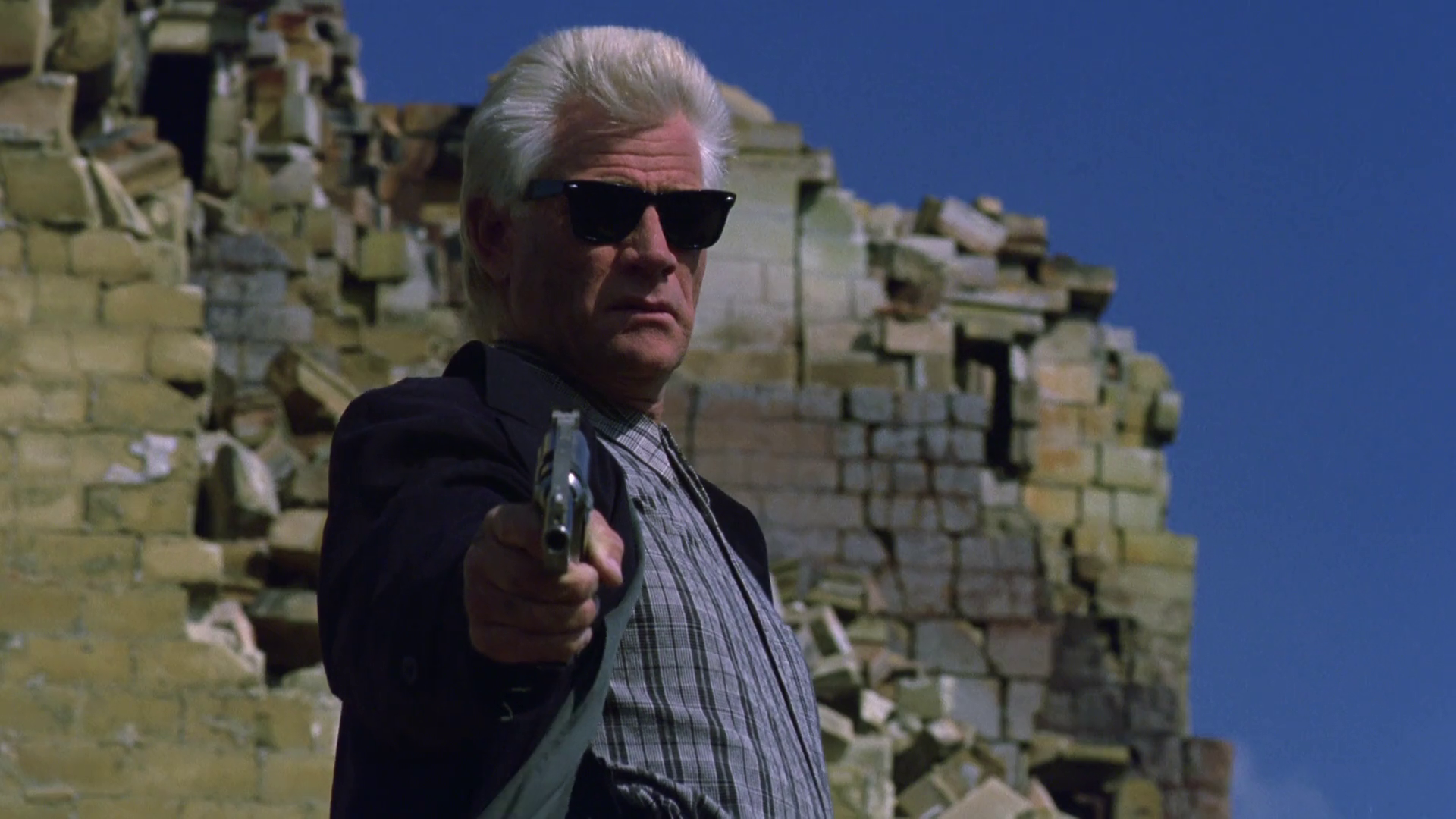
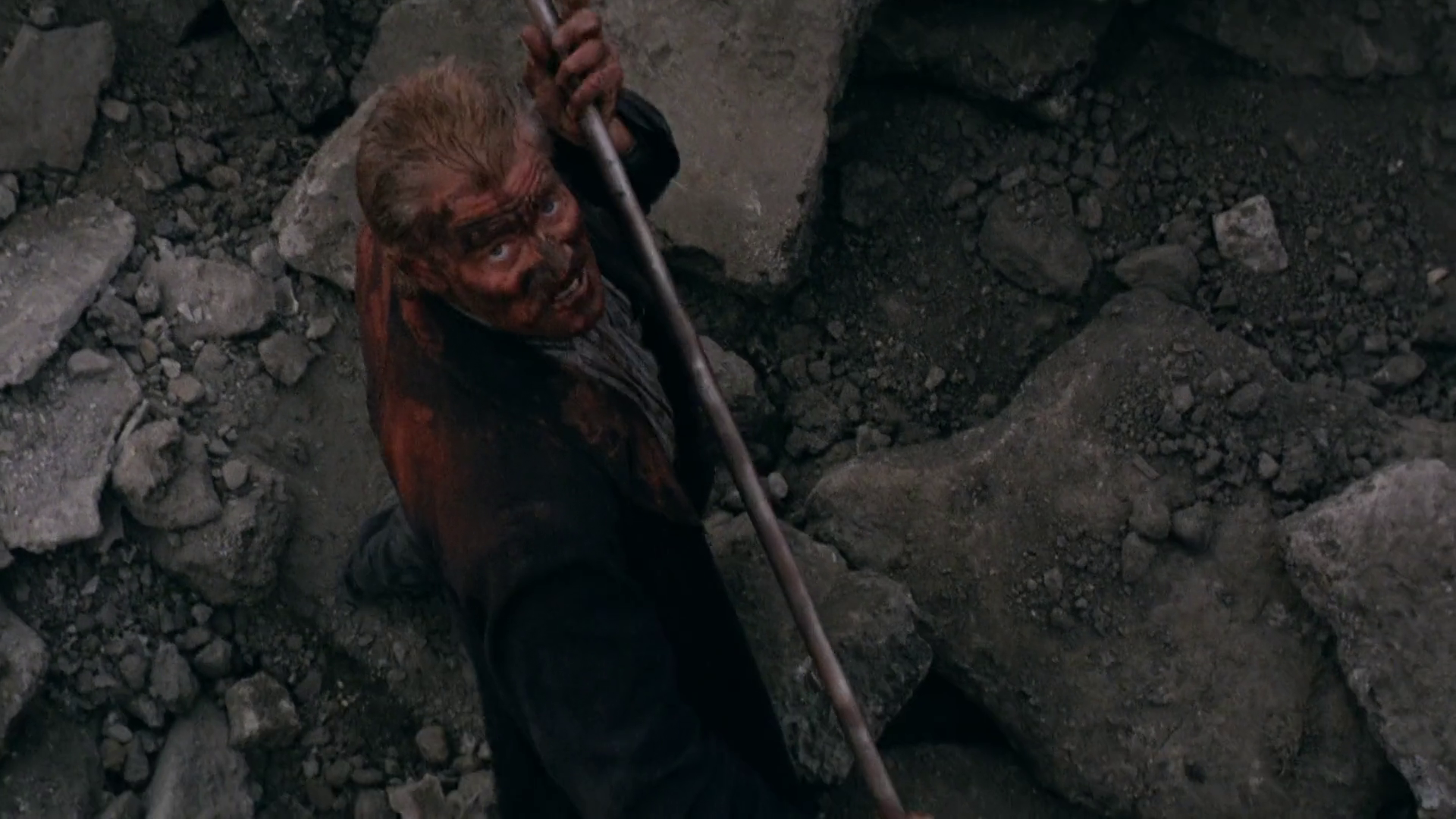
It’s obvious that director Albert Pyun had virtually no budget to work with, as for the most part the “cop in a land of giants” premise is handled by either long POV sheets of Brick Bardo running through rubble or him standing in front of rubble — this version of the Bronx consists mostly of rubble — all because they had no money to build scale sets or props. The film also seemed uninterested in dealing with how a thirteen inch dude could take on a gang of street thugs in any creative capacity whatsoever, as he mostly just shoots them with his hand cannon — which on his world pretty much explodes people while on Earth it just makes fist-sized holes in people — so not much different than any other cop vs. thug scene in any generic action film. The one time they try to do something different — with thirteen inch Bardo sneaking up on a gang member — they completely fuck it up, because they have Bardo knock a guy out with a long pipe … well, long if you're thirteen inches high, but when used against a regular sized dude, it’d be like hitting somebody across the head with a knitting needle, which is not going to knock someone out.


“From Hell’s heart, I poke at thee!”

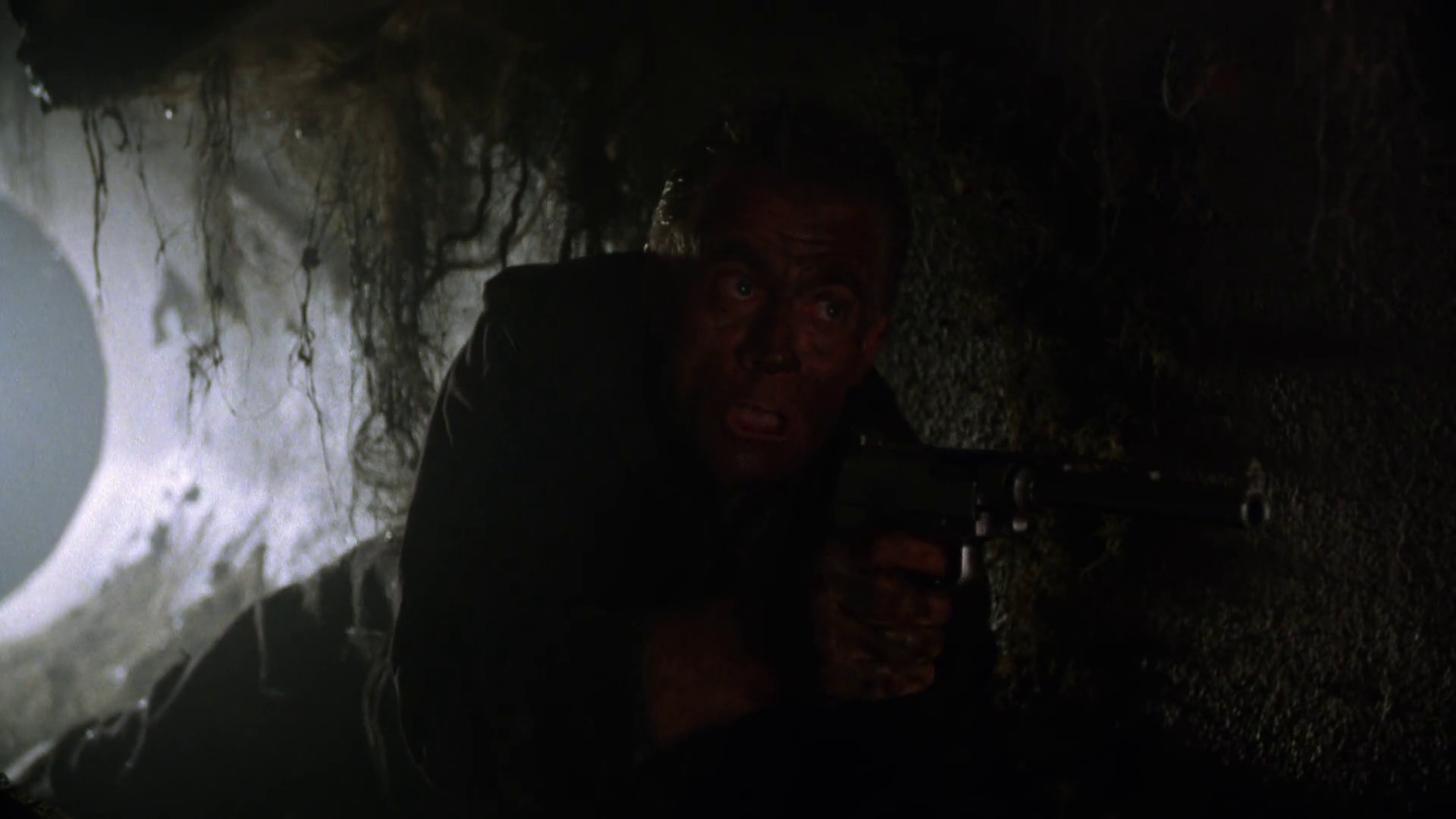
Is Brick Bardo supposed to be made of denser matter, and that's why he is able to hit people with the proportionate strength of a regular sized person, like Marvel’s Ant Man? If Charles Band and Albert Pyun had bothered to put more than ten seconds of thought into this film’s science fiction premise I’d be very much surprised, because the one scene where he sneaks through a small drainage pipe is the only moment where he kind of utilizes being tiny … oh, he does hang onto the gang’s car door so that he can follow them to where they have Deb held hostage, so I guess that’s two times he exploits the advantage of being small, but even the scene in the drainpipe is a big disappointment. He encounters a rat, but instead of a cool “man against rat” fight, the rodent just scurries away, probably to audition for the remake of Willard.


“Go ahead, make my millennia!”

There’s not much fun or substance for even the most forgiving of genre fans to focus on, and aside from Jackie Earl Haley’s performance, and whatever enjoyment you can get out of Tim Thomerson’s Dirty Harry impression, Dollman is a lost effort, for as a whole, the film is fairly predictable and forgettable.

Couple of Stray Observations:

• On the planet Arturos we hear a news report that seems to be framing Brick Bardo for the death of a bunch of hostages, when in reality he saved them all, but this idea of a corrupt media is never addressed again as we never come back to this planet.
• Deb is able to pick up Brick Bardo’s ship as if it weighed about as much as an actual toy. So is his ship made out of some super light polymer material?
• The villainous Sprug is found by Braxton’s gang and he offers them his “dimensional fusion bomb” if they help him get home, but he also tells him that this particular device has a ten second fuse and that everything within three parsecs will be sent to another dimension, forever. Now, I’m sure that these idiot gangbangers don’t know that a parsec is a unit of length used to measure astronomically large distances between objects beyond our Solar System — which certainly wouldn’t leave much of  South Bronx, or Earth for that matter, if that thing went off — but even taking into account their lack of “scientific knowledge,” who would want a bomb with only a ten second timer? Doesn’t seem very safe to me.
• When this apparent “dimensional fusion bomb” does go off, detonated by a dying Braxton, all we get is a very bright light. No real explosion, and certainly nothing disappearing into another dimension, and our heroes are definitely standing closer than three parsecs away.


I guess the moral of the story here is, “Don’t trust a floating head.”

At its heart, Dollman is just a cheapy sci-fi action flick, one laden with gore and “F” bombs to titillate teenagers, but if a viewer goes in expecting more, than that viewer may find themselves briefly entertained, but I myself found writer/producer Charles Band to be guilty of wasting a clever premise, as well as Jackie Earl Haley’s performance, in a movie that barely crawls out of the gutter long enough to get your attention. There are certainly worse examples of the genre, and even worse outings by Full Moon Entertainment, but Dollman doesn’t even fall into the category of “So bad it’s good.”

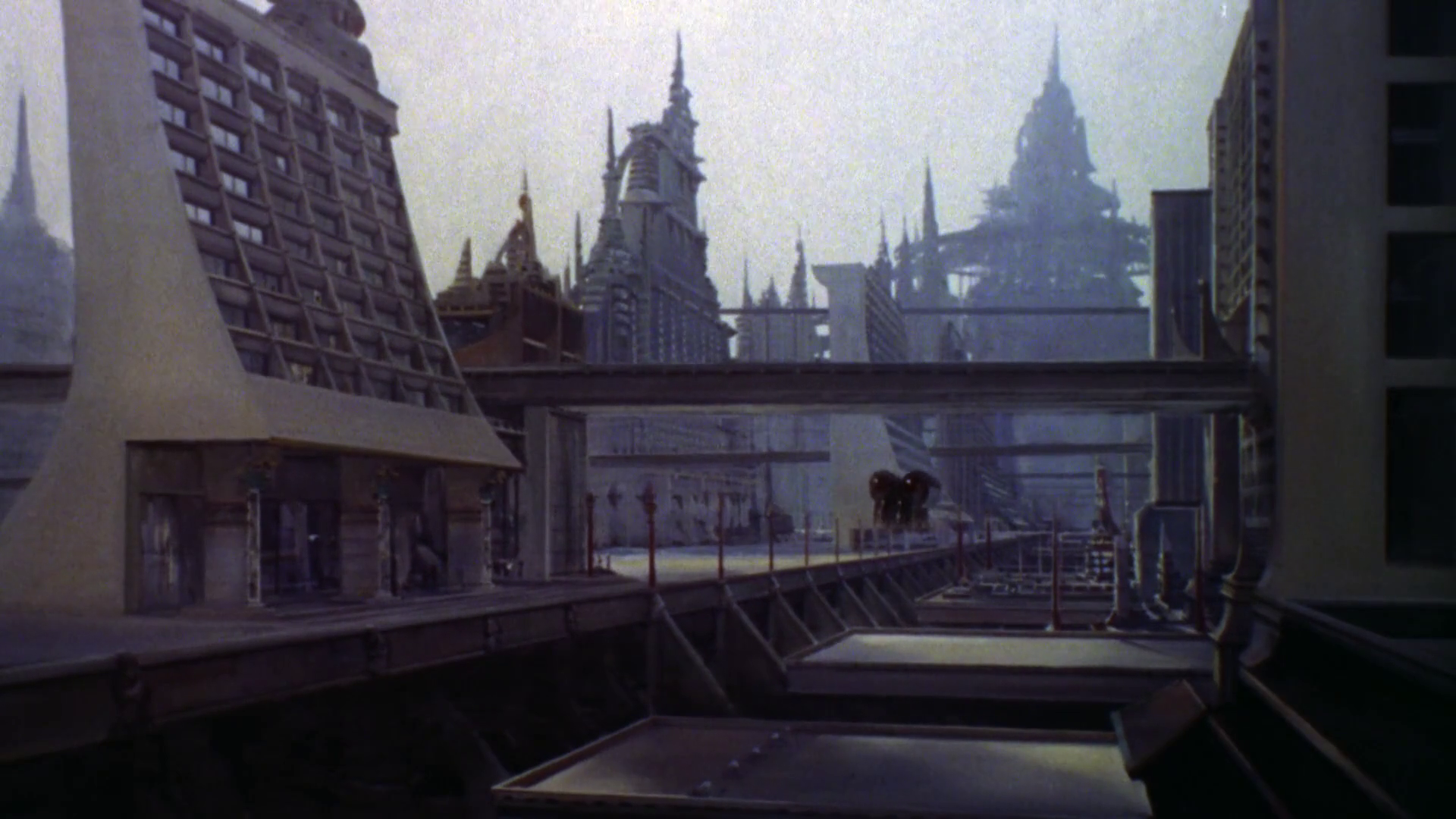
Note: The planet Arturos consists mostly of rubble, which funnily enough looks a lot like the South Bronx we later visit, and matte paintings borrowed from the television series Buck Rogers in the 25th Century.

Sunday, April 7, 2019

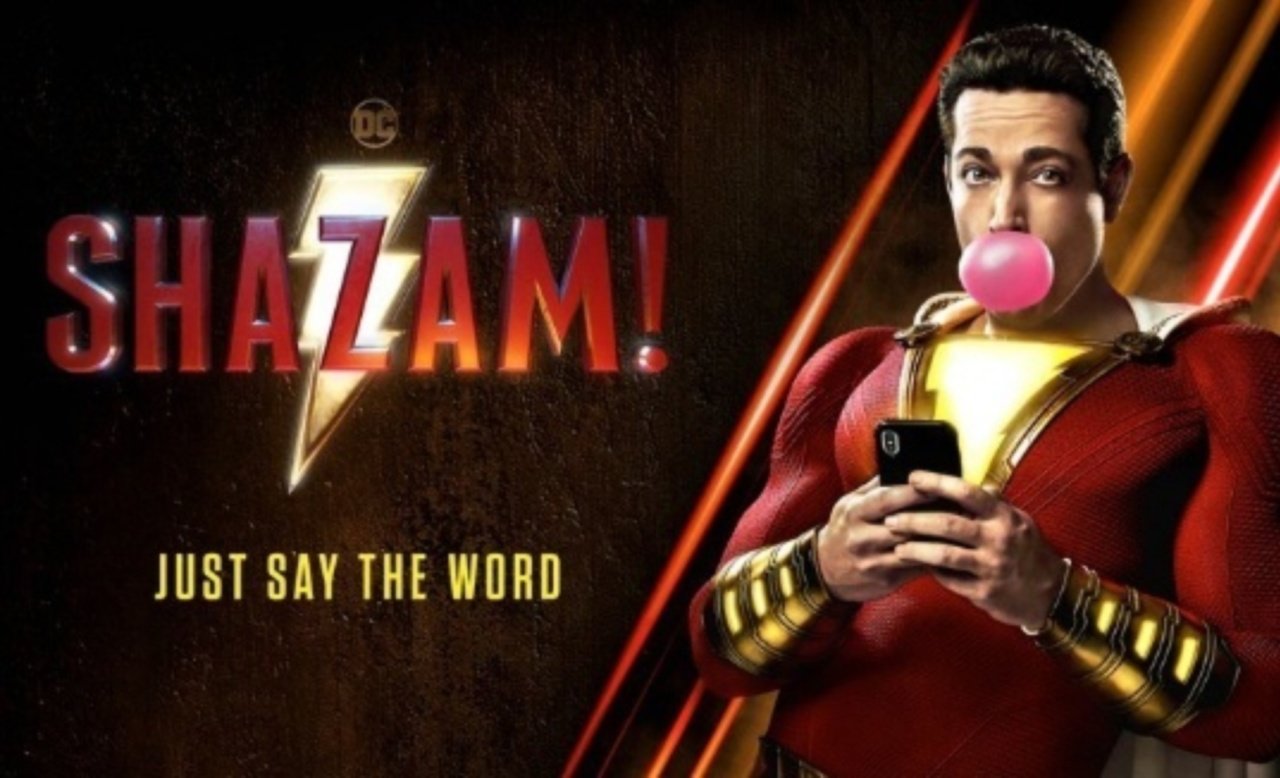
Shazam! (2019) – Review

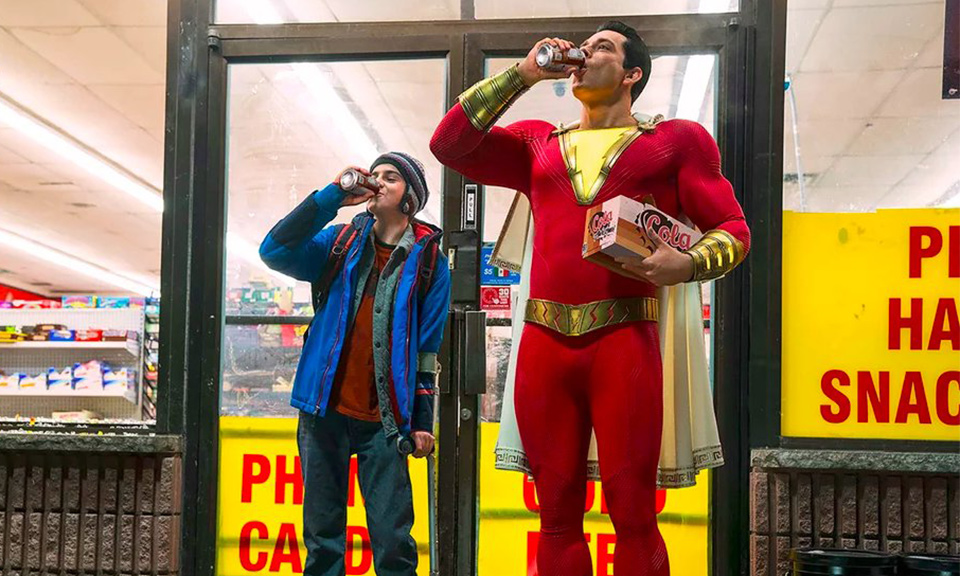
In this seventh installment of the DC Extended Universe, the people over at Warner Brothers do something the guys at Marvel haven’t really dealt with, the existence of superheroes from the point of view of kids — you know, the target audience the original comics were aimed at — and with Shazam! director David F. Sandberg does just that, and it’s rather refreshing.


With this film we get the origin story of Captain Marvel, and no I don’t mean the Captain Marvel who is teaming up with the Avengers to save the universe from Thanos, we’re talking about the hero Billy Batson, the one found in the Shazam comics, but this confusion is understandable considering the legal history of the character. Captain Marvel was created by Fawcett Comics back in the late 30s, and whose popularity started to exceed that of DC’s flagship hero Superman, which resulted in a whole bunch of lawyers being brought in and Fawcett Comics eventually ceasing publication of comics with the Captain Marvel-related characters. Case closed, but not quite. Then in the 70s, DC Comics licensed the character from Fawcett only to then run into problems stemming from the fact that over at Marvel they now had their own hero by the name of Captain Marvel, which forced DC to publish their comic under the title "Shazam" — the word that Billy Batson uses to transform into Captain Marvel — and due to this change, over time many people took to identifying the character as "Shazam" instead of "Captain Marvel," which then led to DC officially changing the character’s name to Shazam in 2012. Have we all got that straight now?


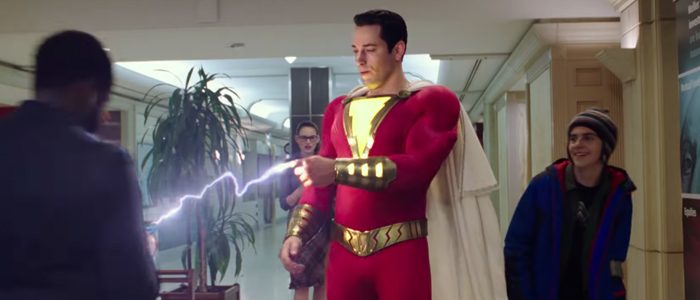
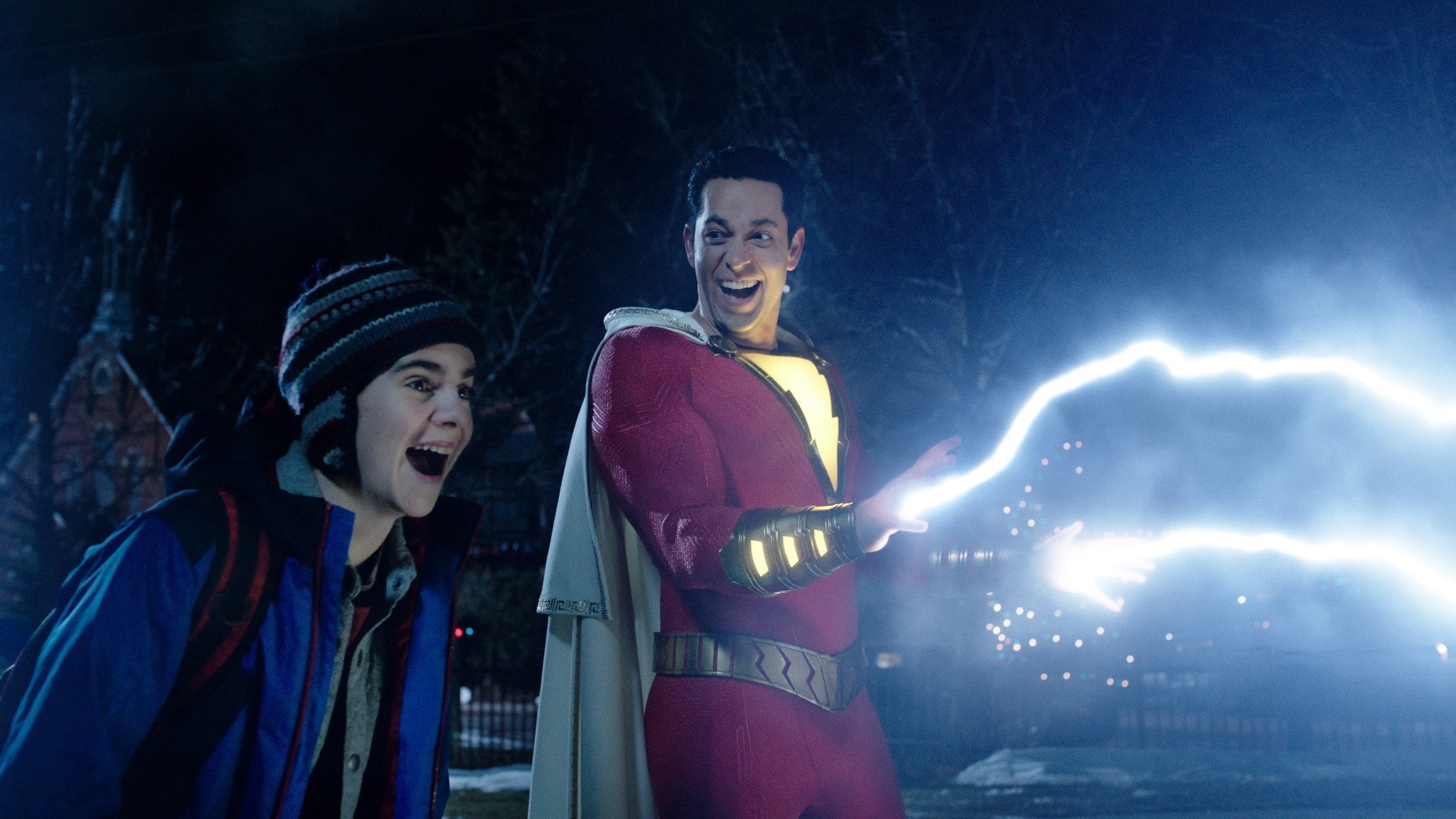
We now bring you Mister Sparkle Fingers.

With the movies flowing out of the DC Extended Universe being criticized for being too dark and gritty — with Batman and Superman killing villains left right and center — the studio has been making some quick course corrections to fix this perception, and now with Shazam! we get an even more comedic entry into the franchise, one that stars the title character from the television comedy Chuck. What's even more odd here is when you consider the fact that this comedic superhero film is coming from director David F. Sandberg who is known for such horror films as Lights Out and Annabelle: Creation. He is certainly not an obvious choice for the subject matter, as this film is basically a superhero version of the Tom Hanks film Big, but as this particular superhero film does have some actual horrific elements to shake things up, I’m not completely surprised. I mean if James Wan, the creator of The Conjuring Universe can give us Aquaman, why not?


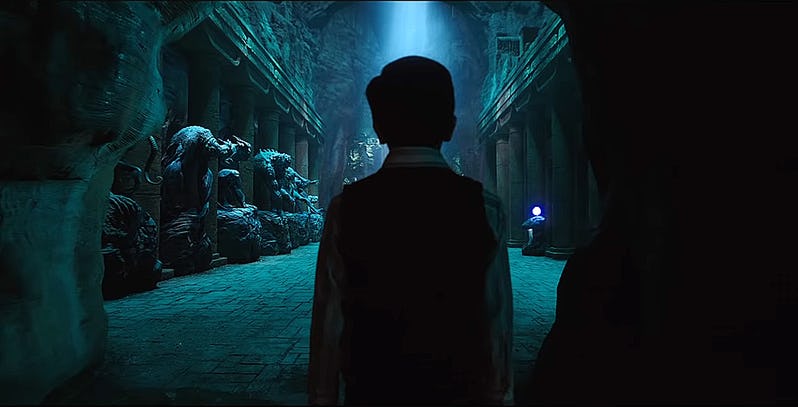
Thus the Rock of Eternity now looks a little more frightening.

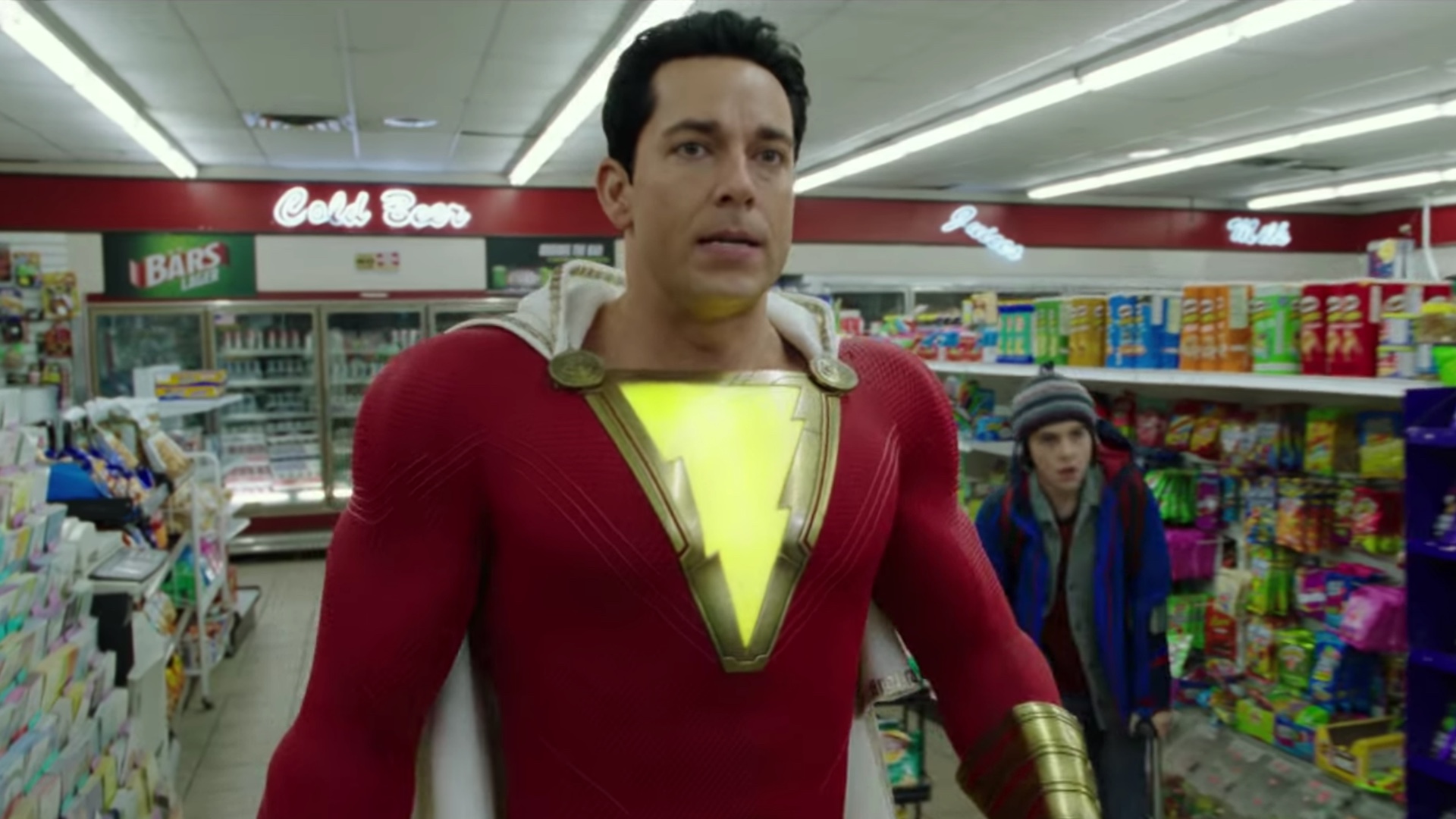
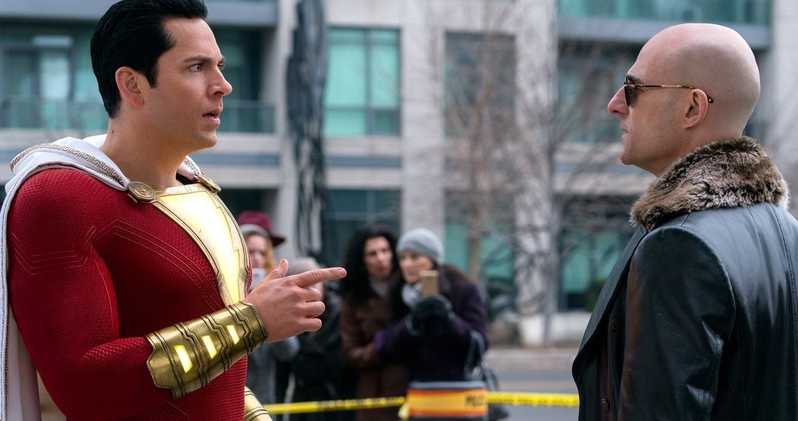
The hero of this movie is a young boy named Billy Batson (Asher Angel), who was separated from his mother at an early age, but even as a 14-year-old delinquent, he clings to the hope of a reunion, and has since become obsessed with tracking down his birth mother. This obsession has resulted in him bouncing from one foster home to another until finally landing in the group home run by Victor (Cooper Andrews) and Rosa Vazquez (Marta Milans) — who aren’t running a secret sweatshop, so that’s nice — and Billy “befriends” his crippled roommate Freddy Freeman (Jack Dylan Grazer), a kid who has his own obsession with the numerous superheroes that now populate the world. When Bill defends Freddy from some school bullies, this results in him being transported to the Rock of Eternity, the mystical lair of the Wizard Shazam (Djimon Hounsou), where he is told that Shazam has been protecting the world from an invasion of the Seven Deadly Sins, which he keeps locked up inside some seriously creepy looking statues. Shazam has been looking for a pure soul to take on his powers and become his “Champion,” but unfortunately, the villainous Dr. Thaddeus Sivana (Mark Strong), who as a child didn’t pass Shazam’s test to become a champion and was harshly rejected, has now returned and released the Seven Deadly Sins into the world. Billy is certainly not “pure of heart” being a bit of a selfish prick, and with a serious flexibility when it comes to stealing, but the wizard is desperate, and thus Billy Batson is given the wisdom of Solomon, the strength of Hercules, the stamina of Atlas, the power of Zeus, the courage of Achilles, and the speed of Mercury. What a 14-year-old kid would actually do with such powers is the crux of this film.


The key theme of Shazam! is the idea of what really makes up a family, and with this the screenwriters do an admirable job illustrating the message that “family” truly comes from those you care about and those who care about you, not necessarily those that are blood related. Of course, this film isn’t all about personal growth and understanding; we’ve got a lot of comedy on deck. The bulk of the film’s run-time deals with Billy and Freddie figuring out how his powers as Shazam work — Does he have invisibility? Is he fireproof? What about laser vision? — and this stuff is brilliantly funny, as is the chemistry between Asher Angel and Jack Dylan Grazer, which is what truly holds this film together. Unfortunately, the pacing is a bit of an issue as the story they are telling certainly didn’t warrant a two-hour-plus run-time, and some of the drama between the two boys could have been easily trimmed to fix this.


I should also point out that the tonal shift with the arrival of Sivana, and the monstrous Seven Deadly Sins, could catch some viewers off guard, especially younger ones, as the trailers certainly didn't allude to scenes of monster carnage resulting in multiple murders including heads being bitten off. So parents, be warned that there are some quite frightening scenes that could scare the little ones.  Yet it’s when the villainous plotline moves front and center that the film starts to stumbles the most, and Mark Strong, who is no stranger to playing the heavy, isn’t given much to do other than chase after Billy and offer cliché speeches — which are not excused just because the screenwriters make fun of them — and the monsters themselves offer no consistent threat. What these creatures can and cannot do is never made clear by the filmmakers.

Stray Observations:

• The Seven Deadly Sins don’t look much like representations of their specific sins, with gluttony being the only one with a fitting appearance. I’d say they're more in keeping with the average monsters that Hellboy would be comfortable punching.
• If the Seven Deadly Sins have been imprisoned inside the Wizard’s statues all these years, why does the world still suffer from greed, pride, lust, envy, gluttony, wrath and sloth? Clearly the writers lifted this idea from the Greek myth of Pandora’s Box, but then forgot the part about the sins never being put back inside.
• None of the monsters use aspects of the sins their named after. Wouldn’t it have been cool to see Lust or Gluttony using their aspects to torment the hero?
• When freed, these monsters can turn to mist as to avoid being punched, an ability they forget they have later on.
• Silvana gets his powers from being possessed by these Sins/Monsters, but his power level doesn’t seem to fluctuate, even if he’s down to just one of the Sins residing within him.


“Wait a minute, aren’t you Sinestro?”

Easily the most stand-out element of this movie is of course Zachary Levi’s ability to channel his inner child, and he clearly had a blast with the part, but as fun as Levi was with the comic shenanigans (like getting shot in the face or tossing muggers around), his portrayal of Billy Batson wasn’t quite on point with what Asher Angel was doing earlier in the film. Levi gives us that wonderful schism between an adult body and the mind of a teenage boy, but it leaves out the fact that the Billy we’ve seen is a distrustful, over-defended kid who has definite issues with authority. The Zachary Levi version of Billy is so completely divorced from the one Asher gave us that it’s all but impossible to reconcile that they are the same person. Sure, being given immense powers would change you, but we really don’t see any of the young Billy in Levi’s performance.


Shazam! is an immensely fun movie, and Zachary Levi is a hoot as the title character, but when the final act arrives it does devolve into your standard superhero slugfest, and the fact that we have another two-dimensional villain to thrash doesn’t help much. In conclusion, I’m still able to heartily recommend seeing this film as there are some solid moments of both comedy and action, and it certainly is a step in the right direction for DC and Warner Brothers, I just wish they’d worked a little harder on the nuts and bolts of the plot because the overall message of the film, about what it means to be a family, was really well done.

Note: This is not the first live-action incarnation of Shazam, as he first appeared on screen back in the 40s with the serial The Adventures of Captain Marvel, then later on, there was a godawful kid’s show in the 70s called Shazam!

Thursday, April 4, 2019

The Hole in the Ground (2019) – Review

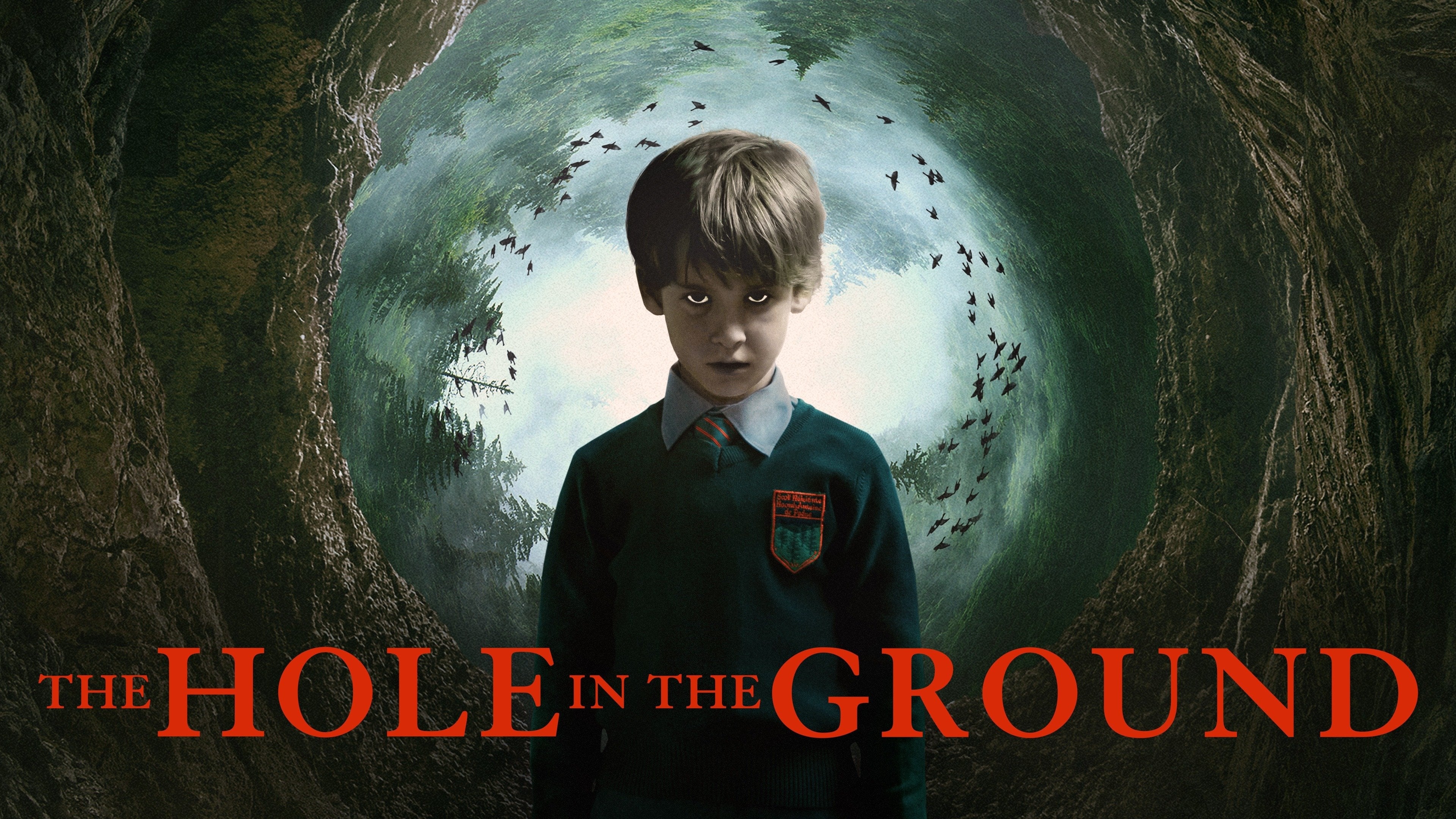
One of the more prevalent staples of the horror genre is the creepy kid, whether he be the son of Satan, as in The Omen, or a whole brood of them, such as from Children of the Corn. No matter what, there is something inherently horrifying about kids — even ones not in horror movies — and once again, this trope is explored with writer/director Lee Cronin’s The Hole in the Ground, sadly without bothering to add anything original to the genre.


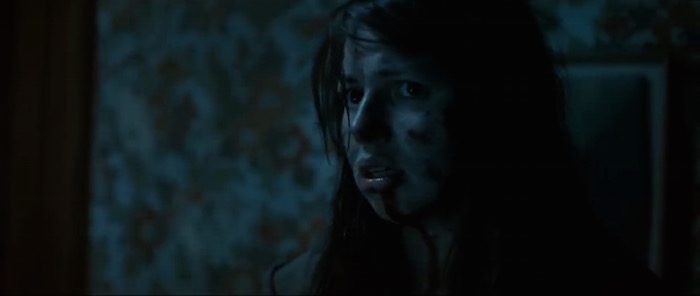
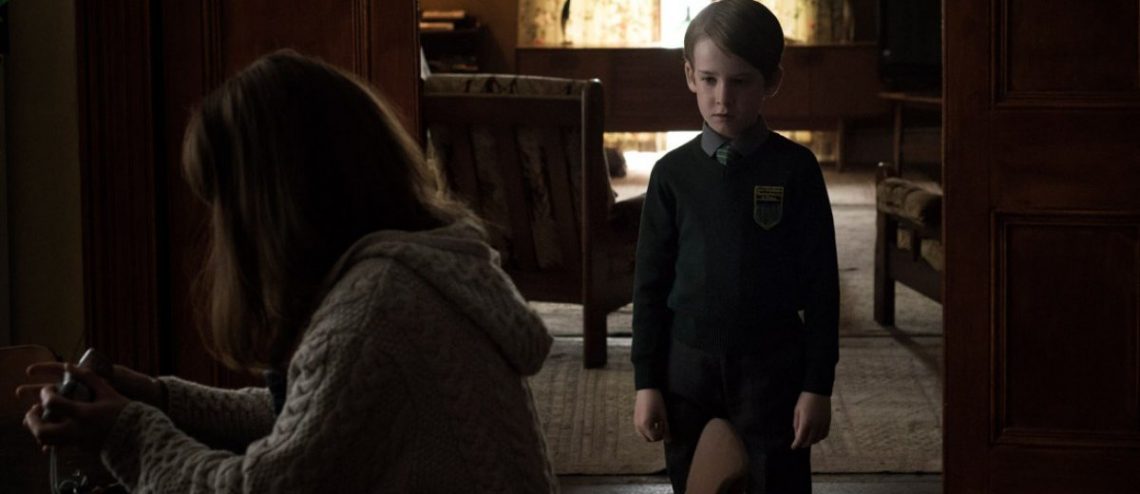
We are introduced to Sarah O'Neill (Seána Kerslake) and her son Chris (James Quinn Markey) while visiting a carnival, where we see them making faces in a funhouse mirror, giving us a little foreshadowing of the twisted duality yet to come, and as the story unfolds, we discover that Sarah had moved to this particular hamlet to escape her abusive husband, with whom she had a son. Will this film touch on the drama of spousal abuse and the effects it has on the children? Nope, that carrot is dangled for about a half a second before being cast aside so that we can have horror trope after horror trope rolled out as if on some kind of evil train schedule.

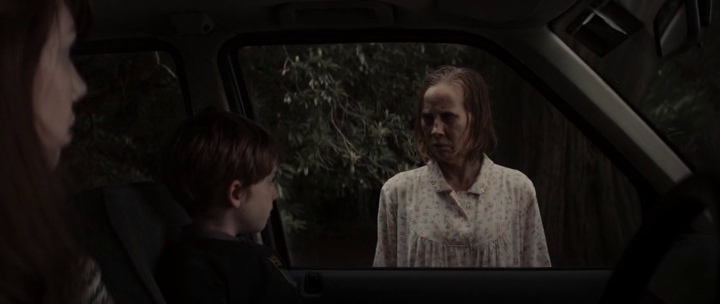
• Sarah and Chris meet a crazy lady (Kati Outinen) who may or may not have murdered her son for “Not being her son.”
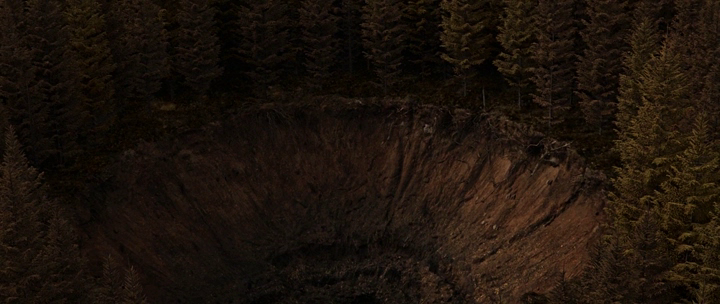
• They’ve move into an isolated farmhouse next to a dark forest that contains a massive sinkhole.
• The farmhouse has your standard spooky basement with flickering lights.
• Sarah will be plagued by nasty visions and nightmares.
• Chris will start acting oddly while giving Sarah creepy blank stares.
• Friends and doctors will “pooh-pooh” her belief that Chis is not her son.


"Ireland, come for the sinkholes, stay for the unrelenting evil."

The basic premise of The Hole in the Ground is that Sarah’s young son has been switched out for a doppelganger — or a changeling, if you are up on your folklore — and at times, it looked to me like director Lee Cronin was trying to make a dark psychological horror film, exploring the nature of motherly bonding while also dabbling in dark fantasy. She, this was not the case, and instead, the end result was a tedious mess that never seemed sure of what it wanted to be or say. When Sarah started to suspect things may not be all right with her son — him going from being afraid of spiders to eating them being a big red flag — she doesn’t do much in the way of constructive investigating, other than hiding a camera in the kid's room and confronting the husband (James Cosmo) of the crazy lady who murdered her own son, but none of these scenes go anywhere.


Ireland actually has road signs warning you about creepy heralds of doom.

A key part in the balancing act of the horror genre is keeping your protagonist's behavior somewhat believable; there can be only so many instances causing such questions as, “Why are they still in that house?” or “Who checks out a dark basement in the middle of the night?” or “Why is she diving into that fucking massive sinkhole?” Yet in Cronin’s The Hole in the Ground, we find the protagonist doing maybe one intelligent thing but then completely undermining it by doing the most insane thing possible the very next minute.

Stray Observations and Spoilers:

• It’s stated that a changeling’s reflection reveals their true nature, and we do see an evil creature in the mirror when Sarah tries to verify if her son is truly a monster, but if that's the case, shouldn't it be easy to prove to others by just hauling her kid before witnesses — friends, doctors, even the bloody police — and placing a mirror in front of the little monster?
• Sarah confronts the creature that is impersonating her son, after catching him out on the fact that it doesn’t know her son’s favourite game, which results in the monster proceeding to toss her around like a rag doll. Now, Sarah did plan a little ahead for this outcome — a rare moment for her — as she had drugged the kid’s dinner. Unfortunately, it was one of those slow-acting drugs that gets her buried head-first in the front yard before finally taking effect, but once she is able to drag his evil ass down into the basement, she doesn’t bother to tie him up, which then results in her being attacked again.
• She then heads out into the forest to find her real son, which involves diving into the sinkhole with nothing but a flashlight. Now I know a mother’s love for her child is a powerful force, able to draw on almost supernatural strengths, but maybe one should have taken a breath and thought this through — maybe write a pros and cons list — before jumping into an unknown environment, with no weapon of any kind, in the slim hope you will find your son. We can almost buy this impulsive act — and the actress does manage to sell the moment — but when she easily escapes from a horde of these monsters, with her unconscious kid in tow, I called bullshit.


Doesn’t Ireland have a Scully and Mulder she could have called?

The Hole in the Ground is wonderfully shot by cinematographer Tom Comerford, and the music provided by Stephen McKeon sets the mood brilliantly, but these are just two elements in service of a rather pedestrian story that brings nothing new to the genre. I’m not expecting every film dealing with this particular subject matter to be Guillermo del Toro Pan’s Labyrinth, but a little extra effort in your world-building can really make a difference. Cronin’s film isn’t altogether terrible, and the two lead actors did their best considering the script given to them, but it’s the wasted potential that bothered me the most.


“I see faerie people.”

Wednesday, April 3, 2019

The Fantastic Journey (1977) – Review

In 1977, producer Bruce Lansbury brought to the small screen a show called The Fantastic Journey, a startling tale about a small group of people trapped on a mysterious island — decades before J.J. Abrams would conjure up his series Lost — and though this particular series didn’t even manage a full season, thanks to the evil machinations of NBC network's executives, it was quite a remarkable little adventure show, and deserved more than to become "One of the Forgotten."


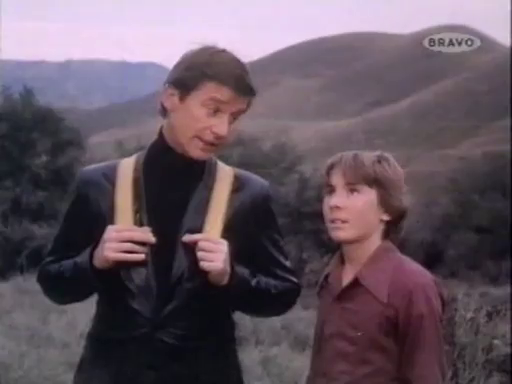
 In the pilot episode “Vortex,” a small but diverse group of “eggheads” take a boat cruise into the Bermuda Triangle — to what end is never exactly addressed — with a party consisting of Professor Paul Jordan (Scott Thomas), his thirteen year-old son Scott (Ike Eisenmann), young African American Dr. Fred Walters (Carl Franklin), university students Jill Sands (Karen Somerville) and Eve Costigan (Susan Howard), marine biologists Andy (Jack Stauffer) and George (Byron Chung), with the boat itself being operated by Captain Ben Wallace (Leif Erickson) and his First Mate Carl Johanson (Scott Brady). Don’t worry about remembering all those names and characters because most of them won't make it past the pilot episode.


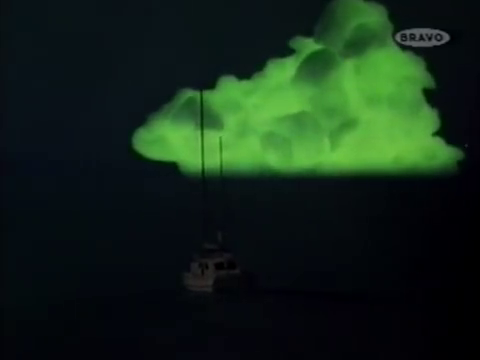
Entering the Bermuda Triangle.

When night falls, the boat loses power as well as the use of its radio, as it's drawn towards a mysterious glowing green cloud. The first casualty is poor Carl, who during the stormy passage into the cloud falls overboard, and when the rest of them find themselves washed ashore the following morning, Carl is nowhere to be found. Professor Jordan and his son do a quick reconnoiter, where they soon discover that they are on a massive island, one with mountains in the distance and no sign of indigenous people. So it’s clear that they are on some strange and uncharted island, which has Andy and George eager to try and take the ship’s surviving dingy back out to sea in an attempt to make it into the shipping lanes. This does not go well for the two marine biologists, as they are both found washed ashore, dead, the very next day.


Enter Varian, man from another time.

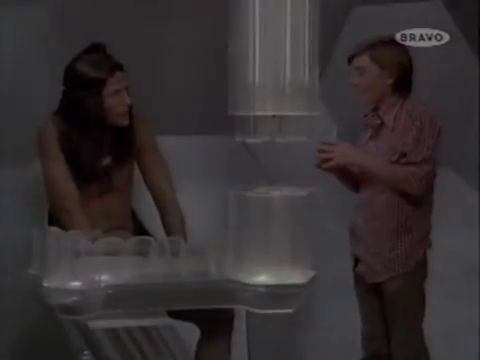
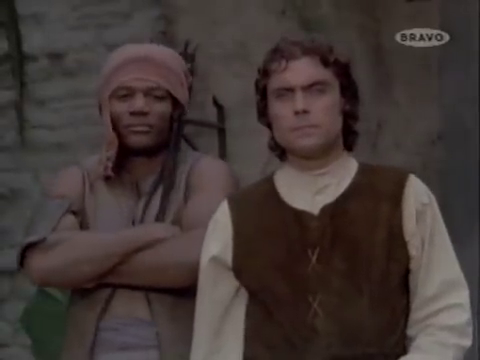
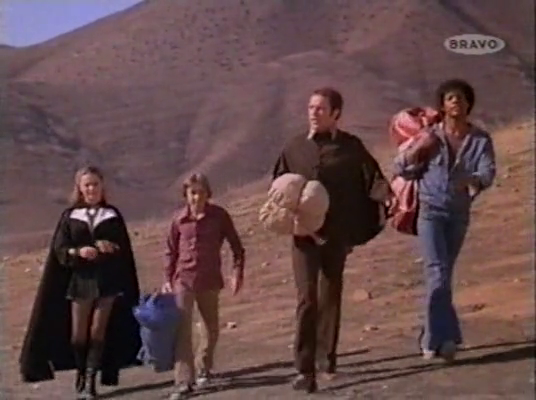
The group soon encounters a man dressed like a member of an extinct indigenous tribe — standard loin cloth and long hair style — but the man is clearly not too primitive as he carries a device that instantly heals Captain Wallace’s broken arm, and when Scott follows this strange individual into the jungle (Scott does this wandering off thing quite a bit on this show), he discovers that the man is not a primitive tribesman at all, but a man from the 23rd Century named Varian (Jared Martin) who, like our intrepid group of castaways, was also marooned on this strange island. He later tells the group that, “In Earth year 2230, I was a musician, and my work was very important to me because in my century, musicians do nearly all the healing.” From this, Professor Jordan deduces that, “We’re in some sort of time lock, a space time continuum. Past, present and future exist together, each on its own terms.” Unfortunately, running into musicians from the future is far from their only concern, as also located nearby is a group of 16th Century privateers, led by Sir James Camden (Ian McShane), and Jill, Fred and Captain Wallace are soon captured by these English ruffians.


Pirates of the Bermuda Triangle.

The trio are rescued, with the reluctant help of Varian, who is opposed to violence and destruction of any kind, but Captain Wallace succumbs to greed and runs back to grab some Spanish treasure, which leads to his demise at the end of the poisoned fangs of Camden’s pet cobra. Thus, another member of the original party exits the series, and the show isn’t finished yet, as only three of the original nine will make it to the second episode. This is easily the highest attrition right I’ve ever seen in a television series. This would be like if the second episode of Lost only included Jack, Hurley, and Walt, and it's this kind of shake-up in casting that would have been a key reason for the show's failing, as a certain amount continuity of cast members is something audience members of the time were more used to, but for me, the bigger issue came along with how the show ditched the next three cast mates.


Enter the evil Atlanteans.

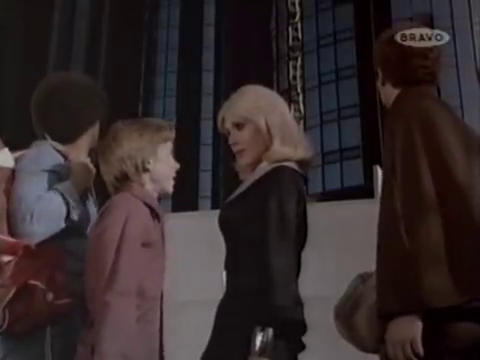
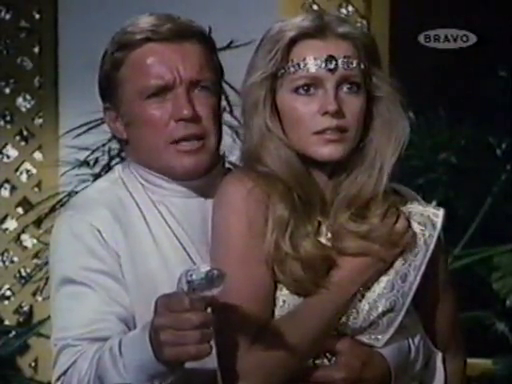
Varian explains to the travelers that, “Here on this island, even as the first man walked upright out of his Neanderthal cave, man was also taking his first step on the moon, and that there is only a thin tissue of consciousness separating one event from the other.” He further explains that the island is honeycombed with many different “time zones,” all separated by invisible fields, and that one step through these “invisible gateways” can take you from the 23rd Century to the 16th Century in an instant. They also learn that the only way home is to head towards the Eastern Shore, to a mythical terrain called Evoland, where a device purportedly exists that could send any person back to his appropriate home in time. At the end of the pilot, Professor Jordan, Jill and Eve step through one of these invisible gateways, but when Varian, Fred and Scott step through, they find no sign of Scott’s dad or the two girls, but they are met by an Atlantean named Rhea (Mary Ann Mobley) who tells them that Professor Jordan and the two girls had gone on ahead to the city of Atlantium.


She certainly doesn’t look like the lying type, I’d trust her.

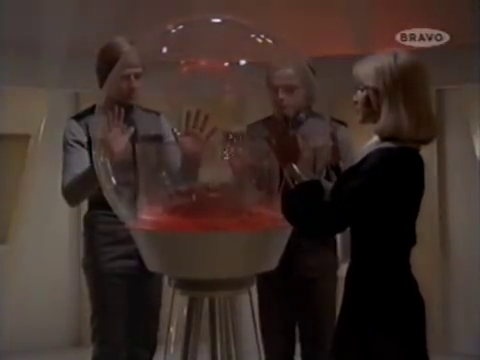
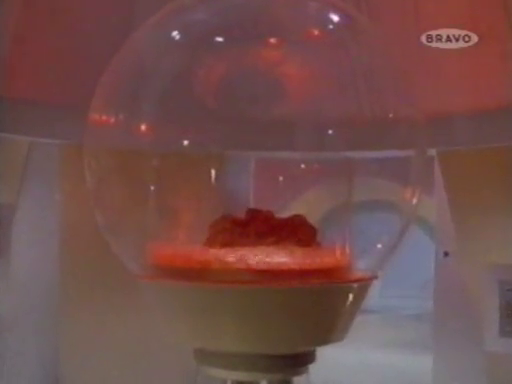
Yet when they enter the city, they are quickly informed that Scott’s dad and the two girls have gone back to their own time. Needless to say, that rather upsets Scott. Dar-L (Gary Collins), one of Atlantium triumvirate, gives Scott a letter written by his dad, explaining that he knew that Scott would be fine while in the capable hands of Varian and Fred, and that he needed to get home as soon as possible so as to relieve the pain that Scott’s mother must be going through. Now the level of bullshit here is just staggering, and at first I’d assumed this was some duplicitous scheme of the Atlanteans, but turns out the letter was genuine, and that Scott’s dad is just such an asshole that he couldn’t wait five damn minutes for his son to show up. If the showrunners were so eager to get rid of these three characters — which seems a like strange thing to do after just one episode — why not have it be revealed that the Atlanteans murdered them, and that the letter was a fake? We quickly learn that the city is run by a giant brain in a jar, simply called The Source, and that it needs a new body for rejuvenation, and that it had chosen Scott to serve that purpose, so having them kill off Professor Jordan, and those with him, would certainly be in keeping with their evil plan.


Never trust a brain in a jar.

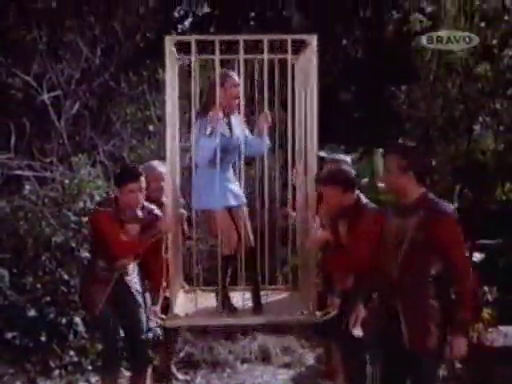
Lucky for our trio, the Atlanteans were about to have a rebellion, led by an Atlantean named Liana (Katie Saylor), who is the daughter of an Atlantean father but with an extraterrestrial mother, and with her help Scott is saved and The Source is defeated.  When all is said and done, she decides to leave Atlantium with our heroes. Now, Liana is quite an interesting character; she has some psychic abilities, such as telepathically communicating with animals — which comes in handy when she uses her cat as a spy — and she also has greater than normal human strength due to her mother being from a planet with a higher gravity than that of Earth's. Sadly, her “super strength" is rarely used, so instead of having a show featuring a woman kicking serious ass, which would have been awesome, we often see Liana captured and in need of rescue by the boys. This is such a criminal waste of potential, especially when you consider that over on ABC they had Lynda Carter tossing around Nazis as Wonder Woman, so why not make Liana the action hero of this show? With pacifist Varian in charge of our trio, it would have been natural to have her as a physical back-up, but instead, fisticuffs and flying dropkicks were left to George.


This is just embarrassing.

In episode three, “Beyond the Mountain,” the group were separated after being engulfed by a mysterious red cloud, so while Varian, Fred and Scott end up in a dreary swamp, Liana finds herself in a small little utopia run by a man named Willoway (Roddy McDowall), who we later learn is the only human inhabitant, as all the other “citizens” are robots. Willoway is very happy to see Liana, but she is less than thrilled when he announces the fact that they are to be married — even his robot “son” seems a tad jealous — and it’s only with the arrival of Varian, Fred and Scott, along with the little green men who original lived in this utopia before Willoway betrayed them and had them ousted, that she is saved from an awkward matrimonial situation. What is quite surprising is that after the little green men reclaim their homeland, and exile their usurper, Varian offers Willoway the opportunity to travel with them, stating that the Dr. Jonathan Willoway he knew was a man who treasured life over death, and whose achievements became the building blocks of the future that Varian comes from.

It’s not every show where an episode's villain ends up becoming a regular cast member, and he’s not even given the cowardly aspect we got with such charactera like Dr. Smith from Lost in Space — he becomes a valued member of the team, whose somewhat “flexible moral compass” serves them well, from time to time.

Note: The character of Willoway was written specifically to attract Roddy McDowall to the part, and he was so liked in the role by the producers that he was asked to become a regular.

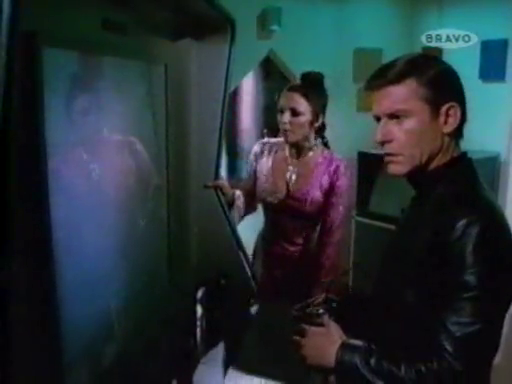
The rest of the season finds our group running into various science fiction clichés, with only the excellent work by science fiction legend (and this show’s story editor), Dorothy Fontana, preventing The Fantastic Journey from becoming a running joke. The network wasn’t too keen on having our heroes running across figures from the past, maybe it cost too much to find period sets and clothing for those kinds of episodes, and thus the 16th Century privateers were the only historical encounter our heroes would have. Instead, they ran into a post-apocalyptic city run by children — think “Miri” from the original Star Trek series — then there was a military dictator (John Saxon) who wanted to march across and conquer the various time zones, a society that practiced human sacrifices, who wanted to chuck Varian into a volcano, Willoway is briefly possessed by an ancient Greek magician (Mel Ferrer) in a "Funhouse" of horror, then in the episode “Turnabout” we find a society where sexist men have enslaved women, but the slave queen (Joan Collins) leads a rebellion, and our heroes are captured so as to be used as breeding stock. We even have an episode where space convicts (Richard Jaeckel and Nicholas Hammond) make things tough for an alien colony of pacifists (Cheryl Ladd and Lew Ayres).


Take note, there are lot of aliens in this show, but mostly of the humanoid variety.

In the ten episodes that make up this brief run, our heroes come across a helluva lot of aliens, for every dystopian future society they come across they encounter two made up of aliens who got sucked in by the Bermuda Triangle, making this show more Lost in Space than Time Tunnel. Sure, we are told these aliens races are from the future, but they’re aliens, does it really matter what time zone they came from? The repetitive nature of these encounters was probably key in the show's cancellation, as one could easily imagine how “old hat” our heroes stumbling from one alien society to another would get, until eventually reaching the fabled Evoland. The show’s formula became quickly apparent.

• Our heroes would step through a gateway.
• They would encounter a strange society.
• Varian would not want to interfere.
• Willoway would want to get the hell out.
• Scott would befriend one of the residents.
• Varian would change his mind about interfering.
• Ben would then get to punch or dropkick somebody.
• Our heroes would then step through another gateway.

You can see how that could get tiresome after a while, but with the addition of Roddy McDowall to the cast they really had an ace up their sleeves, as any scene where Willoway had to debate the bizarre aspects of whatever topsy-turvy society they’d wandered into was a true joy to behold. McDowall was simply brilliant, and I would have happily listened to him read the phone book for fifty minutes, but even his valiant efforts could not save the show from being flushed by the network executives.


The Fantastic Journey certainly had an interesting concept, and the cast were uniformly excellent — that is, once they settled down to our four main heroes — and the show allowed time to develop some great comradely moments between them, but the network’s decision to no longer have our characters encounter people from the past was a huge mistake, as a show about time travel kind of needs that aspect or it’s just becomes another generic space opera, only without the cool spaceships. Since its cancellation, we’ve had several shows with similar themes, but I for one would love to see a complete reboot of the series, for with a proper budget, and writers given free reign, you could really give modern audiences a real Fantastic Journey.


I’d love HBO to take a crack at a show like this.