Blog Archive

Monday, May 2, 2016

King Kong (1933) – Review

During the 1930s escapism from the realities of The Depression made movie going more important than ever, and in 1933 Merian C. Cooper gave the world King Kong, the Eighth Wonder of the World, a film that defined the term escapist entertainment. Prior to Kong Merian C. Cooper was known for his independently produced nature films, he and camera man Ernest B. Schoedsack would travel to far off lands and then bring back footage that would amaze American audiences. When Cooper asked RKO to financially back a trip to Africa to make a film about a killer gorilla he was given the greenlight to make the movie, but was also told that Pasadena, California looks enough like Africa, so no going on location. Who knows what the King Kong would have been like if Cooper had been allowed to film in Africa.  Would he have used actual footage of real gorillas? Would we have got a giant gorilla rampaging through New York City, or would it have been more of a Gorilla at Large mini-rampage? Regardless of what King Kong could have been, better or worse we will never know, but the film we did get is still one of the greatest action adventure films ever made.

vlcsnap-2016-04-05-16h58m36s704

 The movie begins with film producer Carl Denham (Robert Armstrong) trying to locate an actress that will join his film expedition to parts unknown. He’s having a tough time as most theatrical agents are a tad reticent about sending a woman off on a long sea voyage to places not currently on a map. The character of Carl Denham is an analog of producer Merian C. Cooper; they were both larger than life characters and Armstrong even looks a bit like Cooper. The screenplay for King Kong was written by Ruth Rose, wife of director Ernest B. Schoedsack, a person who clearly knew Cooper well, and who went onto write Mighty Joe Young (1949) where we once again got Robert Armstrong doing a Merian C. Cooper impression.

vlcsnap-2016-04-05-13h40m59s446 

Robert Armstrong is Carl Denham/Merian C. Cooper

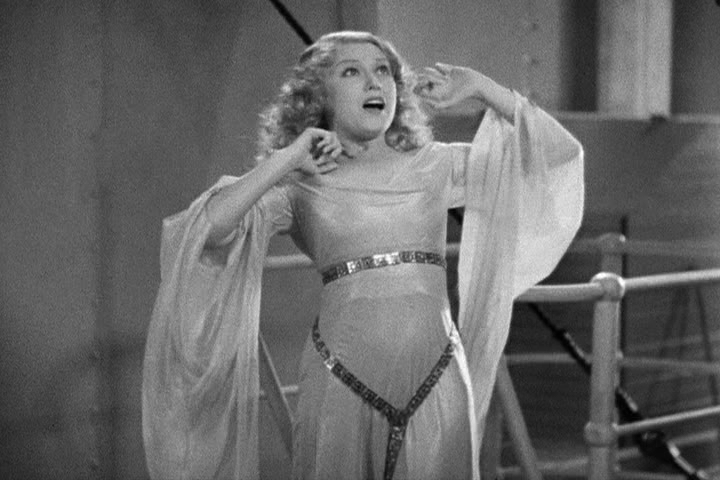
When Denham rescues Ann Darrow (Fay Wray) from being arrested for stealing an apple, he discovers that she is near starvation, has no family, and does have some acting experience. If not for the charismatic portrayal by Robert Armstrong the character of Denham could easily have come off as the film’s villain. Later he even thinks of using Ann for bait to catch Kong, not something a “good guy” would come up with, but somehow Armstrong keeps Denham likable. Fay Wray brings a wonderfully sense of naiveté and sweetness to the role of Ann Darrow, and when she is in danger we truly feel her terror. She is mostly remembered for her screams, but even though her part isn’t as showy as Armstrong’s she really anchors the film.
vlcsnap-2016-04-05-13h51m19s048 

Fay Wray, the original Scream Queen.

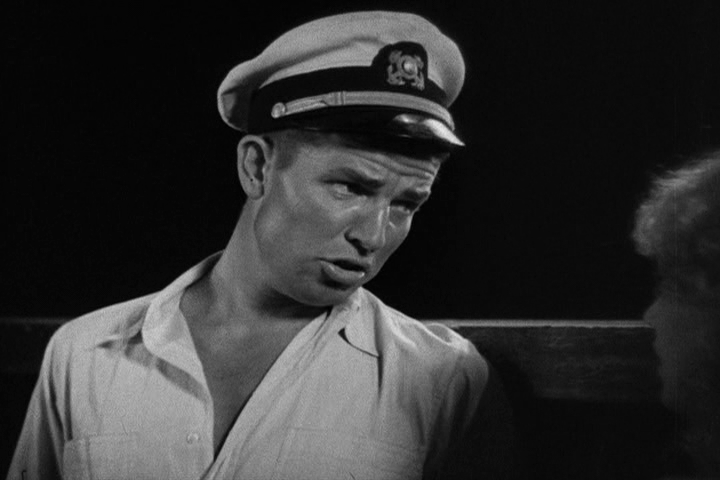
On board The Venture we meet Captain Englehorn (Frank Reicher) and Jack Driscoll (Bruce Cabot) the surly first mate. In most movies Driscoll’s character would be the film’s lead; the hero and chief love interest to the leading lady, and he does rescue Anne from Kong and we assume he eventually marries her, but Armstrong is really the film’s lead as Cabot’s character is just your basic square-jawed hero and nowhere as entertaining as Armstrong is. I’m not saying that Cabot is terrible in this film, but some of his line deliveries are so flat you’d think a giant ape stepped on them. Though to be fair some of his dialog was a bit clunky to begin with.
vlcsnap-2016-04-05-14h01m45s555 

“Say, I guess I love you.”

Of course neither Robert Armstrong nor Bruce Cabot are truly the film’s lead as that honor falls to Kong himself. Brought to life by special effects wizard Willis O’Brien the creation of Kong had inspired hundreds of movie effects artists for decades to come. Kong is not just a raging monster; he has as much character, if not more, than his co-stars. Because he has no dialog we have to guess at his motivations; why does he spend so much effort to keep Ann alive? The natives of Skull Island clearly sacrifice women to Kong on some kind of routine basis, but for what reason? If they don’t will he kick down that wall and wreak havoc on their village? Could the reason for the sacrifice been lost to time, and that the natives and Kong now act out this ritual from pure force of habit? Does Ann’s blonde hair change his attitude? We never learn what Kong did to the previous native sacrifices; did he eat them or eventually just toss them aside?

vlcsnap-2016-04-05-14h16m00s067 

“Oh, this one is blonde, she must be a collector’s item.”

What we do see of Kong relationship to Ann is something I find akin to a young boy with a new toy. He is very possessive, and will not let anyone else play with it (or eat it). Whenever he puts his toy down some other denizen of Skull Island will try and take it, most of these times Kong wasn’t even around when they spotted this new chew toy, but when one of them so much as lays a finger ( or claw) on Kong’s property a major beat down is in the offing.

vlcsnap-2016-04-05-14h26m19s291 

“I swear to god, I didn’t know she was yours!”

Driscoll eventually rescues Ann so we will never know what fate she would have had if she had remained with Kong. Would he eventually have gotten bored with her? Tossed aside like a broken toy that would then be quickly snapped up by one of Kong’s neighbors. In the Peter Jackson remake an emotional bond clearly develops between and Ann and this lonely giant, but that is certainly not the case in the 1933 version as Fay Wray obviously wants nothing more than to be free of the horrors of this place, giant monkeys included. Kong of the original movie is an animal with animal instincts and desires, sure he is more sympathetic than your average beast, and when he is shot down from atop the Empire State Building we feel sorry for him. None of this is his fault, if white man had just stayed the hell out of his jungle everyone would have been much better off…well maybe not the village women.
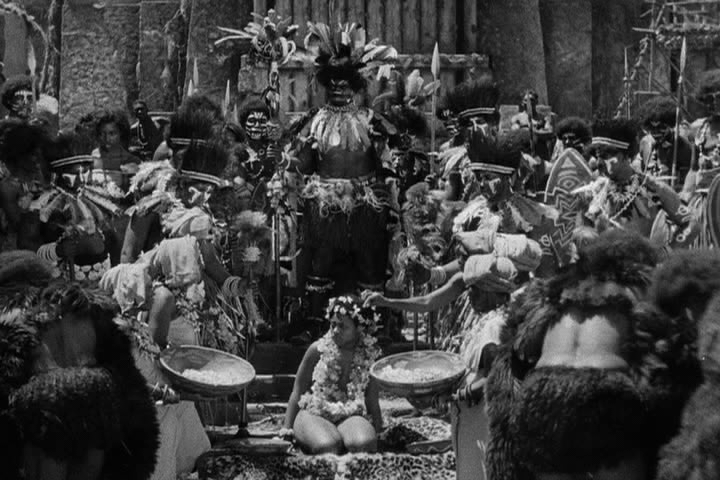
vlcsnap-2016-04-05-14h39m52s105 

You know, the whole sacrifice thing.

King Kong has a very economical script; from Denham finding Ann, introduction of a love interest, to the arrival on Skull Island and Kong, the story just rockets along. And when the action kicks in boy does it ever; our heroes are attacked by a rampaging stegosaurus, sunk and chewed on by an angry brontosaurus, then tossed to their deaths by Kong.

vlcsnap-2016-04-05-14h50m45s161 

“Get the hell out of my jungle.”

Kong does have to put up with a lot grief just for the sake of this new possession; not only does he have to deal with her stupid friends chasing after him but he has to fight a Tyrannosaurus Rex, in what is still one of the best titanic fights ever committed to film, later an Elasmosaurus tries to strangle the life out of him for trying to protect Ann, and then when his back is turned again a stupid Pteranodon tries to make off with his prize. When Denham takes him out with some tossed gas bombs it’s basically the end of a really shitty day.

vlcsnap-2016-04-05-15h15m11s283 

You think you’ve had women troubles.

This may be considered a Beauty and the Beast story but as I’ve mentioned earlier this version is a little one sided. Ann never come to "understand" the beast let alone come to love him, and despite fake Arabian proverbs I don’t think it was the look of Beauty that stayed Kong’s hand. Ann was simply an object that Kong desired for the simply for the sake of wanting. At most she was a cute pet that he kind of got attached to, and then the whole world went all nuts on him. Kong in New York is just an extension of his journey with Ann on Skull Island, only this time Kong is the sacrifice and no one rescues him.
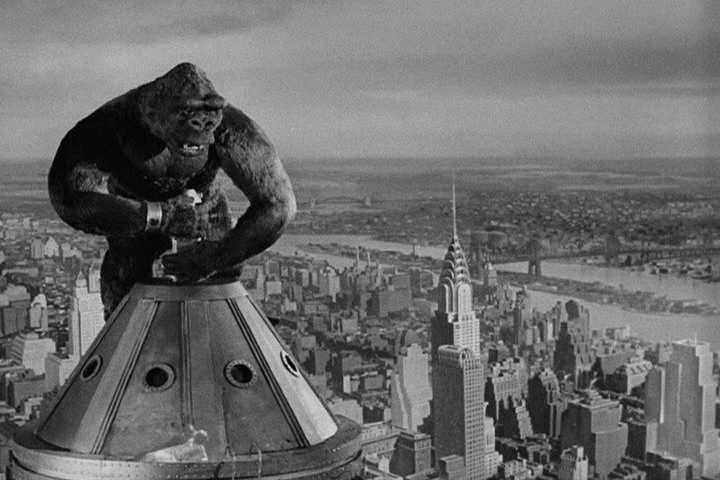
vlcsnap-2016-04-05-16h40m45s200 

“Hey, I can see my house from up here!”

When Kong meets his end atop the Empire State building we look back at what brought him here, a filmmaker wanting to make a ton of money. The only reason Ann was on this trip was because Denham was routinely told his pictures would gross twice much if it had a pretty face in it. So Carl isn’t so much brave explorer as he is a guy looking to make a buck. He also has some unfortunate words at the opening of his "The Eighth Wonder of the World" attraction that have some nasty racial overtones, “He was a king and a god in the world he knew, but now he comes to civilization merely a captive, a show to gratify your curiosity.” Yeah, as charismatic and charming as Armstrong’s Carl Denham is that is a pretty dick thing to say. And as to his famous last line, “Oh no, it wasn't the airplanes. It was beauty killed the beast.” Sorry, I have to disagree with you there Carl, I’m pretty sure it was you taking a wild animal from its natural habitat, placing it on stage for the amusement of others, and then failing to have proper security measures in place. You can’t pin any of that on Ann, you bastard.
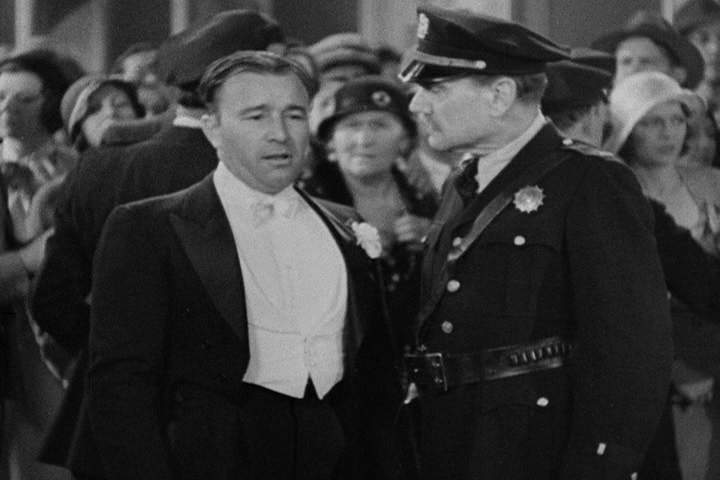
vlcsnap-2016-04-05-16h05m25s036 

“I’m hoping the city sues Ann and not me.”

King Kong was a blockbuster long before the term was ever coined, and it holds up today as one of the best action adventure flicks ever put to film. This movie had a great story, an excellent cast, a beautiful score by the great composer Max Steiner, and fantastic special effects that stunned audiences back in the 30s but that are still impressive today.

Final Thoughts:

• The Great Wall had such a big door because it was made for the film Cecil B. DeMille’s Biblical epic King of Kings.
• Carl thought to bring back Kong to exhibit but not any of the dinosaurs. Didn’t people give a shit about dinosaurs in the 30s?
• Tickets to Denham’s show went for $10 dollars apiece which equals about $137 in today dollars. That’s a lot for staring at a monkey no matter how large.
• One female patron seemed confused that this wasn’t going to be a movie but a live show. How was this thing advertised? Before dropping that kind of cash I’d want to know what I was seeing.
• Denham didn’t think to have those "ever so handy" gas bombs around during the show.
• A brunette looks out her window at the escaping Kong and screams, but moments later when Kong peaks in her room she is fast asleep. Who goes to sleep after seeing a giant ape rampaging outside?

vlcsnap-2016-04-05-17h04m48s829 

She must have had a really big day.

Saturday, April 30, 2016

Tarzan the Untamed: Edgar Rice Burroughs – Book Review

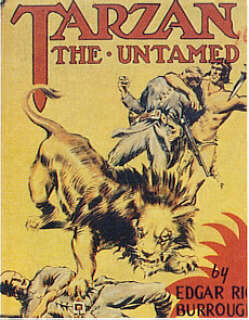
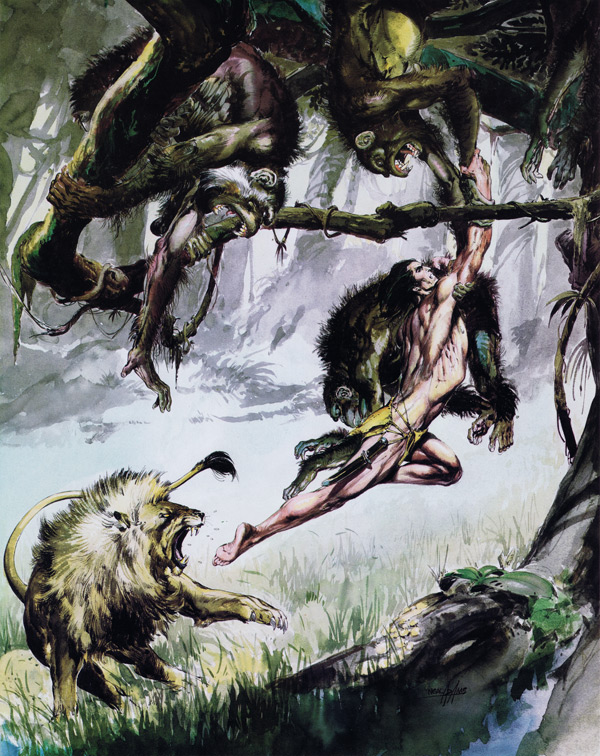
Tarzan_the_UntamedTarzan declares war on Germany. That could have been an alternate title to this book as a good portion of it has Tarzan go all Rambo on the invading German forces during World War I. This story was released in serialized form as two separate stories in two different pulp magazines; "Tarzan the Untamed" (AKA "Tarzan and the Huns") for Redbook Magazine in 1919, and as "Tarzan and the Valley of Luna" in All-Story Weekly in 1920. This is a grimmer and more brutal Tarzan than we have seen in the past books, and for a very good reason, his wife is murdered. If one was to make a list of things not to do I’m betting killing Jane, Tarzan’s most beloved wife, would probably appear near the top. There are certainly easier ways of killing yourself.

The book begins with a group of German soldiers, and their native porters, approaching the Greystoke estate in British East Africa. The “War to End all Wars” has broken out but unfortunately that information had not yet reached Tarzan or Jane. Tarzan is away doing Tarzan stuff so it is Jane who welcomes these Germans in with open arms. Things do not go well. When Tarzan learns of the outbreak of war he ditches his civilian garb and races across the land with the speed and manner only Tarzan could accomplish, but he is too late. Much of the estate is burned to the ground; he finds one of his most trusted Waziri warriors crucified, but worst of all he finds the charred remains of Jane. Tarzan declares a silent oath that the men responsible for this will pay, and pay dearly.

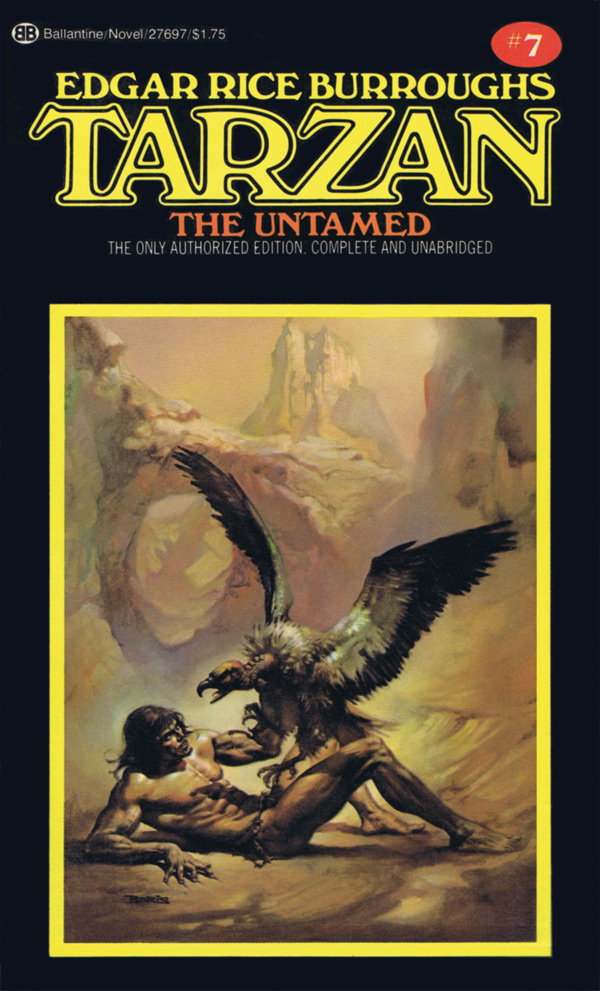
The first half of the book is pretty much all about a wrath filled Ape Man wreaking holy hell on the German forces while he tries to locate the men directly responsible for the atrocities he found at his home. He would grab a native porter for interrogation, scarring the living crap out of him, and then once he has gained what information he can get Tarzan would then crush the life out of the man. One German officer is left stuck in a tree with a hungry lion waiting for a meal, while others meet brutal if not as sadistic ends. At one point Tarzan takes the aforementioned lion, which he has leashed and beaten into submission, and forced him into the German trenches. When the hapless German soldiers flee the trenches Tarzan is there waiting for them, with a machine gun, and he rakes them with a deadly hail of bullets.

His hunt for Captain Fritz Schneider runs into a few snags when he learns that the Schneider he left for lion chow in a tree was actually just the brother of the man who led the attack on the Greystoke estate. His continued hunt for the correct Schneider leads Tarzan to cross paths with Bertha Kircher, a woman he has seen in both the German and British camps, and who he believes to be a German spy. When Tarzan discovers that Kircher has in her possession his mother's locket, which he had given as a gift to Jane, he is less than impressed with her. He decides to take her back to British headquarters, where he assumes that she will be executed for being a spy, but she manages to escape. This is not one of Tarzan’s finer moments. He basically told Bertha Kircher that he was going to personally escort her to her doom.   Yet for some unearthly reason he lets her walk behind him, and with her still in possession of her gun. I know grief can make you do stupid things but that is a bit ridiculous. The only reason she doesn’t shoot him in the back of the head as she can’t bear the idea of killing such a magnificent specimen of manhood. So she just coldcocks him with the butt of her pistol.

It’s at this point that Tarzan decides he has had about enough of civilization and will spend the remainder of his days deep in the jungle, living as he did as a young man, and far away from the supposed civilized world. What is strangely never mentioned is anything to do with John Clayton, Tarzan and Jane’s son. We know he went off to live with Miriam but wouldn’t it have been nice of Tarzan to maybe send his kid a letter, “Dear Son, going back to live with the apes. PS Your mom is dead.” I believe the death of Jane, and the lack of their son’s appearance in this book, has more to do with Burroughs’ desire to have Tarzan free to run off and have adventures than it is about his bestial nature. A tied down Lord of the Jungle isn’t as fun as one that can rush off to investigate the latest lost city.

tarzan book 7

 And this book does have a lost city. In the first six books we’ve only had a couple of short visits to Opar, the lost outpost of Atlantis, but following this book lost cities will become so numerous one will start to question if there is enough jungle in Africa to hide them all. The second half of the book has to do with Tarzan trying to make a life with a new group of Apes, and maybe venturing to the coast and the cabin his father built, but his attempt at ditching civilization is constantly interrupted by the Bertha Kircher, the German spy. She is captured by black deserters and Tarzan is forced to rescue her. He is complete and utter hatred of her wars with his inability to leave a white woman in danger. He even lets her live with him and the apes. Yeah, that’s swell of him. Eventually another character enters the picture in the form of downed British pilot Harold Percy Smith-Oldwick. One of the great moments in the book consists of Tarzan and Percy about to be burnt at the stake by a group of cannibals when Bertha leads a rescue attempt consisting of the Great Apes. Tarzan repeated tells himself that he hates Bertha with every fibre of his being, but he also can’t help but acknowledge his growing respect for her.

Poor Percy falls almost immediately in love with Bertha, even after Tarzan informs the British aviator that she is a German spy, but Berth does not return his love, she has eyes for another. You get three guesses as to who that person is, and the first two don’t count. This is a sprawling epic with Tarzan wiping out German soldiers, traveling desert wastes, battling cannibals, befriending lions (two of them in this book), and of course he finds a lost city. Only the inclusion of Bertha and Percy in the second half of the book, which is mostly jungle adventure and lost city finding, connects it to the first half, which is all about war and revenge.

As I’ve mentioned this book does have a lost city, and it’s a doozy. The lost city of Xuja, hidden in a secret desert valley, is populated by inbred madmen who use lions for cattle and security, and worship parrots and monkeys. Bertha and Percy are of course captured by Xujans so it is up to Tarzan to stage another rescue. Will the Ape Man be able to sneak into a city of madmen, can Percy win the love of Bertha, will Tarzan actually desert civilization for good, and most importantly of all, “Is Jane really dead?

boris_vallejo_7-tarzan_the_untamed-cover

 Tarzan the Untamed is bit lopsided at times and Tarzan constantly going on about how much he hates the German’s gets a bit grating. He did write this during the war so the anti-German sentiment is not surprising, but what he didn’t quite take into account was how sales of his books in Germany were going to suddenly plummet. I guess some people can’t handle being called cowardly, vile, despicable and evil. I mean seriously, who could possibly take that personally?

In the book The Beasts of Tarzan Burroughs allowed us to spend more time with characters other than Tarzan, and Tarzan the Untamed is really where that element of the series kicks into high gear. Following the adventures of people like Bertha and Percy bring a fresh to the story, and of course this allows Burroughs to get in some fresh love interests as it’s hard to make that work with a married Ape Man. Overall Tarzan the Untamed is a fun if uneven story, but made a little extra awesome by having Tarzan going on a rampage. Check it out, you won’t be disappointed.

Tuesday, April 26, 2016

Midnight Special (2016) - Review

There is something nice about seeing a small science fiction film, so full of wonder and magic, that it almost makes up for all the Michael Bay or Roland Emmerich special effects extravaganzas that we are subjected to. Jeff Nichols’ Midnight Special is such a film, and along with last year’s Ex Machina by Alex Garland I’d like to believe we are on a new wave of smart and heartfelt science fiction movies. Many directors have tried to capture the awe and mystery of Steven Spielberg’s Close Encounters of the Third Kinds or even his more whimsical E.T. The Extra-terrestrial, J.J. Abrams certainly gave it a shot with Super 8, none quite hit the mark but Midnight Special is easily the closest.

midnight special poster

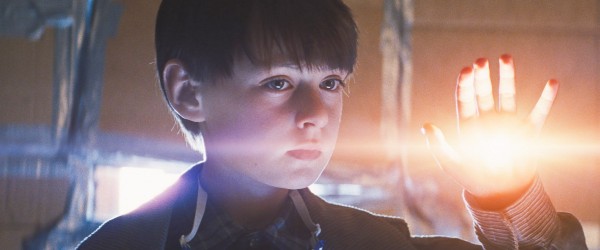
 Midnight Special begins with an Amber Alert being issued for eight-year-old Alton Meyer (Jaeden Lieberher), who is believed to have been abducted by one Roy Tomlin (Michael Shannon). What the authorities don’t know is that Roy is the boy’s biological father and that they are on the run from a religious cult known simply as The Ranch.  Along with Roy’s friend Lucas (Joel Edgerton) this small group must cross America, to some mysterious coordinates, before the cult tracks them down.   The cult's leader is Calvin Meyer (Sam Sheppard), who had raised the boy as his own, and desperately wants him back at all costs, but what is so special about Alton? Well it seems he is able to speak in tongues, which Calvin had integrated into his sermons, and they all believe that if Alton is with them they will be spared when the coming Rapture happens.

118593_original 

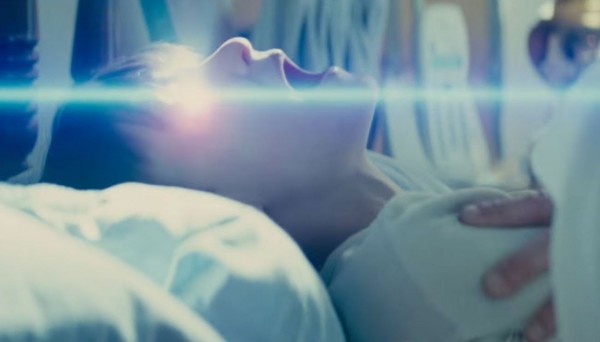
Oh, and he can shoot light out of his eyes and give you visions.

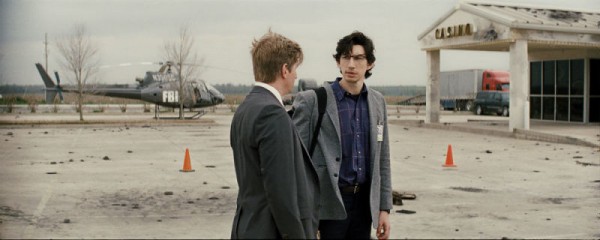
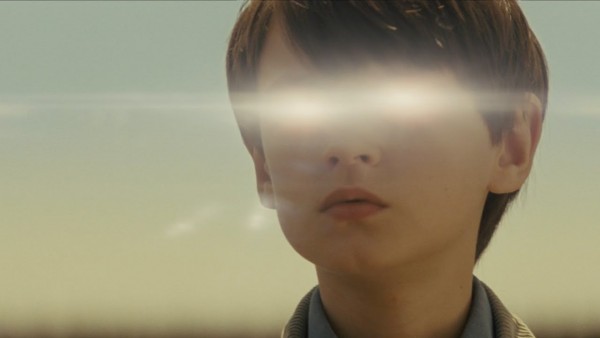
The government are also very interested in Alton as the sermons he’s been “dictating” contained classified government information. The F.B.I. swoops in to interrogate the members of The Ranch to find out how they came by this info, but Roy and Alton are long in the wind, on a dark and scary road trip. The more we learn about Alton the more intrigued one gets; he constantly wears goggles and at night wears sound suppressor earmuffs (a strange fashion statement to say the least), but it’s when he rips a spy satellite out of orbit that we start to really get a grasp on just how different Alton is. It’s this very strangeness that brings NSA analyst Paul Sevier (Adam Driver) in on the case, and Driver is clearly stepping into the shoes of Francois Truffaut from Close Encounters.

adam driver 

“Hey wait a minute, you don’t have an outrageous French accent.”

This is not a fun road trip, with religious nuts and the full weight of the American government hunting them, our little bands seems quite out of their depths. They eventually do hook up with Alton’s biological mother, Sarah Tomlin (Kirsten Dunst), and surprisingly she doesn’t reveal that she was knocked up by God or probed by aliens. So what is Alton’s story? Where did his powers come from and where do the co-ordinates that were buried in those sermons lead to? The answers to this may not satisfy all viewers, as it’s left purposely vague, but the movie isn’t about the destination but the journey itself, and the decision to focus the narrative mostly through the eyes of concerned father Roy (who is certainly a better dad than Richard Dreyfus’s Roy was in Close Encounters) makes this a unique film. Both Roy and Sarah clearly love their son and they are terrified that all this weirdness is going to lead to them losing their son.

midnight special 2 

E.T. you can totally suck it.

Though this movie will be classified as a science fiction movie, and rightly so, it’s more about the responsibility of parenting and an overzealous government. Now I've compared Midnight Special to Spielberg's Close Encounters of the Third Kind but it actually has more in common with Disney’s Escape to Witch Mountain than it does its big budget brother.  They are both road trips with decidedly twisty endings.

maxresdefault 

Is he from the Village of the Damned or Neo Tokyo?

The biggest flaw is the cult itself, which consists mainly of cardboard caricatures designed to simply force our heroes into action, but that's just a quibble and overall this is an excellent flick.  This is certainly a movie that fans of the genre should check out, though it isn’t without flaws the pluses easily outweigh them.

Monday, April 25, 2016

The Mask (1961) – Review

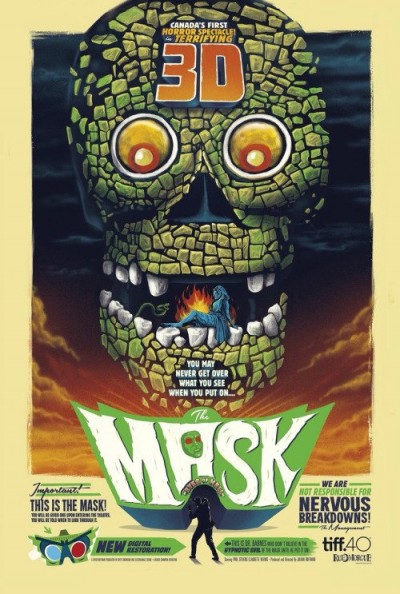
When one thinks of a man putting on a strange mask, one that turns him into a dangerous Mr. Hyde like character, most will immediately think of the Jim Carrey movie or the comic it was based on, but Canadian director Julian Roffman was there first with his 1961 movie also called The Mask. Roffman is considered by most as the godfather of genre filmmaking in Canada, and The Mask has the distinction of not only being the first Canadian horror but for being the only Canadian 3D feature film as well. Though the film has only three 3D sequences, totaling roughly 14 minutes, they are truly remarkable and are what makes it the cult classic it is today.

the mask 3d

 Borrowing from the gimmick master William Castle the film opens with Jim Moran, a popular television personality at the time, informing the audience of the mysterious history and power of The Mask, explaining that when you see someone put on The Mask you would then put on the cardboard mask that was provided to you, “Then you will share in an adventure in the darkest recesses of the human mind.” This is very reminiscent of William Castle’s 13 Ghost which had the audience don “Ghost Viewers” when prompted, and it came out only a year earlier.

vlcsnap-2016-04-01-14h56m02s160 

“I’m totally not William Castle, now put on those Ghost Viewers…I mean Masks.”

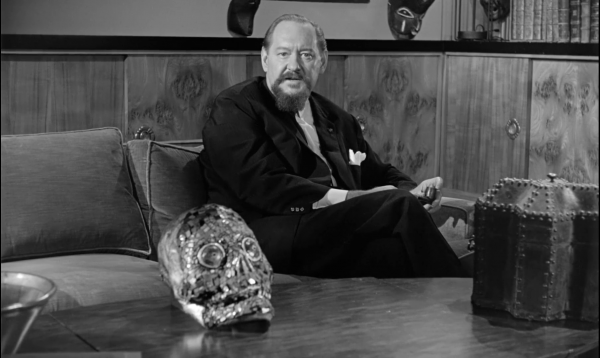
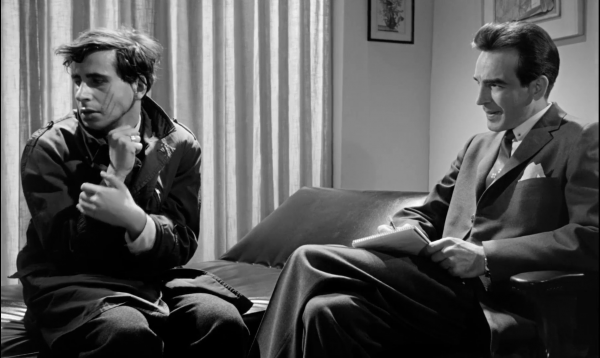
After the films infomercial like prologue we jump right into the action as we see a poor woman being chased by a deranged man. The man is Michael Radin (Martin Lavut), a professor who works at the local museum, and he isn’t chasing this woman in some strange way to get tenure. He had taken a South American mask home to study (Do museums really allow that?) upon donning the mask it had opened his mind, expanding the evilness deep down in his soul, and turned him into a murderous bastard. After brutally murdering the woman Radin goes to see Dr. Allan Barnes (Paul Stevens), a psychiatrist that Radin hopes can free him from this living nightmare. Barnes is the film’s main character and clearly falls into the category of people that are “Really bad at their jobs” for though he chalks up Radin’s ravings about The Mask to stem from some deep seated psychological issue, and not from some form of mystical possession, but what he doesn’t do is notify the police. Radin tells him of his dreams of committing murder, and he has the defensive wounds on his face from his last victim, but Barnes puts that down to probably self-inflicted.

vlcsnap-2016-04-01-15h12m34s890 

“And then you felt the need to write Helter Skelter in pig’s blood?”

A mentally distraught Radin leaves Barnes’s office, goes home, and blows his brains out, but not before packing up The Mask and having his landlady mail it to Barnes. This is certainly a nasty way at getting back out your skeptical shrink.  It’s here that the film introduces police detective Martin (Bill Walker) who is investigating Radin's death to insure that it was in fact a suicide and not murder, and after discovering that Radin had a valuable mask on loan from the museum (Again, really? I know us Canadians are known for politeness but letting someone take a valuable artifact home seems rather odd), and now that it's missing he amps up his investigation. Barnes tells Martin about his patients strange obsession with The Mask, but has no idea where it us.

vlcsnap-2016-04-01-15h24m44s811 

“It’s definitely not in that unopened package on my desk.”

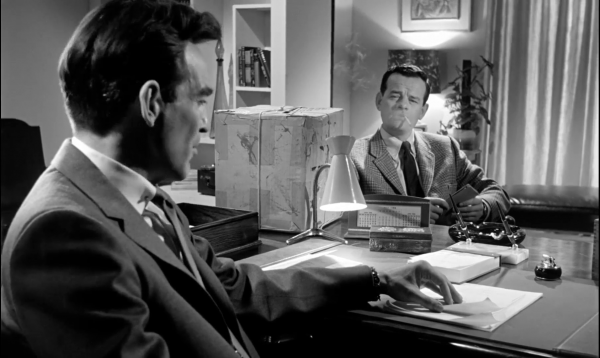
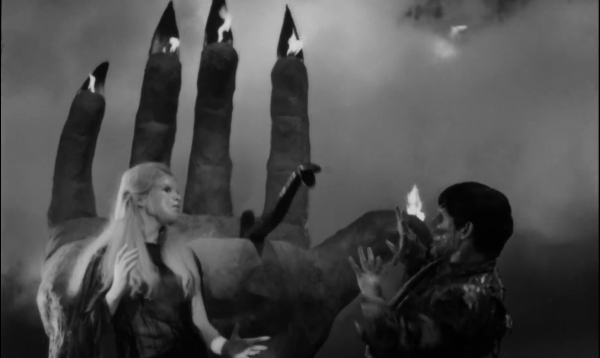
When Detective Martin leaves Barnes opens the package and discovers The Mask, he first tries to get his secretary to stop Martin from leaving, but he’s too late, so he then sits down and reads the packages accompanying note from Radin. The note basically goads Barnes into putting on The Mask, and as Radin knows what is most likely going to happen this quite the “Fuck you for not helping” note from beyond the grave. It’s here that we get out first of three nightmare sequences as a booming voiceover orders, “PUT ON THE MASK NOW!" This sequence is as if Salvador Dali had dropped acid while watching Jean Cocteau’s Beauty and the Beast. Ghastly figures in hauntingly tortured death masks parade through one visual nightmare after another, and the 3D effects just add to the otherworldliness of the scene.

vlcsnap-2016-04-01-15h33m44s864 

If I’d seen this as a kid I’d have been under my seat with my eyes covered in record time.

The rest of the film's running time is divided between Detective Martin trying to find The Mask and Barne’s fiancée Pam Albright (Claudette Nevins) and her desperate attempts to get The Mask away from the man she loves. Barnes tries to explain to her the importance of The Mask, how it can further man’s understanding of the psyche like never before, but she clearly sees that he is being driven insane by the damn thing. That Barnes later seduces his secretary, and later tries to kill her, kind of bears out Pam’s worries.

vlcsnap-2016-04-01-15h44m02s630 

I totally understand the psyche on display here.  Barnes is batshit crazy.

Even with just 83 minute run time some people may find some of the police procedural stuff a bit of a slog, but the acting across the board is fantastic, and those nightmare dreamscapes will most likely haunt long after you’ve turned off your player. With The Mask Julian Roffman brings a visual flair to what could have been just your average thriller, and added to that is the excellent electronic score of “Electro Magic Sound" provided by Myron Schaeffer, which just makes those nightmarish vision even spookier. This is a must see for fans of the genre, and really makes me proud to be a Canadian.

mask poster 

Note: The film had several re-releases and sometimes billed as "Eyes of Hell."

Saturday, April 23, 2016

Jungle Tales of Tarzan: Edgar Rice Burroughs – Book Review

Jungle-Tales-Of-TarzanThe Jungle Tales of Tarzan is the sixth book in the Tarzan series but chronologically it actually takes place during the first Tarzan novel, Tarzan of the Apes. This book consists of twelve short stories that deal with Tarzan's days prior to meeting Jane but after the death of his foster mother Kala. These twelve short stories ran monthly in Blue Book magazine before eventually be published in book form in 1919, and though each chapter can be considered as individual stories they as a collection are connected with one major theme, Tarzan realizing that though he is surrounded by numerous jungle residents he is in fact quite alone.

It’s in the opening story "Tarzan’s First Love" that sticky topic of bestiality is danced around. Tarzan has been raised by apes since he was but an infant and so his views on beauty are a tad different than what most English Lords would have had. The young female ape Teeka catches Tarzan’s eye for she is quite beautiful, by ape standards, and Tarzan does his best to win her love. Clearly love is in the eye of the beholder and to Tarzan this she-ape is everything one could want in a mate, but unfortunately the feeling isn’t actually mutual. Tarzan may have grown-up thinking the Great Apes of the Tribe of Kerchak bestial appearances are normal but that also means Tarzan’s appearance are not the norm. Tarzan is a hairless ape, and without even a decent set of fighting fangs. That Teeka would prefer fellow ape Taug over Tarzan is no surprise, but then when Tarzan saves Teeka, from the savage claws of Numa the lion, Teeka chooses Tarzan.  Sadly fickel is the heart of a she-ape for when Tarzan roams off into the jungle to hunt he later returns to find Teeka grooming Taug. You can practically hear Tarzan’s heart breaking.

When Tarzan finds Taug trapped by the local natives he at first thinks finally Teeka will be his, but when he breaks the news of Taug’s capture he notices Teeka’s wistful expression of sorrow, and when the sad Teeka snuggles up to Tarzan he puts his arm around her he finally notices, “The strange incongruity of that smooth, brown arm against the black and hairy coat of his lady-love.” This causes an epiphany within Tarzan as he realizes that all the other species of the jungle have matching mates but him, that even though, “The males and the females differed it was true; but not with such differences as existed between Tarzan and Teeka.” Tarzan screams at the heavens, beating his fists against his breast, railing against the unfairness of his life.

neal_adams_6-jungle_tales_of_tarzan

 Tarzan eventually rescues Taug from the natives, and later he becomes godfather to Teeka and Taug’s child, but still Tarzan is alone. It’s seeing the bond between Teeka and her baby that leads Tarzan to one of his more questionable decisions, the kidnapping of a ten year old native boy. He quickly realizes that taking care of a child that is constantly terrified of the creatures in the jungle may have been a mistake as even Tarzan’s ape companions want this kid dead. In the end Tarzan comes to grips with the fact that Kala loved him, Teeka loves her baby, and that the mother of this poor snatched kid is now living in grief because of his actions.  So Tarzan returns the child.

For Teeka there is Teek’s balu,” he soliloquized; “for Sabor there are balus, and for the she-Gomangani, and for Bara, and for Manu, and even Pamba, the rat; but for Tarzan there can be none – neither a she nor a balu. Tarzan of the Apes is a man, and it must be that man walks alone.

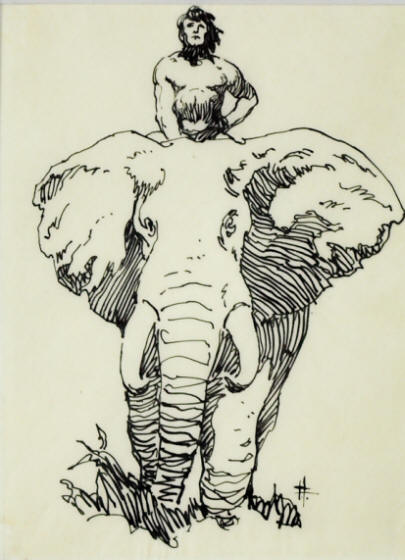
The central theme of these stories focus on how even though Tarzan may be “Lord of the Jungle” he is still a lonely figure, aching for someone to share his life with, but that’s not all on offer here; Tarzan is no tragic figure moping around the jungle like a half-naked Hamlet, we still get plenty of jungle fun. Tarzan hangs with his pal Tantor, the elephant, murders the shit out of anyone or anything that stands in his way, hunts for god, plays practical jokes, and even rescues the moon.

tantor

The Jungle Tales of Tarzan give us a great glimpse into the youthful days of Tarzan and really shows us that this creation of Edgar Rice Burroughs was a lot more deep and complicated than many people thought. A man raised by apes would certainly have different set of morals, and his personal code was something he developed overtime. Tarzan is one cruel bastard, many of his practical jokes involve killing some hapless sap, but you can see in these stories the seed of the man that Jane will eventually meet and fall in love with.

Wednesday, April 20, 2016

The Jungle Book (2016) – Review

Back in 1967 Disney released an animated version of Rudyard Kipling’s stories from The Jungle Book, which was also the last animated film to have the personal touch of Walt himself as he passed away in1966, and this is what the Disney Studios have tried to remake here today. Now in 1994 Disney did make a live action version of The Jungle Book, which was also pretty good and starred Jason Scott Lee, but this isn’t so much Disney doing another remake of the stories by Kipling but more of a remake of the animated version, only with a live action Mowgli and CGI everything else. This is all part of Disney’s current plan to make live action versions of all their classic animated films.

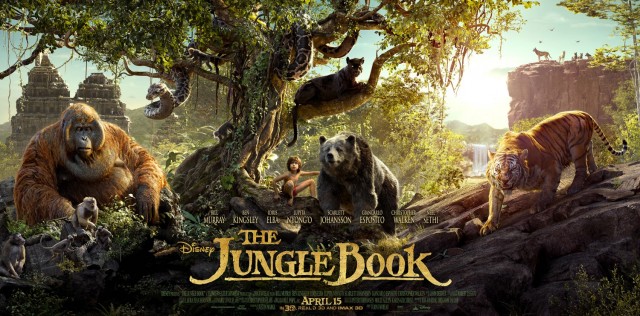
jungle book poster 2016


The original 1967 animated film took many elements from the Kipling stories but Walt Disney was not keen on the darker tone of the source material, so we got a much more upbeat movie with singing bears and dancing monkeys, but in this “live action” version director Jon Favreau had decided to adopt that darker tone found in the books. This will make the film a bit off putting for some parents as elements of this movie could scare the little ones. I had no problem with the tonal change, but I did have a problem with it being inconsistent. Making a gritty and dark fantasy world is all well and good, and I did like that Mowgli (Neel Sethi) is shown to be dirty and scarred from his life in the jungle, but then when we have him later helping Baloo (Bill Murray) steal honey or lazily drift down the river singing “The Bare Necessities” it’s a bit jarring.

baloo 

Not helped by the fact that neither Neel Sethi nor Bill Murray can carry a tune.

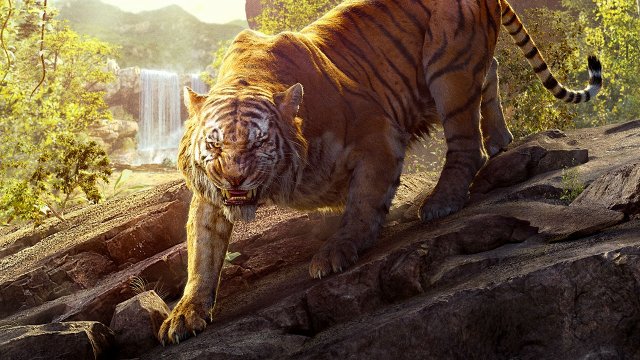
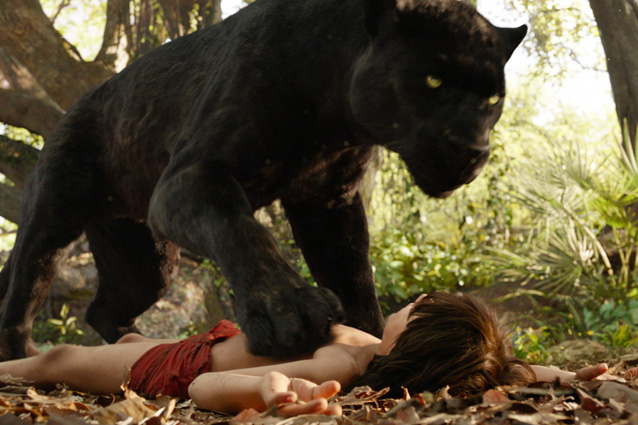
The basic story structure is the same as the original, which is often the problem when adapting Kipling's books as they are not what one would call “plot centric” as they are really just a series of episodic adventures in the jungle. The movie begins with us seeing Mowgli playing with his fellow wolf cubs and the panther Bagheera (Ben Kingsley), but then drought strikes and all the animals gather at “Peace Rock” for a truce where eventually Shere Khan (Idris Elba) shows up to threaten Mowgli. Shere Khan really hates man, he has a burnt face because of an encounter with a fire wielding man, and he wants this man cub dead. We later learn that Shere Khan was the one who orphaned Mowgli, and it’s also possible that he may have killed Bruce Wayne’s parents as well.

the-jungle-book-new-poster-reveals-shere-khan_rv4p.640 

“Have you ever eaten a man by the pale moonlight?”

Shere Khan demands that the animals of the jungle turn over the man-cub or else many will die, which does not go over well with Raksha (Lupita Nyong'o), Mowgli’s adoptive wolf mom, who wants to protect her son. When the wolf pack later tries to decide just how they are going to handle the situation Mowgli interrupts their debate by telling them that he will leave. This is a nice departure from the original which had the wolves getting Bagheera to take Mowgli away for his own good, but then the film screws that up by still having Mowgli decide to still stay in the jungle, but maybe with the crocodiles. Mowgli is a bit of an idiot in this film, except when he is showing off his amazing inventor skills, then he is a jungle genius. Being human Mowgli has the creative ability to craft tools that would make his jungle life a tad easier, he makes a water gathering device and multiple rope gadgets, but both Bagheera and Akela (Giancarlo Esposito), Mowgli’s foster dad and head of the wolf pack, give him shit for not doing things the wolf way.

junglebook_t2_cms2 

The apes didn’t give Tarzan this kind of crap.

This is an odd theme for the movie to toss out there. Why would animals give a crap if one of their own was using his abilities differently, especially if it could help out the pack? It comes across as a false and unnecessary conflict, we already have Shere Khan demanding the death of Mowgli, do we really need more drama than that? Overall I hated the wolves in this movie as not only do they give Mowgli grief for not acting more "wolf-like" but they come across as complete cowards who almost immediately give into Shere Khan’s threats. In the original story I always felt that the wolves knew that there was no way they could protect Mowgli one hundred percent of the time if Shere Khan was hunting him, so the little tike was sent away for his own good, but here it's clear that wolves are more worried about their own hides than Mowgli's, and they show their bellies to the big cat right off the bat.  I'm not sure the filmmakers understand pack mentality at all. Regardless Mowgli leaves with Bagheera and his jungle adventures begin, and by that I mean they begin to check off moments from the animated film.

The_Jungle_Book_2016_Kaa_Mowgli 

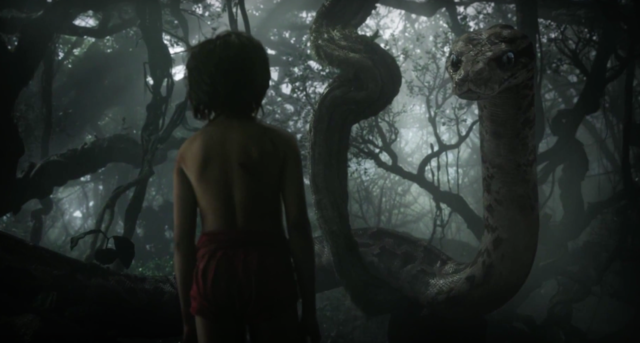
Trust in me, it doesn’t get any better from here on in.

Mowgli runs into Kaa (Scarlett Johansson), who uses her snake like charms to mesmerize Mowgli, and for some reason this gives him flashbacks to his father being killed by Shere Khan. Baloo shows up to rescue the kid, but only so he can help him get honey as this version of Baloo is more of a con man than a lovable jungle bum. It’s here that we see that Mowgli can invent the hell out of anything as he devises an elaborate rope and cable system for getting honey that would put the Swiss Family Robinsons to shame. Bagheera eventually shows up again so that we can move onto the King Louis (Christopher Walken) portion of our movie. A group of monkeys and apes snatch Mowgli on behest of their king who really wants man’s red flower (that's fire for you non jungle folk). This scene is just bizarre. King Louis here is more akin King Kong than orangutan from the original, he’s bloody huge and lurks in the shadows mimicing Marlon Brando from Apocalypse Now. This is certainly a strange reference to make in what is marketed as a kid’s film.  Though a massive and scary looking King Louis singing “I Want to be Like You” was kind of awesome, and a little freaky, I found the decision to incorporate some of the songs from the animated film to be a major misstep as they constantly fought against the tone Favreau seemed to be aiming for.

The-Jungle-Book-3-600x316 

Note: Walken is a better singer than Bill Murray but he’s no Louis Prima.

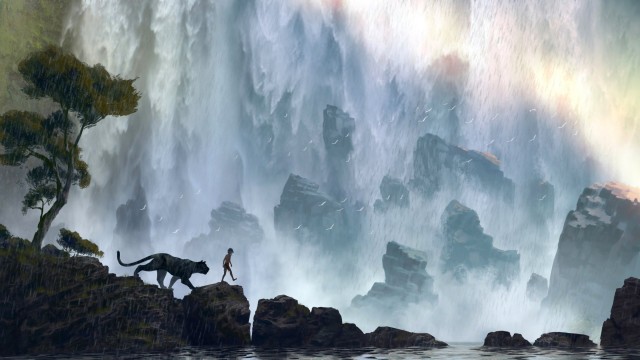
Now I must say the look of this film is simply gorgeous. Though shot onstage with green screen technology Jon Favreau gives us an amazing jungle that one easily gets lost in just by looking at it. The CGI for all the animal characters is universally excellent, and the action sequences with them are beyond reproach, but by god is Neel Sethi ever a terrible actor. I hate to slam a young kid in his first movie role but he was horrible, not one line of dialog was convincing. All he seemed to be doing was reading lines of dialog at different decibels with no emotion whatsoever. Though to be fair he was working in a completely green screen environment, starring at green tennis balls can't aid ones acting, and he certainly wasn’t helped out by the script as for much of the film’s running time I was wishing Shere Khan would eat the irritating little shit. I know many will like this film based on the nostalgia factor, and how visually stunning the whole project looks, but it failed to engage me on any emotional level. Shere Khan is trotted out way too early which diminishes his onscreen power, Mowgli’s motivation changes like the wind, and his friends are almost as annoying as he is. If you are going to see this movie see it on the big screen because on a television set it will lose most of its positive elements.

TheJungleBookConceptArtPreview

Notes:
  • This jungle has “Peace Rock” instead of “Pride Rock” so that’s original.
  • Mowgli gets caught in Simba’s wildebeest stampede.
  • How has Mowgli lived in the jungle all these years yet had never met an elephant until now?
  • Mowgli also seems unfamiliar with Kaa, so this seems like a case of bad parenting.
  • Why some animals have language yet others don’t is never explained.  The apes and monkeys minions don’t talk but King Louis does.
  • Mowgli has magically disappearing bee stings.
  • By the end of the film most of the animals should be siding with Shere Khan as Mowgli is clearly the greater threat.
  • The end credit sequence was my favorite part.

Monday, April 18, 2016

Donovan’s Brain (1953) – Review

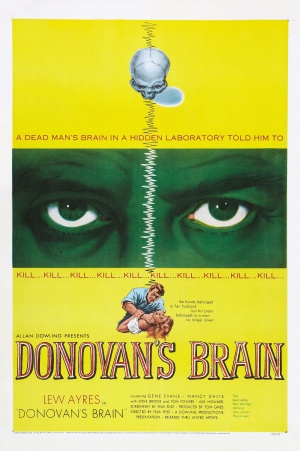
The mad scientist is truly one of the most beloved tropes of early science fiction stories, and I particular love the whole “brain in a jar” subgenre. Now the story that really started all this was the novel Donavan’s Brain by Curt Siodmak, who also wrote the screenplay for the 1941 Lon Chaney The Wolf Man, but this novel isn’t about a man fighting his animal nature, this is about a doctor trying to see if a brain could survive outside of the body. I’ve seen this film twice now and I’m still fuzzy on the medical value of living brains in jars, but then again I'm not a mad scientist. This 1953 movie was not the first adaptation of Donovan’s Brain as director George Sherman first took a crack at it in 1944 with The Lady and the Monster. That title was a bit misleading as most audience viewers wouldn’t expect the titular monster to be of a metaphorical nature. Curt Siodmak was to direct this 1953 version but studio politics nixed this and the job went to Felix E. Feist, who with a name like that should really be fighting Wonder Woman.

donavons brain

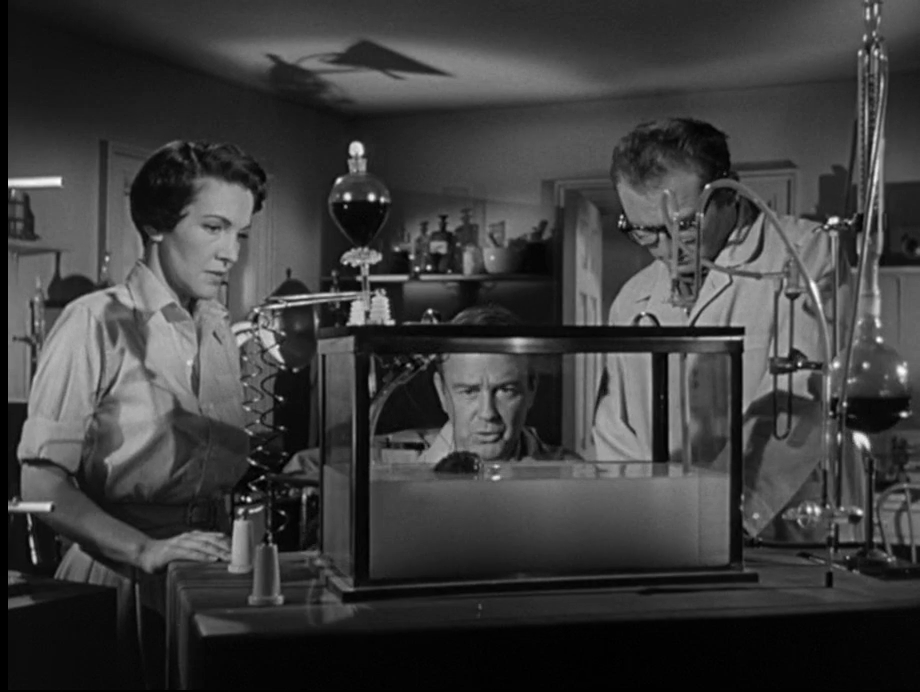
 The movie follows the work of Dr. Patrick Cory (Lew Ayres) as he tries to figure a way to get a brain to survive outside its host. His wife Janice (Nancy Davis who will later become First Lady Nancy Reagan) is a bit distressed that they’ve killed four capuchin monkeys in his attempt to prove his theories, and would really rather keep this latest monkey as a pet, but science must march on. When the brain of this latest monkey survives its removal and dumping into an aquarium things start looking up.

vlcsnap-2016-03-26-21h54m05s833 

Janice is also no longer keen on keeping it as a pet.

This amazing breakthrough is interrupted by a phone call informing them of the nearby crash of a small business plane. This kind of medical emergency should be handled by the local on call doctor, but Dr. Frank Schratt (Gene Evans) is a bit of an alcoholic and was sleeping off a bender at Dr. Cory’s home and wasn’t able to field the call. So to save lives, and possible Frank’s job, Cory heads to crash site where the only survivor is millionaire William Donovan. The millionaire is seriously injured, and no one expects him to survive, but regardless they rush him to Cory’s place as it is the nearest medical facility. When Donovan does die Cory decides to check for brain waves and discovers that the brain can in fact survive after the body dies. He quickly cuts open Donovan’s head and plops the brain in a jar.

vlcsnap-2016-03-26-22h25m16s310 

“I expect a Noble Prize and five years in jail for this.”

Both Cory’s wife and Frank question the ethics of all this but they are quickly convinced by Cory’s rhetoric on how this will explore man’s ability to understand emotions, thought processes, and the like. Unfortunately things get a bit complicated when Donovan’s heirs want to know if there was a last will and testament, and worse when a yellow photojournalist Herbie Yocum (Steve Brodie) wants to photograph the operating room were Donovan died. For some baffling reason, something about not wanting to arouse suspicion, he allows Yocum into the operating room to take pictures, with bloody jar containing the brain in plain sight. Yokum “accidentally” takes a picture of the brain which allows him to later blackmail Cory. Unfortunately for Yokum the brain eventually uses its telepathic powers to force him to drive off a cliff.

vlcsnap-2016-03-26-22h35m23s617 

“Must kill self, and maybe pick up some milk on the way home.”

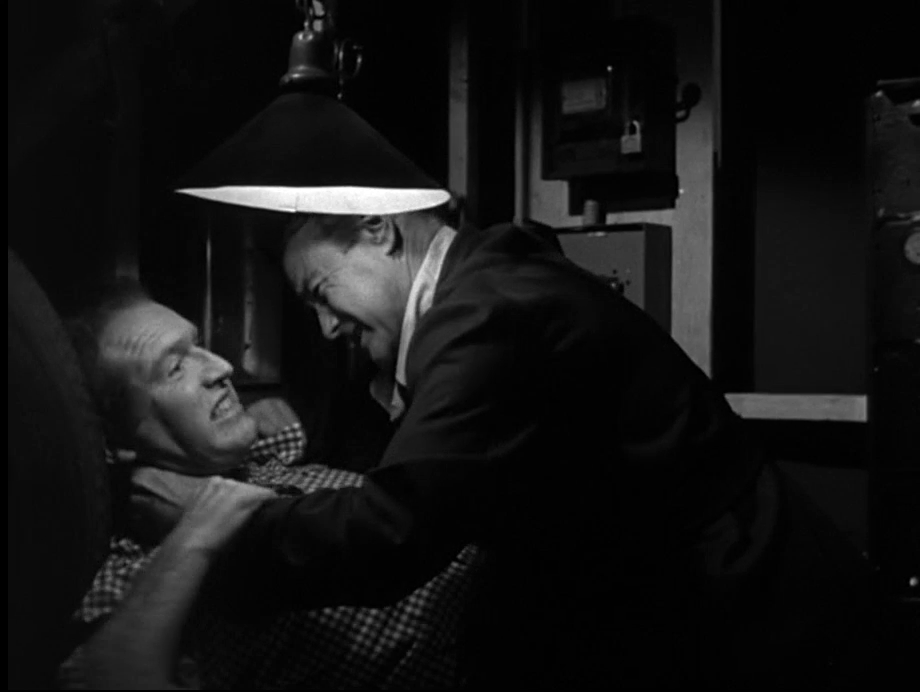
You see it turns out that when you take a brain out of a person and plop it in an electrified saline solution it’s going to develop telepathic powers, and this isn’t even the least believable element, no that would be Doctor Cory immediately ordering Frank to get ever crackpot book on psychic phenomena. Cory goes from average everyday obsessed scientist to a complete wackadoo scientist in record time, and the fact that he’s right does not lessen the stupidity of this. Worse is the fact that Janice and Frank are completely complicit in all the weird shit that goes down. That when they first fully realize that brain is controlling Cory, and don’t immediately run into the lab and smash the jar, makes them just as guilty as Cory. Frank does offer to Janice his services in “accidentally” tripping the breakers thus cutting off the power to the brain, but she of course turns him down as this would upset her wonderful husbands work.  When Frank does eventually get the balls to cut the power the brain has become too powerful.

vlcsnap-2016-03-26-22h47m02s214“Sorry Frank, the brain is totally making me kill you.”

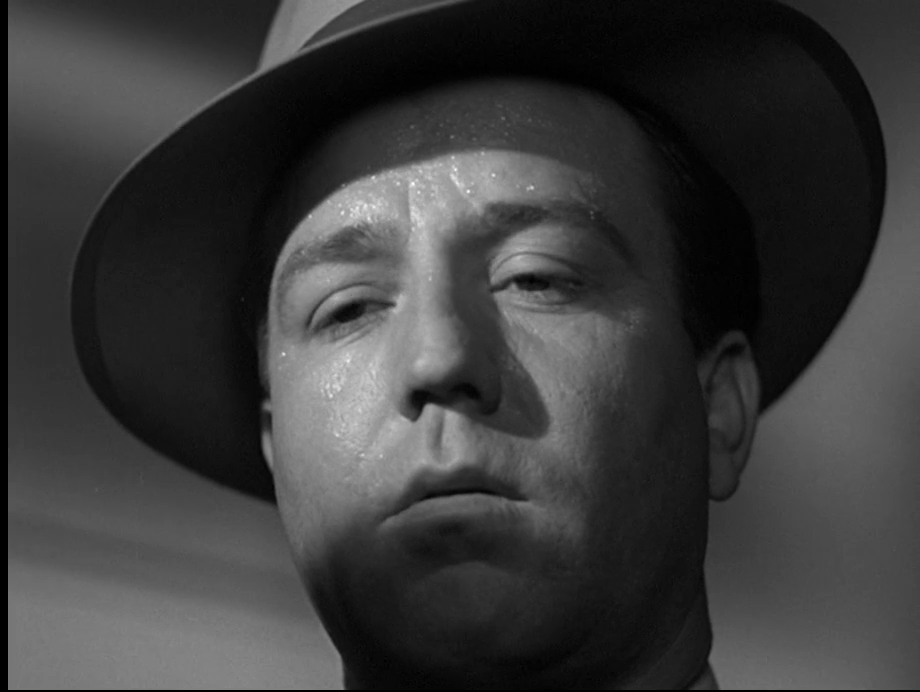
The bulk of the film deals with Donovan’s brain telepathically taking over Cory’s body so that he can continue to rip-off the IRS and build another financial empire through graft and blackmail. These scenes are all handled beautiful by Ayres as he is basically playing two roles in this movie; scientist and loving husband and Donovan, a ruthless man who will let nothing, even death, stop him from amassing money and power. We can tell when the brain is manipulating when he begins to exhibit Donovan's personality traits such as smoking cigars, using ruthless personal manipulation, and walking with a limp. All traits Donovan was known to have.  These scenes where we see him begin to rebuild his fortune, through almost sheer force of will, are quite impressive. The only problem is that Donovan is still just a brain in a jar, and rather vulnerable because of it, despite being able to control people from miles away.

vlcsnap-2016-03-26-22h46m13s118 

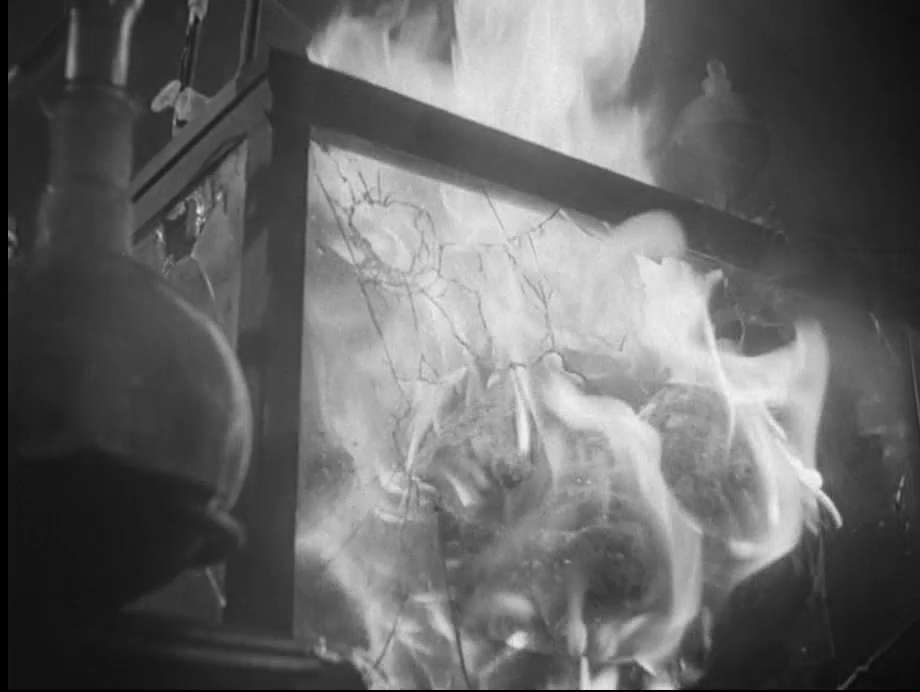
The brain eventually gets a fiery end when God steps in with some lightning.

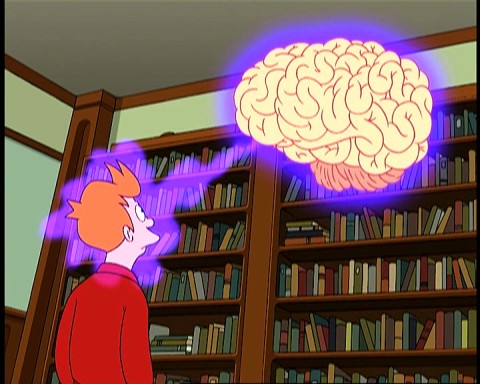
Donovan’s Brain is classic B-movie science fiction, and should be heralded as the forefront of all killer brain movies; from Fiend Without a Face to Steve Martin’s The Man With Two Brains, countless lobes of terror owe a debt to Curt Siodmak.

futurama_fry_brainspawn 

And the brains just keep on coming.