Few horror films slither under your skin quite like Onibaba. Kaneto Shindō’s tale of wartime desperation, lust, and moral decay feels at once ancient and timeless. A fever dream of sex and survival set in a world where human cruelty makes ghosts redundant. Stark, sensual, and shot in eerie black-and-white splendour, it’s a film that transforms a windswept field of reeds into the gates of hell itself.
In 14th-century Japan, not far from Kyoto, two women—a mother-in-law (Nobuko Otowa) and her daughter-in-law (Jitsuko Yoshimura)— eke out a grim existence amid the chaos of civil war. As soldiers flee through the endless sea of reeds, the women ambush them, murder them, strip them of armour and weapons, and toss the corpses into a deep pit hidden in the tall grass. Their grim routine is interrupted only when they take their loot to a wily merchant named Ushi (Taiji Tonoyama), who trades them food and lewd propositions. The world outside is disintegrating, but the reeds whisper that survival, however monstrous, must go on.
 “It’s a living.”

One day, a familiar face returns: Hachi (Kei Satō), a neighbour who had gone to war with the older woman’s son, Kishi. When the women ask about Kishi’s fate, Hachi grimly admits that they deserted the army, and Kishi was killed while stealing food. The mother-in-law blames Hachi for her son’s death and warns the younger woman to stay away from him. Naturally, this only makes the younger woman want him more, because nothing spices up forbidden love like a haunted swamp and the constant threat of starvation.
 Splendour in the Grass.

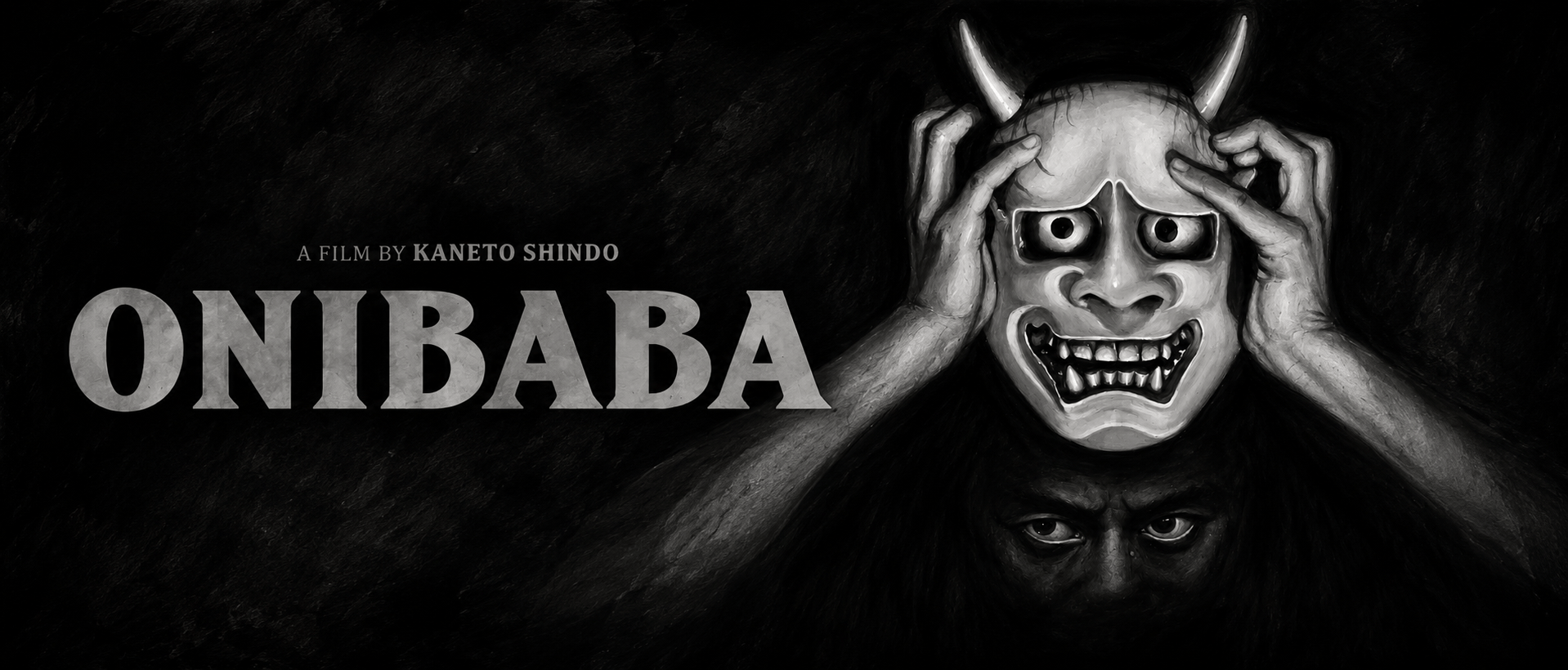
Hachi and the younger woman’s nightly escapades soon become the talk of the reeds. She sprints through the grass like an Olympic athlete just to get some action, while her mother-in-law grows furious and jealous, worried that she will be left to die alone. When seduction and pleading fail to stop the affair, the older woman turns to supernatural measures. Enter a lost samurai general (Jūkichi Uno), wearing a grotesque Hannya mask to protect his supposedly beautiful face. She kills him, steals his mask, and discovers his face beneath is a nightmare of rot and ruin. Inspired, she dons the mask to terrify her daughter-in-law away from her lover.
 Yep, that would scare me straight.

The deception works, for a while. But as rain falls and passions flare, nature itself seems to turn against the older woman. Her mask fuses to her face, her trick becomes her curse, and the line between demon and human blurs into a moral quagmire. When she begs her daughter-in-law to help remove the mask, her flesh tears away with it, revealing a monstrous visage beneath. The younger woman, convinced her mother-in-law has truly become a demon, flees into the night. The older woman follows, shouting, “I’m human!” as they leap across the pit, the final boundary between sin and damnation, before the screen cuts to black.
 This is something right out of E.C. comics.

Stray Observations:
•
The reed field was real and enormous—director Kaneto Shindō shot on
location in sweltering heat, where the cast had to dodge snakes and
mosquitoes. That’s a solid work ethic.
• Hachi is basically the horniest man in medieval Japan, and the younger woman runs to him like she’s training for Onibaba: Tokyo Drift.
•
The “pit of death” is never explained—was it natural? A sinkhole? The
world’s worst well? Either way, it’s a convenient plot device and a
health hazard.
• The mother-in-law states, “We’ve done nothing wrong. No demon can come after us.” I guess multiple murders weren’t considered “wrong” back in feudal Japan.
•
That mask? Based on an actual Noh theatre mask used to represent
jealous female spirits. It’s beautiful, creepy, and cursed—a triple
threat.
• The demon mask in Onibaba was so creepy it gave William Friedkin ideas; he basically said, “What if this nightmare had a cameo in The Exorcist?” and thus, the white-faced demon was born.
 Behold, the Japanese Pazuzu!

Kaneto Shindō directs Onibaba like a ritual etched in flesh and shadow. The film’s pacing is hypnotic—repetitive by design—drawing viewers into the same endless loop of violence and desire that ensnares its characters. His camera doesn’t merely observe the reeds; it breathes with them. The landscape itself seems alive, whispering, moaning, moving in rhythm with lust, guilt, and fear. Shindō’s horror comes not from sudden shocks but from suffocating atmosphere, the terror of being trapped in a godless world where the reeds always grow back, no matter how many bodies lie rotting beneath them.
 “Did I discover a plot hole?”

Kiyomi Kuroda’s cinematography is nothing short of exquisite. The high-contrast black and white accentuates both the sensuality and savagery of the story. Light flickers across wet skin, blades of grass glint like knives, and shadows seem to devour the characters whole. The scenes of the women navigating the reeds at night are among the most striking in all of Japanese cinema, like watching ghosts haunt the living. Every frame could be mistaken for a still photograph, yet the restless motion of wind and grass keeps the film alive, pulsing with primitive energy.
 Every shot is a postcard of beauty and darkness.

While Onibaba is often categorized as a horror film, it transcends genre boundaries. It sits comfortably alongside Kwaidan (1964) and Kuroneko (1968)—also by Shindō—as part of Japan’s rich tradition of folk-inspired horror that blurs the line between ghost story and moral allegory. Unlike Western horror, which often externalizes evil in monsters or murderers, Onibaba internalizes it; the true horror comes from within. The supernatural here is psychological, born from hunger, jealousy, and fear of abandonment. It’s as much a feminist parable as a ghost story—an examination of women reduced to savagery by a world that has stripped them of everything else.
 Fear is the mind killer.

In Japanese cinema, Onibaba occupies a fascinating middle ground between the postwar realism of Kurosawa and the surrealism of Kobayashi or Teshigahara. It’s grounded in historical suffering but elevated by mythic imagery. Shindō uses folklore not as escapism but as confrontation: a way of showing that even in the absence of warlords and spirits, humans are more than capable of becoming demons on their own.
 We all have our own masks.

In conclusion, Onibaba remains one of the great works of Japanese horror, not for its scares, but for its raw, poetic exploration of human depravity. It’s erotic, brutal, and strangely beautiful, a film that asks whether damnation is something we earn or something we inherit. In the end, the reeds keep swaying, the pit keeps yawning, and humanity keeps falling in.
No comments:
Post a Comment