Sword-and-sorcery had been kicking around for years, but 1982’s Conan the Barbarian sparked a full-blown boom, unleashing a wave of bargain-bin imitators like Deathstalker and The Beastmaster. By the late ’90s, the trend was long dead, yet Universal took another swing despite the lukewarm Conan the Destroyer and the flop Red Sonja, once again calling on Arnold Schwarzenegger to return as cinema’s most formidable Cimmerian. He declined.
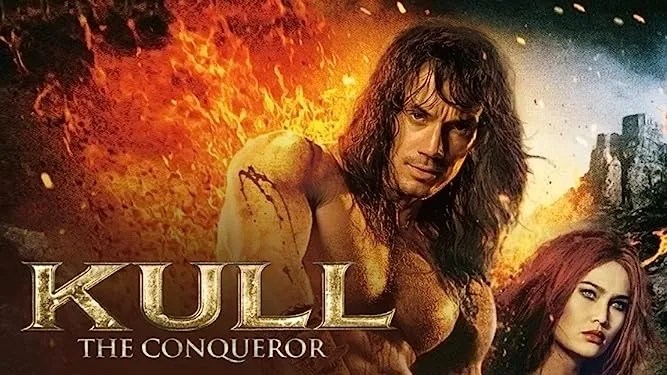
After an endless info dump about ancient demons, fallen empires, and the evil sorceress Akivasha (Tia Carrere), we cut to Kull (Kevin Sorbo) auditioning for Valusia’s elite Dragon Legion by enthusiastically chopping through a group of very committed extras. With the pounding electric guitar and Sorbo’s flowing hair, it feels less like a military trial and more like he’s about to headline a 1987 arena tour. Despite clearly being the best guy in the room with an axe, General Taligaro (Thomas Ian Griffith) rejects him for not being of “noble blood,” because apparently meritocracy hasn’t been invented yet.
 “Why don’t you apply to be an American Gladiator?”

Before Kull can properly process this insult, news arrives that King Borna (Sven-Ole Thorsen) has gone full lunatic and is busy murdering his own heirs. Kull tags along to the palace, where things escalate from tense confrontation to attempted murder in record time, ending with Kull killing the king in self-defence. In his final act of petty spite, Borna names Kull his successor, instantly enraging the nobles and handing the throne to a guy who technically just wandered in off the street. If nothing else, Valusia keeps things unpredictable.
 “Promotion via regicide, nice!”

Now king, Kull stumbles into palace life like someone who won a contest he didn’t remember entering. He meets his harem and recognizes Zareta (Karina Lombard), a fortune-teller who once predicted his rise and now ominously informs him that the fate of the kingdom depends on a kiss. Meanwhile, Kull tries to abolish slavery and promote religious tolerance, only to discover that Valusian law is literally carved in stone and enforced by people who quite like things the way they are. Reform is hard when everyone else is invested in not reforming.
 I give him points for not kicking anyone into a well while screaming, “THIS IS VALUSIA!”

Naturally, the disgruntled nobles decide the best course of action is to resurrect an ancient demon sorceress, because subtlety is overrated. With help from the necromancer Enaros (Edward Tudor-Pole), they bring back Akivasha, who immediately enchants Kull, marries him, and puts him into a deathlike sleep, framing Zareta for good measure. It’s a solid evil plan, slightly undermined by the fact that Akivasha finds Kull too appealing to actually kill, which feels like a pretty major oversight for an immortal conqueror.
 One should never underestimate the power of a broad and hairy chest.

Kull eventually escapes with the help of the priest Ascalante (Litefoot), frees Zareta, and heads off to find the “Breath of Valka,” dragging along his deeply questionable pirate-slaver acquaintance Juba (Harvey Fierstein), because nothing says heroism like keeping a guy like that on speed dial. After betrayals, frozen caverns, and Taligaro deciding he’d rather double-cross a demon than serve her, everything builds to a solar eclipse showdown where kisses double as weapons and prophecies finally pay off. Kull reclaims his throne, kills the remaining opposition, marries Zareta, and smashes the sacred laws, because if you’re going to accidentally become king, you might as well start redecorating immediately.
 “Hail to the king, baby.”

Stray Observations:
- Kull is told that he’s not noble enough to be part of the elite Dragon Legion, but when he hears the king is murdering his heirs, he races off with everyone else to check it out. So, they let just anyone into the palace to watch royal murders?
- The villains’ master plan hinges on everyone involved being just competent enough to start a resurrection ritual, but not competent enough to finish it without chaos.
- Akivasha tells Taligaro that “I’ve altered the pact, pray I don’t alter it further.” Nice, she’s a fan of The Empire Strikes Back as well.
- Nobody seems particularly concerned that an ancient sorceress is wandering around possessing people like it’s a casual hobby.
- Guards in Valusia are apparently trained to stand around in tight formations and do absolutely nothing when things go sideways.
- The film treats political intrigue like an afterthought, even though the entire plot is literally about a coup.
- Kull spends a surprising amount of time reacting to events rather than driving them, which is a bold choice for someone labelled “The Conqueror.”
 “Honestly, I’ve been winging it through this entire picture.”

The strange thing about Kull: The Conqueror is that it wasn’t supposed to exist in this form at all. This was originally conceived as Conan the Conqueror, an adaptation of The Hour of the Dragon by Robert E. Howard, in which an older, battle-hardened Conan faces a conspiracy to overthrow him by resurrecting the ancient sorcerer Xaultotun. That premise has weight, age, and a sense of legacy baked into it. Then Arnold Schwarzenegger declined to return, the script got hastily reworked, and suddenly we’re watching Kevin Sorbo playing a completely different character in a story that still has Conan’s fingerprints all over it. The result feels like a cover version of a song where the band didn’t quite learn the chords.
 Note:
With the heavy electric guitar on this film’s score and Sorbo’s long,
sweaty hair flailing about, it looked more like he was auditioning for a
hair metal band than an elite guard unit.
Note:
With the heavy electric guitar on this film’s score and Sorbo’s long,
sweaty hair flailing about, it looked more like he was auditioning for a
hair metal band than an elite guard unit.
As an adaptation, the film sits in an awkward middle ground among Howard’s works on screen. It’s technically a Kull story, but structurally it’s still The Hour of the Dragon, just relocated from Aquilonia to Valusia. Elements from “By This Axe I Rule!” and “The Phoenix on the Sword” are tossed in, like the filmmakers were hoping no one would notice they were remixing multiple sources into something that doesn’t quite honour any of them. Compared to Conan the Barbarian, which embraced Howard’s grim, mythic tone, this feels diluted, like someone took the original text and ran it through a “make it broadly appealing” filter until all the personality drained out.
 This is the kiss that saved an empire? Yikes!

That dilution becomes painfully obvious when you look at the film’s rating. It was originally intended to be R-rated, which makes sense given Howard’s work is full of brutality, moral ambiguity, and the occasional existential dread. Sorbo refused to star unless it was toned down to PG-13, and the studio, demonstrating the spine of a wet napkin, agreed. Screenwriter Charles Edward Pogue later remarked that the studio “relented to the demands of an imbecile,” which, while not exactly diplomatic, does capture the frustration. What you get instead is a fantasy film that gestures toward danger without ever really committing to it, like it’s worried about scaring off the Saturday afternoon crowd.
 “Conan got a Saturday morning cartoon, how about me?”

What’s left is a movie that looks the part but never quite feels it. The production design is serviceable, the action is competent in a “we showed up” sort of way, and Kevin Sorbo brings an easygoing charm that occasionally convinces you this might be better than it is. But the stakes never land. The villain lacks the mythic menace the story demands – though Tia Carrere gives it the old college try – the political intrigue is paper-thin, and the world feels less lived-in and dangerous than like a theme park version of sword-and-sorcery. It’s not aggressively bad, which might be its biggest problem. It just sits there, occupying space where something memorable should be, and it’s certainly not helped by a central romance that generates all the heat of a damp sock.
 There are tepid love affairs, and then there are these two.

In conclusion, with fantasy films surging again, it’s almost impressive how completely Hollywood still can’t crack Robert E. Howard’s characters. When Arnold Schwarzenegger first picked up the sword, there was a willingness to embrace the grit and darkness that defined the material; now, studios sand everything down, terrified of a hard R. Kull: The Conqueror ends up as a tepid genre entry, promising epic conquest but delivering a man who basically inherits a throne after a violent workplace opening, with very little actual conquering to justify the title.
No comments:
Post a Comment