Blog Archive

Thursday, July 1, 2021

The Lost World (1960) – Review

When one hears the name Irwin Allen the title “Master of Disaster” may leaps readily to mind, what with him being behind some of the greatest disaster movies of all time, such as The Poseidon Adventure and The Towering Inferno, but before that he was a well-respected television producer with such classic shows as Lost in Space and Time Tunnel on his resume and yet the same can’t be said of his time spent in the director’s chair as that often resulted in such box office bombs as The Swarm and Beyond the Poseidon Adventure as well as the film we will be looking at today, and though his 1960 remake of the 1925 silent film Lost World was not a complete failure it was still a less than stellar example of the genre.
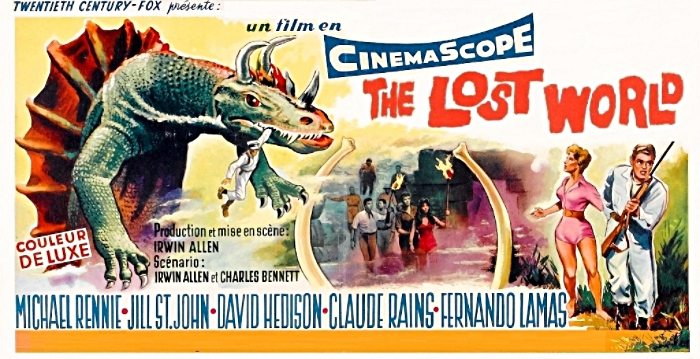
Arthur Conan Doyle’s classic adventure tale The Lost World has been adapted many times over the years, most notably the 1925 silent movie version which truly captured the spirit of Doyle’s novel, but 35-years later Irwin Allen was at the helm of a remake that not only included sound and colour but would also be filmed in the wonderous Cinemascope, and with the advances in special effects over three decades how could the end result be anything less than spectacular? Sadly, the people at 20th Century Fox had a little less faith in the project and with the studio hemorrhaging money due to a certain bloated production called Cleopatra they gave Allen a meagre $1.5 million dollars to bring his dinosaur epic to life, needless to say, the end result was not quite what the legendary producer had in mind.
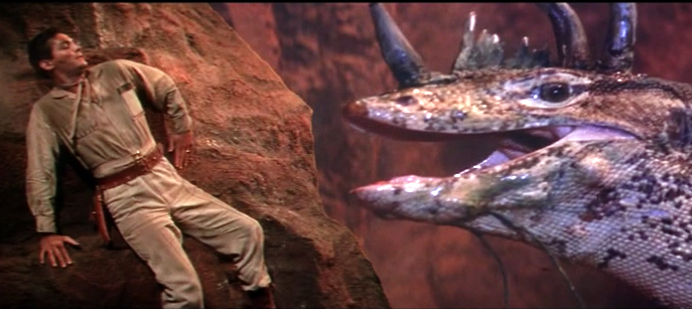
 

To say these dinosaurs were less than awe-inspiring would be a vast understatement.

Irwin Allen had intended the use of stop-motion to bring his prehistoric beasts to life, he even hired legendary special effects man Willis O’Brien to provide conceptual sketches for the dinosaurs, but due to his slashed budget he was forced to full back on the tried-and-true method of gluing plastic horns and spikes to a variety of monitor lizards, iguanas, and crocodiles. This technique had been utilized just a year earlier for the studio's other big Cinemascope epic, Journey to the Center of the Earth, but even though the dinosaurs in the film were just as silly and ineffective looking the movie itself also had wonderful locations at Carlsbad Caverns, amazing sets and spectacular matte paintings to create the fantastical world of Jules Verne which more than made up for shabby dinosaurs.  This would not be the case for Irwin Allen’s The Lost World as he had a third of that film’s budget, and thus hobbled by lack of funds Allen’s attempt at a faithful adaptation of Doyle’s novel was a non-starter from the outset.
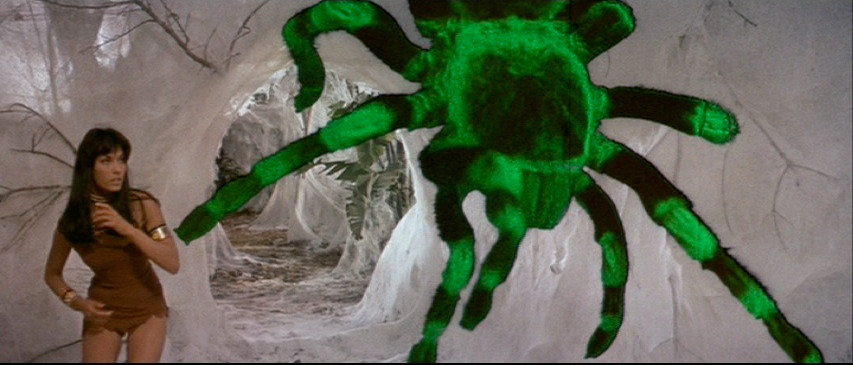
 

I don’t remember half-naked native girls and glowing green giant spiders in the book.

The movie starts out as a fairly faithful updating of the material with Professor Challenger (Claude Rains), a celebrated biologist and anthropologist, arriving at the London Zoological Society to inform the world of his discovery of living specimens of supposedly extinct animals, including dinosaurs, located on a remote plateau deep in the Amazon Basin, which the local natives call Curupuri. Evidence of this startling find was lost when all his camera equipment sank en route back to civilization – which is a nice save from the previous film where the expedition didn’t even bother to bring a camera – but without any proof, it’s up to Challenger to outfit a second expedition to prove his outlandish claims. The group would include the head of Zoological Society Professor Summerlee (Richard Haydn), big game hunter Lord John Roxton (Michael Rennie), newsman Ed Malone (David Hedison), whose publisher advances $100,000 to pay for the expedition and along for the ride is the publisher’s daughter, Jennifer Holmes (Jill St. John ), and her younger brother David (Ray Stricklyn) because you have to have a pretty face in your jungle adventure, I think that’s an actual law by this point.
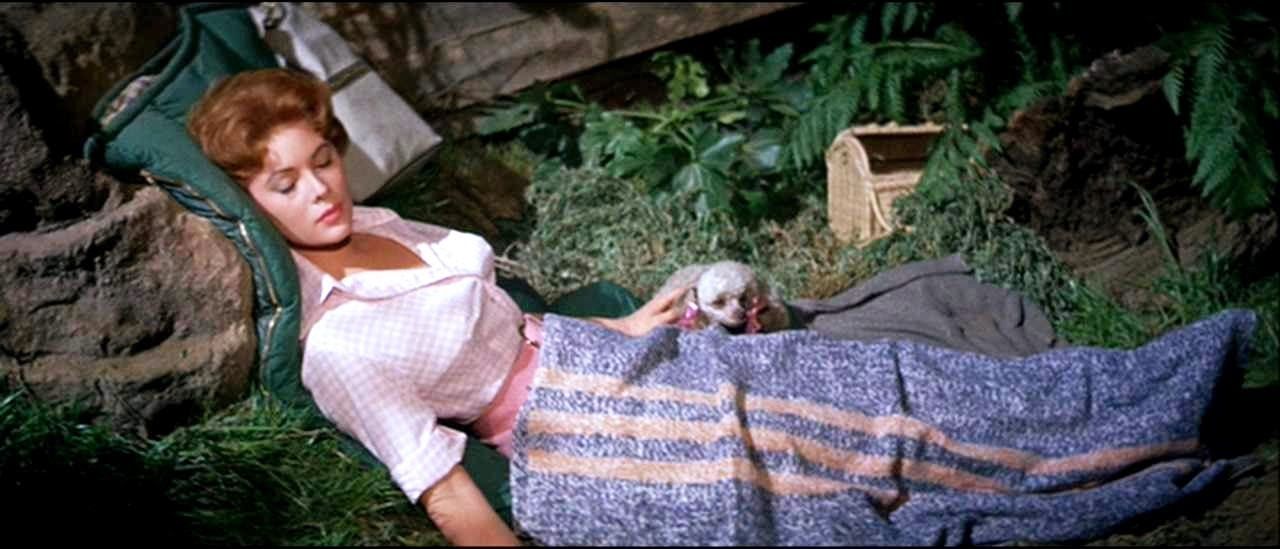
 

Also, bring along a poodle while you’re at it.

Now, the original novel did not feature a female character yet even filmmakers of the silent era knew the importance of a pretty face but in the 1925 version the character of Paula White was the daughter of the leader of the previous expedition and she joined the Challenger party in the hope of finding her missing father, while in this version, she’s just a rich dilettante who comes along for the ride simply because she has her mind set on marrying John Roxton, for his title if not for love as Roxton claims, and her role in this film is mostly forgettable. Did I mention that a sort of love triangle develops between Jennifer, Roxton and Malone? Yeah, that’s a thing, but it is so clichéd and meaningless that if it had been dropped no one would have missed it. But that’s not all; we also get an unnecessary backstory dealing with the fact that, unbeknownst to everyone in this party, three years ago Roxton financed an expedition to this plateau because of the rumoured diamonds that were to be found there. Turns out this plateau is the basis for the mythical city of El Dorado, because why not?
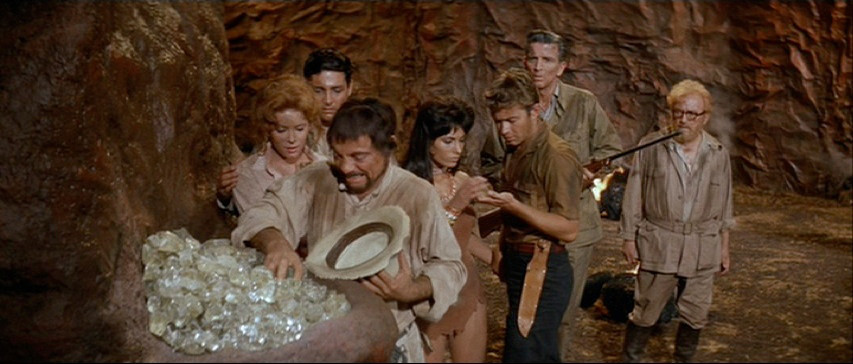
 

Did we really need greed as a motivation, find living dinosaurs was not enough?

Things get complicated when we learn that their guitar-playing helicopter pilot Gomez (Fernando Lamas) had a brother on that lost expedition, and by lost, I mean Roxton abandoned them so he could chase some tail, and he will want revenge against the asshat who got his brother killed. Sure, why not at a revenge subplot while were at it.  Then to make things even more unbearable we also get the racially offensive sidekick Jose Costa (Jay Novello), whose sole purpose is to be a greedy bastard and attempt the rape of a primitive jungle girl (Vitina Marcus), because what says “Jungle Adventure” without a little sexual assault. In fact, women in general, are treated pretty shabbily in this script as they are either skimpily clad native girls or man-hungry women in search of a lucrative meal ticket. Now, if only the script was able to fit in a group of cannibals to either eat or sacrifice our heroes, we’d have the perfect movie, oh wait, I spoke too soon.
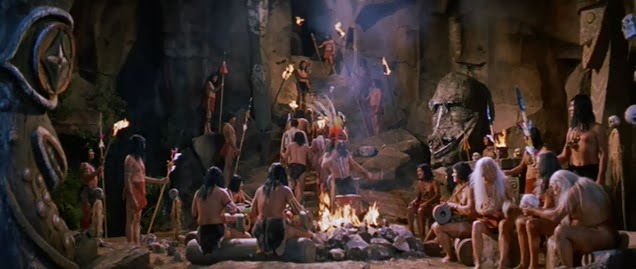
 

If we’re lucky they’ll offer Jennifer as a wife to Kong.

Stray Observations:

• Professor Challenger states that the plateau is "cut off from evolutionary development" but if that were true then dinosaurs from different eras would not inhabit the same place. Clearly, the professor doesn’t understand how evolution works.
• Malone is told that “No one who has seen Curupuri and lived to tell the tale” but if that were the case then how did the legends even start? 
• Challenger is supposed to be this zoological expert but he constantly misidentifies dinosaurs that your average seven-year-old child could correctly name. Of course, his inability to name a dinosaur species is helped by said dinosaurs looking like nothing other than what they really were, which is lizards with crap glued on them.
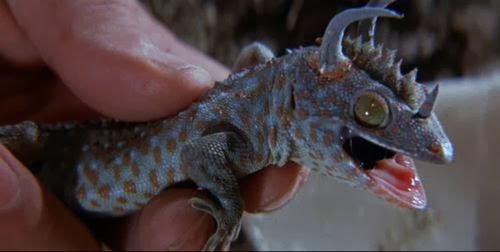
 

He calls this a baby Tyrannosaurus Rex, which is just embarrassing.

As an adaptation, Irwin Allen’s Lost World is dodgy at best and his cast of characters range from the boring to the outright offensive and his casting choices didn’t fare much better as aside from Claude Rains, who appears to be having a ball chewing up the scenery as Challenger, you have a group of actors who look as if they’d rather be anywhere else, probably getting drunk and the worst offender of this David Hedison who’s utterly wooden performance as Malone can best be described as a walking catatonic state. This is not to say there isn’t anything to enjoy about this film, the aforementioned performance by Rains is a highlight and I did quite enjoy the goofy setting, the wacky cannibals and the updating of the group arriving by helicopter – which, of course, gets destroyed by a rampaging dinosaur – but the bad outweighs the good by a fare margin and the fact that we don’t even get a brontosaurus rampaging through London is simply criminal, and yes, I know that scene was not in the original story and simply added for the 1925 adaptation but this film needed that addition even more. In conclusion, Irwin Allen’s adaptation of Arthur Conan Doyle’s The Lost World feels more like a pilot for a television show than it does a big-screen adventure, that footage from this movie would later appear in shows like Land of the Giants makes that even more evident.
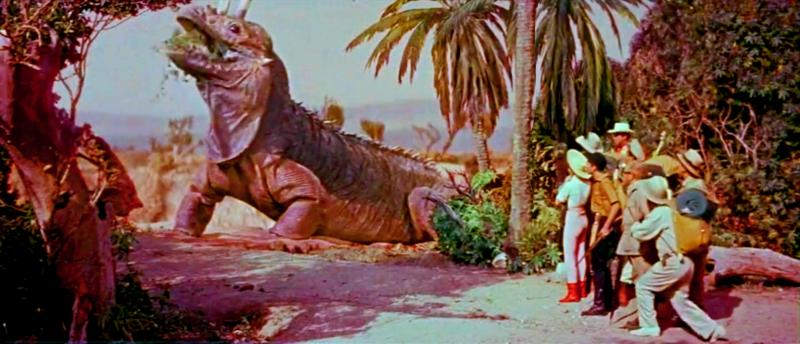
 

Seriously, this looks like an outtake from an episode of Gilligan’s Island.

Monday, June 28, 2021

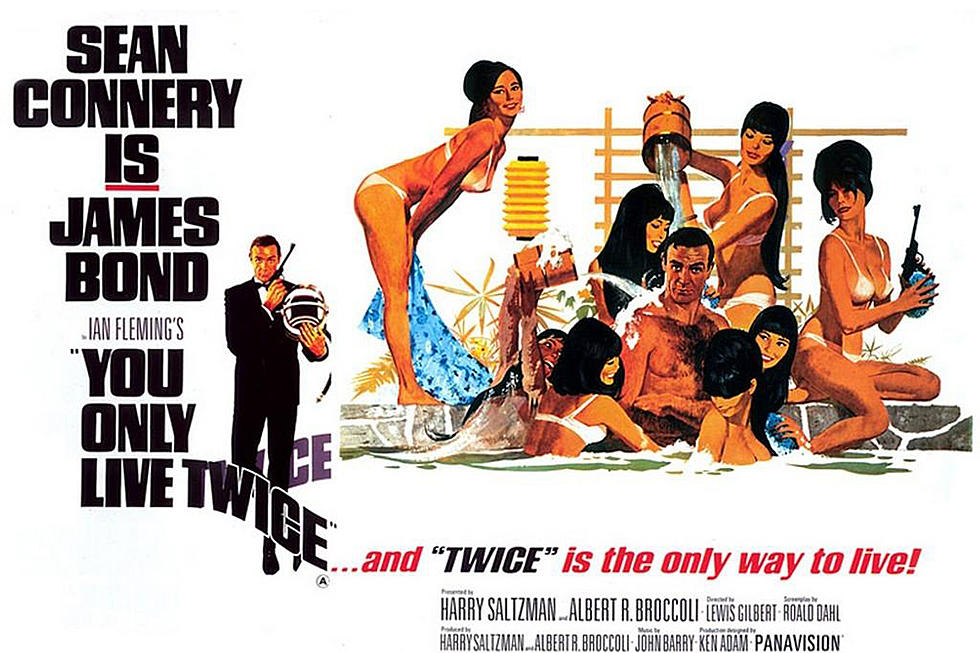
You Only Live Twice (1967) – Review

What happens when you get the author of Charlie and the Chocolate Factory to write the screenplay for a Bond film? As odd as that question sounds the world was treated to the answer in 1967 when children’s author Roald Dahl adapted Ian Fleming’s You Only Live Twice to the big screen.  With this film, not only did we get a volcano lair and a face-to-face meeting with Ernst Stavro Blofeld but we also got Bond in his most challenging role yet, turning Japanese.

This would be the first time that a James Bond adaptation would discard most of Fleming's plot, using only a few characters and locations from the book as the background for an entirely new story. The previous four Bond films may have switched up a few elements but they still contained the bones of the plot, yet with the film, You Only Live Twice we get what is basically an “In Name Only” adaptation. Flemings book takes place after the events of On Her Majesty's Secret Service which had ended with the murder of Bond’s wife by Blofeld, in this sequel Bond, a depressed man in mourning, is removed from ‘00’ status and given a job in the diplomatic branch and is sent to Japan to liaison with Japan’s secret service intelligence, but while there he comes across Blofeld who is operating some kind of “Garden of Death” and so with revenge on his mind Bond goes undercover to live and think as a mute Japanese coal miner in order to penetrate Blofeld's castle. To say that the movie bears very little resemblance to the source material would be an understatement of volcanic proportions.


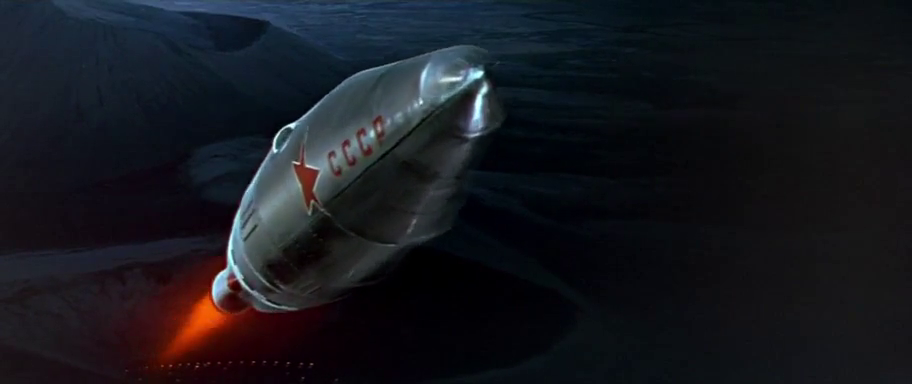
There isn’t a single rocket in the entire novel, shocking!

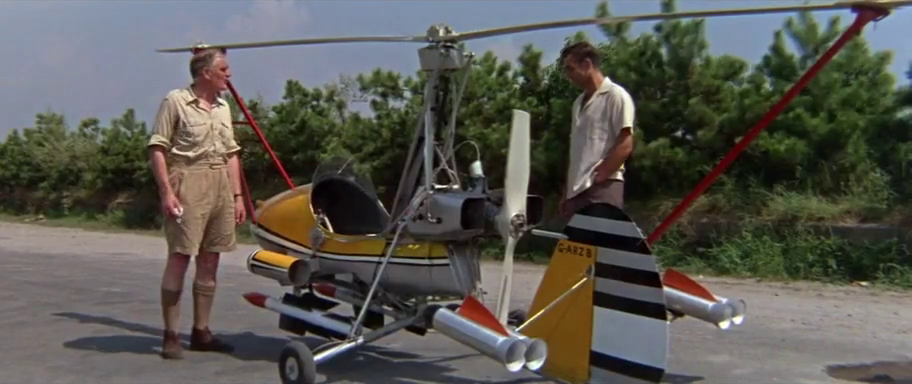
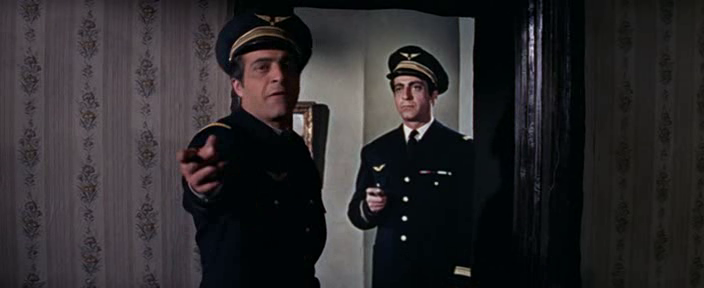
The film deals with a plot by SPECTRE to hijack orbiting spacecraft belonging to both American and Russian space programs, in an act that would hopefully provoke a war between the two nations. The man sent to uncover this dastardly plot is none other than super-spy James Bond (Sean Connery) who fakes his death and is buried at sea in the hopes of giving him a little extra elbow room in his investigations. He teams up the head of the Japanese secret service, Tiger Tanaka (Tetsurô Tanba), and his number one agent Aki (Akiko Wakabayashi), and they help Bond investigate the evil machinations of a Japanese industrialist who just so happens to be in the employ of SPECTRE. With mounting clues pointing to something going on in and around a small Japanese island Bond requests ‘Q’ (Desmond Llewelyn) to bring one of the best gadgets in the Bond franchise, Little Nelly, a heavily armed autogyro.

Note: The Aston Martin DB5 may be the most stylish vehicle in Bond’s arsenal but “Little Nelly” kicks its ass in the offensive category, it had two forward-firing synchronized machine guns mounted on the nose of the aircraft, either side of the autogyro were twin rear-firing flamethrowers, aerial mines to take care of enemies below, twin rocket launchers which fire a cluster of smaller rockets and twin heat-seeking air-to-air missiles.

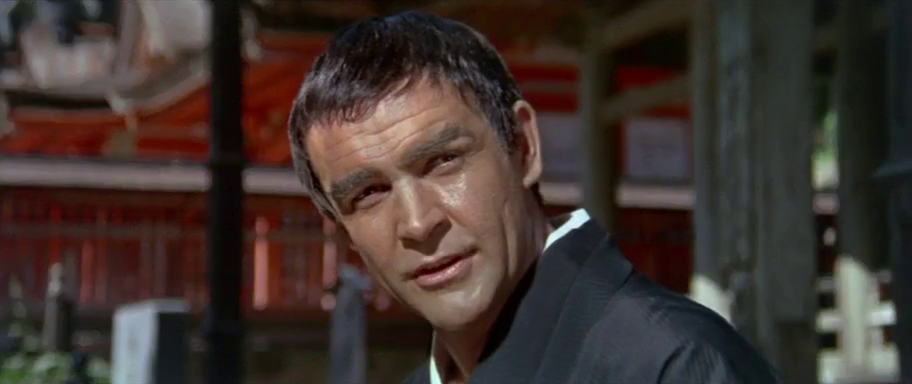
The more dubious element of You Only Live Twice is the plan to infiltrate the island involving Bond disguising himself as a Japanese fisherman as not only is the very idea of a 6' 2" Welshman passing as a Japanese man to be patently ridiculous, no matter how much latex appliances you use, but this entire section of the movie barely moves the plot forward and thus completely unnecessary. Why exactly does Bond have to turn Japanese and marry a local Japanese girl just to investigate a volcanic island? Are they worried that one of the local fishermen may be a SPECTRE agent? Yet what makes it all the more pointless is that there are two attempts on Bond’s life while he is living as a Japanese man, so clearly SPECTRE wasn’t fooled one bit by this silly ploy.


Maybe passing himself off as a Romulan would have been a better idea.

Stray Observations:

• MI6 staging Bond’s murder, as well as his burial at sea, was a trifle elaborate and as he is later identified while wandering around Tokyo it turns out to have been a rather expensive and pointless ploy.
• The local MI6 operative is played by actor Charles Gray who would later play Blofeld in Diamonds Are Forever.
• During a fight with a Japanese killer Bond stumbles across a hidden office safe, good thing he just so happened to have a safe-cracking device in his pocket.
• The villains use the old “Bale out of a plane and leave the hero to crash” scenario when simply shooting Bond would have been more efficient and certainly less costly.
• A piranha pool to remove employees who demonstrate poor performance makes it clear that SPECTRE must not have much in the way of an HR department.
• Aki is easily one of the best Bond girls as not only is she incredibly beautiful but she saves Bond on multiple occasions, unfortunately, she also falls into the Bond trope of sleeping with him and then ending up dead.
• I love me some ninja action but the idea of Bond needing ninja training before attacking a SPECTRE facility is just silly.


What part of ninja training deals with rappelling into a volcano lair?

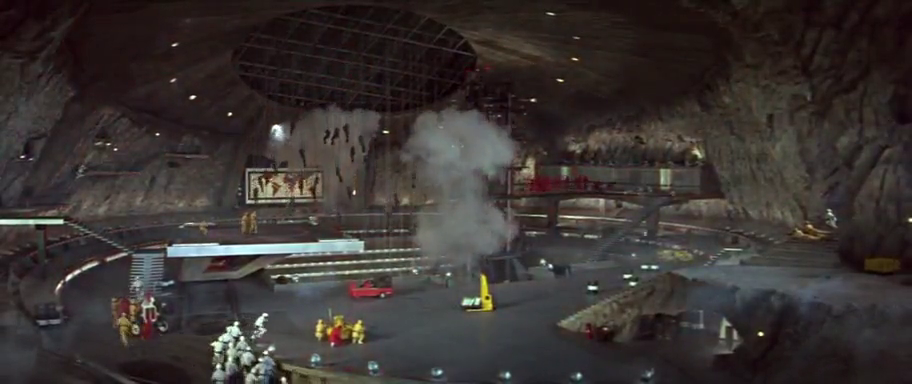
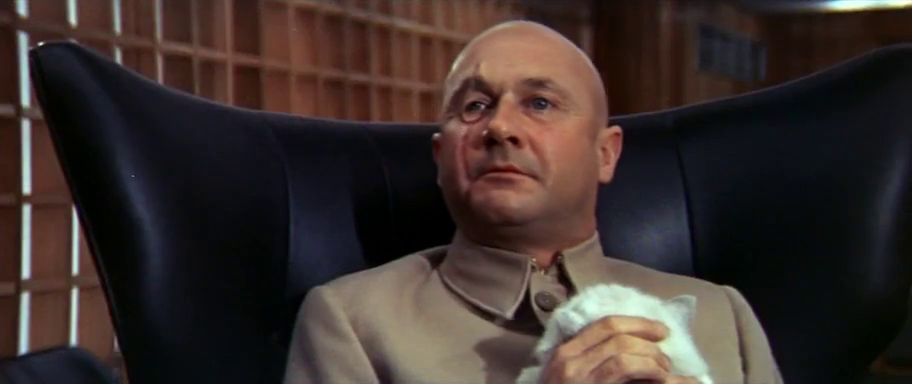
The plot of You Only Live Twice may not have had anything to do with the source material, other than a couple of character names lifted from the book, but it does bear similar elements to Dr. No, what with SPECTRE’s plan to sabotage the American space program, and the idea of a villainous plot to swallow up crafts from other nations in the hopes of instigating a global a war which would be revisited in the film The Spy Who Loved Me. That all said, despite some of the film’s dodgier elements it is the first entry in the franchise where we finally get a good look at SPECTRE’s villainous leader, Ernst Stavro Blofeld (Donald Pleasence), and this is a real treat for fans and Pleasence gives a chilling performance as this iconic villain. Many actors have played this role over the years but it is Pleasence who will be most remembered, in fact, his performance was so iconic that it became the model for Austin Power’s nemesis Dr. Evil, and with scarred visage and white cat he almost manages to steal the movie with but a mere ten minutes of screen time.


“Allow me to introduce myself. I am Ernst Stavro Blofeld.”

When You Only Live Twice hit theatres back in 1967 it didn’t just have to worry about topping the blockbuster hit of the previous Bond film Thunderball but it also had to compete with the dozens of Bond rip-offs that were crowding the cinemas – one that even starred Sean Connery’s brother – and despite all that the film still managed some solid box office numbers though, to be fair, one would have to admit that the franchise brand had more to do with that than the film itself, what with Connery clearly being tired of the role and him refusing to act if either Harry Saltzman or Albert R. Broccoli were on-set, and add to that a plot that spent way too much time treading water and you have an entry that really struggled with itself. On the plus side, it still had John Barry’s wonderful score, a bevy of exotic Bond girls and the sets by production designer Ken Adams were simply breathtaking – Blofeld’s volcano lair would be the benchmark of villainous headquarters for years to come –  and though the film suffers greatly from a “checked out” Sean Connery I'd still say that You Only Live Twice is a helluva lot of fun and a worthy Bond installment.


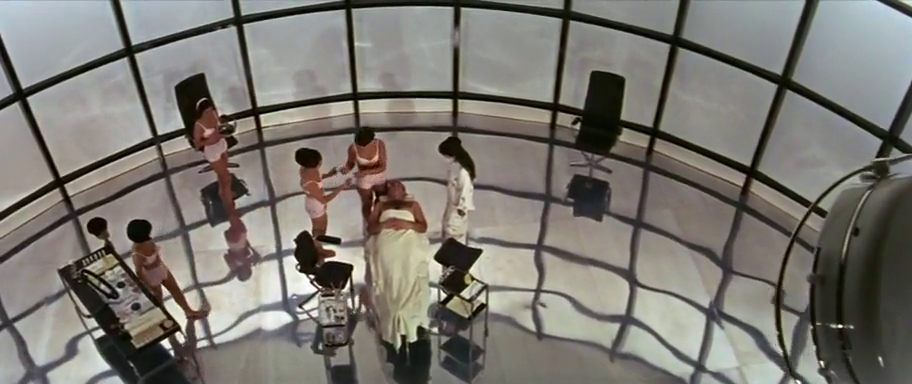
Note: I love that the Japanese secret service has a special operating theatre for Bond to undergo racial reassignment that is staffed with beautiful half-clad Japanese models.

Thursday, June 24, 2021

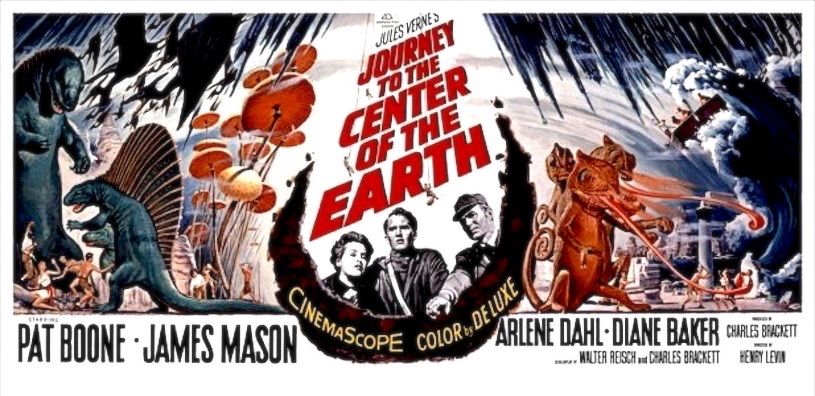
Journey to the Center of the Earth (1959) – Review

With the release of his novel Journey to the Center of the Earth in 1864 author Jules Verne broke new ground in the area of “Subterranean fiction” a genre that dates back as early Dante’s The Devine Comedy where the narrator enters a vast cavern to travel through the center of the Earth and out the other side to Purgatory, now, there are certainly less Biblical centric stories in this genre but it was Jules Verne who used well-researched Victorian science to tell his tale. What is truly surprising is how long it took for this particular science-fiction classic to make it to the big screen.

With the success of Walt Disney’s 1954 adaptation of Twenty Thousand Leagues Under the Sea, it’s odd that the “House of Mouse” wouldn’t jump at the chance to adapt another Jules Verne classic, instead, it was 20th Century Fox who brought Verne’s tale of subterranean adventure to the big screen, but turning the rather episodic nature of Verne’s book into a more robust and fun narrative, that would be more palatable for modern audiences, wasn't all that easy. The novel dealt with an eccentric German scientist who believes there are volcanic tubes that reach the very center of the earth and he drags his rather unwilling nephew into his expedition, along with an Icelandic guide named Hans, on this dangerous adventure.  The trio must survive cave-ins, subpolar tornadoes, the traversing of an underground ocean, and living prehistoric creatures from the Mesozoic and Cenozoic eras, which one has to admit is pretty exciting stuff but it does seem to lack something very important, and by that I mean "What kind of adventure can you have without a pretty face along for the ride?"


"Don't give me that look, just because Jules Verne didn't want you around."

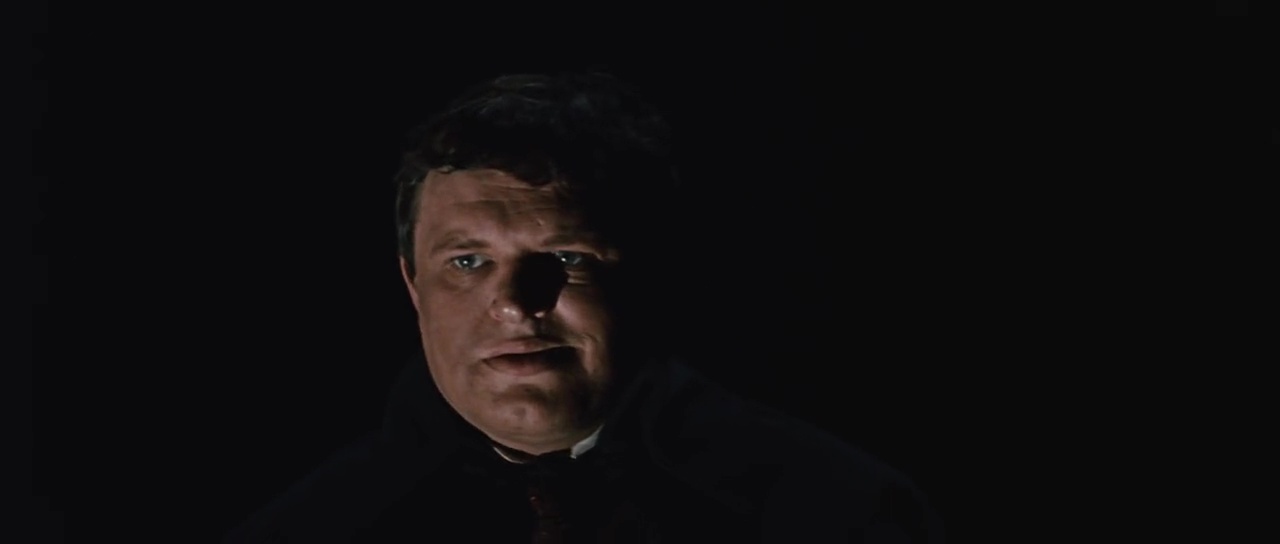
Aside from a few similar encounters and locations the book and the movie are very different animals, with Verne’s fascination in cryptography being the impetus of the narrative with Professor Otto Lidenbrock obtaining an original runic manuscript of an Icelandic saga and discovering a transposition cipher that reveals the location of an entrance to the center of the Earth. In the movie Professor Oliver Lindenbrook (James Mason) receives a piece of volcanic rock by his admiring student, Alec McEwan (Pat Boone) and within that rock is an old plumb bob bearing a cryptic inscription by a scientist named Arne Saknussemm, who, almost 300 years earlier, had found a passage to the center of the Earth but never returned. Aside from a pretty face, it’s clear that the studio thought Verne’s novel was also missing a villain and thus the movie gives us Count Saknussemm (Thayer David), a descendant of Arne Saknussemm who believes that the discovery is to be his and his alone. The Count murders a man named Göteborg, who was a professor that Lidenbrock had corresponded with and who was intent on making the discovery himself, stealing the discovery from Lindenbrook, but with him now dead only Lidenbrock stands in the way.


All this guy is missing is a mustache to twirl.

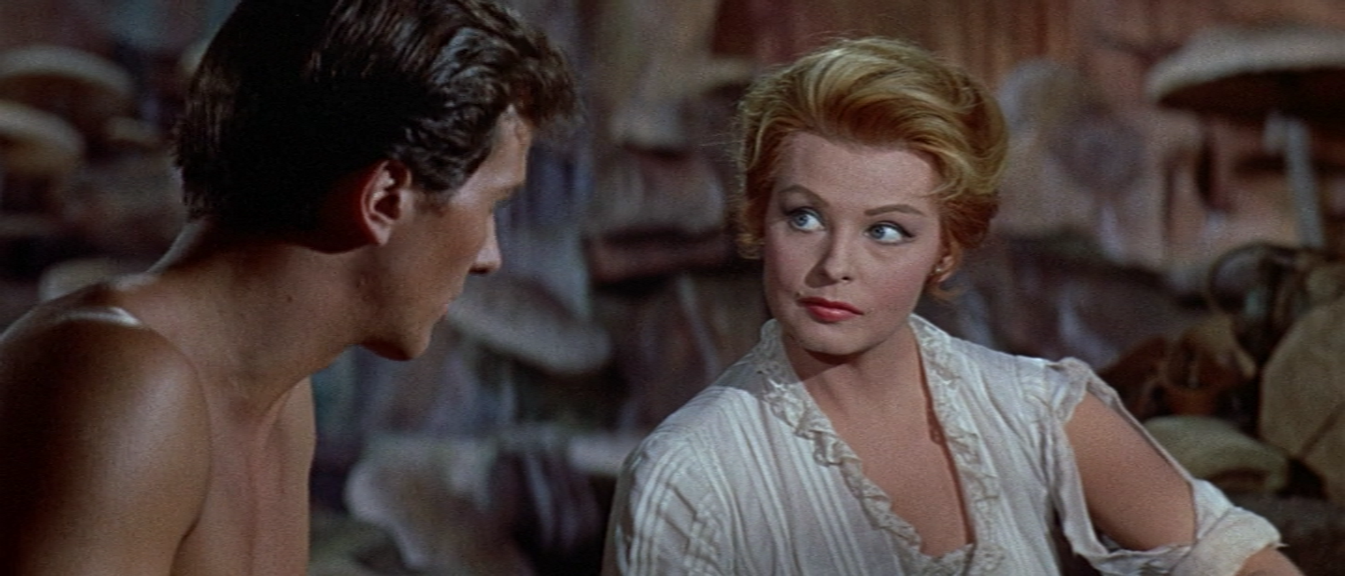
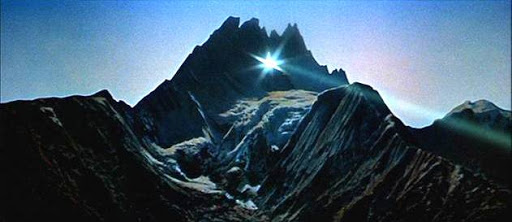
The aforementioned pretty face is provided by Göteborg's widow, Carla (Arlene Dahl), and due to her recently deceased husband having cornered the market on all the climbing supplies in town Lindenbrook and Alex are forced to make a deal with her so they can all that precious gear and the deal, of course, is that she can come along on the expedition. This enrages the very sexist Lindenbrook but without those supplies their expedition would be doomed before it even started and so they agree to her demands, that she can speak Norwegian and their guide Hans Belker (Peter Ronson) speaks no English this is an added bonus. That good ole Hans brings along his duck Gertrude is an even bigger bonus as it's this fowl member who finds the hidden passageway after the sun reveals the location of the correct cave.


Note: A secret access to a mountain being revealed on a certain day of the year was later “borrowed” by J.R.R. Tolkien for his book The Hobbit.
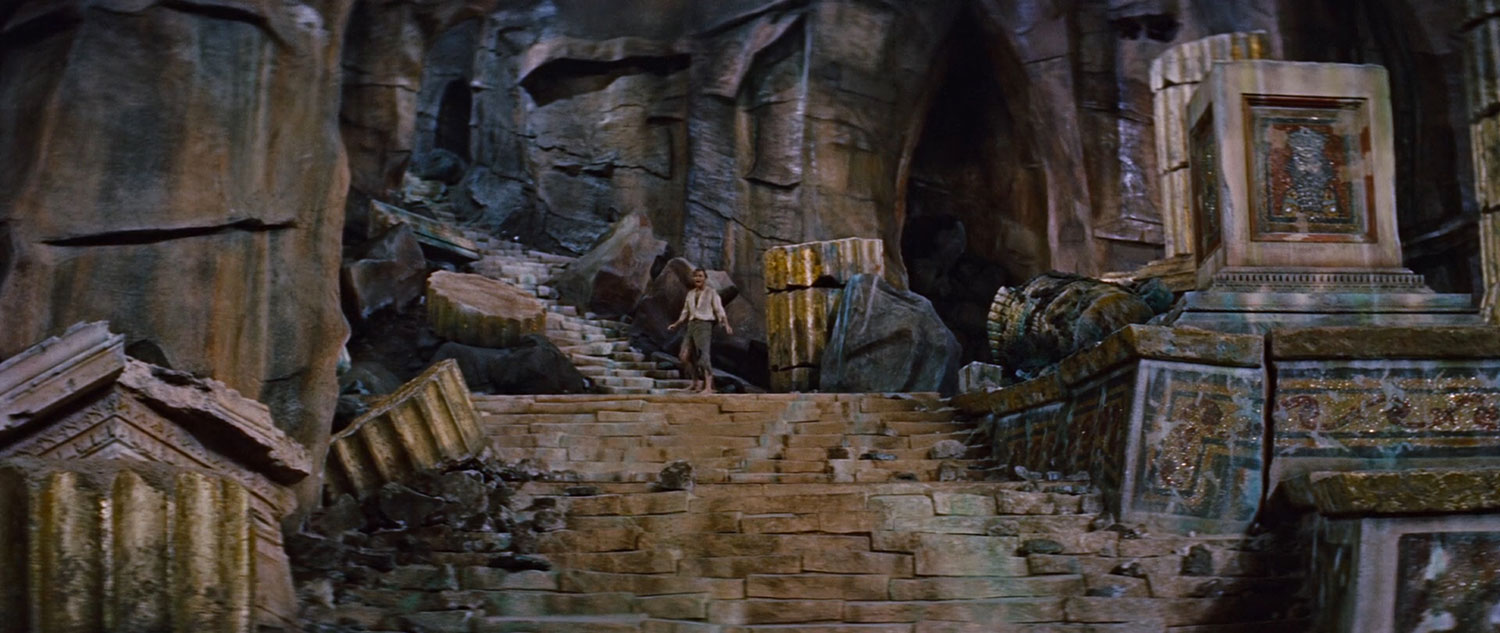
When one sits down to watch 20th Century Fox’s Journey to the Center of the Earth you shouldn’t expect to find much "science" in this particular science-fiction offering because even while Verne’s novel included dinosaur encounters, and even a prehistoric humanoid more than twelve feet in height and watching over a herd of mastodons, he did his best to stay true to the science of the time, there was no such edict from Fox Studios in the making this movie and thus if this film includes any actual science it’s probably accidental. Questions like “Why does everyone in Scotland have Scottish accents except Professor Lindenbrook and Alec?” or “How could these explorers survive the many months underground with only the food in their tiny backpacks?” and “How can there be a lightning storm over a subterranean ocean when a thunderstorm requires an active atmosphere with clouds?” And sure, you may fail to find clouds at the center of the Earth but how about the ruins of Atlantis.
 

Note: Even Jules Verne would have laughed at the idea of the lost continent of Atlantis surviving the 4,000-mile journey to Earth's center in such a condition that buildings would have remained intact and upright, with dishes of stale food neatly stacked on countertops.

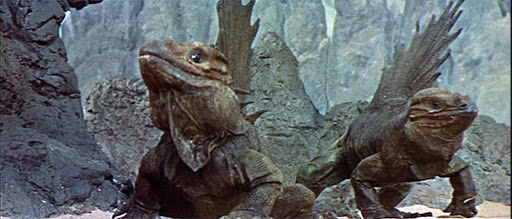
What Journey to the Center of the Earth may lack in the area of actual science or its faithfulness to the source material it more than makes up for it with the film’s fantastic visuals as not only are we treated to a wonderful scenic tour of this underground world, utilizing location shooting at the beautiful Carlsbad Cavern enhanced by beautiful matte paintings, and the film also landed a nomination for Best Art Direction-Set Decoration and the special and visual effects team consisting of Johnny Borgese, L.B. Abbott, James B. Gordon and Emil Kosa Jr. for creating this fantastic subterranean world, that all said, that the film relied on sticking a fin on the back of a bunch of iguanas to provide the film's required dinosaur action is rather disappointing. This movie clearly had a decent budget but they couldn’t cough up some extra do for some decent stop-motion dinosaurs? Was Ray Harryhausen too busy shooting the 7th Voyage of Sindbad?


“Harold, I’d like to eat some nice leafy vegetable rather than that stuffy ole James Mason.”

This adaptation of the Jules Verne classic is a fun and rousing adventure tale, that is if you don’t mind Pat Boone occasionally breaking into song or silly lizards cavorting around miniature sets, as you can get a lot of entertainment out of 20th Century Fox’s Journey to the Center of the Earth, and it should be noted that only an actor of James Mason calibre could make a pompous sexist asshat like Lindenbrook into a rather likable chap, and he along with those great visuals makes this film a classic. If you’ve only seen the Brendan Frazer version that came out in 2008 do yourself a favour and track this one down.


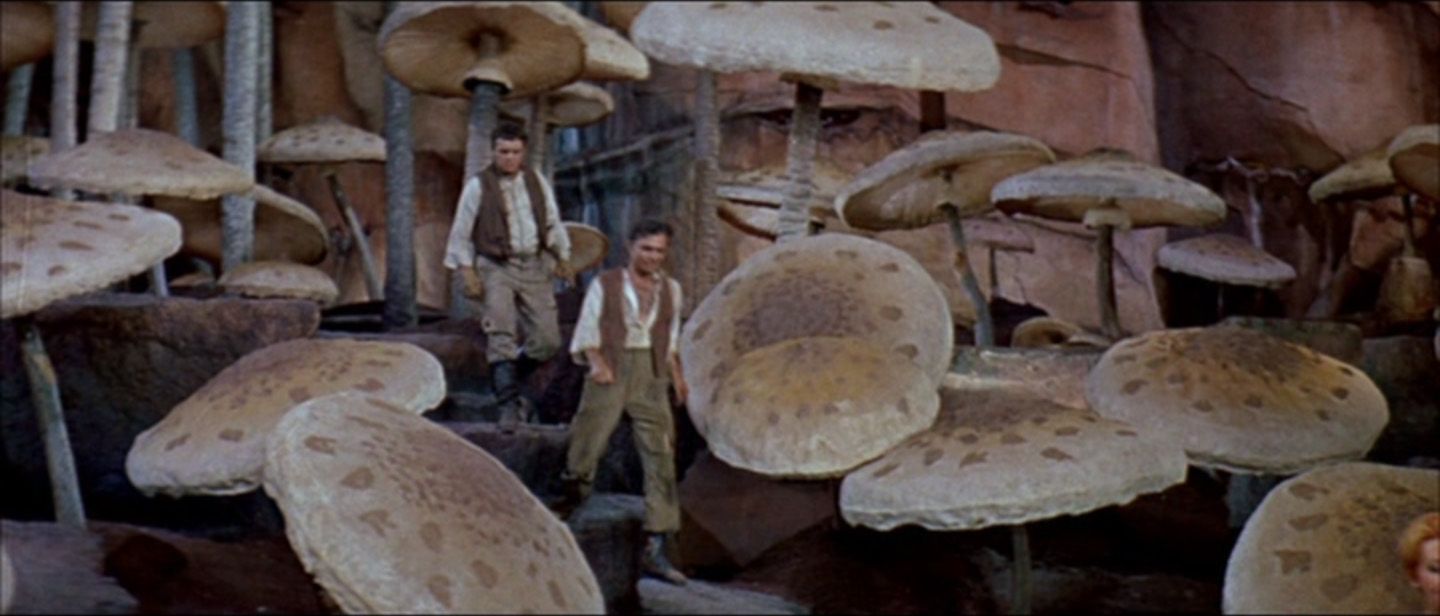
Note: That none of these characters partook of those giant mushrooms and then went on a hallucinogenic trip was certainly a lost opportunity.

Monday, June 21, 2021

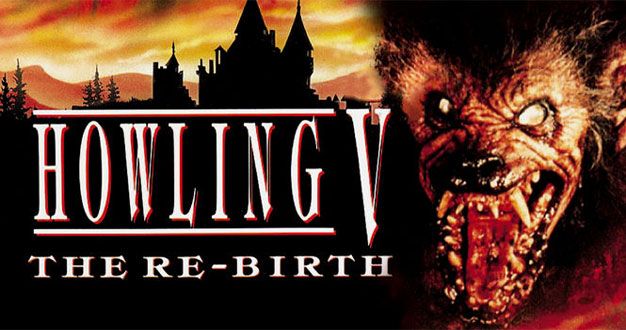
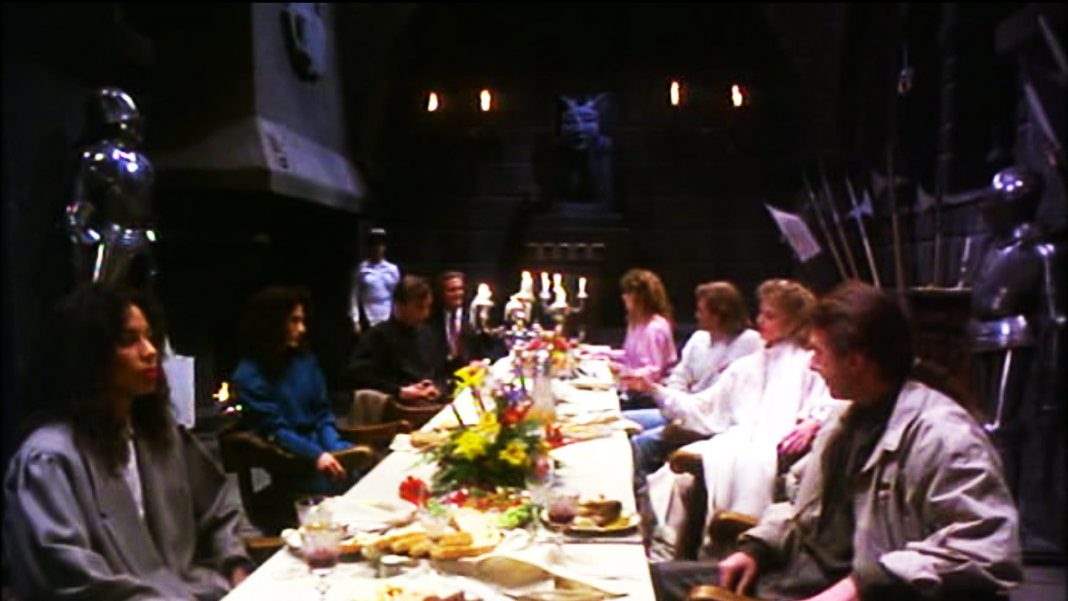
Howling V: The Rebirth (1989) – Review

As a horror franchises go the Howling films are of a very different breed of dog as they’re mostly a series of fairly unconnected film that has the barest amount of loose continuity between them just so that the producers can claim they are all part of a franchise and not just a collection of stand-alone werewolf films and any fan of Joe Dante’s original classic can tell that is just utter bullshit, but with Howling V: The Rebirth they stopped even trying to pretend that this particular outing had anything to do with the original film or the three bizarre sequels that preceded this entry.

What if Agatha Christie wrote a werewolf story? With Howling V: The Rebirth we basically get the “And then there were none” mystery trope with a small group of people trapped in an isolated location with one of them being the killer, which I have to admit is a pretty good setting for a werewolf story, unfortunately, director Neal Sundstrom and writer Clive Turner had neither the talent nor the budget to pull that concept off to any successful degree. The supposed plot of Howling V: The Rebirth deals with a group of people who have been invited by a mysterious Count (Phil Davis) to the opening of a castle in Budapest that no one has set foot inside for over five centuries. The group consists of Gail Cameron (Stephanie Faulkner), Marylou Summers (Elizabeth Shé), Jonathan Hammet (Mark Sivertsen), David Price (Ben Cole), the Professor (Nigel Triffitt), and Dr. Catherine Peake (Victoria Catlin) with the only other people on hand being two servants, but as this is not a proper mystery this will not be a case of “The butler did it.”


I must say, Downton Abbey could have used a werewolf in that last season.

Before the film introduces us to this lovely group of people, and by that I mean a collection of D-Listers who couldn’t act their way out of a paper bag, we get a prologue that takes place in that selfsame castle in 1489 where we witness a knight of some sort overseeing what appears to have been a slaughter. The knight murder-suicides himself and one other survivor but not before hearing the crying of a baby as the knight bleeds out and his last words are “The baby, it can’t be. We died in vain.” That’s a pretty good hook to start your story but, alas, what follows will barely hold your interest. When the group of strangers arrive at the castle they quickly learn that a thousand years ago the region was terrorized by packs of wolves, supposedly being controlled by Satan himself, who could take the form of a wolf and since that time the castle was abandoned and remained empty ever since.


“Shall we all just kill ourselves now and save everyone time and grief?”

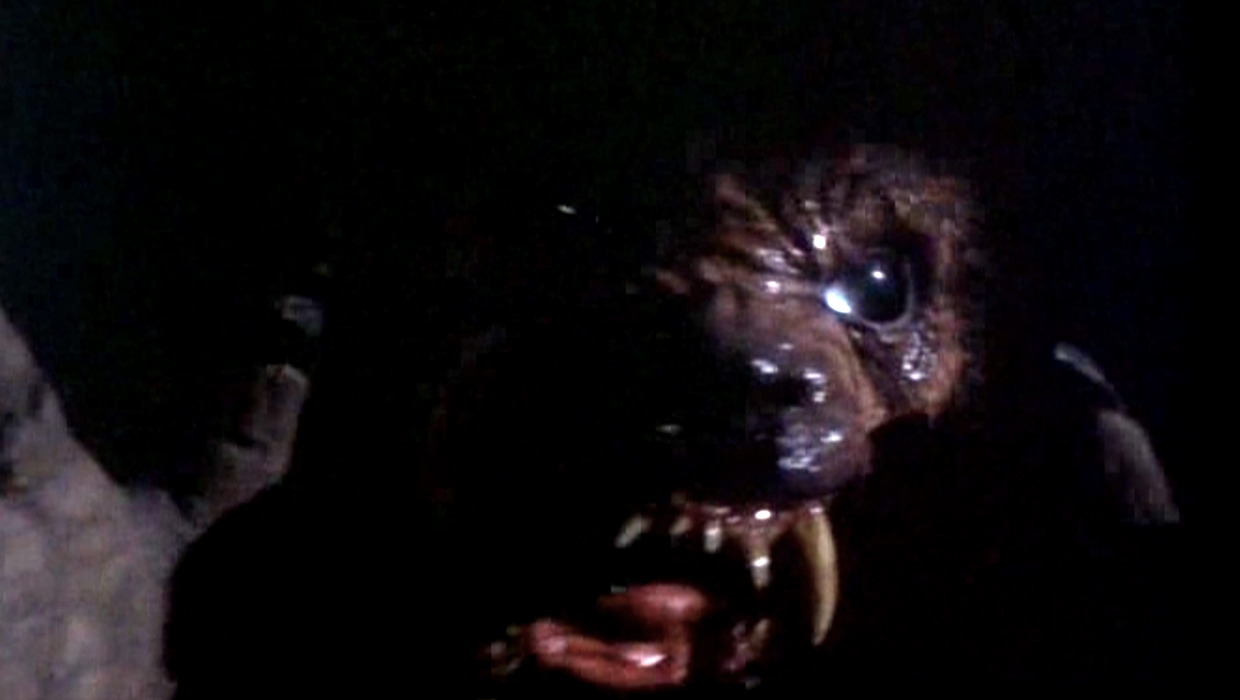
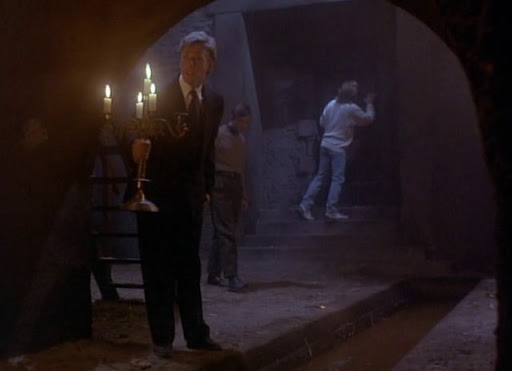
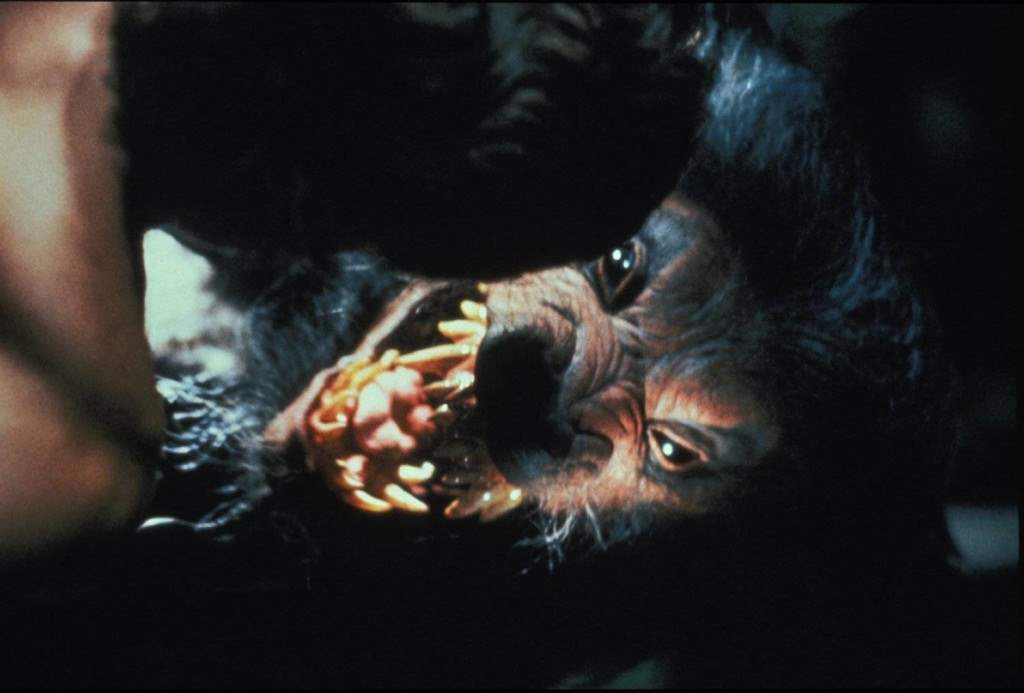
The bulk of the film’s running time consists mostly of people endlessly wandering around dark corridors until a character is occasionally killed off by a werewolf, not that we will actually get a good glimpse of said werewolf as this film clearly didn’t even have the budget for a decent werewolf costume. I have to assume this production had amazing Craft Services because I can’t see evidence anywhere else as to what the money could have been spent on. I’ll give it that the castle the production rented for the film is fairly impressive but the cinematography is so beyond pedestrian that any production value they should have got from this cool location was pissed away. So, if you love to see figures stumble down dimly lit corridors then Howling V: The Rebirth may just be the film for you, otherwise your best bet is to turn it off after the first six minutes and spare yourself the agony of this dreary horror offering.


Barry Lyndon this film is not.

Stray Observations:

• The movie begins with the title card “Budapest 1489” but the cities of Buda and Pest were not merged until 1873, and sure, one doesn’t necessarily expect historical accuracy in a werewolf movie but that looks like something that could easily be fact-checked.
• I find the concept of werewolves to be a lot more believable than that of there being a European castle that not a soul has stepped inside for five centuries as even the most rundown castles in Europe have become a tourist attraction. That someone jokingly suggests “Maybe the lost the key to the front door” nicely points out the absurdity.
• Dozens of torches and candles are lit from the castle towers to the catacombs beneath, which means those two servants were very busy little beavers.
• When they discover members of their group have gone off on their own and are now missing their solution is to split up and look for them, clearly, a brilliant strategy and evidence that none of these people have ever seen a horror movie.
• Catherine spears Richard through a curtain, much as Hamlet accidentally murdered Polonius, but lucky for her Richard was already dead at the “hands” of the werewolf.
• The Count tells the group that only a werewolf can kill a werewolf. Gee, I thought that only applied to Ninjas.


I’d say the world could do with a good Ninja/Werewolf movie.

The idea of Miss Marple or Hercule Poirot trying to unravel the mystery of an abandoned castle, a series of brutal murders and the possibility of an actual supernatural threat is something I would love to see, and maybe someone reading this review will make that happen someday, but Howling V: The Rebirth is just a drab entry in a franchise that couldn’t seem to nail any kind of consistent tone or even quality to its entries. In this movie we get a group of forgettable characters running around like a bunch of idiots, with an occasional clue like matching birthmarks being randomly tossed out, and when we finally get the big reveal as to who is the werewolf we as a viewer are far beyond caring.

Thursday, June 17, 2021

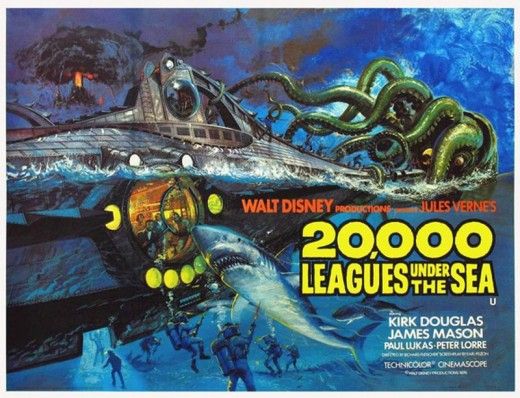
20,000 Leagues Under the Sea (1954) – Review

Author Jules Verne has often been called the "Father of Science Fiction" and with such titles as From the Earth to the Moon and Journey to the Center of the Earth in his bibliography that's a fair assumption but it was his novel Twenty Thousand Leagues Under the Sea that is most heralded as the title which was most ahead of its time, and today we will be looking at Walt Disney’s seminal movie masterpiece based on that classic piece of literature.

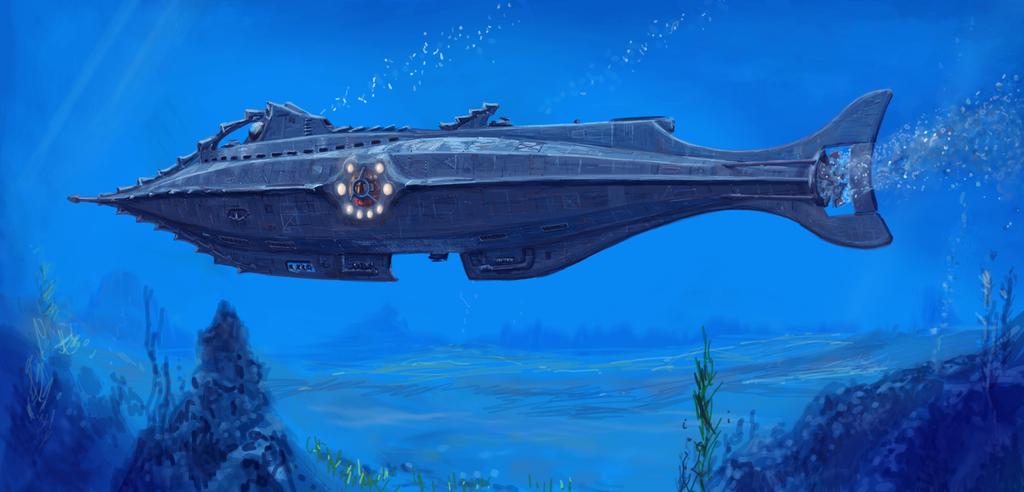
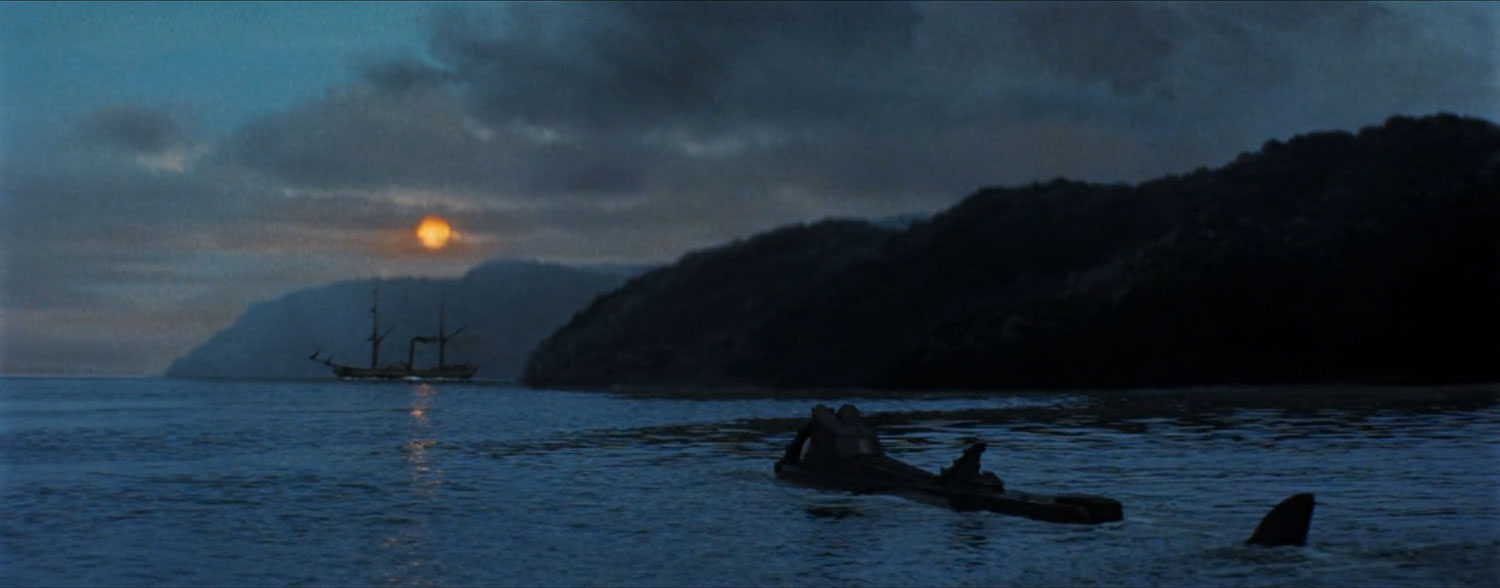
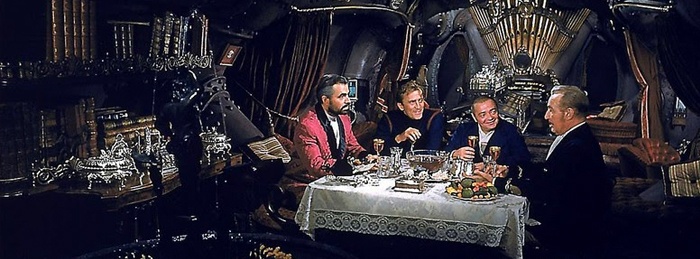
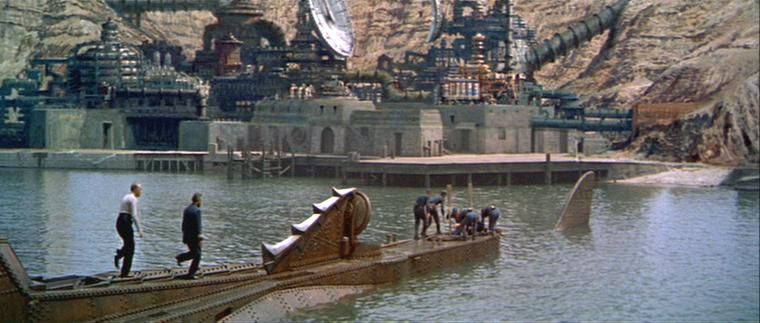
Walt Disney’s 20,000 Leagues Under the Sea follows most of the story beats found in Verne’s novel, though often out of sequence, with the story maintaining the premise of the United States government hiring Professor Pierre Aronnax (Paul Lukas) and his assistant, Conseil (Peter Lorre) to set sail aboard a U.S. Navy expedition so as to investigate the possible existence of a mysterious creature that has been seeking their ships. Turns out it’s not some mythological sea monster but a submarine operated by the enigmatic Captain Nemo (James Mason) who has seemingly declared war on the surface world. The frigate they are on is attacked by Nemo’s submarine, called the Nautilus, and Conseil, Aronnax and the ship’s harpooner Ned Land (Kirk Douglas) are thrown overboard only to be saved from drowning by the Nautilus itself. The key difference between book and movie is where Verne’s novel is a scientific expedition into the mysteries of the depths, with long and I do mean long passages describing the various forms of sea life they encounter, the Disney movie is a rousing adventure more akin the writings of Robert Louis Stevenson than that of Jules Verne.


Note: In the book, Nemo’s submarine the Nautilus is described as a "streamlined, cigar-shaped sub" while the movie gives us a beautifully ornate vessel that looks like a Victorian steampunk craft come to life.

The movie also takes quite a few liberties with the characters themselves, Nemo is no longer of East Indian descent and as depicted by James Mason is a more cold and calculating murder than his movie counterpart – he threatens Ned Lands life on a regular basis – and Mason's Nemo is given more of a concrete backstory than what Verne provided in his novel, though more backstory was later introduced in the sequel The Mysterious Island. In the movie, we learn that Nemo was held captive on the penal colony of Rura Penthe, where a foreign government tried to force him to reveal his scientific breakthroughs and when he refused to break they tortured his wife and child to death.  Needless to say, Nemo didn't take it well.


Note: In the book, Nemo only attacked ships belonging to this unnamed country and the ramming of the warship carrying Professor Aronnax and company was only in self-defence.

What nationality was responsible for the death of Nemo’s family is never mentioned and all the enemy ships in the movie fly no flag, yet in the book, it’s fairly obvious that with Nemo being East Indian his major nemesis would have been the British but Disney certainly didn’t want to call out Britain as the film’s main antagonist as that could have affected the overseas box office, thus they are just faceless bad guys from some unknown fictional country. Nemo and the crew of the Nautilus come across more as members of a cult rather than isolationists who have sworn off humanity, this aspect made more obvious at the film’s conclusion when a fatally wounded Nemo institutes a ship-wide suicide pact.


Nemo may have had many faults but he could never be accused of not having style.

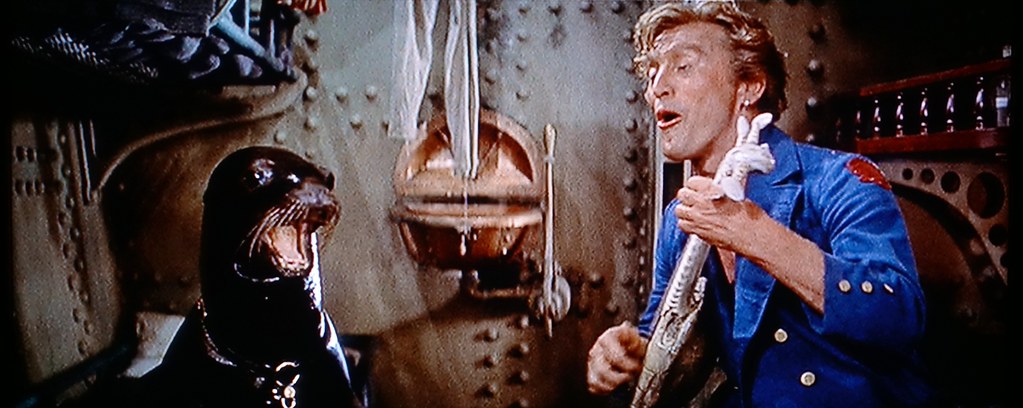
The only character in the movie that stays rather true to his book depiction would be that of Professor Pierre Aronnax as actor Paul Lukas’s bland and one-note portrayal of the French scientist is about as boring as the one found within Verne’s pages, on the other hand, the movie’s version of the Professor’s assistant Conseil is quite a radical departure from the source material as the Conseil in the book was selfless and loyal to a fault while in the movie he’s being played by Peter Lorre, an actor not known for playing noble and loyal characters, and he works behind the Professor’s back with Ned Land on his plans to escape the Nautilus, something the book Conseil would have died before even contemplating. The character of brash harpooner Ned Land is greatly expanded from the source material which was mostly due to the casting of Kirk Douglas, in the book Ned barely has a presence within the pages of Verne's novel, with him being relegated to occasionally pointing out to the Professor their need for escape, but Disney wasn’t going to waste their big-name star on such a small part and so his role was greatly expanded, in fact, Douglas himself insisted that not only should they add some women into the movie – in the opening scene he is given some local ladies to hang off his arm – but as he was a burgeoning action hero they needed to add several fight scenes to the script.


He also got to sing with a seal for some reason.

The greatest deviation from the book would be in the film’s conclusion, in the book the three protagonists escape aboard a skiff while the Nautilus is pulled into the deadly whirlpool of the Maelstrom, with Nemo crying out in anguish "O almighty God! Enough! Enough!" What was the fate of the great submarine remained a mystery until the release of the sequel The Mysterious Island but in Disney’s movie we get Ned Land tossing notes in bottles overboard that contain the location of Nemo’s secret island lair, so as to alert interested parties as to where they can find Nemo and his sub. When the Nautilus arrives at Vulcania they find the island surrounded by warships, of that selfsame unknown nationality, and rather than let his great secrets fall into those unscrupulous hands he plants charges and blows up the island.


Note: Nemo’s island base in the book was just an unnamed volcanic crater, it's where he mined the coal needed to fuel his submarine’s electric power, while the Nautilus in the movie was clearly atomic-powered and Vulcania was an island lair worthy of a Bond villain.

Stray Observations:

• The movie opens with the Disney classic approach of showing the book itself but for some reason, they get the title of the first chapter wrong.
• The first two ships destroyed by the Nautilus explode on impact but Nemo’s submarine sank its prey by simply piercing their hulls, so unless these ships were carrying nitroglycerin there was no reason for them to blow up as they did.
• Ned Land is seen eating a banana during a gale aboard ship but bananas were considered bad luck among fishermen and would not have been something he would have been snacking on.
• The Nautilus has terrible security, while overseeing an underwater burial Captain Nemo leaves his submarine on the surface with the door wide open so that our heroes can just wander in.
• At one point Nemo goes ashore with Professor Aronnax which is something book Nemo would never have done having disavowed the surface world.
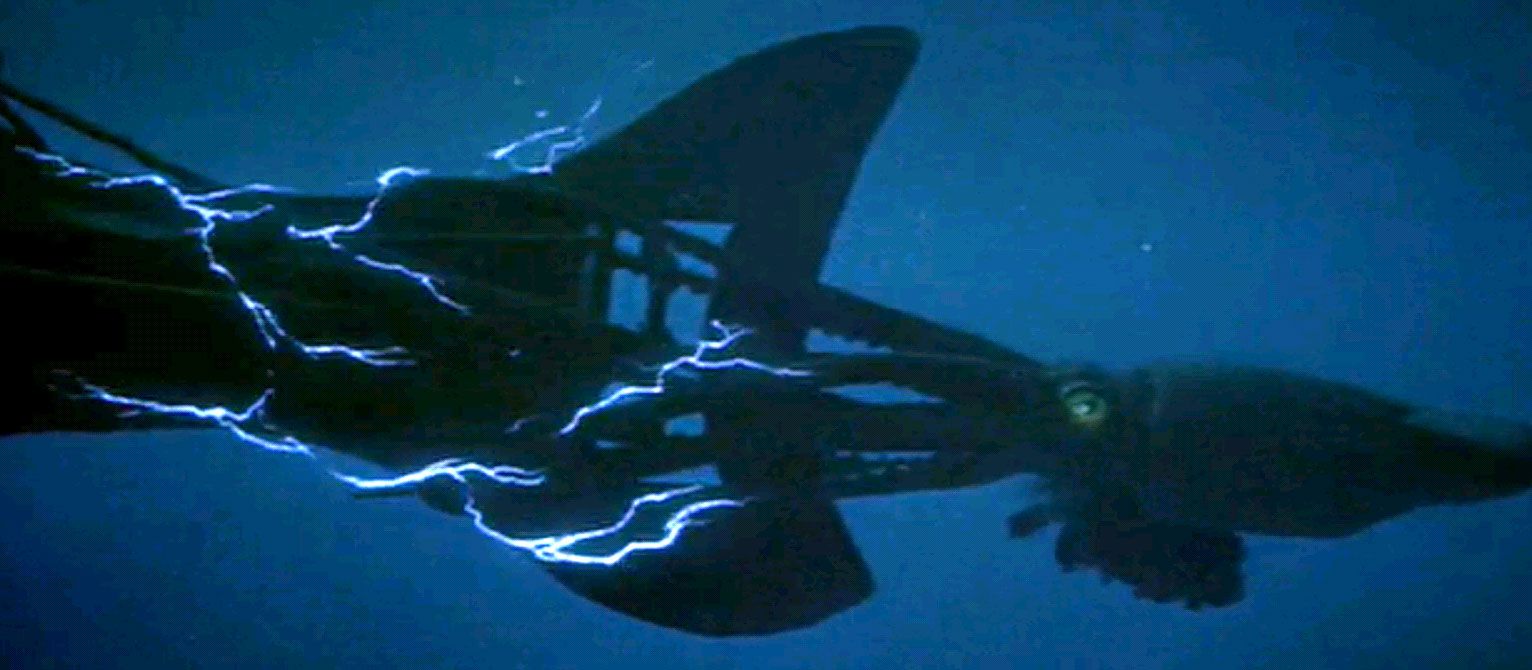
• In the book the Nautilus was attacked by a school of giant squid while in the movie there’s just the one.


I’m not sure what threat a squid even this size would have against an iron submarine.

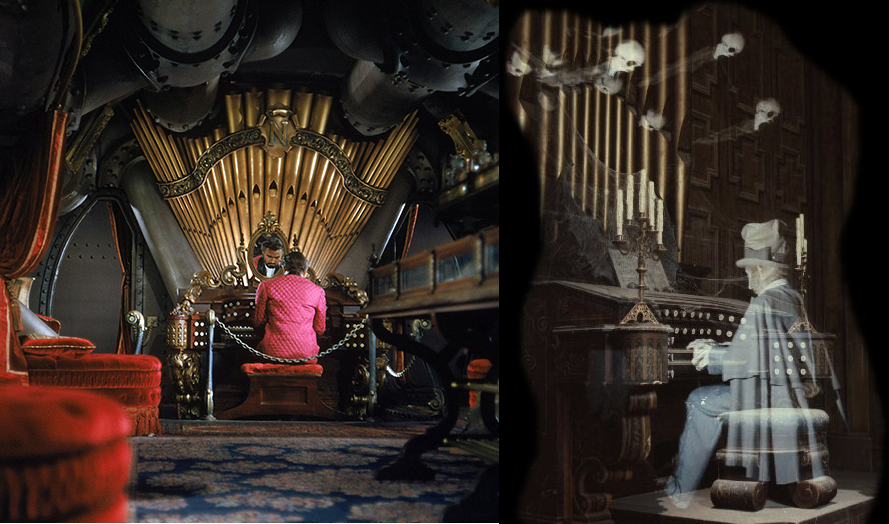
Walt Disney’s 20,000 Leagues Under the Sea may not have been all that faithful to Jules Verne's novel but anyone trying to do so would have ended up with a three-hour nature documentary on their hands, that's just not something Disney was interested in providing, instead, what we got was a pure unadulterated adventure film with James Mason providing one of his most iconic performances – Kirk Douglas and his attempts at comedy I found less engaging – but the true star of the film was the Nautilus herself, from its steel-plated exterior to the gorgeous organ in Nemo’s cabin this is what people will take away with them after seeing this film.  Now, not to throw any shade on director Richard Fleischer as it was his stalwart direction that made this film such an enduring classic and the nail-biting battle with the giant squid is a pretty unforgettably sequence by anyone's standards, but one can’t help but admire the amount of work that went into the design and overall look of this movie. If you have somehow gone through life without seeing Disney’s 20,000 Leagues Under the Sea do yourself a favour and rectify that as soon as possible.


Note: if you want to see Captain Nemo’s amazing organ it's still residing in Disneyland’s Haunted Mansion even after all these years.

Monday, June 14, 2021

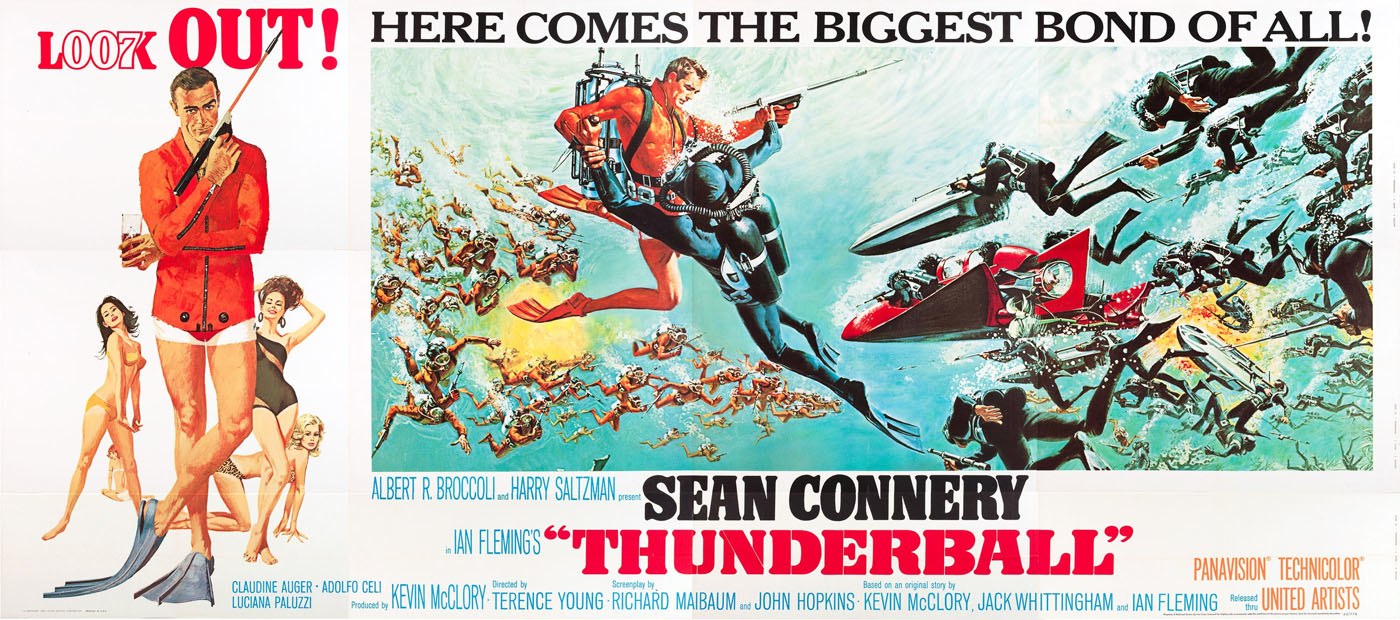
Thunderball (1965) – Review

The fourth Bond film has a very interesting genesis as it was based on a book that originally started out as a screenplay by Jack Whittingham which was based on an original story by Kevin McClory, Jack Whittingham, and Ian Fleming. To say this led to some very complicated rights issues would be a massive understatement and is the reason that the remake Never Say Never Again even exists, in fact, Thunderball would have been the first of the Bond movies to be made if not for those legal disputes over copyright issues.

Most likely due to Thunderball being originally written as a screenplay the movie adaptation is one of the closer entries to the source material, with but a few additions and changes and deals with SPECTRE obtaining two atomic bombs and blackmailing NATO, you know, standard SPECTRE stuff. Now, the basic premise of Thunderball may be rather simple but the final product was nothing but, and with that many cooks in the kitchen on the writing side of things this is kind of understandable, which resulted in a rather convoluted but still fun mess. SPECTRE operative Emilio Largo's (Adolfo Celi) plan to ransom a pair of atomic bombs is possibly a little too elaborate to actually work as it involves recruiting a man named Angelo Palazzi (Paul Stassino) to undergo plastic surgery so that he can double and then replace a NATO observer so that while onboard he can kill the crew and make off with the plane and the two nukes onboard.


“Hey, I didn’t know I had an evil twin.”

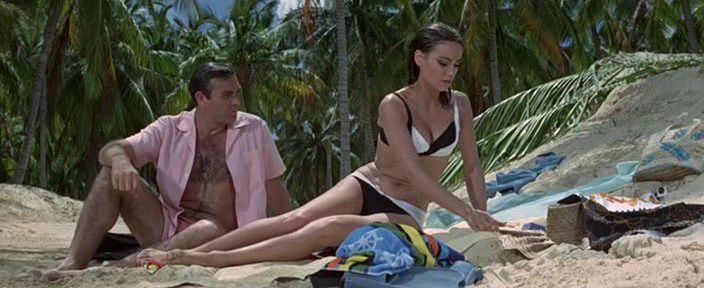
In the book, the NATO observer was just in the pay of SPECTRE and thus there was no need for elaborate plans revolving around plastic surgery and doubles but both the book and the movie do have James Bond (Sean Connery) stumbling across the villainous plot while recuperating at a health clinic, which one has to chalk up to the “Luck of the Bond.” Sadly, that isn’t the only contrived bit of writing that movie suffers from as we also get Bond requesting he be assigned to Nassau, Bahamas, to contact the sister of the murdered NATO man, the beautiful Domino (Claudine Auger), who just so happens to be Emilio Largo’s mistress. What are the odds?  Bond makes the decision to track down Domino simply because in a file provided by “M” (Bernard Lee) he finds a picture of her with her brother but with no other connection to the case at hand. Seriously, that’s all the evidence he has to make that decision, he doesn’t know until he meets her in Nassau that she is dating SPECTRE’s number two operative, and thus the success of this mission relied on a very thin hunch that miraculously pans out.


I have to assume that Bond will want to investigate anybody in a bikini.

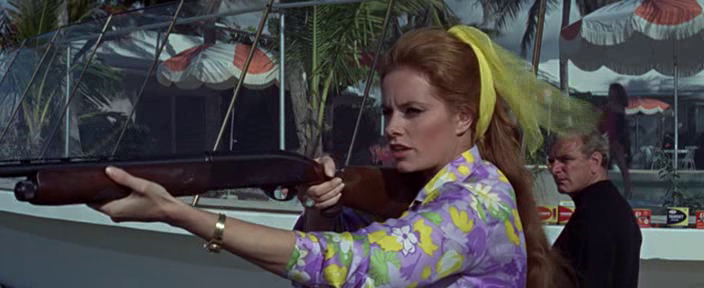
The character of Domino may be the film's primary Bond girl but the one who pretty much steals the movie, and with very little screen time to do it in, is that of SPECTRE agent Fiona Volpe (Luciana Paluzzi), a deadly assassin from SPECTRE's executive branch.  She is a talented killer who not only seduced and murdered the NATO observer but was called in to kill SPECTRE operative Count Lippe (Guy Doleman) because his actions at the health clinic alerted Bond and jeopardized SPECTRE's plans. She is also a rare Bond girl who completely resisted our hero’s charms, “I forgot your ego, Mr. Bond. James Bond, who only has to make love to a woman and she starts to hear heavenly choirs singing. She repents, then immediately returns to the side of right and virtue.” I’d like to consider this a nice rebuttal to the problematic moment of Pussy Galore not only changing sides but sexuality in Goldfinger. Fiona Volpe may sleep with Bond but her intentions to see him dead never waver, sadly, her accomplices aren’t as talented and she ends up getting shot in the back by one of Largo’s idiot henchmen.


Fiona Volpe is easily one of the best of the Bond Femme Fatales.

Stray Observations:

• During a SPECTRE meeting, one of the members is murdered for embezzling from the organization, which one has to admit, is either extremely ballsy or incredibly stupid.
• While recuperating at a health clinic Bond is almost killed while strapped into a device designed to stretch the spine but there are two problems with this scenario, for one a nurse would never leave a patient who is trapped in a medical device – what if there were a fire – and secondly, we have another Bond movie device that, for some reason, has a kill setting.
• Bond extorts sex from the aforementioned nurse, basically threatening to report her if she doesn’t sleep with him, and this is our hero?
• Bond retaliates against his would-be-assassin by locking him in a steam bath which, of course, looks to have a kill setting as well.
• Just prior to the hijacking of the atomic bombs Angelo Palazzi demands more money from SPECTRE to go through with the theft, which one has to admit, is either extremely ballsy or incredibly stupid. Scratch that, it’s just incredibly stupid.
• Bond’s choice of a bright orange wetsuit for nighttime spying is a rather dubious decision and will not win him any espionage awards.
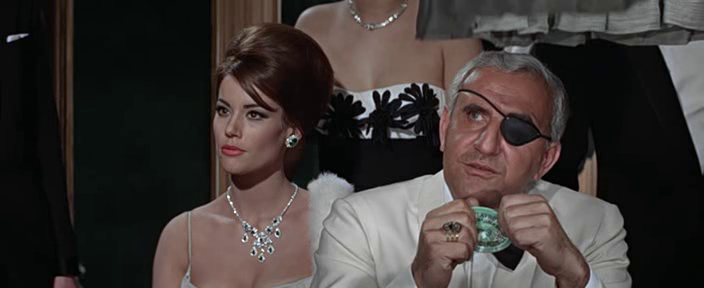
• Both Largo and Fiona Volpe openly wear rings with the SPECTRE emblem which posits the question "Do they not understand that being members of a clandestine criminal organization branding is most likely a bad idea?"


Isn’t wearing an eye-patch a big enough tip-off that you’re evil?

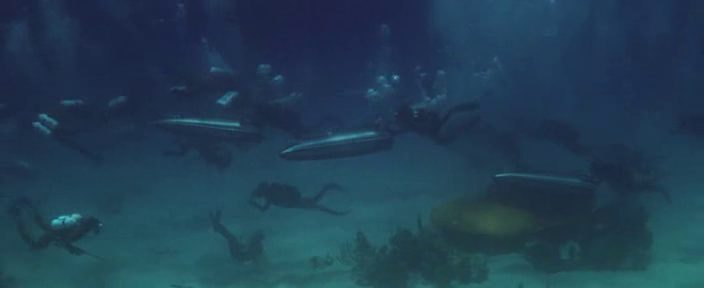
As a Bond film, Thunderball is a solid enough entry as it provides us with the usual beautiful locals and equally beautiful women, not to mention John Barry’s robust and soaring score, and we do get a few fun “Q” provided gadgets as well as a brief return of the Aston Martin DB5, and though Thunderball has some great moments it’s also saddled with not only a rather convoluted plot but an over two-hour running time that just wasn’t necessary. Too much screen time is spent with Bond and CIA operative Felix Leiter (Rik Van Nutter) trying to find the sunken jet bomber, so as to retrieve the missing nukes, but as everyone knows that SPECTRE hijacked the jet and its cargo for blackmail purposes why would anyone think the bombs would still be aboard the sunken plane? Then to compound this squandered screen time a full quarter of the movie takes place underwater and as everyone knows there is nothing that sucks the kinetic energy out of a movie faster than scenes filmed underwater.


Who doesn’t love murky action sequences where you can’t tell what’s going on?

Now, I may seem a little critical of this film but this is still a very fun Bond adventure and both Adolfo Celi and Luciana Paluzzi can be included in any top ten list of great Bond antagonists as their portrayals of SPECTRE agents Emilio Largo and Fiona Volpe provided some of the best moments in the film, and if Claudine Auger as Domino was a trifle forgettable as the film’s “Damsel in Distress” she certainly wasn’t hard on the eyes. If Thunderball had been trimmed down to a healthy 110 minutes we could have had a really great Bond film on our hand, sadly, its waterlogged elements sink its already somewhat bloated plot. Not to say this is a bad film but the fact that this one could have easily been so much better making the end result a little disappointing.

Thursday, June 10, 2021

The Lost World (1925) – Review

When one thinks of author Sir Arthur Conan Doyle most will simply consider him the father of Sherlock Holmes, one of literature's greatest detectives, but what many don’t know is that he practically birthed the dinosaur adventure genre and filmmakers like Ray Harryhausen and Steven Spielberg owe a great debt to him. Published in 1912 his novel The Lost World may not have been the first book to have man encountering dinosaurs, that honour goes to Jules Verne Journey to the Center of the Earth, but it was the film adaptation of Doyle’s novel that first introduced the idea of a prehistoric beast rampaging down modern city streets.

The plot of the 1925 film is a fairly faithful adaptation of the book, with some story elements trimmed due to time constraints and the limitations of the silent film medium, but the movie does toss in a love interest that wasn't in the book because, to quote Carl Denham from King Kong, “The public, bless 'em, must have a pretty face.” The film opens with young newspaper reporter Edward Malone (Lloyd Hughes) learning that his fiancée Gladys (Alma Bennett) has one stipulation before tying the knot “I will only marry a man of great deeds and strange experiences, a man who can look death in the face without flinching.” It’s at this point that any sane man would have told the “love of his life” to go jump in the lake but our hero decides to prove himself and so he asks his editor for a dangerous assignment that could impress his girl.  Lucky for him, there just so happens to be such an assignment as turns out renowned zoologist Professor Challenger (Wallace Beery) is attending a meeting at the Zoological Hall to profess his claims of dinosaurs living in a remote part of South America and he wants some brave souls to join him on an expedition.


Would you travel into uncharted jungles with this guy?

When ridiculed by both peers and students alike Challenger issues a challenge - no surprise there - that he will prove the existence of living dinosaurs, “If any of you spineless are brave enough to go back with me into the trackless jungle where these monsters live.” Despite Challengers apoplectic views towards reporters, he apparently nearly killed three reporters already due to his uncontrolled animosity to the profession, he agrees to bring Edward but along with him, we get sportsman Sir John Roxton (Lewis Stone), Professor Summerlee (Arthur Hoyt) the group’s resident skeptic and Paula White (Bessie Love) whose father went missing on the previous expedition to that mysterious plateau in South America and it's his journal that depicts dinosaurs alive and well atop this isolated mountain. The character of Paula White is not to be found in the novel and the idea that a group of early 20th century explorers bringing a woman along on such an expedition is quite laughable and though the movie tries to explain her involvement by mentioning that Paula was her dad’s assistant it’s clear her existence stems more from the filmmakers need for a proper love interest than any narrative sense.


Call me crazy, but with this kind of action, I don’t need a tacked-on love interest.

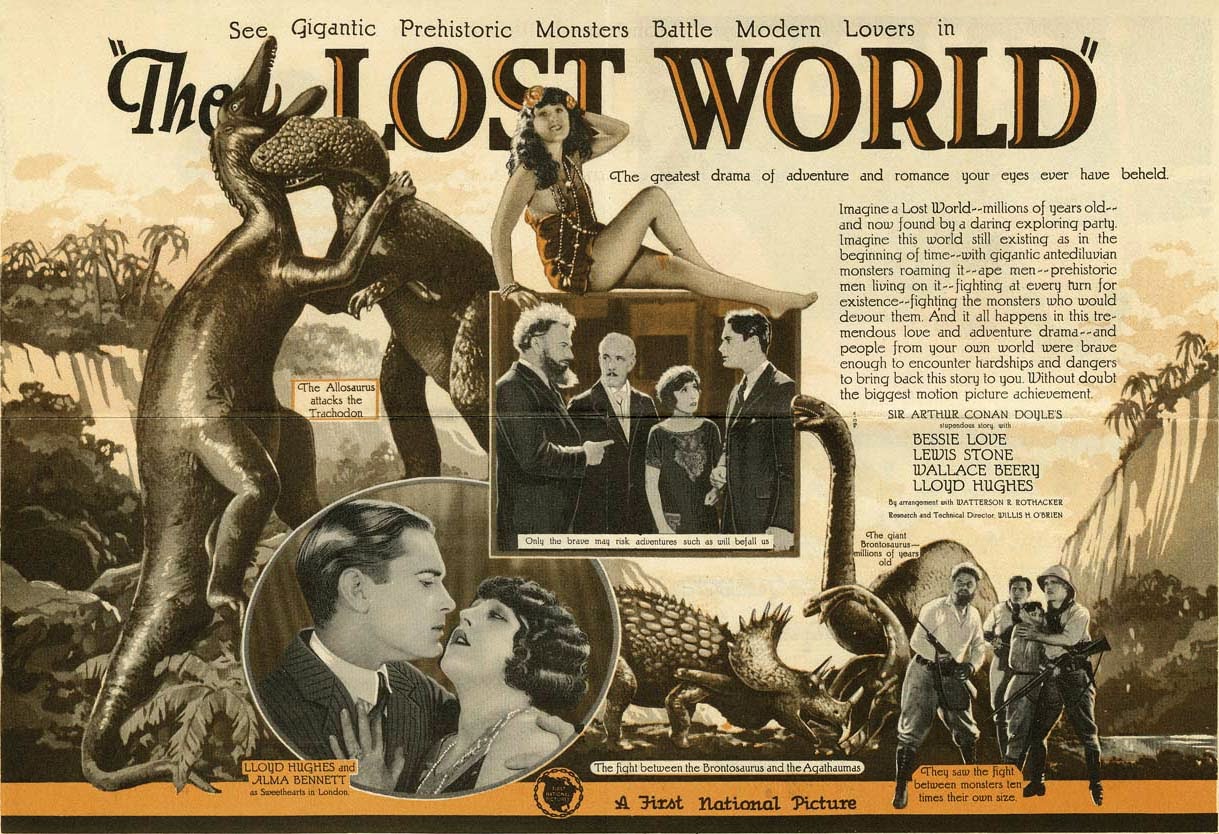
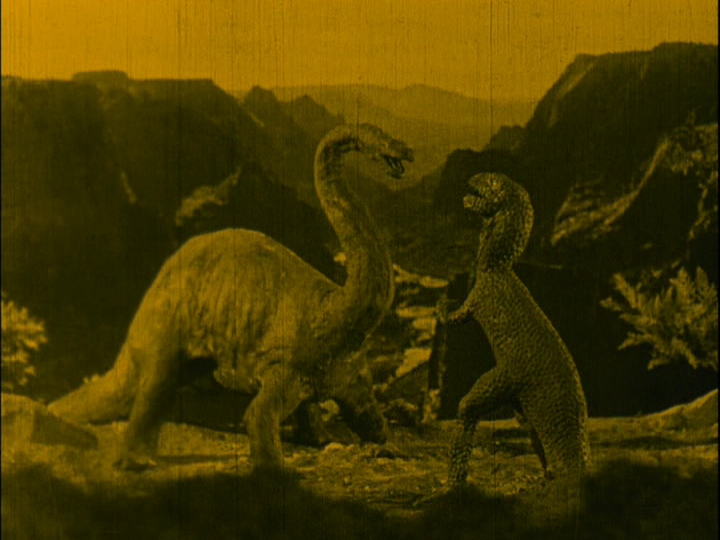
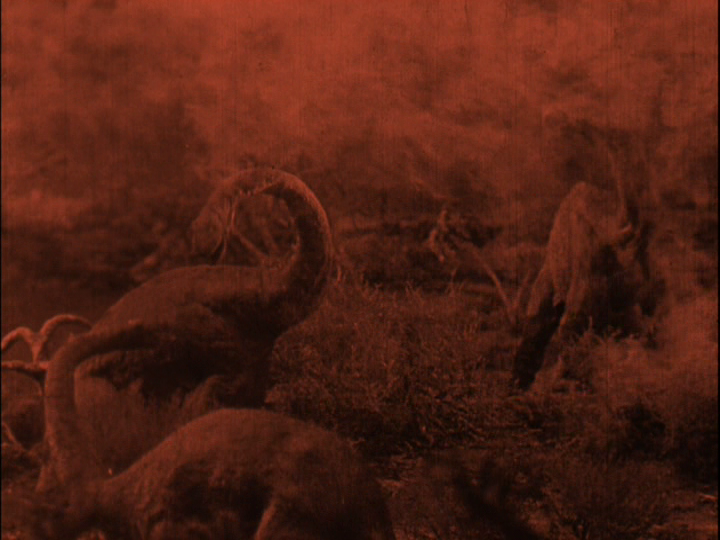
What is most surprising about 1925’s The Lost World is the sheer amount of dinosaur action that is brought to the screen as this particular plateau is literally littered with dozens of dinosaurs of varying species. We get an Allosaurus attacking a Trachodon and Triceratops family, a Tyrannosaurus Rex snatching a pterodactyl out of the air to then battle with a Brontosaurus before pushing that poor animal off a cliff, and then you have an amazing stampede of dinosaurs fleeing a volcanic eruption and all of this was brought to glorious life by legendary effects man Willis O'Brien who, along with sculptor Marcel Delgado would bring this prehistoric haven to life. The art of bringing these dinosaurs to life would later be perfected when the men would re-team for 1933’s King Kong but what is on display here is still quite spectacular. I would love to have been in the audience back in 1925 to see the reactions people had to such amazing and groundbreaking effects, in fact, when Doyle showed test footage of O’Brien’s work to the Society of American Magicians a reporter for The New York Times wrote: “If fakes, they were masterpieces." You can’t get better praise than that.


Question: Why do volcanoes always erupt when humans arrive in a lost world?

One thing that always bothered me about the Challenger Expedition is that it is never made clear as to how exactly they were intending to prove what they found, even Challenger himself questions this point when discussing the dinosaurs with Summerlee, “What will our fellow scientists say when I tell of this in London? They’ll call you what you called me in London, a liar!”  Now, bringing a camera along is the obvious solution to this problem yet not one single member of the party, including the newspaper reporter, thinks to bring a camera along with them. Lucky for them a Brontosaurus falls off the edge of the plateau and becomes trapped in a mud bank, which allows them to capture it and transport it back to London and provide that much-needed evidence. Now, in Arthur Conan Doyle’s novel, it was pterodactyl that was brought back to the zoological society to prove Challenger’s claims but as a flying reptile can’t quite rampage through the city streets this was changed to the more exciting Brontosaurs for the film version, which is an idea that animator Willis O’Brien would later revisit with his 1959 film The Giant Behemoth, but that entry would provide the added bonus of it giving off lethal levels of radiation. What should be noted here is that the Brontosaurus in The Lost World is portrayed more as a confused animal rather than a rampaging monster and though it does cause a significant amount of damage it is more sympathetic than monstrous.


“None of you guys would call out bi-panes on me, right?”

What’s nice about the conclusion to The Lost World is that the poor Brontosaurus isn’t gunned down by the military, instead, it is allowed to escape into the river Thames to presumably either swim back to South America or take up residence in Loch Ness.  Meanwhile, young Edward, upon returning home and seeing that his betrothed Gladys has married some random store clerk finds that he is now able to marry Paula. So it’s happy endings all around. Now, this being a silent film it may scare some viewers away but I’d like to point out that anyone who loves dinosaurs or monster movies this is a must-see classic as not only does this film give a fantastic look at early cinema and the growth of the special effects industry it also tells a great story and Wallace Beery as Professor Challenger is simply fantastic. Overall, The Lost World was a major milestone in this history of cinema and well worth checking out, trust me, you won’t be disappointed.