Blog Archive

Thursday, February 7, 2019

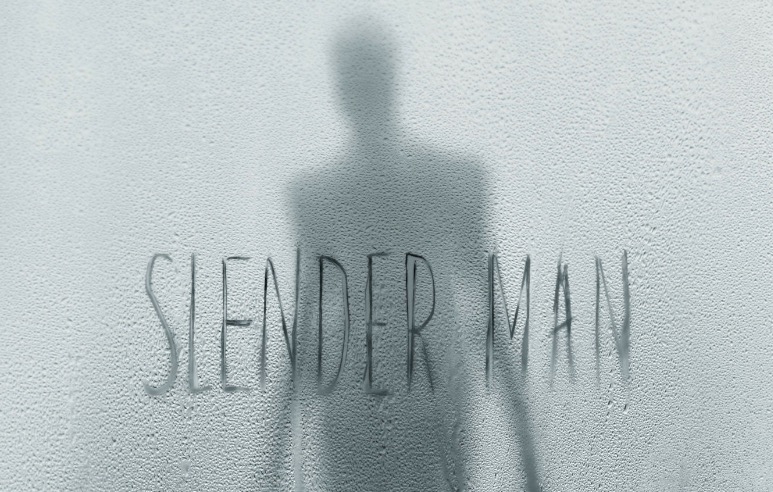
Slender Man (2018) – Review

Have you ever stood in front of your bathroom mirror and repeated the name “Bloody Mary” five times, so as to invoke the dark spirit? Yeah, me neither, but it’s this kind of irrational fear that has served as groundwork for many horror films – most notable examples being 1992’s Candyman and Gore Verbinski’s The Ring – and now with Sylvain White’s Slender Man we get an example of what the bottom of the barrel of horror looks like, as this film is nothing more than a collection of horror clichés based on an internet meme, resulting in a film that makes the recent Bye Bye Man look like a cinematic masterpiece.  Worst is the fact that Sony Pictures released Slender Man years after it had been a pop culture phenomena – I guess a decade late is better than nothing – and it makes me wonder how some studio execs got their jobs, maybe they repeated "Bloody Mary" four times too many into a bathroom mirror?


One night four High School best friends; Wren (Joey King), Hallie (Julia Goldani Telles), Chloe (Jaz Sinclair), and Katie (Annalise Basso) decide to summon the legendary "Slender Man" at a sleepover – they’d learned a group of boys were planning the same thing that night so obviously they had to try it out – and thus this quartet of teenage idiots click on a video link that will apparently call forth this supernatural being, a creature that will either haunt you, drive you insane, or simply take you – not my idea of a fun evening but then again I'm not a teenage girl – and sure enough a week later the four girls are being plagued by nightmares, freaky hallucinations, and nausea.

Now in the hands of a talented filmmaker we’d be invested in the survival of these poor girls, but director Sylvain White and screenwriter David Birke are not such filmmakers, as they fail to create characters that anyone could give a damn about (Note: This failure is solely due to these two and not the four young and talented actresses) so that when the first girl goes missing, after a school field trip to a local cemetery – cause that’s a thing I guess – we immediately start checking our watches to see how long we have before the end credits roll.


Will they survive the Slender Man, or more importantly does anyone care?

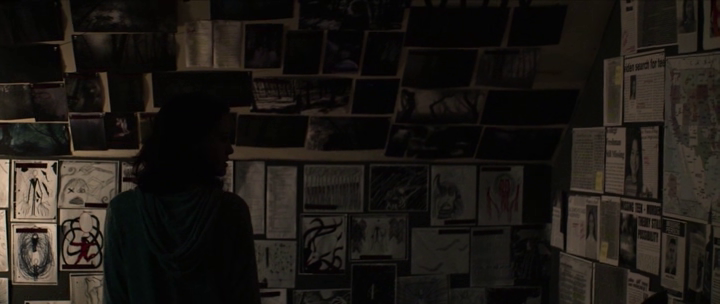
After their friend Katie goes missing – we later learn she dabbled in the occult but this has little baring on the plot – the three surviving friends decide to go all “Nancy Drew” with their efforts to find out what happened to her, and this involves discovering a hidden laptop that shows them that the “Slender Man” has being snatching children for quite some time, but this laptop also brings then into contact with a girl on a Slender Man message board, and she informs them on how to get Katie back. How are they to accomplish such a task? Well apparently they are told to find something important to them, then head into the woods in the middle of the night, blindfold themselves, and wait for the Slender Man to arrive. The true surprise here is that these girls didn’t end up in a cargo container bound for the Middle East.


You know you’re in bad film when meeting a supernatural creature is the better outcome.

If the intent of this film was to be some kind of warning parable about the dangers of predators on the internet, it fails miserably, as even the dumbest person on the planet wouldn’t do what these girls do, and if it was to provide chills and scares, for us the viewer, it failed at that even harder. Worst of all is that the film hasn’t one ounce of originality to be found in its 93 minute running time; we have the prerequisite jump scares, accompanied by your standard loud musical stings, there are so many “dream within a dream” moments that it eventually undercuts any element of suspense, and finally we have the “scary imagery” that the girls are exposed to, and it all looks like cuts scenes from The Ring.


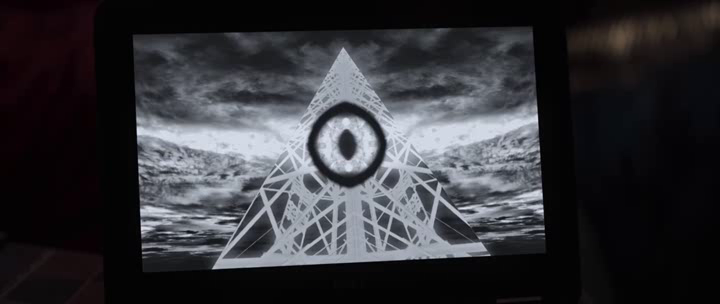
Could the Illuminate be behind it all?

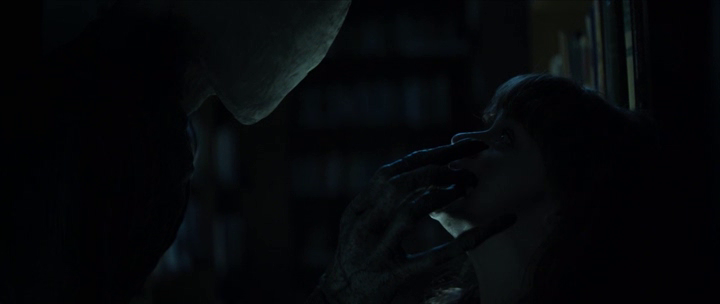
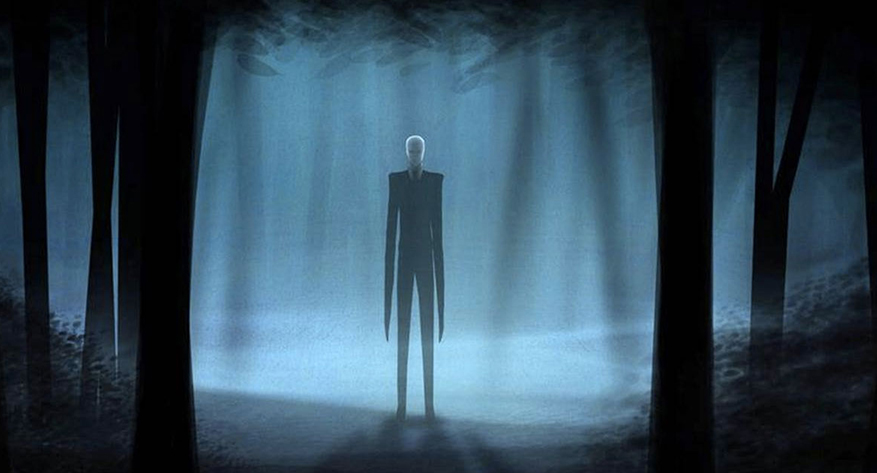
The design of the Slender Man itself isn’t that bad - Eric Knudsen's internet meme depicted a thin, unnaturally tall humanoid with a featureless head and face and wearing a black suit, with Cthulhu like tentacles sprouting from his back, and it is pretty disturbing – and the moments of him creeping into view could have been unsettling in the hands of a better director, but all Sylvain White manages to do is remind us of better horror films – one character is grabbed by vines and tree branches in a complete lift from Sam Raimi’s Evil Dead films – and when Slender Man finally reaches its “startling conclusion” we are beyond carrying about any of it. With this film we are subjected to tired and generic tropes, cheap scares, and a plot that is thinner than the monsters itself, so do not waste your time with this predictable and boring attempt at a motion picture, instead check out the countless web movies about the Slender Man, or better yet just re-watch The Ring, all would be a better use of your time.


How this film got made is the true mystery here.

Sunday, February 3, 2019

The Swarm (1978) – Review

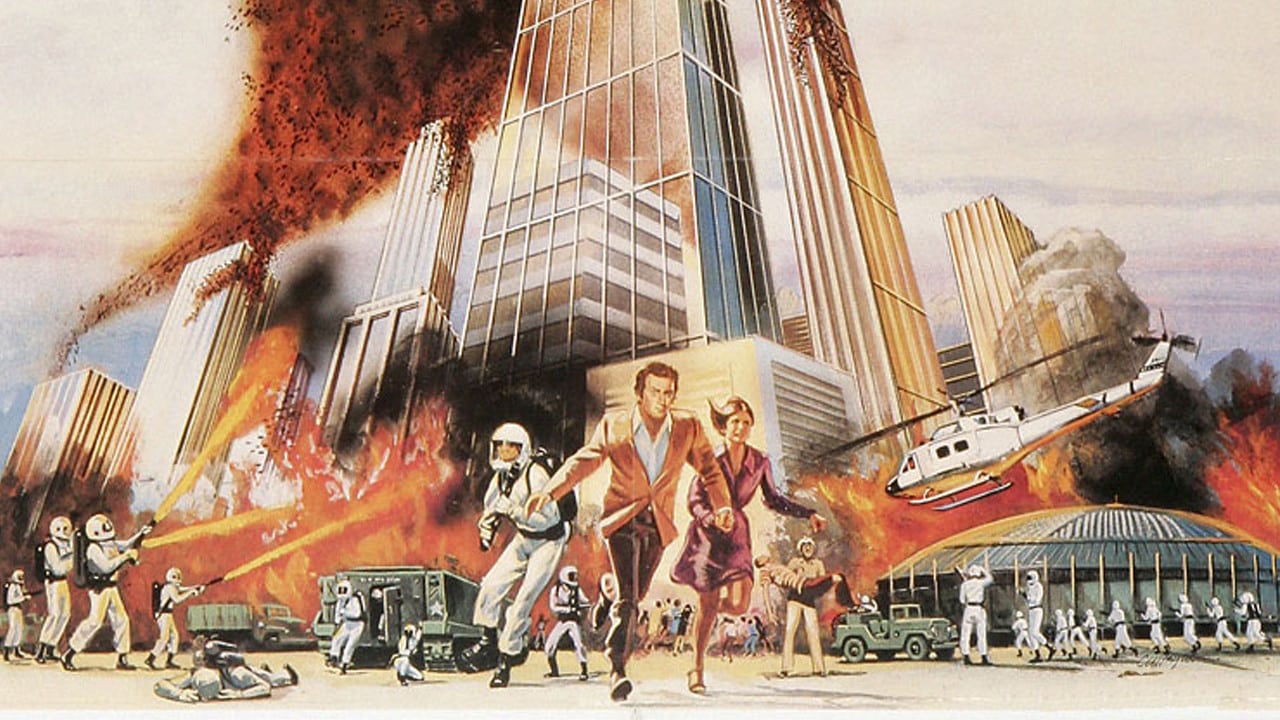
Producer Irwin Allen made a name for himself in television with such classics as Lost in Space, Time Tunnel, and The Voyage to the Bottom of the Sea, and in the 70s he earned the nickname “Master of Disaster” by bringing to the big screen such epic disasters as The Poseidon Adventure and The Towering Inferno. Then along came 1978’s The Swarm, a film that Irwin Allen not only produced but also directed — a movie so colossally bad that it hearkened the beginning of the end for the 70s disaster boom.


“It is more than speculation ... it is a prediction!” This boastful tagline was typical of the larger-than-life producer Irwin Allen, taking the supposed threat of African killer bee and making a movie that is “not science fiction but science fact” while of course getting absolutely nothing correct when it comes to the actual Africanized bee. The film has to throw in lines like, “mutant strain” to cover up the fact that the sting of the Africanized bee is no more potent than any other variety of honey bee, they are just a more aggressive species. The real threat to life and limb in this movie is the idiot humans, as their moronic actions result in jacking up the death toll beyond what even a swarm of killer bees could accomplish.


I swear more people die onscreen due to self-immolation than bee attacks.

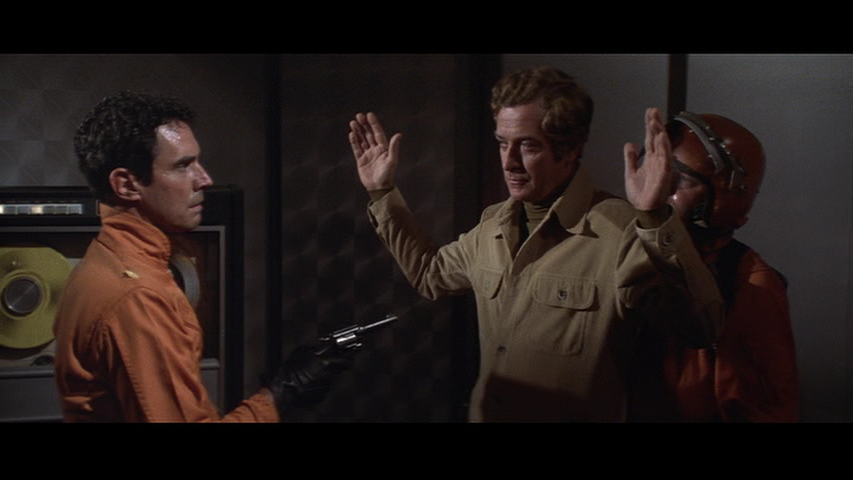
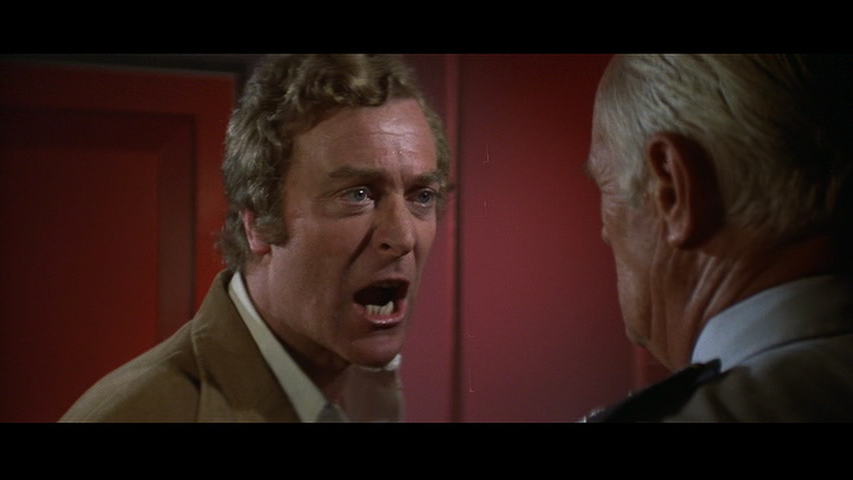
The movie opens with a bit of dramatic mystery: we see a soldiers storm a missile base only to discover that all of the occupants have been killed, and we immediately wonder what kind of force could so easily take out a military installation, but as we are watching a film called The Swarm, we are pretty sure it has something to do with bees. Unfortunately, General Slater (Richard Widmark) and Major Baker (Bradford Dillman), the two idiots commanding these soldiers, who — having not read the script — spend a lot of time trying to figure out what happened, even when explicitly told by etymologist Dr. Bradford Crane (Michael Caine) (who they discovered wandering around the base), that he’d followed a swarm of bees to this location. The General even fosters suspicions that Crane could somehow be responsible, as if he sent the bees to attack the missile base. Now this idea is clearly insane, but a movie where Michael Caine plays a mad scientist, one who controls killer bees, well that’s a movie I want to see.


“Damnit Caine, where are your bee commandos hiding?”

Sadly, that is not the kind of film we are in store for. From the opening moments of The Swarm, we are quickly introduced to what kind of movie we are watching, with characters shouting inanities at each other until the film gets around to having another bee attack sequence, and because this is a 70s disaster film, it is just jam-packed with big name stars, who not only suffer these bee attacks, but also career lows by appearing in this monstrous epic. The film was released into theaters as a 116 minute cut, but has since been extended to 156 minutes for its video release, and this padding expands on already needless subplots.


Unnecessary Subplot Alert!

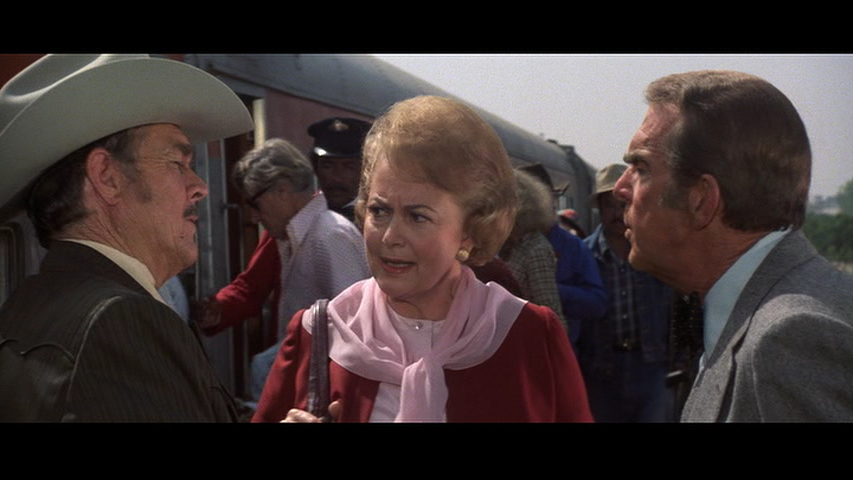
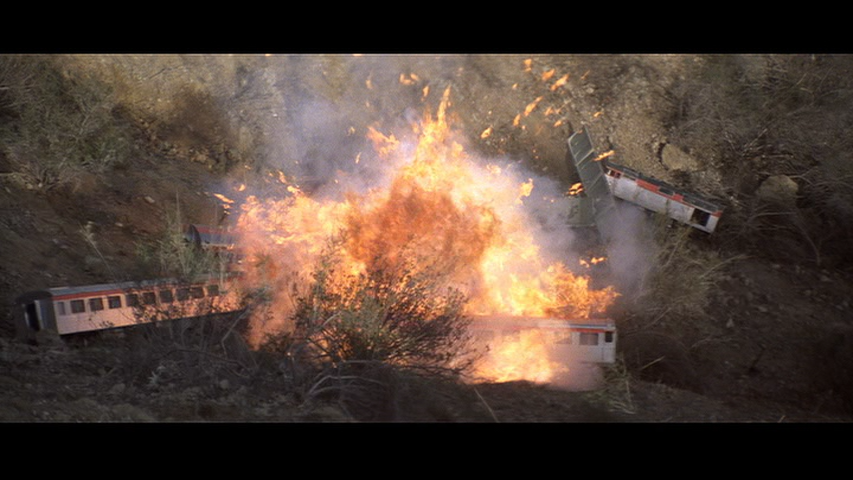
In the nearby town of Maryville, which of course is having its annual flower festival, we are introduced to the town’s mayor Clarence Tuttle (Fred MacMurray), who is in love with the school principle Maureen Schuester (Olivia de Havilland), and retiree Felix Austin (Ben Johnson), who has also proclaimed his love for Maureen. This trio seems to have wandered off the set of Follow Me Boys, as this romantic subplot of Maureen unable to decide which of these men she should marry is not only completely pointless, it’s not even bloody well resolved. She promises to make a decision by the end of the school year, but during the evacuation of the town, the killer bees attack the train that our love-tangled trio are on — do not ask me why the bees are attacking trains, I haven’t a fucking clue — and all three of them are killed when the attack causes the train to derail, tumble down a mountainside, and explode.


I’m also not sure why passenger cars explode as if carrying hydrogen gas.

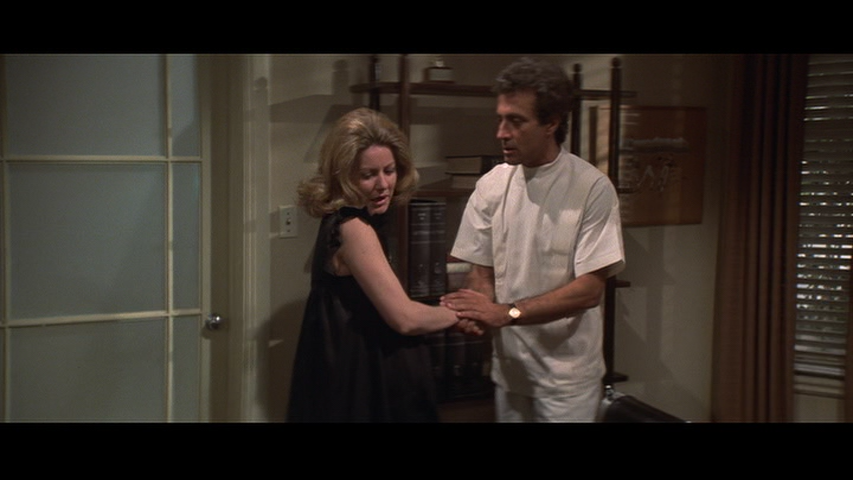
A love triangle between septuagenarians was not enough for Irwin Allen, because we also have to spend time with a very pregnant waitress (Patty Duke), whose husband died during the initial bee attack at the missile base, and she goes into labor before boarding the doomed train — lucky for her, not so lucky for us — for right after giving birth, she says to her doctor (Alejandro Rey), “I guess it’s true what they say, that a woman sort of falls in love with her doctor at this time.” And who exactly is the “they” she is referring to, because I had no idea it was common for a woman to fall in love with her obstetrician, especially in this case where she’s been a widow for about four days, and this is all made worse because of the fact that earlier in the film he was totally hitting on her.


Who can resist a woman in black maternity wear?

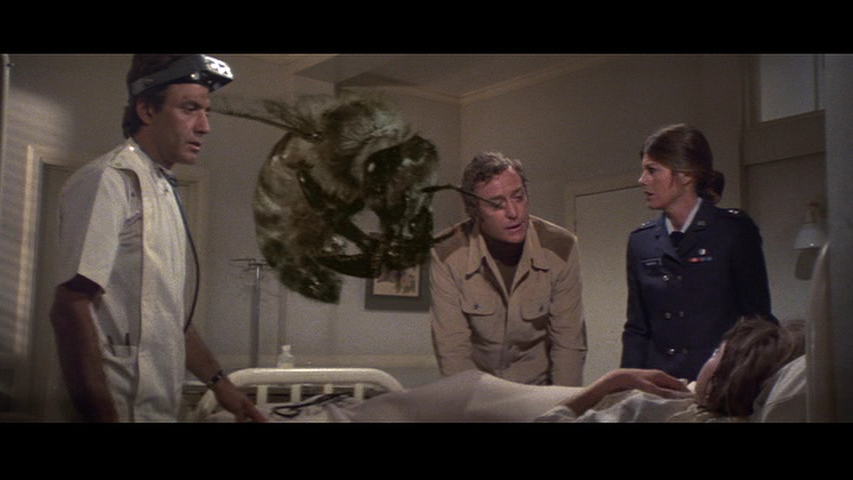
Now, those were the two extraneous love stories that we are subjected to during this film’s bloated run-time, but we also have to endure the developing relationship between Dr. Crane and the military base’s doctor Helena Anderson (Katharine Ross), who promptly abandons her patients — the six soldiers who managed to survive the bee attack but were stung several times, and when they eventually die she is completely unaware of the occurrence — all so that she can tool around in Crane’s van. In fact, both her and Crane show complete disregard for their respective jobs in favor of driving in and around Marysville, for even after Crane repeatedly states that “Time is of the essence,” he and Helena spend almost all their time visiting young Paul Durant (Christian Juttner), whose parents were killed during a picnic bee attack, instead of working on solving the whole “Bees are going to conquer the world” problem. Now, this does lead to one of the film’s most iconic moments, where Crane and Helena visit Paul in the hospital — having been stung during the picnic, he managed to drive the family car into town before passing out — who is now suffering from hallucinations of a giant bee attacking him. Crane calmly informs the boy that “There's no bee here. I promise you, there's no bee here.”


I’m no expert on bee toxins, but is this actually a thing?

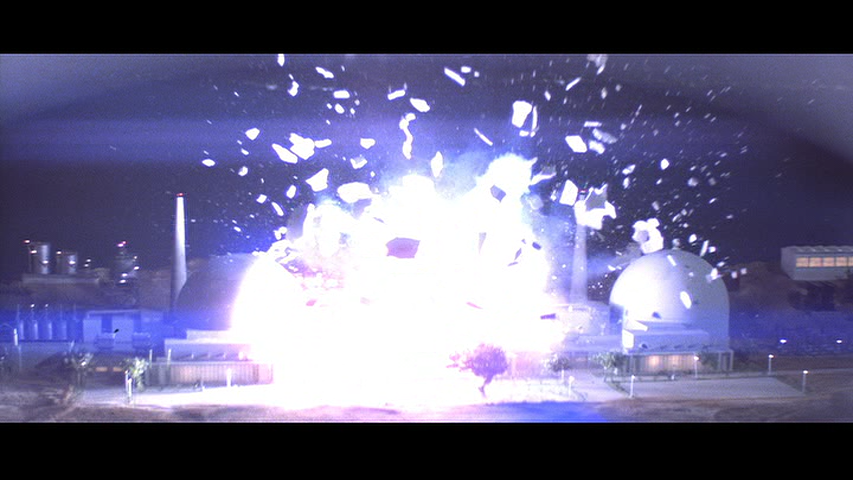
The Swarm is simply loaded with these kinds of bizarre moments, such as Slim Pickens playing a grieving father who shows up at the missile base demanding to see his dead son, or world-renowned immunologist Dr. Walter Krim (Henry Fonda) testing his cure for the African bee venom on himself, for some bizarre reason. And then we get a scene of Dr. Hubbard (Richard Chamberlain) warning the nuclear power plant manager Dr. Andrews (José Ferrer) of the dangers of the approaching killer bees, only to be told, “Billions of dollars have been spent to make these nuclear plants fail-safe! The odds of anything going wrong are astronomical.”


Never tell me the odds.

What is truly odd here, is that though Bradford Crane is the film’s apparent hero, and he does eventually save the day, for almost the entire film's run-time, he is completely ineffectual. He and General Slater are constantly butting heads, and with the death toll mounting and Crane refusing to allow attacks on the swarm, you kind of side with the General at times. But when Crane isn’t failing, he’s in a constant state of inaction. We can laugh at Slater for suggesting, after Dr. Walter Krim has collected thousands of African Bees for study, that “When that swarm finds that their friends have been taken captive they might come back to Marysville.”  Now, this is patently ludicrous, and Crane even mocks him for suggesting such a thing, “Are you endowing these bees with human motives? Like saving their fellow bees from captivity, or seeking revenge on Mankind?” yet we don’t get anything helpful out of Crane but pompous proselytizing about how “The bees have always been our friends,” and any suggested action by Slater is shouted down.

“No! No, general! There will be no air drop, until we know exactly, what we are dropping, and where, and how! Excuse me!”

Michael Caine is one of my all-time favorite actors, but The Swarm was clearly one of his paycheck movies, and his performance veers from painful to laughable; however, the script was certainly doing him no favours, having him spout off some of the most ludicrous lines of dialogue ever put on film. This is also why The Swarm falls into the category of “so bad it’s good,” but at two and a half hours, your ability to laugh at the ridiculous plot and hammy acting will be sorely tested.

Stray Observations:

• Upon arriving at the missile base, Major Baker informs the General that all the personnel are dead, but later Helena shows up stating she saved six servicemen. What kind of search did his men perform?
• Helena states that during the bee attack she saw servicemen above ground lying dead, but when Baker arrived, there were no dead bodies to be seen until they reached the communications room. Did the bees somehow hide the dead soldiers?
• The President puts Crane in direct command of all operations relating to this emergency, which is what allows Crane to boss General Slater around for the bulk of the movie, but there is no instance in which a civilian would be given complete control of military. Crane would at most be allowed to hang around and advise.
• When a bee stings a person, it actually rips out its stinger and part of its abdomen, and thus it dies, but not one dead bee is found at the site of any of the bee attacks. In fact, we never so much as see a bee sting.
• Slim Pickens threatens to cut off the base's supply of water unless he is allowed to see his son, and not only would this result in his immediate arrest, treason being an obvious charge, but an ICBM base would not be relying on the local water supply.
• Paul and a couple of friends return to the site of the picnic massacre so that they can toss Molotov cocktails at the swarm, but earlier we saw Slater, Crane and the military pouring over the picnic site, so how did they miss the swarm if it was still hanging around?
• The General repeatedly drops the words “Killer Bee” when referring to the African killer bees, so we get uncomfortable moments of him informing Crane that Dr. Krim has been “Rounding up Africans“ or stating that, “By tomorrow there will be no more Africans ... at least not in the Houston sector.”
• Crane requests the audio tapes of the attack on the ICBM base, but it takes him weeks to figure out that it was the sound of the sonic alarm test that drew the swarm to the base.
• With Crane’s repeated failures, Slater is finally allowed to spray pesticide all over the Southwest. This of course fails. as the bees have developed a resistance to pesticides, so he then resorts to plan “B” which is apparently torching Houston, Texas.


“Houston on fire. Will history blame me, or the bees?”

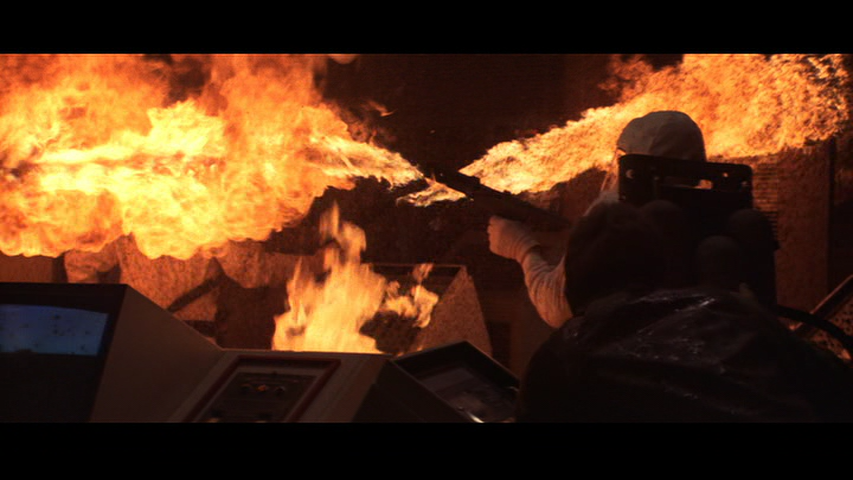
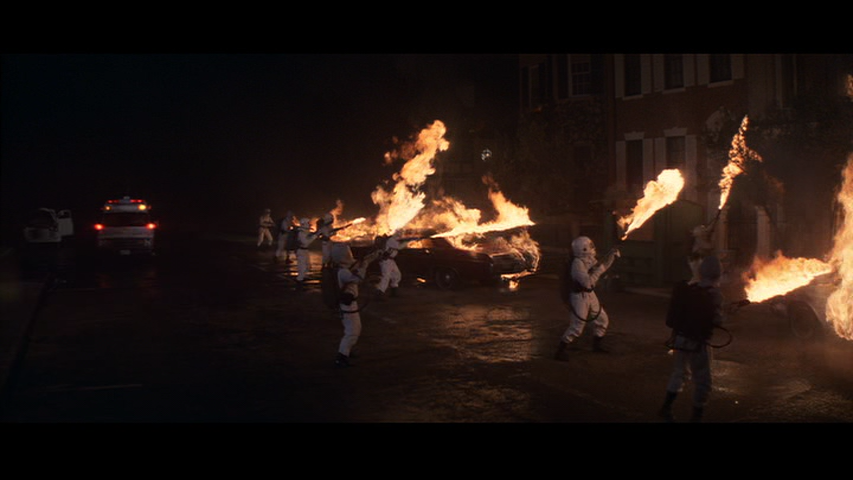
I'm pretty sure history is going to blame Slater, but who am I to judge. However, this final act, with the city of Houston in flames, must have been Irwin Allen trying to recapture the glory that was The Towering Inferno, and the execution of this sequence is so laughably bad that it’s hard to believe that not one person would have pointed out to Allen just how stupid it was. Exactly how stupid you ask? Well, when the pesticides fail to kill the swarm, Washington decides to go with “Man-made burnings,” and you’d think this would involve jets dropping napalm, or maybe the use of a fuel-air-bomb, but for some reason they decide to go the route of men with flamethrowers walking up and down the street torching everything around them. Do they not realize that the bees can just fly away?


And does this seem even remotely safe for those poor soldiers?

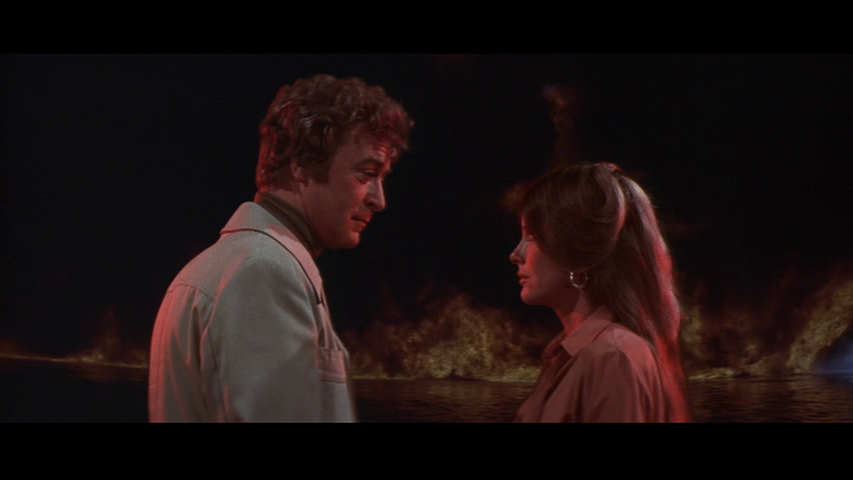
Eventually, Crane is able to pull his head out of his ass long enough to finally deduce that it was the sonic alarm that drew in the bees, and that this sound can be used to lure them out into the Gulf of Mexico, into an area doused with oil, so that when the swarm arrives they set the oil ablaze, destroying all of the bees once and for all — or do they? Because this is a disaster film that also falls into the category of “Nature attacks,” it thus has one of those open-ended codas, with Helena asking Crane, “Did we finally beat them? Or is this just a temporary victory?”


“I hope not, I have to fly to Bermuda and fight a giant shark.”

The Swarm – Disaster Pedigree:
  • Michael Caine was in Beyond the Poseidon Adventure.
  • Henry Fonda was in City on Fire.
  • Richard Chamberlain was in The Towering Inferno.
  • Olivia de Havilland and Lee Grant were in Airport '77.
This is one of those films that was an embarrassment to all involved, and we're talking a cast that includes six Academy Award winners. But as bad as The Swarm is, it will always hold a special place in my heart, simply for the sheer audacity of it all, and of course for Michael Caine’s eternally entertaining utterance of “There is no bee.”

Wednesday, January 30, 2019

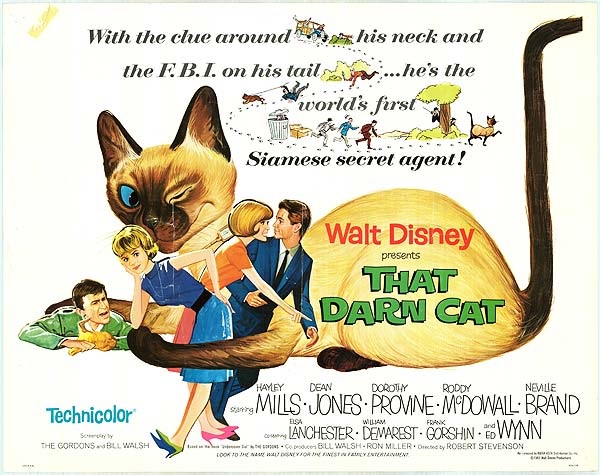
That Darn Cat (1965) – Review

or Disney, the 1960s saw the release of a couple of animated classics — One Hundred Dalmatians and The Jungle Book, and also the lesser received The Sword in the Stone, but in their live-action division they pulled out all stops with their big budget adventure films like In Search of the Castaways, as well as solid family dramas such as the Fred MacMurray film Follow Me Boys. Yet as good as those films were, it was the Disney comedies that kept the studio afloat. Today we will look back at Disney’s That Darn Cat, a screwball comedy with a little romance and a dash of danger.


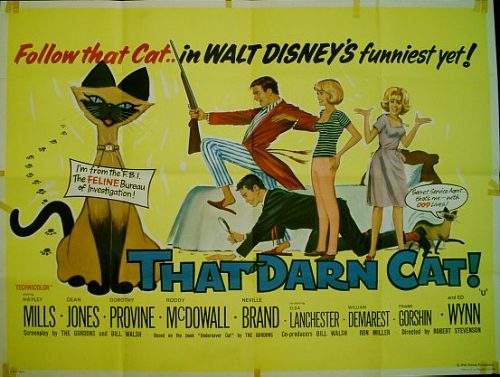
As in the book it was based on, Undercover Cat by Gordon and Mildred Gordon, That Darn Cat follows the misadventures of a Siamese cat named DC — which of course stands for "Darn Cat" — whose nightly prowls raise quite a degree of ire amongst the neighbors (leaving muddy paw prints on cars or stealing food out of neighboring houses), but when DC wanders into a tenement apartment occupied by two bank robbers and the poor bank teller they are holding hostage, things get a bit tense … and a bit screwy. The hostage, one Miss Margaret Miller (Grayson Hall), manages to slip DC’s collar off and replace it with her wristwatch, after quickly scratching a message for help on the back of it, and when DC’s owner, Patricia "Patti" Randall (Hayley Mills), discovers her cat’s new accessory, she quickly deduces that the watch came from the kidnapped bank teller. She informs cat-allergic FBI agent Zeke Kelso (Dean Jones) of her theory, and despite this leap in deduction, the FBI take her seriously. What follows is roughly two hours of hilarious hijinks as FBI agents try to tail a cat in the hopes that it will lead them to the villains and the poor woman.


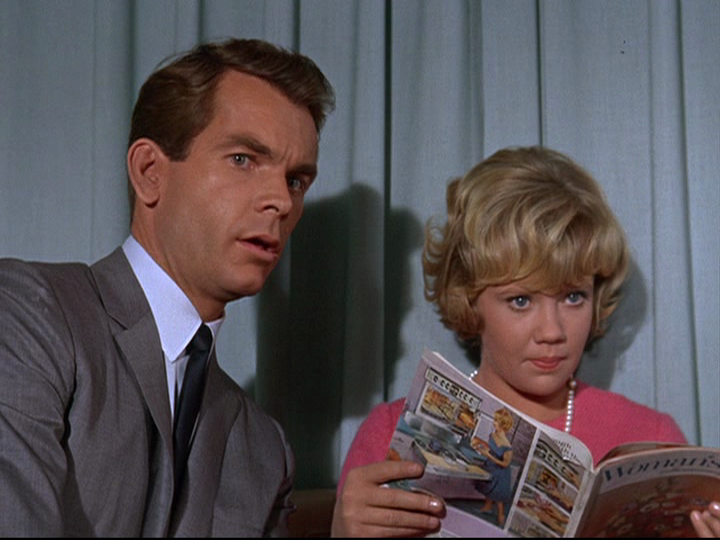
Haley Mills and Dean Jones, two titans of Disney films.

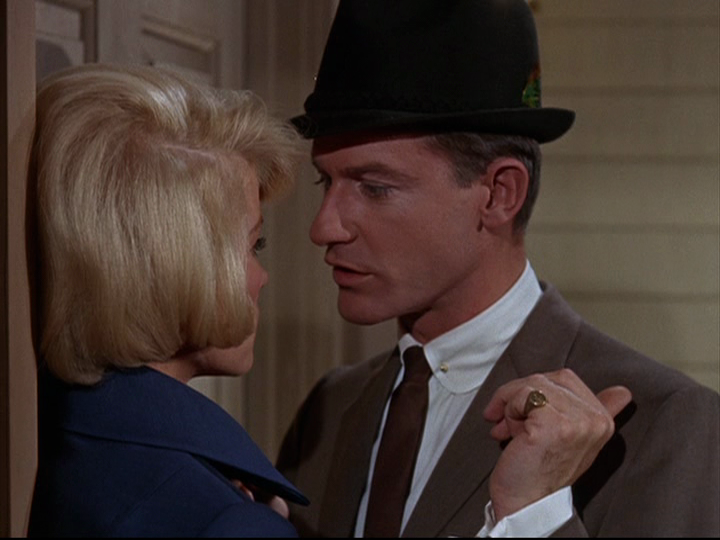
That Darn Cat would be the exit picture for Hayley Mills from the studio — she wouldn’t return to Disney until 1986 with the sequel to The Parent Trap — but it was the beginning of a long series of Disney films for actor Dean Jones. The two actors work off each other beautifully in this film, but not in any kind of romantic way — we have Patti’s older sister Ingrid (Dorothy Provine) to provide that — as Mills and Jones bounce off each other with both verbal and physical comedy, all while futilely trying to wrangle the cat. The film’s climax will throw this odd couple into a good degree of peril — much as you’d expect to see in a Hitchcock thriller — but as stated, there is no romantic sparks between the two, despite Patti finding Agent Kelso attractive. So there may not be sparks between Patti and Kelso, but something does develop between Kelso and Ingrid, and as with many films of this type, there is of course romantic foil to contend with. Providing the romantic rivalry in this film we have Gregory Benson (Roddy McDowall), a lawyer who drives Ingrid to work, but whose carpool designs have a more overt nature, as he sets his sites on Ingrid. McDowell portrays the perfect mother’s boy cad, whose desire for the girl is most definitely not about true love, and he is certainly no match for a cat.


Comic relief or sexual predator, you decide.

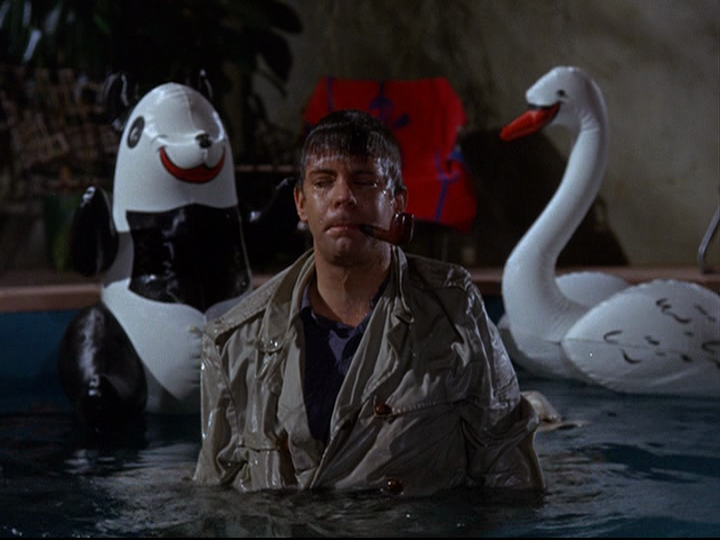
In the few scenes they have together, Dorothy Provine and Dean Jones have excellent chemistry. That they end up together by the film’s end will surprise no one, and McDowell is the typical strawman fall guy in this dynamic, as he's never really in the running as a credible romantic foil, but instead he's a target for slapstick humor. Yet the film also throws in another “love interest” to complicate matters, this in the form of Patti’s sort of boyfriend Canoe (Tom Lowell), a pipe-smoking man-child whose life seems centered on surfing and raiding the Randall’s fridge. Tension is caused when he spots Kelso lurking about, mistaking him for a romantic rival — the FBI’s involvement being kept secret so as not to tip off the kidnappers — and he along with Roddy McDowall, traipsing around in the dark, provide much of the film’s physical comedy.


What the hell kind of name is Canoe anyway? The 60s sure were weird.

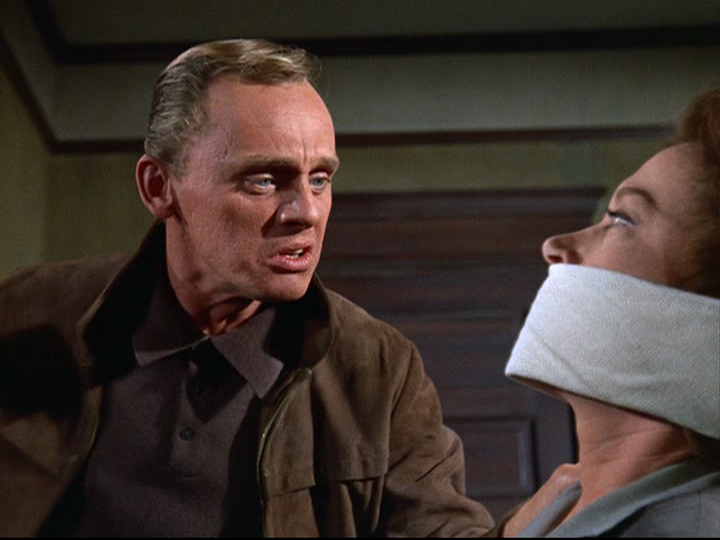
One of the more interesting elements in That Darn Cat was the portion of the film dealing with the bank robbers and their hostage. The villains are portrayed by Neville Brand, who has appeared in such films as Stalag 17 and DOA, as he brings a great deal of threatening gravitas to the film, but it’s his partner in crime, played by the great Frank Gorshin, who is the real standout here, as he is simply chilling as killer/bank robber Iggy. Of course, Frank Gorshin is known by most audiences as the Riddler from the Adam West Batman series, but it's films like this that show us just how scary he can truly be. The poor hostage is in constant fear, as she repeatedly overhears their plans to murder her and how best to get rid of the body when they do, and it’s these dread-filled moments that create an interesting counterpoint to the comedy elements of the rest of the film.


“Riddle me this, Disney!”

Director Robert Stevenson was one of the best and most prolific directors at the Disney studios, helming such classics as Old Yeller to Mary Poppins, and he has a deft hand with comedy, as he’d prove later with such entries as The Love Bug and Blackbeard’s Ghost, which would re-team him with Dean Jones. That Darn Cat is simply one of many live-action gems out of the Disney vaults that have mostly been forgotten — even though it was remade in the 90s with Christina Ricci, which is a film that actually should be forgotten — and if you happen to come across this piece of Disney history one afternoon while surfing channels, do yourself a favor, check it out; you won’t be sorry you did.

Note: The film has a supporting cast of Hollywood greats that include Elsa Lanchester, William Demarest and Ed Wynn.

Tuesday, January 29, 2019

Reign of the Supermen (2019) – Review

How does one adapt a storyline that introduced four new characters, ran across multiple comic book titles, and is over four hundred pages long, all in a ninety minute animated film? Well, with the Reign of the Supermen we get to see Warner Bros. Animation and DC Entertainment giving it their best shot, but do they hit the mark? Working as a direct sequel to their 2018 animated feature Death of Superman, this film encompasses the events following Superman’s death at the hands of Doomsday, and his inevitable return, but to capture the scope and grandeur of the “Return of Superman” storyline, major changes had to be made, some working quite well, while others I’d have to say were a little less so.


Reign of the Supermen

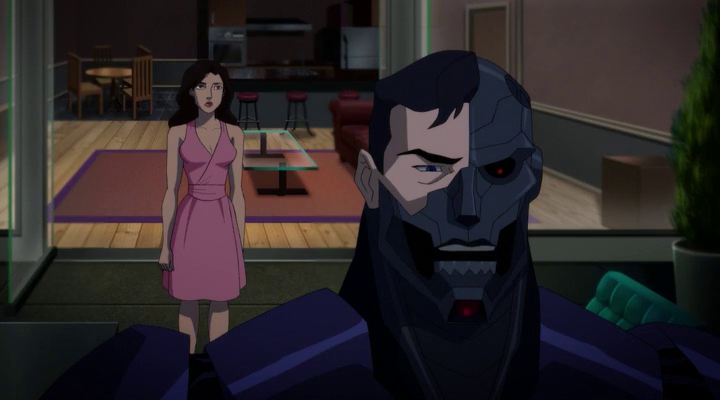
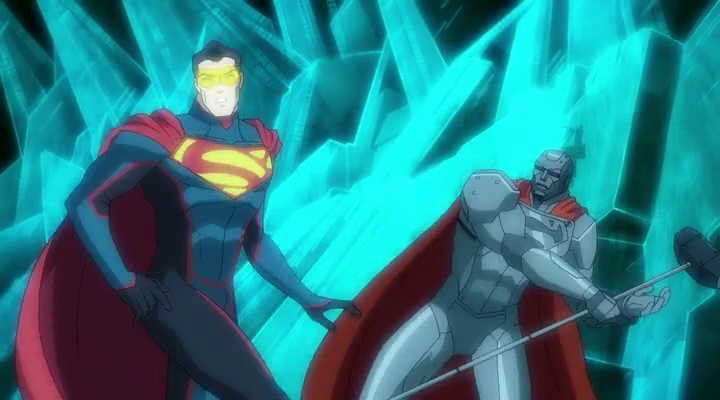
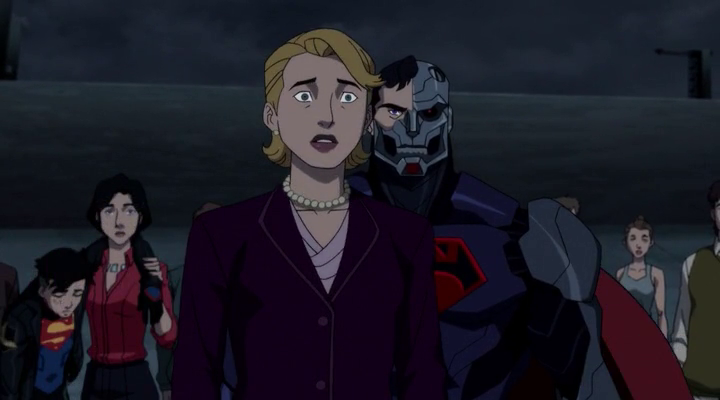
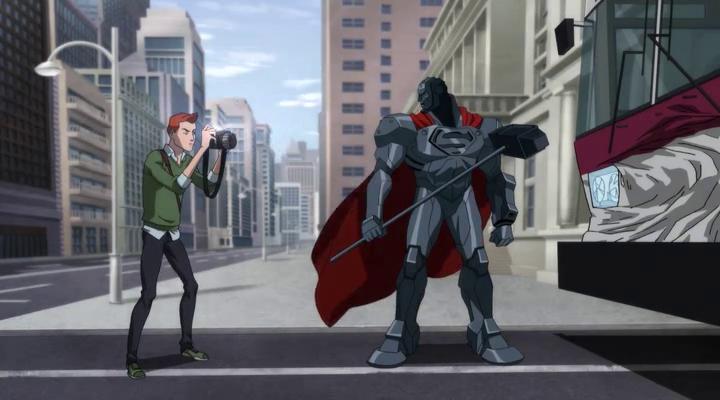
The film opens with the world mourning the death of Superman, though some people believe mankind should step up and be their own superhero, but self-help talks alone will only get you so far, and without Superman around, crime in Metropolis has begun to get out of hand. Filling in the red boots of the fallen Last Son of Krypton are four very different heroes; first we have The Eradicator (Charles Halford), a visor-wearing Superman with a very “Dirty Harry” approach to meting out justice — as in he kills bad guys without a second thought; next there is Superboy (Cameron Monaghan), a hormonally challenged clone of Superman who seems more interested in hitting on women than fighting crime; then there is John Henry Irons AKA Steel (Cress Williams), a man in an armored suit who is trying his best to stop high-tech weapons from flooding the streets; and finally there is Cyborg Superman (Jerry O'Connell and Patrick Fabian), who is the most disturbing of this quartet of Supermen, and not just because of his half-robot look.


Can Lois love this Heart of Steel?

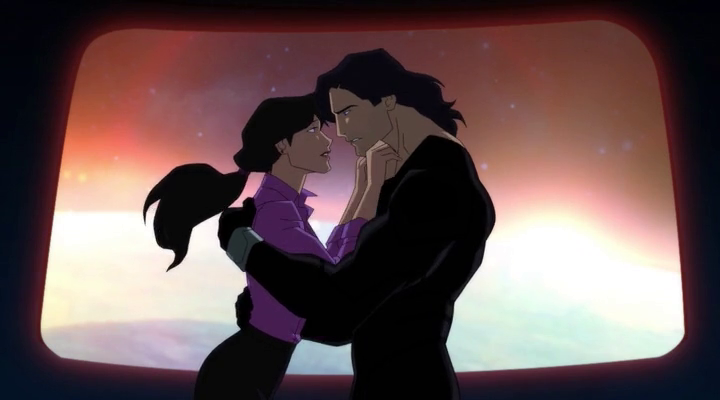
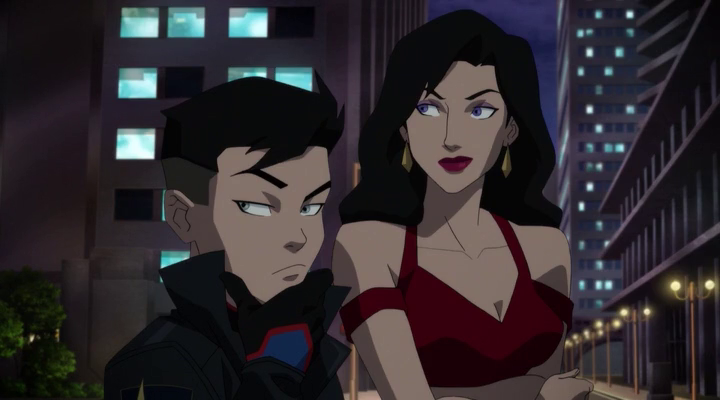
The Death of Superman told a very condensed version of the original comic book story, but with Reign of the Supermen, we not only get an immensely abridged version of what comic book readers had experienced back in the 90s, but we are also given a completely new story, with an entirely different villain … well, kind of. The first act of Reign of the Supermen does move several beats from the source material, with the various "Supermen" fighting over the rights to be the one and only Superman — except for Steel who just wants to honor the fallen hero — and we do get a nice added moment with Lois Lane (Rebecca Romijn) sitting down with Wonder Woman (Rosario Dawson), as they bond over their past relationships with The Man of Steel, but once the backbiting and super punching over “Who is the real Superman?” plays out, the mystery is basically forgotten by the screenwriters, as at about the thirty minute mark the movie essentially chucks what was found in the comics into the dustbin.

Note: With a ninety minute running time there was just no way four new Supermen could be fully realized, so Steel and Eradicator appear as almost glorified cameos here.

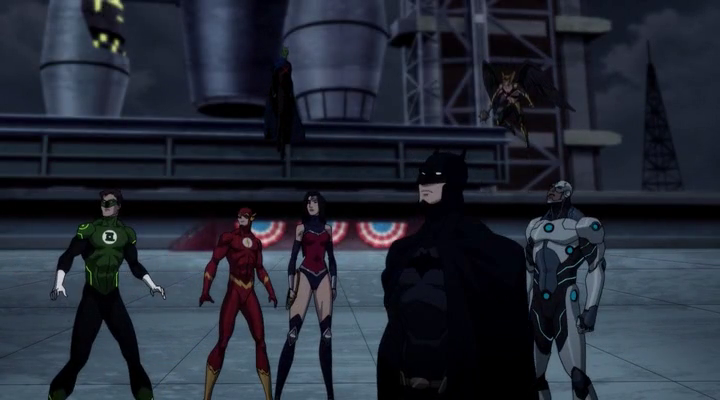
I will now discuss key differences between the comic books and this animated adaptation, obviously this will include spoilers, so stop reading now if you want to enjoy the full “mystery” of the Reign of the Supermen untainted. In this movie, we find Lex Luthor (Rainn Wilson) promoting his new hero, Superboy, who is sponsored and bankrolled by LexCorp, but the press conference is attacked by the Eradicator, who is looking to kill Lex — Luthor being a known if unconvicted criminal — which then leads to a massive super brawl, for as it turns out John Henry Irons/Steel was also in attendance — he’s there looking into LexCorp's weapons turning up in the hands of criminals — and so Superboy, Steel and then Cyborg Superman all battle it out with the Eradicator. It’s the timely arrival of Cyborg Superman that drives away the Eradicator, and it is this victory which puts the cyborg ahead of the  running for being The Real Superman, and this angers Luthor to no end, him wanting his “Superboy” to be the one and only hero of Metropolis. To fix this, he gets Superboy the top spot in The President’s security detail, for the ceremonial launching of the Justice League Watchtower, but when a boom tube opens, and Parademons terrorize the event, Superboy is defeated and Cyborg Superman is declared the "real" Superman when he saves The President of the United States.

Note: In the original comics, it was President Bill Clinton who declared Cyborg Superman to be the “real” Superman, after being saved by him during a terrorist attack, while in the animated film we get President Dale, who is clearly a stand in for Hillary Clinton.

Getting the Justice League out of the way was an important element in both the comic and this adaptation — they are a force to be reckoned with and having them around would certainly complicate any evil plan. In the comic book they were told by Cyborg Superman that the aliens, who had attacked and destroyed Coast City (killing over seven million people), had fled into space, and that Cyborg would stay and fight the Eradicator, who he claimed led the alien assault, while the Justice League would pursue the alien armada into deep space.

In Reign of the Supermen there is no destruction of Coast City — an event which set up the rise and fall of Hal Jordan — instead, the Boom Tube that had opened, and let the Parademons in, collapses and falls onto the League, appearing to have killed all of them. This is all kinds of bullshit. Are we to believe that none of the Justice League could move out of the way of a slowly falling portal? That they just stood around like a bunch of idiots?


Over half the Justice League can fly or has super speed, for Christ’s sake.

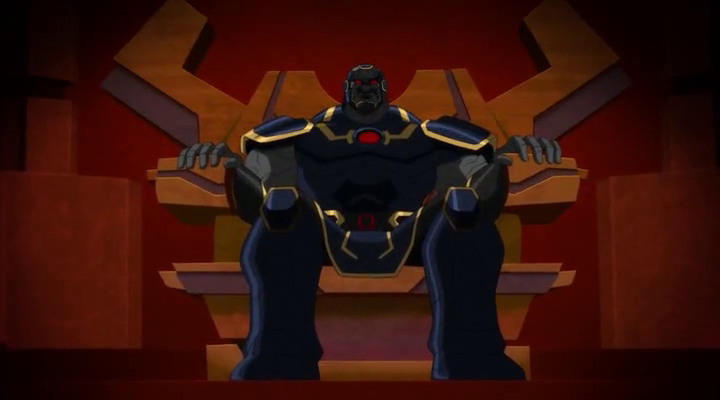
The movie then diverges even further from the source material, by having Cyborg Superman creating a new peacekeeping force, one to replace the presumed dead Justice League. This is done by turning regular people into a modified meta-human army he calls his Cyber Corp, using some advanced form of superpower-giving technology. Lois, of course, recognizes these modifications as being of Apokoliptian nature, and that the true villain of this piece is of course the villainous Darkseid (Tony Todd), and also discovers that Cyborg Superman is actually Hank Henshaw, who died in The Death of Superman, after the Man of Steel was a no-show when his space shuttle was destroyed by meteors.  In this adaptation, Henshaw has become Darkseid’s lackey, just to get some sweet revenge on Superman.


They even add in some bullshit that Darkseid created Doomsday.

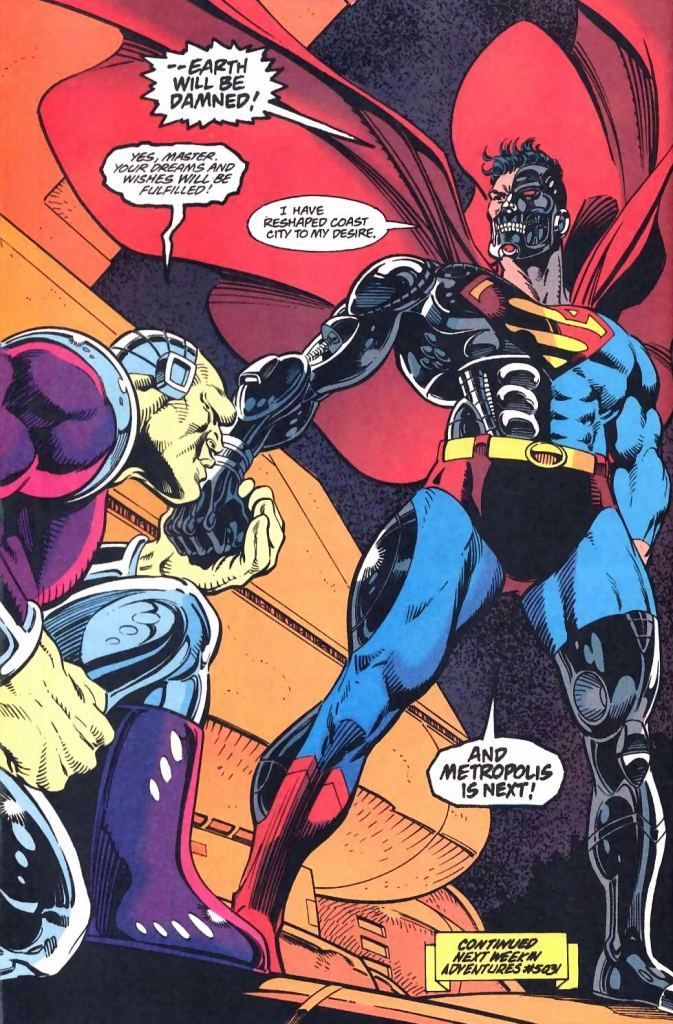
Now Darkseid is easily one of the most prominent villains in Superman's rogue's galley, a villain who can give the entire Justice League a run for their money, but he was not the architect behind the attack on Earth in the comics. In the Return of Superman storyline, Hank Henshaw was still revealed to be Cyborg Superman, also still pissed at Superman for supposedly letting him and his crew die, but he was no puppet to Darkseid. He had posed as Superman to destroy his reputation, and had forcibly recruited the alien warlord Mongul, as part of an elaborate revenge plot against Superman's adopted home, but still, he wasn't Darkseid's puppet.


This is much cooler than him being a Darkseid lackey.

Making Darkseid the “man behind the scenes” completely undercuts the threat of Cyborg Superman. When the actual Superman (Jerry O'Connell), who eventually wakes up from his Kryptonian healing matrix takes on Cyborg in this movie, he’s not fighting the chief threat to Earth, which would be Darkseid, instead the film ends with our hero basically fighting a mechanical henchman. In the comic storyline, Cyborg Superman was so powerful that he had made Mongul his bitch, an alien who had in the past gone toe to toe with the real Superman, and only the team-up, consisting of Superman, Superboy, Supergirl and Green Lantern, was able to stop Cyborg Superman’s plan to turn Earth into a new Warworld.

In this movie we later discover that the Justice League weren’t actually dead, but simply trapped in another dimension, to eventually be saved by Lex Luthor hacking a Mother Box, and they spend the last act of the film working with Superboy and Steel to take down Cyborg Superman’s lame Cyber Corp, while a weakened Superman — death and rebirth takes a lot out of you — dukes it out with Cyborg Superman aboard the now launched Watchtower. Superman wins by stabbing Cyborg in the head with a crystal from the Fortress of Solitude, which contains the Eradicator’s essence — him having been revealed to be a Kryptonian defense system all along — and thus the day is saved.


A clear happy ending, because they omitted the destruction of Coast City.

Aside from containing four new Supermen, and the revelation that Cyborg Superman was actually a villain, there really aren’t too many similarities between this animated movie and the comic books it was supposedly based on. In the comics, Supergirl was key to taking down Cyborg Superman, yet she doesn’t even warrant a cameo in Reign of the Supermen. In the comic book, Superboy was not a clone created by Lex Luthor — he was a clone to be sure, but he’d been grown in the Cadmus labs, after they’d briefly acquired the corpse of Superman, and not by LexCorp. In the comics Luthor did want Superboy to sign with LexCorp, and fight alongside Supergirl — who post-Crisis on Infinite Earth was not Superman’s cousin but actually synthetic protoplasm created by Lex Luthor — but the young and impulsive clone ended up signing with a shady entertainment lawyer.


Though the movie does capture Superboy’s hormonal issues quite well.

There was simply no way that a ninety minute animated movie was going to be able to encompass the four hundred-plus pages that made up the epic tale that is The Return of Superman, but in truncating the backstories of the four Supermen, the film is left feeling a little hollow, and with the Justice League crammed in — and embarrassingly disposed of — in such a lazy fashion, the Reign of the Supermen was bound to come across as a rushed and haphazard endeavour. On the other hand, the animation is quite nice, giving us some really fun action set pieces, and the voice casting is still one of Warner Bros. Animation and DC Entertainment's best achievements, and I really look forward to more of Tony Todd as Darkseid.

Comic book purists will find much to gripe about with this adaptation, and its rushed characterizations will bother others, but there is still much to enjoy with this outing, I just think the Reign of the Supermen would have worked a lot better as a two-parter.


And I could certainly do with a proper movie starring Steel.

Thursday, January 24, 2019

Elseworlds: An Arrowverse Crossover (2018) – Review

To say that DC’s theatrical attempts have had a rather bumpy run of things would be a vast understatement, yet on the small screen their collection of heroes have met with a fair amount of success — I myself enjoyed the first few seasons of Arrow, and season one and two of The Flash and Supergirl were quite entertaining — but as these shows drag on, the abilities of the showrunners to juggle such a diverse group of heroes has been sorely put to the test. Case in point, Elseworlds, a crossover which may have looked good on paper, failed miserably in the execution.


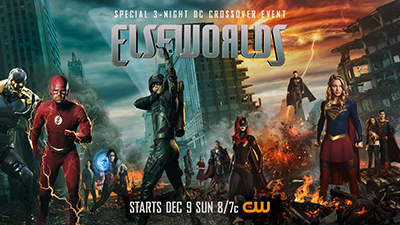
Originally, in the pages of DC comics, the Elseworlds stories contained “imaginary” adventures of some of our favourite DC heroes — Batman hunting Jack the Ripper or infant Superman landing in Russia instead of Kansas — but now the DC Multiverse has incorporated some of these stories into proper continuity, which brings us to the Arrowverse. In what has become an annual event, this Elseworlds three parter brings The Arrow, The Flash and Supergirl together to fight a threat to reality itself (Legends of Tomorrow gave this crossover a pass) as an all-powerful being called The Monitor (LaMonica Garrett) strides across the multiverse, leaving destruction in his wake.
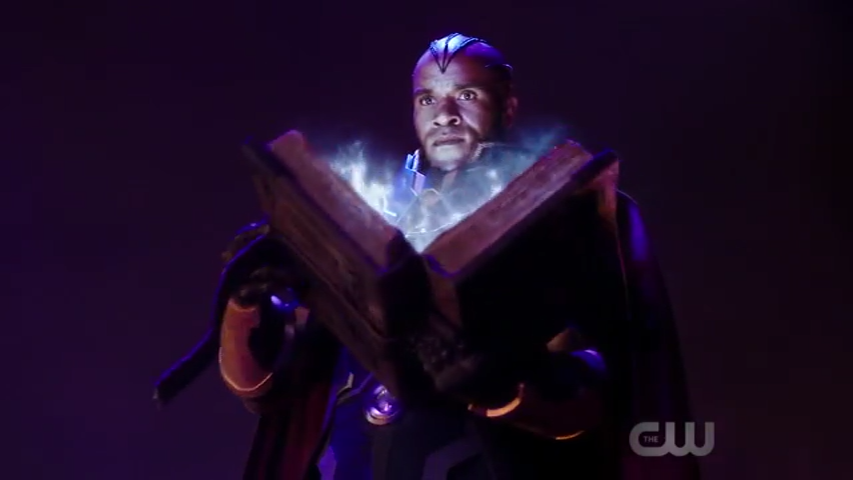
 

He has the “Book of Destiny” but none of The Endless show up to take it back.

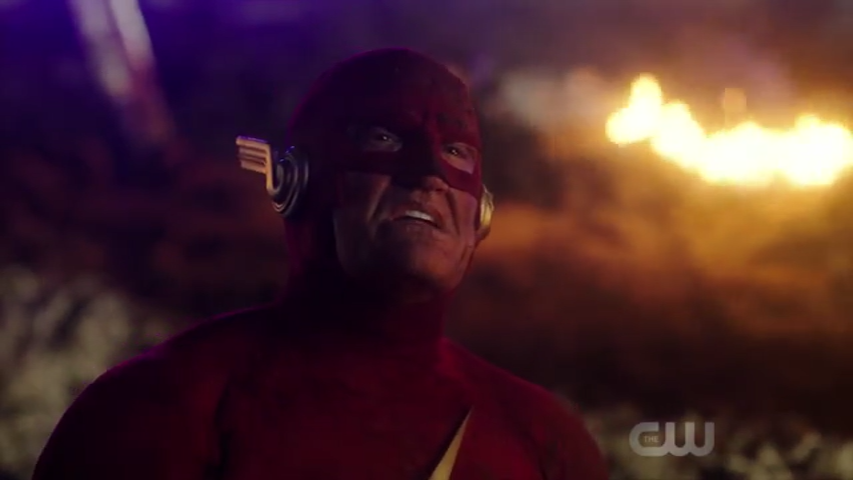
We are first introduced to The Monitor as he destroys Earth-90 — where Barry Allen (John Wesley Shipp) is the last of Earth's Mightiest Heroes to stand up to this mysterious book-wielding figure. We then jump to Earth-1 where The Monitor hands over the book to John Deegan (Jeremy Davies) — who comic fans may recall is Doctor Destiny — and asks him to, “Reshape the world as you see fit.” Giving a supremely powerful artifact to a “mad doctor” is, of course, going to mess things up pretty badly, and thus, the following day, Oliver Queen (Stephen Amell) and Barry Allen (Grant Gustin) wake up to find themselves living in each other's lives; Oliver is the speedster known as The Flash and Barry is the masked vigilante Green Arrow. Oliver and Barry spend a little time exploring their new identities — Oliver having a hard time controlling the speed force while Barry has to get used to shooting arrows and kicking ass without super speed — and when they try and explain to their friends at S.T.A.R. Labs what has happened to them, they are disbelieved, knocked unconscious, and locked up in one of S.T.A.R. Lab's containment cells. There is a lot wrong with this, and we’re not even twenty minutes into the first episode of this crossover.
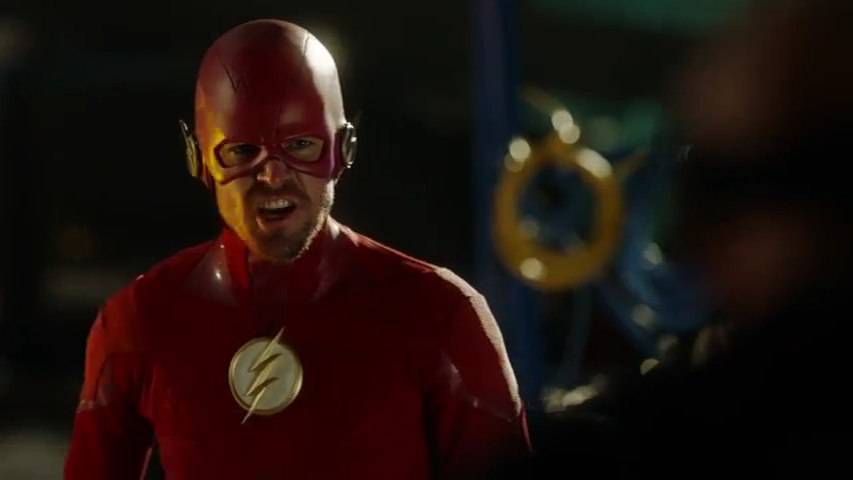
 

“You have failed this City!”

The first question that came to my mind was, “Why are Oliver and Barry the only ones aware of the changes in their reality?” Did Deegan have some arcane reason for leaving these two with the memory of the original reality intact? Was this an element that The Monitor snuck in as part of his “Big Test” — he’s apparently rewriting reality to test out worlds to see if they are capable enough to stop an upcoming crisis, yet he never explains why this requires a mortal stooge like Deegan for this to work — but if that is the case, this is never explained. This is called lazy writing, and falls into the category of plot crutches such as “A wizard did it.” This also raises a big question as to how Barry can function at all as Green Arrow; if he has retained his memory of being The Flash, how is he able to fight and shoot like the real Oliver Queen?  In this new reality where Oliver Queen has the power of speed, stopping criminals at super speeds can still work — he may not be as good at it as Barry but super speed is damn effective even if used by a novice — but Green Arrow has no super powers, so unless muscle memory is more effective than I’ve been led to believe, Barry should have gotten his ass kicked while trying to be Green Arrow.
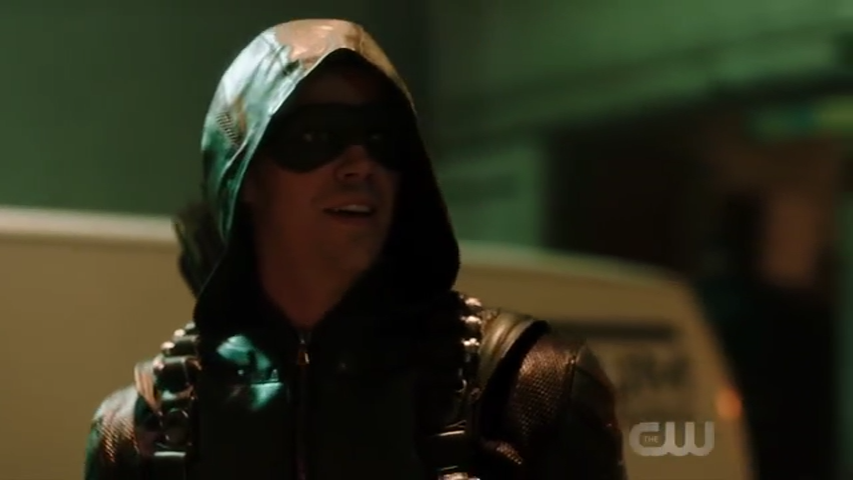
 

“Who needs years of training on a deserted island?”

Then we have the added stupidity of Team Flash not believing in the whole “Freaky Friday” body switch thing, which is insane because this is the kind of crazy shit they deal with on almost a weekly basis, so them immediately locking them up is ridiculous. Luckily, Barry is able to convince Iris (Candice Patton) to open a portal so that they can travel to Earth-38, where they hope to get help from Supergirl (Melissa Benoist), their theory being that the changes to their reality may not have affected other worlds. This turns out to be the case, but not only does Supergirl recognize them for who they really are, she is also able to recruit her cousin Superman (Tyler Hoechlin) to help them on their mission to correct reality on Earth-1. Good thing they did, because once they return to Earth-1 they soon find themselves battling the robot know as A.M.A.Z.O — the super adaptoid who can copy the powers of any meta-human it encounters — but really all that was needed to defeat the robot was Team Flash building an off switch for Barry to shoot into its eye. And how exactly did they pull this off? Well Cisco (Carlos Valdes) and Caitlin (Danielle Panabaker) reverse-engineered A.M.A.Z.O’s operation system and whipped up a virus to wipe out its CPU, and all of this is done in a matter of seconds. Star Trek: The Next Generation was known for pulling such technobabble nonsense out of their collective asses, but even by Geordie standards, this was absurd — they didn’t know of the robot's existence until now, and yet somehow these yahoos could still reverse-engineer the thing in a hot minute.
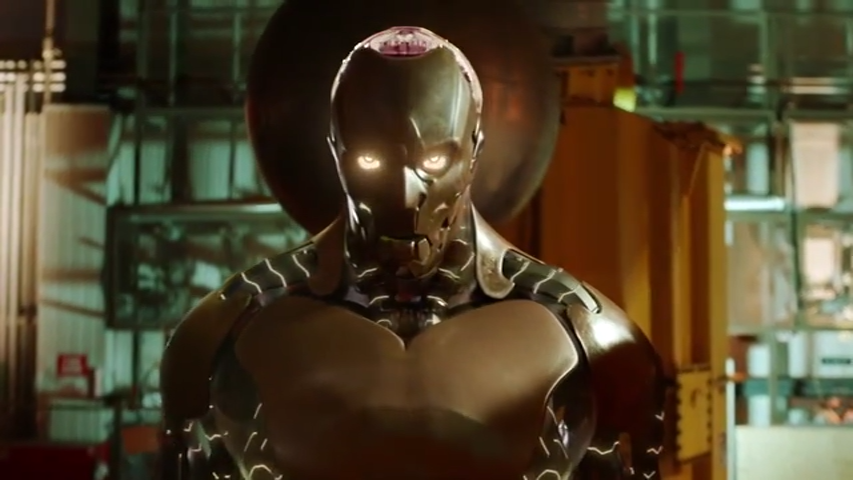
 

The bigger crime here is wasting A.M.A.Z.O. as a throwaway villain.

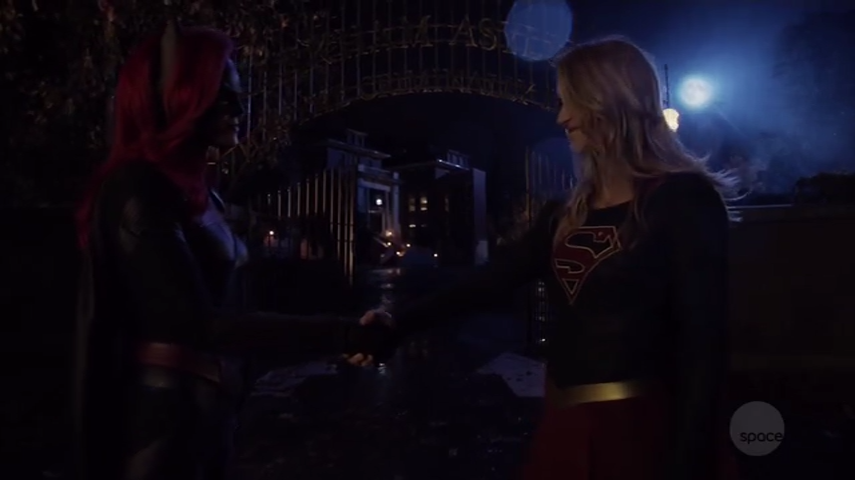
Superman returns to Earth-38 to keep Lois safe — from what, we don’t know, but as Lois is constantly getting into trouble he’s probably right to be concerned — and so Barry, Oliver and Kara head to Gotham City to hunt down Deegan (Cisco had used his “Vibe” powers to show them that The Monitor and Deegan were in Gotham), and while visiting the home of the Dark Knight, they are arrested, but then quickly bailed out of jail by Kate Kane (Ruby Rose), Bruce Wayne’s cousin who has been running Wayne Enterprises since Bruce vanished three years ago. She informs them that Deegan is at Arkham Asylum, and thus the group rushes off to retrieve the “Book of Destiny” from this madman.

A few Stray Observations:

• We see John Diggle (David Ramsey) and his A.R.G.U.S. Team fighting the son of Deathstroke, none of whom think to shoot the dude in his unprotected head.
• Oliver doesn’t want the team to tell Felicity (Emily Bett Rickards) about him and Barry switching identities, but being the fact that she was brought into help solve the problem, how is that even supposed to work? This is simply for the sake of bad comedy and the continued ruination of Felicity’s character.
• Oliver hacks the GCPD database to find the location of Deegan, but since being fired five years ago, there is no known address for him. Yet Kane, minutes later, informs Kara that Deegan works at Arkham Asylum. I guess this is why Oliver needs Felicity, because his computer skills suck.
• Oliver is not yet comfortable with his speed powers, so the idea of him doing a “Super Speed Reconnaissance” of Arkham is kaboshed, but why doesn’t Kara use her Super Speed?
• Caitlin/Killer Frost gets into a fight with Nora Fries, and she loses. *sigh*
• Canisters of the Scarecrow’s fear toxins are broken open, causing Oliver to hallucinate Reverse Flash and Barry to see Malcom Merlin, but why is the fear gas causing them to see each other’s main nemesis?
• Batwoman knocks the two out of their hallucinatory state, and tells them to leave Gotham, and once again this is not how Scarecrow’s fear gas works, a punch in the head does not end the effects of the toxin.
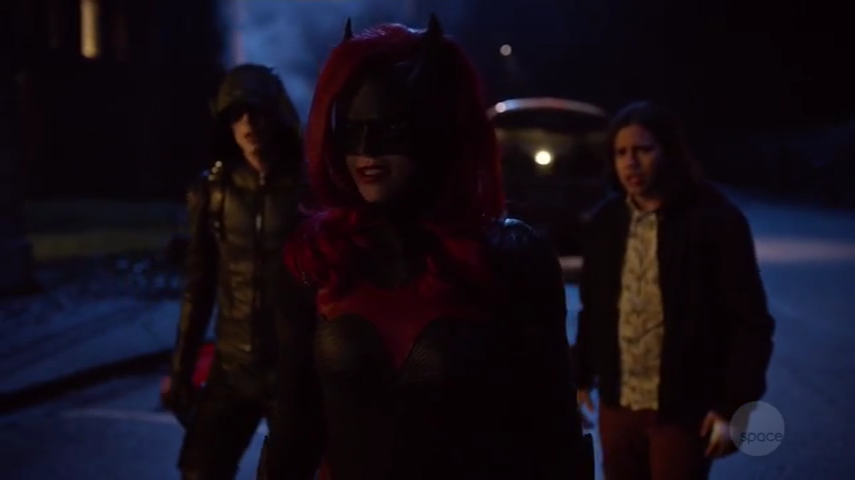
 

“I told you to get out of Gotham, and don’t come back until my series starts.”

Supergirl retrieves the “Book of Destiny” from Deegan — though he manages to escape because the plot requires this to happen — and the group returns to A.R.G.U.S. to figure a way to use the book to restore reality, but The Monitor just steals the book back and hands it to Deegan, telling him to, “Do better, think bigger.” Which means this whole trip to Gotham and finding Deegan was not only a complete waste of time, but also pointless … well aside from introducing Batwoman (and to be fair that was the only reason I tuned back in to the Arrowverse).

Note: Supergirl uses her X-Ray vision to see how much of Batwoman’s body is covered in tattoos, and suddenly dozens of fanfics leap into existence.

So Deegan rewrites a new reality, where Barry and Oliver are criminals known as the Trigger Twins, who have super powers, and Deegan has made himself this reality's Superman, and we are still left wondering why our main protagonists are left with their memories of previous realities intact. Meanwhile, Kara is being held prisoner in this new reality’s version of S.T.A.R. Labs — under the grumpy supervision of the Earth-1 version of Kara's adoptive sister Alex Danvers (Chyler Leigh) — and I’m left wondering, “Why is he now blending the reality of multiple Earths?” Did Deegan even know of the existence of Earth-1 till now? Did opening the book a second time widen his scope of knowledge? Once again, the showrunners don’t think such trivial things need to be explained, because they have the whole “A wizard did it” explanation to fallback on, in the form of The Monitor.
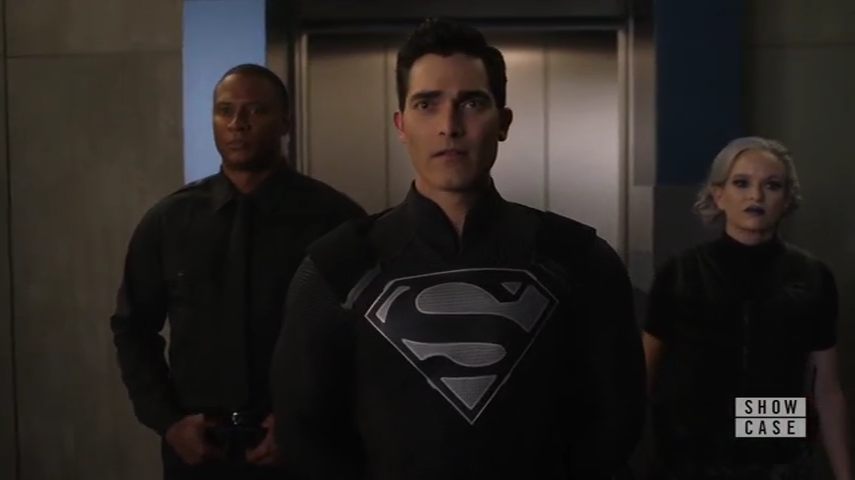
 

And why exactly would Deegan choose to make his version of Superman dark?

Barry and Oliver track down this reality’s version of Cisco, who is apparently a crime lord here, so that he can use his portal-making abilities to get them to Earth-38 to retrieve the real Superman, and the reason why Superman took a break to “protect his Earth” is once again brought into question, considering all of reality is in danger, but of course, the obvious answer is that the bad writers always have a hard time figuring out ways to handle Superman’s incredible power set, without tossing kryptonite into the equation. So, the crossover wraps up with Alex, Barry, and Kara finding the “Book of Destiny” inside Barry’s Time Vault — Deegan calls it his Fortress of Solitude in this reality — and they give it to Superman to operate because cosmic artifacts are something he’s dealt with before, but then Deegan gets the book back and starts to alter reality all over again … and damn, this getting old. Oliver confronts the Monitor, giving the usual heartfelt speech about humanity, inspiring hope, and other such bullshit, and he then returns to shoot the book with an arrow enhanced by the Monitor.
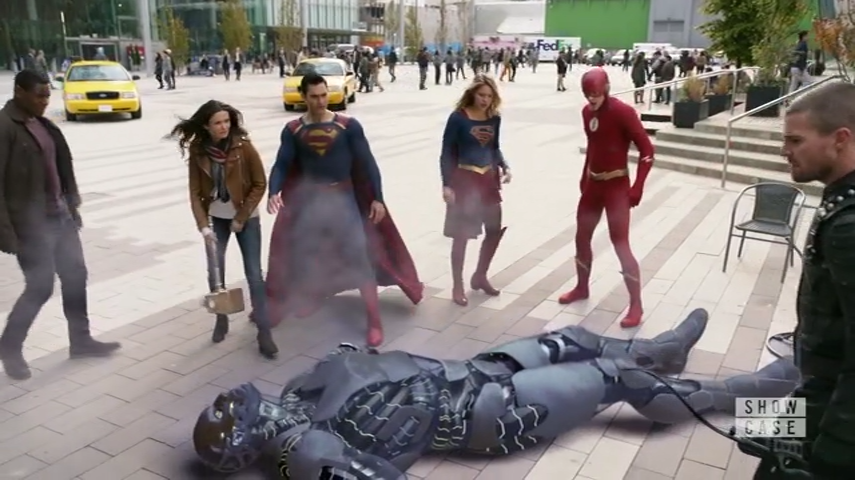
 

They also get to defeat A.M.A.Z.O. again, so that’s nice.

A Couple More Stray Observations:

• Oliver and Barry manage to escape Deegan/Superman by knocking over a crane, forcing him to save innocent lives while they escape, but being it would take Superman less than a minute to catch the crane, I don’t see why he couldn’t have just caught them after catching the crane — he does have super vision and super speed.
• Supergirl is able to talk Alex Danvers into freeing her by pointing out that she knows her adoptive sister is a lesbian. This is certainly an interesting tactic, and maybe in future we can hope to see Alex hooking up with Kate Kane.
• To impede Deegan’s reality altering progress, Barry and Kara slow down time by speeding around the Earth in opposite directions … WTF? How exactly is that supposed to work? Barry states that, “If Supergirl and I travel in opposite directions, going just over Mach 7, it should create enough centrifugal force to slow the Earth’s rotation.” Superman did this in his first movie, reversing time to save Lois, but that is as bullshit then as it is now, because this would most likely result in ripping the planet apart, not reversing time. And wouldn’t two super people, who are going in opposite direction, just negate each other?

Note: That we got to see John Wesley Shipp as Barry Allen, from the 90s Flash series, was easily my favorite moment in this crossover.

Deegan is incarcerated at Arkham, looking now much like the comic book incarnation of Doctor Destiny, and Kara and Clark return to Earth-38 where we get a nice moment where Clark and Lois (Elizabeth Tulloch) reveal to Kara that Lois is pregnant, and that they will be returning to Argo City for an extended period of time — because at least one of the writers had read Larry Nivens essay “Man of Steel Woman of Kleenex” — and that they are leaving Earth's protection to Supergirl, stating, “The world doesn’t need Superman if it has Supergirl.” That’s a nice sentiment and all, but didn’t he save their asses a couple of times in this one crossover alone?

 

I do love that the Fortress of Solitude has a barbecue.

Comic book fans will of course know that this entire event was only to set up next year’s big event, as the crisis that The Monitor was alluding to would be “The Crisis on Infinite Earths,” and though I doubt a television version of such an epic event will come close to what we saw in the comics, I do hope it’s at least not as much of a convoluted mess as their television version of Elseworlds.
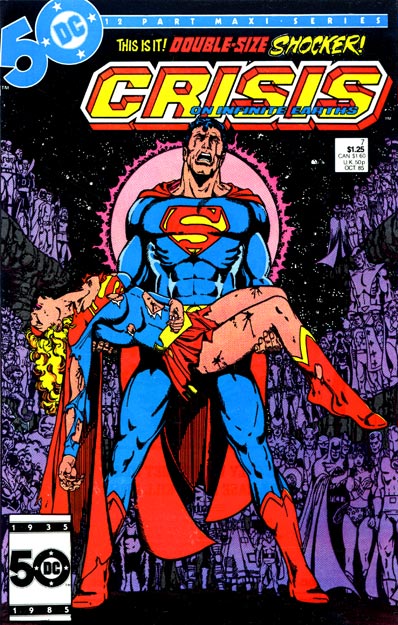
 

Do you think they’ll have the balls to kill off Supergirl?

The most depressing thought to me is that the writers believed they were telling an actual Elseworlds story, but they weren't; we don't see an 18th century version of Green Arrow teaming up with Allan Quatermain, or the Speed Force being gifted to Sherlock Holmes. What we got instead was a lame identity swapping shtick, which is not at all what the Elseworlds comics are about. Now, I will admit there were some fun moments in this "Elseworlds" crossover, and I do look forward to seeing more of Ruby Rose as Batwoman, but the writers of these shows are just so monumentally bad at their jobs, it’s just staggering. And I know it can’t be easy to juggle the continuity of a comic book multiverse, or balance the power sets of various heroes, but it looks like the showrunners here didn’t even care to try.
 

See you again in the fall to see how they pull this off.
Friday, January 18, 2019

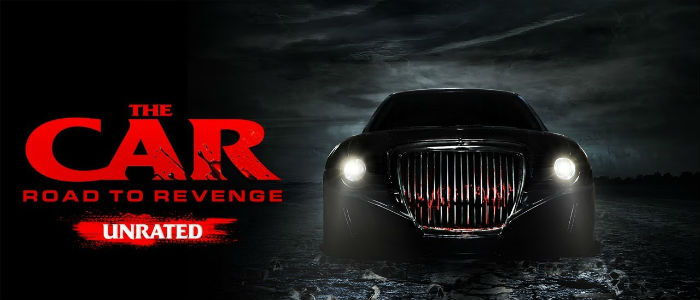
The Car: Road to Revenge (2019) – Review

In 1977, Universal Pictures released a nice little horror film called The Car, which had James Brolin and Ronny Cox dealing with a demonic car that was terrorizing their small Midwestern town. Not, over forty years later, we get a sequel to that horror classic…well, kind of, but not really. Universal Pictures is once again the distributor, but fans of the original will be hard pressed to find any similarities between their beloved classic and this supposed sequel.
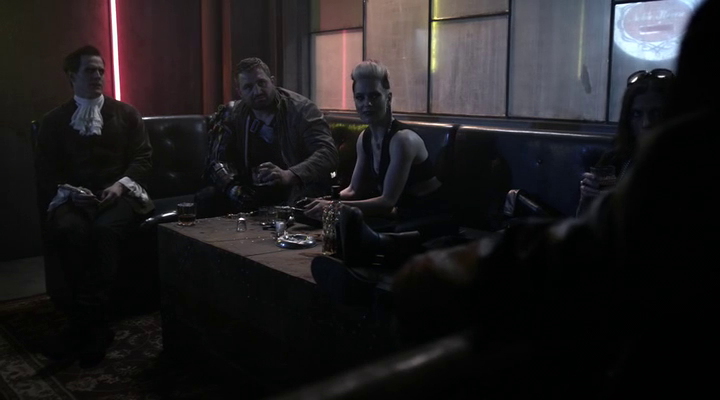

 The film takes place in the not so distant future — your basic low budget cyberpunk setting — where criminals are tried, convicted, and executed all in the same day, and even in the same place, so it's nice to see that the future is all about convenience, but as harsh as the judicial system seems to be, crime itself is still running rampant in this dystopian city. District Attorney Caddock (Jamie Bamber) wants to see the streets cleaned up, even if he has to be an asshole about it, but when he comes into possession of a certain data chip, one that belongs to the notorious crime lord Talen (Martin Hancock) who runs a human trafficking ring, while also dabbling in illegal cybernetic enhancements, a group of said cybernetic goons are sent to retrieve the chip.


These guys are The Devil’s Rejects' rejects.

Torture fails to make Caddock give up the data chip, so they toss him out of his high rise office window, where he crash-lands on the roof of his own luxury sedan. Homicide Detective Rainier (Grant Bowler) is put on the case, and his first step is to track down a woman named Daria (Kathleen Monroe), who was the last person known to have seen Caddock alive. Daria had a complicated history with the deceased, her being an ex-girlfriend with a past drinking problem, that wasn't helped by Caddock being a controlling dickhead. Talen’s minions also wish to have a few words with Daria, hoping that she may have some idea as to where the data chip is located, and that is when The Car rolls in. Turns out that when Caddock pancaked onto the roof of his car, his soul fused with the vehicle, and now the driverless automobile prowls the streets seeking revenge, as well as the continued stalking of his ex-girlfriend.


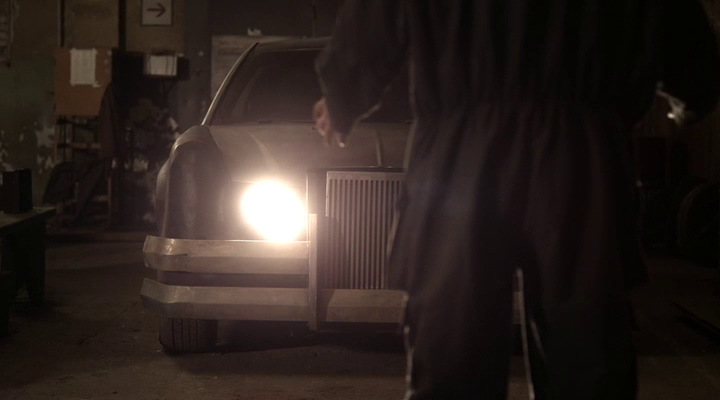
Is this director G.J. Echternkamp’s idea of an imposing killer car?

By this point, it’s obvious that for anyone who has seen the 1997 original, The Car: Road to Revenge is not running by the same playbook, as in the original, it was made fairly clear that The Car was some incarnation of The Devil himself, while in The Car: Road to Revenge we are dealing with a car possessed by a vengeful spirit. Basically, we’re talking a bargain basement Christine, but with a standard Tales From the Crypt plot, and as the film progresses, Echternkamp looks to make up for any lack of continuity, or originality for that matter, by tossing in random moments of nudity and extreme gore. This pretty much fails at every level. The only shining light amongst this used car lot of crap is the chemistry between the two leads; Bowler and Monroe really seem to be enjoying themselves, and the script even allows them some fun banter, when not being interrupted by the puerile garbage that makes up the rest of the script. But whenever we start to think the film might try something interesting, or at least to not be openly insulting, the script forces characters to do the standard dumb things people are apparently required to do in a horror movie.


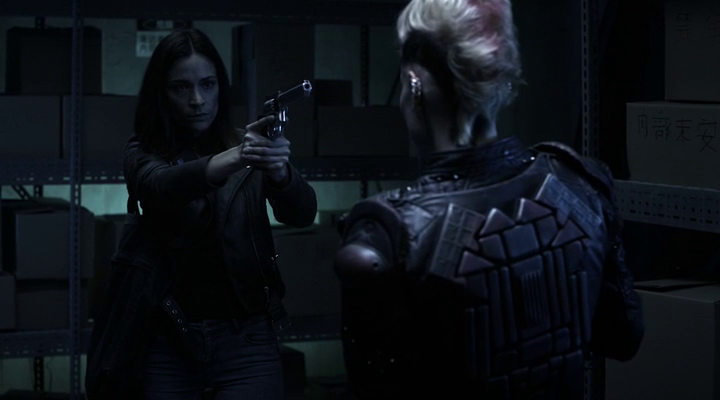
Pull the bloody trigger, you complete idiot!

But just when you think this movie is a sequel in name only, with not one single plot element to connect this thing with the original, Ronny Cox shows up as some junkyard dude. Now this cannot be the same character that Ronny Cox played in the original, as not only was the character a cop, but going by this film’s “futuristic” timeline, he’d be long dead, so maybe this is just a cute casting nod to the original film, but no, that is not the case. At some point in the film, The Car is practically destroyed by Talen’s minions — by gunfire no less, which is something that couldn’t even scratch the original Car — and Ronny Cox's junkyard mechanic come’s across the wreckage and decides to fix it up, but the damage is too extensive, so he must use a “donor car” to rebuild the vehicle, and the donor car looks like The Car from the original film.


Does this make sense to anyone else?

• Is the donor car just another customized 1971 Lincoln Continental Mark III, or is it the actual Devil car from the original movie?
• If this thing was The Car, what was it doing in this dude's garage? And how and why The Car ended up here would easily have made a better movie than the one we got.
• After killing Ronny Cox, the “new” Car proceeds to drive through the city, mowing down innocent civilians, left right and center. Before it was just knocking off the gang members who murdered Caddock, so why is it now murdering people at random?
• This seems to imply that parts from the donor car have made it more evil, yet it still seems to have the hots for Caddock’s ex-girlfriend. So what the fuck is controlling The Car, is it Caddock or The Devil?


This is one of those sequels that seems designed to piss off fans.

The 1977 original ended with a perfect set-up for a sequel, during the end credits we saw that The Car had survived being blown up by Brolin and Cox, and was now heading into Los Angeles, but the filmmakers behind The Car: Road to Revenge decided to ignore such notions, and instead made a movie that is more a mash-up of Robocop 2 and John Carpenter’s Christine, than anything to do with the original film. This film is so bad that you won't find any of the actors listing this thing on their IMDB page. I know one must not expect too much from a direct-to-video sequel, but goddamn it, I’ve waited over forty years for a sequel to that classic horror film, and this is the crap we got?


This film deserves to languish in the used car lot of hell.